1,000 miles to memphis March rallies against voter suppression
The gist
Civil rights activists are marching 1,000 miles to Memphis, retracing a historic route to register 100,000 voters and fight back against new waves of voter suppression across the South.
What to know
- Grassroots leaders like Stand Up Nashville and Black Voters Matter have invested nearly $60 million into 800+ Black-led groups, powering multiracial coalitions for voting rights and economic justice.
- The march fuses physical activism, voter registration drives, and viral social media campaigns, overcoming harsh weather and emotional toll to keep the movement's momentum alive.
- Spurred by Supreme Court rollbacks of the Voting Rights Act, organizers target key Southern states before the midterms, demanding lasting change—not just noise.
Marching in King's Footsteps
Retracing the 1968 Memphis route, activists fuse historic civil rights symbolism with a demand for real policy change and multiracial coalition-building.
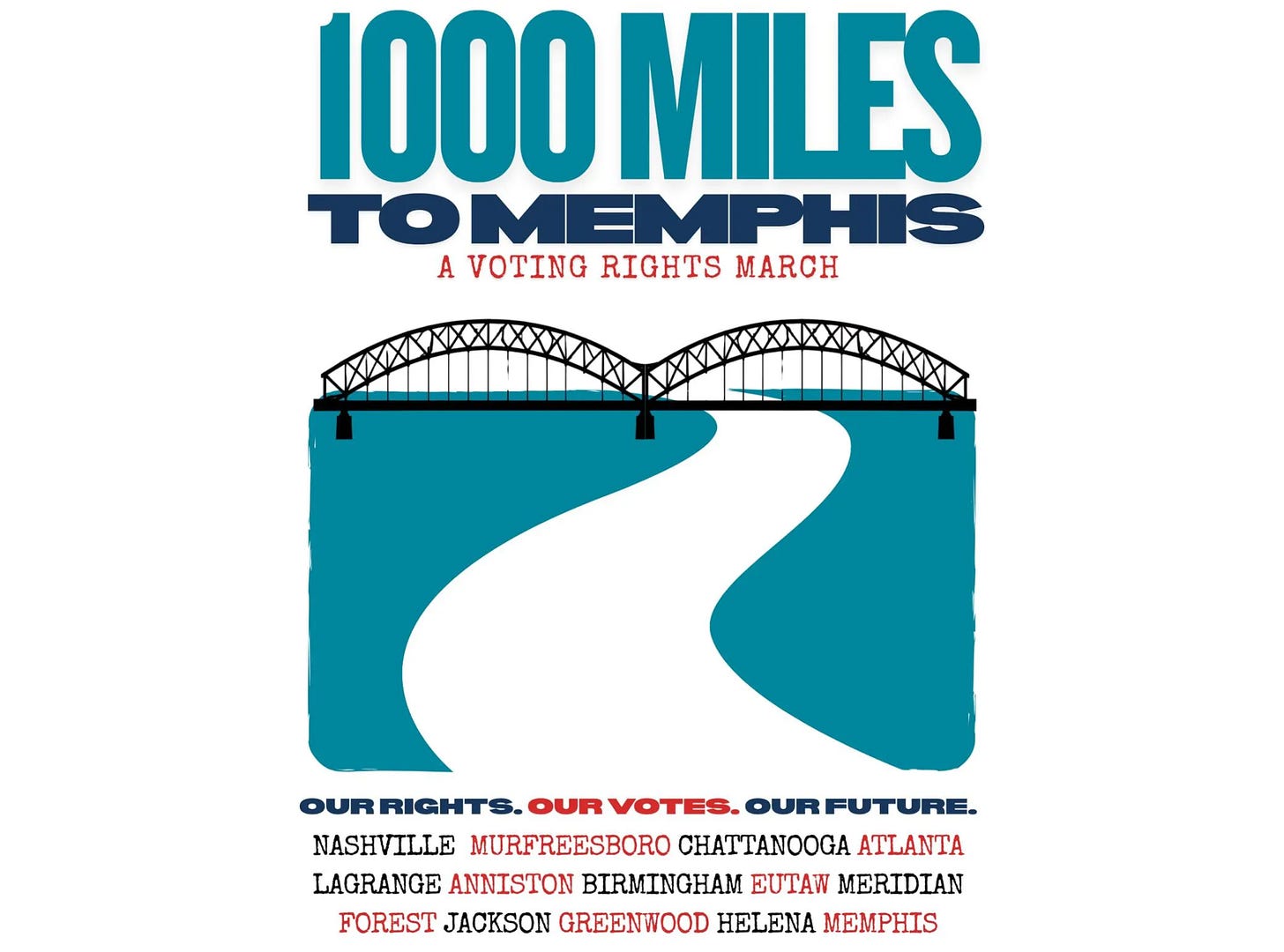
The 1,000 Miles to Memphis march draws direct inspiration from the historic civil rights movement, retracing a route that culminates at the National Civil Rights Museum in Memphis, where Dr. Martin Luther King Jr. stood with striking sanitation workers in 1968. This symbolic journey connects past labor and civil rights struggles to contemporary battles over voting rights, emphasizing a continuum of activism aimed at protecting democracy. As organizers state, the march fights for "the descendants of that same struggle—and for every American whose right to vote is under attack," highlighting the enduring legacy and urgency of their cause.
Launched in response to the Supreme Court’s gutting of Section 2 of the Voting Rights Act in Louisiana v. Callais and amplified threats from false election fraud claims and legislation like the SAVE Act, the march aims to register 100,000 voters across Southern states before the fall midterm deadlines. This measurable target underscores a strategic shift from symbolic protests to sustained grassroots activism, with organizers insisting, "I am tired of marches that make noise and demand nothing... 1,000 Miles to Memphis exists to demand change." The coalition behind the march is deliberately multiracial and multifaceted, comprising activists, academics, artists, and organizers committed to fighting voter suppression through direct action, in-person protests, and community organizing rather than mere online outrage.

Grassroots Power, Local Impact
Black-led, women-led, and local organizations are blocking power grabs and rewriting policy by connecting historic trauma to modern resistance in the South.
Local organizations like Stand Up Nashville and Black Voters Matter exemplify how grassroots leadership is vital in empowering marginalized communities by building multiracial coalitions that address systemic issues such as economic inequality and voter suppression. Stand Up Nashville’s 'Ask, Test, Organize' model has not only mobilized Black, brown, and working-class residents to achieve policy victories like strong data center bans but also trained leaders to influence critical local governance decisions on zoning and housing, ensuring that those most affected have a seat at the table. Meanwhile, Black Voters Matter, under LaTosha Brown’s leadership, has reinvested nearly $60 million into over 800 Black-led groups, emphasizing sustained political power through a framework of blocking power consolidation, building new activism models, and believing in a just future—linking contemporary efforts to historic civil rights struggles and underscoring the interdependence of all Americans in the fight for democracy.
The 1,000 Miles to Memphis March, led by local figures like Bri Woodson, powerfully connects today’s voting rights activism to the enduring legacy of white supremacist terror and systemic voter suppression, from the KKK to Jim Crow laws. Woodson’s reflection at the National Voting Rights Museum in Selma highlights the emotional weight of confronting this history firsthand, reinforcing the march’s role in bearing witness to past and ongoing struggles. This continuity of resistance not only honors previous generations but also galvanizes a multiracial coalition that recognizes the shared stakes in dismantling voter suppression and advancing racial and economic justice.
Coordinated grassroots mobilization, as demonstrated by Black Voters Matter’s rapid organization of 228 groups and thousands of activists across multiple Southern states, shows the power of local leadership in countering voter suppression efforts. Their swift action successfully delayed redistricting sessions in Mississippi, Georgia, and Alabama, illustrating how multiracial coalitions and community-driven strategies can disrupt attempts to consolidate political power and protect voting rights at critical junctures.

Mobilizing Every Mile
A relentless blend of in-person activism and viral organizing is turning each step of the march into a voter registration engine and a test of movement endurance.
The 1,000 Miles to Memphis march employs a multifaceted strategy to mobilize grassroots activism by integrating physical marching with voter registration drives, community organizing events, and robust social media campaigns. Targeting a measurable goal of 100,000 voter registrations over 30 days, the organizers emphasize that "every mile is a voter registration opportunity" and every stop serves as a platform to build multiracial coalitions, particularly in the face of recent Supreme Court rulings like Louisiana v. Callais that have severely weakened voting rights protections across the South. This approach underscores the urgency of timely, sustained grassroots engagement to counteract the dismantling of fair maps and erosion of Black representation.
Sustaining momentum throughout the march is achieved through a combination of consistent organizing events, strong partnerships with hyperlocal, community-driven groups such as The Equity Alliance, StandUp Nashville, NAACP Nashville, and the Tennessee Immigrant and Refugee Rights Coalition, and leveraging social media to amplify reach beyond physical participants. Despite challenges like inclement weather, safety concerns, and the emotional toll of prolonged separation from families, nearly 100 marchers have persevered through "pouring rain, blistering heat," while social media analytics reveal millions of views, with tens of thousands actively sharing and holding the movement accountable. This grassroots persistence reflects the organizers’ rejection of fleeting social media trends in favor of measurable, community-rooted impact.
The march strategically elevates local, Black-led, women-led, and immigrant-led organizations to ensure authentic community engagement and build lasting relationships that fuel ongoing activism beyond the march itself. As one organizer explains, the initiative exists to "elevate the local orgs doing the work," recognizing these groups as the backbone of daily voting rights advocacy. Supporters are encouraged to participate in diverse ways—whether by walking a mile, donating, registering themselves and others, or amplifying the cause on social media using hashtags like #1000Miles and #CourageNow—highlighting a comprehensive call to action designed to sustain energy even as physical and emotional fatigue mount in the final days of the campaign.
Defying Suppression, State by State
Coordinated mass actions at historic sites are halting gerrymandering and exposing how new laws echo Jim Crow, as communities fight for democracy on the ground.
The 1,000 Miles to Memphis march powerfully bridges past and present by retracing a historic civil rights route that culminates at the National Civil Rights Museum in Memphis, a site where Dr. Martin Luther King Jr. stood with striking sanitation workers in 1968. This physical journey through Nashville, Atlanta, Birmingham, and Jackson serves not only as a symbolic homage to the legacy of the civil rights movement but also as a call to tangible action, urging participants to move beyond online activism toward voter registration drives and on-the-ground protests that confront contemporary threats to democracy and racial justice.
The march is a direct response to the rollback of voting protections through legislative and judicial actions, notably the SAVE Act and Supreme Court decisions in 2013 and 2023 that dismantled key provisions of the Voting Rights Act. These rulings, such as Shelby County’s elimination of preclearance and the gutting of Section 2, have emboldened states like Florida, Tennessee, and Alabama to redraw maps and impose restrictions reminiscent of Jim Crow-era voter suppression, threatening the democratic participation of women, Black and brown communities, and low-income voters.
By organizing massive grassroots resistance at historic sites like Selma and Montgomery, activists have demonstrated that coordinated community engagement can effectively disrupt voter suppression efforts, as seen when thousands gathered to halt congressional map redrawing sessions in Mississippi and Alabama. This contemporary defiance underscores that the fight for voting rights transcends racial lines, embodying a fundamental democratic and human rights struggle that affects all Americans, with leaders like LaTosha Brown emphasizing that ‘no one is free until we’re all free.’
LaTosha Brown’s strategic framework—Block, Build, Believe—captures the essence of contemporary resistance by acknowledging the death of the Voting Rights Act as a legal shield and advocating for blocking power consolidation, building new democratic infrastructures, and sustaining belief in a just future. This approach, combined with the march’s emphasis on bearing witness to the enduring legacy of white supremacist violence, such as the KKK’s 160-year terror campaign memorialized at the National Voting Rights Museum, highlights how confronting historical racial terror remains vital to combating modern voter suppression and advancing racial justice.