After supreme court’s voting rights retreat, southern states fast-track maps that fracture black power—and spark national uproar
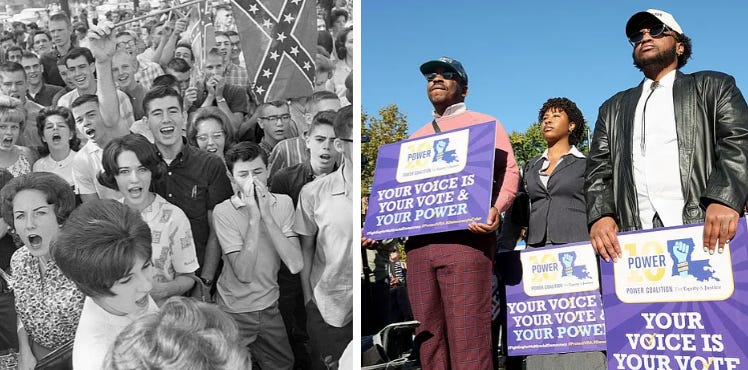
The gist
The Supreme Court’s 2026 gutting of the Voting Rights Act has unleashed a wave of Southern redistricting that fractures Black political power and sparks a nationwide uproar.
What to know
- A 6-3 Supreme Court ruling in Louisiana v. Callais sharply weakened protections against racial gerrymandering, giving states freer rein to redraw maps that dilute Black voting strength.
- Florida, Alabama, Louisiana, Mississippi, and South Carolina rushed to split up majority-Black districts—moves projected to add about 12 new GOP House seats while forcing Black incumbents into the same districts.
- Civil rights leaders and grassroots groups, like the Black Power War Room, are mobilizing nationwide protests and demanding sweeping reforms from Congress and the Supreme Court.
Voting Rights Act Hollowed
Supreme Court decisions have stripped the Voting Rights Act of its core protections, leaving minority voters with only token safeguards as up to 19 Black and Hispanic districts face erasure.
By early 2026, the Supreme Court's ruling in Louisiana v. Callais marked a pivotal weakening of Section 2 of the Voting Rights Act, a provision crucial for protecting Black electoral majorities, including Mississippi’s majority-Black congressional district. This decision, alongside other rulings, has effectively gutted both Sections 2 and 5, leaving only limited protections such as the ban on literacy tests intact, which progressive groups warn endangers as many as 19 congressional districts with primarily Black or Hispanic populations. As one analyst lamented, “the two big parts of the Voting Rights Act, section 2 and section 5, are there in a shell only, and it is a sad day for voting rights and democracy in the United States.”
The Court’s legal reasoning has raised the bar for proving violations under Section 2 by increasing the intent requirement, as seen in both Louisiana v. Callais and LULAC decisions, effectively removing a critical legal barrier against partisan gerrymandering that dilutes minority voting power. This shift has emboldened states like Louisiana, Alabama, and South Carolina to redraw congressional maps that reduce majority-Black districts, with Louisiana’s Senate passing a new map cutting its majority-Black U.S. House districts from two to one. Critics highlight how the legal process is weaponized under the guise of neutral procedure, treating Black voting power as a mere inconvenience in mapmaking and redrawing democracy around Black absence.
Beyond congressional representation, the erosion of the Voting Rights Act’s protections destabilizes accountability in state and local elections, where most successful Section 2 cases historically occur, directly impacting daily life for minority communities. Both political parties contribute to this dilution: Republicans seek to eliminate minority opportunity districts, while Democrats often dilute minority voters by dispersing them across multiple districts to maintain broader electoral advantages. As one expert noted, “the real losers here are minority voters and the American people overall,” underscoring how these legal shifts undermine democratic representation at multiple levels.
The Supreme Court has increasingly substituted its own judgment for Congress’s in voting rights enforcement, limiting Congress’s constitutional authority to regulate elections and enforce the 14th and 15th Amendments. While Congress retains the power to address partisan gerrymandering and voting discrimination through legislation, political will has been lacking, leaving a critical gap in protections. Moreover, the Court’s expedited implementation of rulings like Callais during active election cycles has caused redistricting chaos, disrupted already-cast votes, and contradicted established principles such as the Purcell doctrine, revealing inconsistency and potential hypocrisy in the Court’s approach to safeguarding minority voting rights.




Southern States Redraw Power
Republican-led legislatures are rapidly fracturing Black-majority districts and exploiting legal loopholes to turn racial gerrymandering into a partisan weapon, reshaping Congress and destabilizing elections.
In the wake of the Supreme Court's weakening of the Voting Rights Act, Southern states such as Florida, Alabama, Louisiana, Mississippi, and South Carolina have aggressively redrawn majority-minority districts with a clear intent to dilute Black political representation. Florida notably passed a new map within hours of the Cala decision, while Louisiana moved swiftly to reduce its Black-majority congressional districts from two to one, even forcing Black incumbents like Troy Carter and Cleo Fields into the same district. These efforts are not isolated but part of a coordinated regional strategy to undermine Black electoral power ahead of critical midterm elections.
The Supreme Court’s rulings, especially in Louisiana v. Callais, have effectively re-legalized racial gerrymandering under the guise of partisan politics, allowing states to target Black voters by labeling these actions as partisan rather than racial discrimination. This legal shift has enabled Republican-led legislatures to redraw maps that fracture majority-Black communities, such as Tennessee’s splitting of Shelby County into three sprawling districts, two extending over 200 miles, which State Sen. Jeff Yarbro condemned as 'the most blatant dilution of Black voting power since the height of Jim Crow.' Consequently, these redistricting maneuvers are projected to add approximately 12 House seats for Republicans, significantly reshaping the political landscape.
Beyond map drawing, states have weaponized the timing and administration of elections to suppress Black voting power, exemplified by Alabama’s rapid mid-primary redistricting that invalidated already-cast ballots and forced primary do-overs. This chaos extends to ballot design, voter-roll demands, and precinct management, creating confusion that disproportionately affects Black voters. Civil rights advocates warn that these destabilizing tactics, enabled by weakened federal protections and expedited Supreme Court rulings via the shadow docket, amount to a systematic effort to marginalize Black communities and erode democratic representation.
Legal challenges have emerged as a critical frontline in the battle over redistricting, with organizations like the NAACP and ACLU suing states such as Tennessee for maps that dismantle Black political power by splitting key districts like Memphis. Meanwhile, state courts have become pivotal arenas for voting rights litigation as federal protections wane, with Virginia’s Supreme Court striking down voter-approved maps on procedural grounds, effectively nullifying Black voters’ efforts. These ongoing legal and political maneuvers underscore a broader pattern of institutional resistance to preserving Black electoral influence amid aggressive partisan gerrymandering.


Leaders Demand Bold Reform
Black lawmakers and civil rights advocates are calling for Congressional action and Supreme Court reforms as judicial rulings erase decades of progress on minority representation.
In the wake of the Supreme Court's 2026 rulings that significantly weakened the Voting Rights Act and dismantled majority-Black districts, political leaders like Representative Cleo Fields and Terri Sewell have vocally condemned these decisions as major setbacks for Black voting power and democratic representation. Fields has been particularly outspoken, emphasizing that the core issue is ensuring that people who look like him have the opportunity to serve in Congress, and calling for a robust, unambiguous Voting Rights Act that addresses the gutted Section 5 protections. Both Fields and Sewell have urged Congress to pass legislation such as the John Lewis Voting Rights Advancement Act to restore and strengthen voting rights, highlighting the urgent need for institutional action to counteract judicial rulings that undermine minority representation.
The Supreme Court's conservative majority, particularly the so-called MAGA justices, has sparked a vigorous political and civic backlash advocating for systemic reforms, including expanding the Court and instituting term limits for justices. Representative Cleo Fields has been a leading voice in this movement, arguing that the Court has overstepped its constitutional role by effectively making laws rather than interpreting them, and stating, 'we need to probably put term limits on the Supreme Court because these justices are now acting as lawmakers.' This push for Court reform reflects broader frustration with the judiciary's substitution of its judgment over Congress’s constitutional authority to regulate elections and enforce the Reconstruction Amendments, as seen in rulings like Louisiana v. Callais and others.
Institutional responses to the Supreme Court's reshaping of voting rights reveal a stark partisan divide and ongoing resistance at multiple levels of government. While Republicans have aggressively leveraged institutional mechanisms to redraw voting maps and consolidate power—as exemplified by state-level actions in Mississippi, Alabama, and South Carolina—Democrats have shown more caution, sometimes hesitating to pursue bold reforms such as altering judicial retirement ages despite mounting political turmoil. This dynamic was encapsulated by analysts noting, 'Republicans break the machinery and call it strategy. Democrats touch the wrench and start apologizing to the furniture.' Meanwhile, civil rights organizations and the Department of Justice continue to litigate voting rights issues despite recent setbacks, underscoring the persistent institutional struggle over the future of Black electoral representation.
The ongoing legal battles in states like Alabama illustrate the deep institutional engagement and grassroots mobilization confronting discriminatory redistricting efforts. Following the Supreme Court’s affirmation that Alabama violated the Voting Rights Act by intentionally discriminating against Black voters, federal courts intervened to enforce maps that create two majority-Black districts, resulting in Alabama electing two Black representatives for the first time since Reconstruction. This judicial activism has been met with mass rallies and denunciations from civil rights leaders and Democratic lawmakers, including Senator Corey Booker, who warned that 'some people in black robes try to deny or take away our rights,' drawing historical parallels to past Supreme Court injustices. These developments highlight the critical role of courts, Congress, and advocacy groups in both resisting and responding to institutional attempts to dilute Black voting power.


Grassroots Uprising Ignites
Activists and Black-led organizations are mounting a nationwide campaign for voting justice, connecting today’s fight to historic struggles and demanding structural change from the courts and Congress.
The Supreme Court's 2026 decisions, particularly the gutting of the Voting Rights Act, have ignited a fierce grassroots backlash aimed at defending Black voting power and combating racial gerrymandering. Activists, led by figures like Cliff Albright and LaTosha Brown of the Black Power War Room, have mobilized through protests, petitions, and direct lobbying efforts, emphasizing urgent calls for systemic reforms such as expanding the Supreme Court, instituting term limits for justices, and restoring comprehensive voting protections. This wave of activism underscores a broader demand for electoral reforms like proportional representation, which promises to dismantle winner-take-all districts and ensure minority voters retain meaningful representation in multi-candidate districts.
Grassroots movements have framed their struggle against voter suppression within a historical continuum of systemic racial disenfranchisement, linking contemporary battles to legacies like the 1890 Mississippi Plan. This historical consciousness fuels campaigns such as the NAACP’s 'Out of Bounds,' which critiques institutional complicity—highlighting how state universities profit from Black athletes even as their states enact policies that weaken Black voters. Activists also confront subtle yet pernicious tactics like restrictive voting procedures and targeted redistricting in states including Tennessee, South Carolina, and Louisiana, which deliberately fracture majority-Black districts and dilute Black political influence under the guise of neutral politics.
The activism surrounding Black voting rights is not only reactive but deeply strategic and community-centered, involving real-time legislative tracking in Southern states and direct engagement with state lawmakers to counteract suppression efforts. Leaders emphasize that Black voters are dynamic decision-makers, balancing respect for institutional memory with demands for leadership that addresses present crises, as seen in Texas’s 18th Congressional District race described as a 'generational baton pass.' Moreover, activists stress the importance of translating abstract political issues—such as the influence of special-interest and cryptocurrency money—into tangible concerns that resonate with voters’ daily lives, thereby strengthening democratic responsiveness and combating political polarization.
Beyond electoral politics, grassroots activism highlights the profound social consequences of weakened voting rights, linking diminished political participation to adverse public health outcomes and broader social trust erosion. As underscored in recent opinion pieces, the erosion of Black voting power threatens not only representation but also the ability of communities to influence policies that improve well-being, reinforcing the critical need to protect and expand voting rights. This activism situates voting rights as a foundational pillar for equitable health and social outcomes, confronting a history of disenfranchisement rooted in poll taxes, literacy tests, and Jim Crow laws.



Disenfranchisement’s Deep Costs
Modern voter suppression not only silences Black voices at the ballot box but also entrenches economic and health disparities, echoing Jim Crow’s legacy in today’s South.
By early 2026, aggressive redistricting efforts, such as Tennessee Republicans splitting majority-Black Shelby County into sprawling districts, have starkly diluted Black voting power, echoing Jim Crow-era tactics and perpetuating systemic racism. This political disenfranchisement exacerbates entrenched economic disparities in Southern states, where lower employment rates, depressed wages, and elevated poverty levels are deeply intertwined with racial inequities, as highlighted by the Economic Policy Institute. Together, these forces undermine Black communities' ability to influence policies that could address economic injustice and improve living conditions.
The Supreme Court’s 6-3 decision in Louisiana v. Callais, which gutted the Voting Rights Act, catalyzed a wave of Republican-led redistricting and administrative suppression tactics across Southern states, sowing confusion and chaos in election processes. This strategic dismantling of voting protections not only destabilizes Black political representation but also erodes trust in democratic institutions for all voters, as unstable districts and bureaucratic overload leave citizens uncertain about their ballots and representatives. As one analysis notes, 'the machinery is still deciding who gets to choose,' undermining the very foundation of representative democracy.
Diminished voting rights have profound public health consequences for Black Americans, as political power directly shapes access to resources like Medicaid, hospital funding, and environmental protections. Historical data underscores this link: the Voting Rights Act’s initial enforcement prevented approximately 6,700 Black infant deaths in its first five years, and Harvard research connects civil rights protections to reductions in Black infant mortality and aggressive breast cancer rates. Conversely, restrictive voting measures and felony disenfranchisement laws—rooted in white supremacy—correlate with poorer self-reported health among Black populations, illustrating how political marginalization translates into tangible health disparities.
The erosion of the Voting Rights Act threatens not only Black political representation but also the broader health of American democracy and public well-being. As noted in a June 2026 opinion, diluting Black voting power risks redrawing out of existence numerous districts currently represented by Black lawmakers, thereby weakening inclusive governance. Voting is foundational to social trust and community cohesion—key determinants of health—and restricting it jeopardizes lives by undermining the democratic processes that enable communities to elect leaders who enact policies improving economic and health outcomes.