Agentic AI forces enterprise overhaul: trust, pricing, and productivity get a reboot
The gist
Agentic AI is forcing a radical enterprise reboot—rewriting trust, pricing, and productivity playbooks as automation moves from pilot to profit center.
What to know
- Enterprises like Salesforce, Affirm, and Zuora are embedding layered human-in-the-loop controls and real-time governance to make agentic AI safe, transparent, and compliant—especially in finance and healthcare.
- Traditional seat-based SaaS pricing is getting upended as leaders like DocuSign and Salesforce shift to usage- and value-based models that reflect AI agent-driven output, not just headcount.
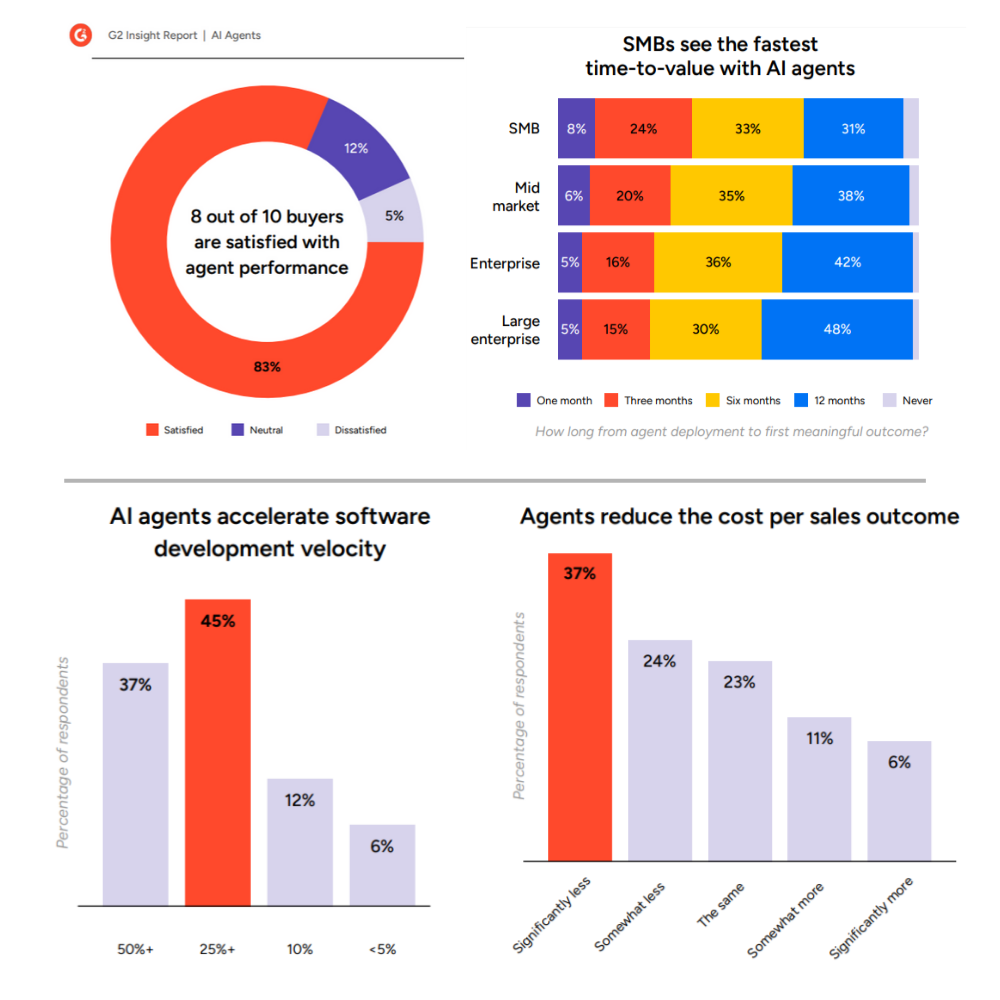
- Unified data platforms and advanced context engineering from Snowflake, Elastic, and Workday are now mission-critical, enabling up to 50% productivity gains and tripled ARR per employee for AI-forward companies like Shopify and Vista.
Trust by Design: AI’s New Mandate
CIOs and boards are embedding trust, compliance, and explainability into every layer of AI deployment, turning governance into a core business strategy—not just a technical safeguard.
Establishing trust and reliability in agentic AI is fundamentally intertwined with robust data governance, human-in-the-loop controls, and a layered approach to oversight. As seen in enterprises like Zuora and Salesforce, the deployment of agentic AI at scale demands not just technological readiness, but also organizational alignment, with CIOs and boards now directly involved in setting trust as a strategic imperative. This means embedding compliance, explainability, and security into every layer—from foundational data infrastructure and semantic layers to customizable guardrails (as offered by Witness) and rigorous governance processes—ensuring that AI agents operate safely, transparently, and in accordance with regulatory and business requirements, especially in high-stakes industries like finance and healthcare.
Human-in-the-loop controls have emerged as a non-negotiable element for building trust in agentic AI, particularly as enterprises grapple with the risks of shadow agents, model non-determinism, and the potential for catastrophic errors. Companies like Affirm and Automation Anywhere exemplify this approach, using layered trust mechanisms—such as escalation pathways, audit trails, and explainability hooks—to ensure that AI handles routine tasks while humans oversee complex or sensitive decisions. This deliberate friction, while initially slowing adoption, has proven to increase user confidence and long-term engagement, as demonstrated by healthcare and financial services where even a single unsafe output can trigger feature shutdowns and erode trust irreparably.
The unique reliability challenges posed by agentic AI—stemming from its stochastic, prompt-driven nature and the speed at which autonomous agents can make mistakes—require enterprises to adopt rigorous engineering and governance practices. Techniques like prompt versioning, systematic evaluation frameworks, and advanced optimization (as seen at Zeta Alpha and Stanford) are now essential, alongside robust observability and domain-specific customization. As Dion Hinchcliffe and others note, building production-grade agentic AI systems often requires hundreds of specialized engineers focused on governance, security, and orchestration, a level of investment that distinguishes enterprise-ready platforms from consumer-grade tools.
Ultimately, trust in agentic AI is not a static achievement but a continuous process that must be measured, validated, and reinforced through transparency, user experience design, and ongoing organizational literacy. Metrics such as override rates, correction velocity, and escalation ratios are now tracked to gauge user confidence, while progressive disclosure of AI capabilities and clear boundaries between AI and human roles help demystify the technology. As Karen from Salesforce and Nina Old from Weights and Biases emphasize, trust is now the key differentiator in a commoditized AI landscape—built not just on technical accuracy, but on narrative, relationships, and the ability to deliver tangible value while minimizing risk.





Productivity Gains Demand Reinvention
Enterprises are achieving double-digit productivity leaps only by reimagining workflows from the ground up, with AI-first teams and outcome-driven KPIs replacing legacy automation approaches.
Agentic AI is delivering measurable productivity and efficiency gains across the enterprise landscape by fundamentally automating and enhancing workflows. Companies like Salesforce, Block, and Bank of America have demonstrated that embedding AI agents at the core of operations—whether through automating RFP responses, orchestrating sales and customer service, or handling billions of customer interactions—can translate into dramatic time savings, margin expansion, and even new revenue streams. For example, Salesforce’s Agentforce platform added 6,000 enterprise customers in a single quarter, generating over $540 million in annual recurring revenue and automating more than three billion workflows monthly, while Bank of America’s ‘Erica’ virtual assistant handled the workload of 11,000 full-time employees and drove a 19% revenue lift through strategic cross-selling.
The key to unlocking these gains lies in outcome-driven metrics and continuous workflow optimization, rather than simply deploying AI for its own sake. Enterprises are shifting focus from experimenting with every new AI tool to prioritizing solutions that directly impact KPIs like revenue growth, margin, and customer engagement. This approach is evident in the adoption of robust governance frameworks at companies like Zuora and Snowflake, and in the use of context layers at Workday and Virgin Media O2, which have improved AI accuracy fivefold and enabled large-scale user adoption. As Sabrina, a European tech leader, notes, 'the expectations for what you can do with headcount has definitely gone up,' with investors now demanding material improvements in traditional efficiency metrics such as gross margin and revenue per employee.
Real-world case studies reveal that agentic AI’s value is maximized when enterprises reimagine business processes from first principles, rather than layering automation onto legacy workflows. At Davos 2026, Ernst & Young showcased an 87% reduction in risk management process time by involving 'AI-first newbies' who redesigned the workflow from scratch, while Vista Equity Partners reported 30-50% productivity improvements across its portfolio through its 'agentic factory' model. This reinvention mindset is echoed by Box CEO Aaron Levie, who emphasizes that 'the amount of output you get from AI agents will be directly correlated to how much you change (or reset) your workflow,' underscoring that true productivity gains require not just automation, but transformation.
Across sectors—from SaaS and logistics to retail and finance—agentic AI is not only reducing manual hours and operational costs but also enabling organizations to scale without proportionally increasing headcount. Shopify, for instance, tripled its ARR per employee while reducing headcount by 30%, and C.H. Robinson improved quote response rates from 65% to 100% while expanding operating margins despite a revenue decline. These outcomes highlight a broader economic shift: AI is decoupling revenue growth from headcount growth, fostering leaner, more resilient organizations and lowering barriers for new company formation.




SaaS Pricing Faces an AI Reckoning
The rise of AI agents is forcing SaaS vendors to abandon per-seat pricing in favor of usage and value-based models, triggering a seismic shift in how software is sold and monetized.
The rise of agentic AI is rendering traditional seat-based SaaS pricing models increasingly obsolete, as enterprises like DocuSign openly question the need for human seats when AI agents can deliver equivalent or superior productivity. This shift is forcing a fundamental rethinking of monetization frameworks, with leading voices in the industry—such as Alan, DocuSign’s CEO—noting that the contraction in seat demand is directly tied to the growing capabilities of AI agents. As a result, SaaS providers are moving toward usage- and value-based pricing models that more accurately reflect the diverse and measurable outputs AI agents can deliver, rather than simply charging per user.
Legacy SaaS monetization stacks—built atop platforms like Zora, Salesforce, and Chargebee—are struggling to keep pace with the demands of agentic AI, which requires granular attribution of value across a wide array of automated functions. As one executive laments, 'our systems cannot support all the various ways in which agents deliver value,' highlighting the technical debt and rigidity of infrastructure that hasn’t evolved in decades. In contrast, AI-native platforms and startups are building from the ground up to capture these new value dynamics, positioning themselves to outmaneuver incumbents by offering real-time usage tracking, flexible pricing, and seamless integration of multiple AI agents into enterprise workflows.
The move to usage- and value-based pricing is not just a technical necessity but a strategic imperative, as SaaS companies grapple with shrinking margins—falling from historic highs of 80–90% down to 40–50%—due to ongoing AI inference costs. This mirrors the telecom industry’s earlier transformation, where survival hinged on mastering usage data and building intelligent billing systems capable of handling billions of complex events. SaaS leaders now face a similar mandate: obsess over accurate, real-time usage data to maintain customer trust, control costs, and enable flexible, outcome-driven pricing models, with companies like Salesforce experimenting with everything from flex credits to agentic enterprise licenses to meet evolving customer preferences.
Agentic AI is also catalyzing the emergence of new monetization and attribution frameworks, where pricing is increasingly tied to high-autonomy, high-attribution outcomes—such as ticket resolution or transaction completion—rather than commoditized metrics like tokens or credits. Companies like Sierra, Decagon, and Intercom exemplify this trend by charging per resolved event, while others in sectors like mortgages and insurance take a percentage of the transaction, reflecting a broader industry movement toward pricing models that directly align with business value delivered. However, this transition brings challenges, as the 'invisibility' of agent-driven value complicates attribution, demanding new tools and frameworks to capture and communicate the impact of AI agents within enterprise operations.





Context Engineering: The Hidden Engine
Unified data platforms and advanced context layers are now essential infrastructure, enabling AI agents to deliver reliable, secure, and business-ready automation at scale.
The rise of unified data platforms and advanced context engineering has become the backbone of effective agentic AI, transforming how enterprises automate, secure, and scale their operations. Companies like Snowflake and Elastic have demonstrated that centralizing data teams and integrating context layers not only break down silos but also ensure that AI agents operate on relevant, business-ready information rather than random or redundant data. As Ken Exner of Elastic and leaders at Workday and Mastercard point out, context engineering bridges the gap between raw technical data and actionable business value, with context readiness now recognized as a prerequisite for true AI readiness and sustained operational resilience.
Context engineering is rapidly evolving from a technical afterthought to a high-value discipline, underpinning the reliability, security, and compliance of agentic AI systems. The maturation of open standards like MCP and the adoption of advanced techniques—such as embedding and reranker models from Jina—allow organizations to optimize the information fed into large language models, supporting multimodal and multilingual data while masking sensitive information. This precise orchestration not only prevents 'context rot' from data overload but also enables dynamic, context-aware automation that aligns with complex regulatory and operational requirements, as seen in sectors ranging from DevOps to construction and financial services.
The operational impact of unified data and context engineering is evident in the acceleration of AI adoption and measurable business outcomes across industries. Enterprises like Virgin Media O2 and Salesforce have leveraged context layers to onboard thousands of employees and automate customer engagement, while Agave’s unified API infrastructure has eliminated manual data entry bottlenecks in construction. By starting with targeted, business-driven use cases and building reusable context engineering around them, organizations are moving AI initiatives from pilot to production, achieving improvements like a fivefold increase in accuracy and enabling real-time, predictive workflows that were previously unattainable.
As agentic AI systems grow in complexity and ambition—tackling long-horizon tasks in domains like coding, SRE, and research—the importance of explicit orchestration, robust tracing, and context management becomes paramount. Thought leaders like Harrison Chase of LangChain and practitioners in production engineering advocate for instrumenting systems with LLMOps and graph databases from the outset, ensuring that agents can traverse evolving data landscapes and deliver actionable insights in real time. This disciplined approach not only reduces incident response times but also supports the secure, scalable automation that enterprises demand as they shift toward agent-first business models.


Competitive Moats Are Going Agentic
Enterprise advantage is shifting from static data ownership to speed, vertical integration, and domain expertise, as agentic AI rewrites the rules of organizational structure and market leadership.
Agentic AI is fundamentally redrawing the boundaries of competitive advantage in the enterprise, shifting moats from static data ownership and legacy systems to dynamic capabilities like speed, vertical integration, and deep domain expertise. Companies such as Microsoft, Salesforce, and Meta are embedding agentic AI at the core of their operations—replacing traditional SaaS logic layers with autonomous agent layers that orchestrate workflows, optimize decision-making, and continuously learn from proprietary data. This transformation is not just technical but organizational: enterprises are reengineering teams, prioritizing AI fluency in hiring (with B2B GTM jobs requiring AI skills up 14x in two years), and restructuring around hybrid human-AI teams to maximize productivity, as seen in Shopify’s tripling of ARR per employee with 30% fewer staff and Vista Equity Partners’ 30-50% productivity gains across its portfolio.
The rise of agentic AI is collapsing the gap between intent and execution, enabling near-instant fulfillment of complex workflows and rendering legacy systems of record less defensible as moats. New agent layers—close to the user and context-aware—are empowering agile disruptors to outpace incumbents, as evidenced by Meta’s $3B acquisition of Manus AI and the emergence of AI-native CRMs that autonomously surface and act on opportunities. This shift is also transforming business models: usage-based 'Service as Software' pricing is supplanting per-seat licenses, with 'agents as the new seats' and revenue increasingly tied to agent productivity and outcomes rather than static subscriptions.
Domain expertise and vertical integration are proving to be enduring moats in the agentic AI era, especially in complex or regulated verticals where generic LLMs falter. Companies like AWS, Salesforce, and vertical SaaS providers (e.g., ServiceTitan, Toast) are leveraging proprietary data, deep integrations, and compliance know-how to deliver agent-enabled solutions that incumbents and horizontal AI players struggle to match. As Matt from AWS puts it, 'Generic tokens are useless unless they know your business,' underscoring the premium on tailored, context-rich AI that can navigate the nuances of specific industries and workflows.
Enterprise transformation in the agentic AI era is as much about reengineering operational models and team structures as it is about technology. Organizations are moving beyond incremental automation to first-principles reinvention of workflows, as seen in Ernst & Young’s reduction of a 46-hour risk management process to just 15 minutes with AI-first teams. This requires not only integrating AI into core business systems but also fostering a culture of velocity, experimentation, and AI-native mindsets—qualities now prized by both startups and established players like Airbnb, which recently hired top AI talent from Meta and Apple to lead its transformation.