Agentic AI takes the financial helm: productivity soars, human touch endures amid trillion-dollar market shakeup
The gist
Agentic AI is turbocharging financial productivity and product development while robust governance ensures the human touch—and accountability—endure in a trillion-dollar market shakeup.
What to know
- EXANTE and others are slashing feature release times and labor costs as AI automates data synthesis, underwriting, and handles up to 70% of customer queries, saving $15,000–$25,000 per year per company.
- Human advisors remain essential: by early 2026, AI will handle routine financial questions and admin, boosting productivity by two hours a day while advisors focus on empathy and complex planning.
- Enterprises are racing to deploy agentic AI at scale, using two-loop governance models for compliance and oversight as vertical AI platforms like Altruist disrupt legacy service models and trigger rapid industry shifts.
AI Supercharges Financial Workflows
Agentic AI is collapsing weeks of product development, customer service, and underwriting into hours by automating complex data tasks and enabling seamless cross-platform operations.
Agentic AI is dramatically accelerating financial product development and operational workflows by automating complex data synthesis and cross-platform documentation, as demonstrated by EXANTE’s product owner Nastya, who halved feature release times from six to eight weeks down to three to four. This AI-driven automation not only streamlines competitor analysis and user interview processing—reducing tasks from a week to a single day—but also generates consistent, platform-specific feature specifications from a unified core logic, minimizing iterative cycles and enhancing product consistency.
Beyond product development, agentic AI is reshaping routine financial and customer service operations by automating repetitive tasks at scale, significantly cutting labor costs while maintaining quality. For instance, AI-powered customer support platforms like Tidio and Intercom efficiently handle up to 70% of predictable queries, saving companies $15,000–$25,000 annually by reducing part-time hires, while AI content workflows manage production for a fraction of human coordinator costs. This shift allows human agents to focus on complex issues, supported by AI-generated real-time briefings that accelerate conflict resolution and improve service quality.
In financial planning and real estate acquisitions, agentic AI platforms are revolutionizing data integration and analysis by automating labor-intensive tasks such as underwriting, market analysis, and client report conversion. For example, AI systems can underwrite up to 100 real estate deals per month in minutes—tasks that traditionally took weeks—and synthesize diverse market data to inform investment decisions rapidly. Similarly, firms like Capital Income Lab leverage AI to transform client reports into actionable financial plans without manual input, while OCR and data scraping tools reduce errors and manual entry, enhancing both speed and accuracy across financial workflows.
While agentic AI increasingly automates complex financial operations, human judgment remains indispensable for final decision-making, regulatory compliance, and nuanced planning assumptions. EXANTE’s approach emphasizes AI as a productivity multiplier rather than a replacement, reclaiming time lost to drafting and data formatting while preserving critical oversight. This evolution is reflected in platforms like Gusto and BlackLine, where agentic AI is transitioning from basic automation to proactive business partners, expanding the scope and impact of AI-driven financial operations.





Human Advisors, AI-Enhanced Impact
AI is freeing up advisors for high-value, empathetic client relationships as it handles routine queries, but the enduring trust and nuance of human guidance remain irreplaceable.
By early 2026, financial advising is undergoing a transformation where AI-driven agentic platforms are integrated to assist rather than replace human advisors, ensuring a human-in-the-loop approach to decision-making. This shift allows AI to handle routine, micro-level financial queries—such as budgeting or lease affordability—thereby freeing advisors to focus on complex, emotionally nuanced planning and crisis management that require empathy and human judgment, aspects AI currently cannot replicate.
The evolving dynamic between AI and human advisors is fostering a complementary service model where clients fluidly navigate between AI tools for preliminary questions and human advisors for validation and deeper insights. As one advisor noted, clients often say, 'I asked AI already but I want to hear what you said,' highlighting the enduring value of human connection, continuity, and empathy in financial planning that AI augmentation supports without sacrificing authenticity.
AI adoption in financial operations is significantly boosting advisor productivity by automating administrative tasks and sharpening customer-centric workflows, potentially saving active users up to two hours daily on routine work. However, this productivity gain is coupled with an emphasis on AI literacy and sustainable integration into operations, ensuring that technology enhances rather than disrupts the advisor’s role and preserves the lifelong continuity and relationship-driven nature of financial planning.


Governance: AI’s Make-or-Break Factor
Robust, real-time governance models are becoming the linchpin for safe, scalable AI deployment in finance, shifting success from tech prowess to accountability and regulatory rigor.
Scaling agentic AI in regulated financial environments demands a governance framework that seamlessly integrates compliance, legacy infrastructure, and human oversight, not as sequential steps but as concurrent pillars. As Chris Nobles emphasizes, embedding governance into workflows from the outset—rather than as an afterthought—is critical to managing operational risk amid complex legacy systems, fragmented data, and stringent regulatory requirements that often stall AI pilots. This holistic approach ensures that agentic AI platforms can operate safely and effectively at enterprise scale.
The adoption of a two-loop governance model stands out as a pivotal capability in regulated settings, enabling real-time interaction between AI agents and subject matter experts to continuously refine decision logic. This dynamic feedback loop, highlighted in recent analyses, transforms AI from static automation into a proactive business partner, enhancing accuracy and accountability while maintaining compliance. Platforms like BetaNXT’s Val exemplify this by embedding rules, controls, and human oversight to validate documents and enforce business rules, reducing manual effort without increasing risk.
Decisions around building versus buying agentic AI solutions hinge less on technological capabilities and more on ownership and accountability, which directly impact regulatory exposure and scalability. Leaders must clearly define where accountability resides before selecting solutions, a nuance underscored by Matthew Cheung, CEO of ipushpull, who asserts that governance will be the decisive factor in who succeeds in the evolving landscape of messaging and AI agents. Furthermore, as AI unlocks vast troves of chat data for enterprise use, robust governance frameworks become indispensable to ensure compliance and maintain data trust.


Vertical AI Reshapes Markets
Specialized AI agents are outpacing generic tools, fueling a trillion-dollar industry shakeup by embedding directly into workflows, slashing costs, and commanding premium valuations.
Agentic AI is fundamentally reshaping user interfaces in financial services and beyond by embedding conversational workflows directly within existing tools like Slack and WhatsApp, as exemplified by open-source agents such as OpenClaw and Hermes. This evolution diminishes the role of traditional software interfaces, positioning AI agents as proactive partners that interact directly with data and business logic, transforming the user’s role into one of supervision and governance rather than manual navigation. As noted in recent trends, this shift enables seamless integration of AI into workflows, prompting business leaders to reconsider how employees engage with technology and how AI augments decision-making processes.
Vertical specialization of agentic AI platforms is driving remarkable productivity gains and strategic market shifts, particularly in financial and retail sectors where AI agents optimize complex tasks such as price elasticity analysis, sales profitability, and advanced tax planning. Altruist’s AI tax planning agent, for instance, completes scenarios and audits in minutes at a fraction of traditional costs, disrupting established service models and triggering a $120-130 billion market cap wipeout in financial services stocks within 24 hours. This vertical AI approach not only accelerates decision-making but also fosters faster innovation cycles, enabling firms to 'try fast and fail fast' with less effort and external dependency.
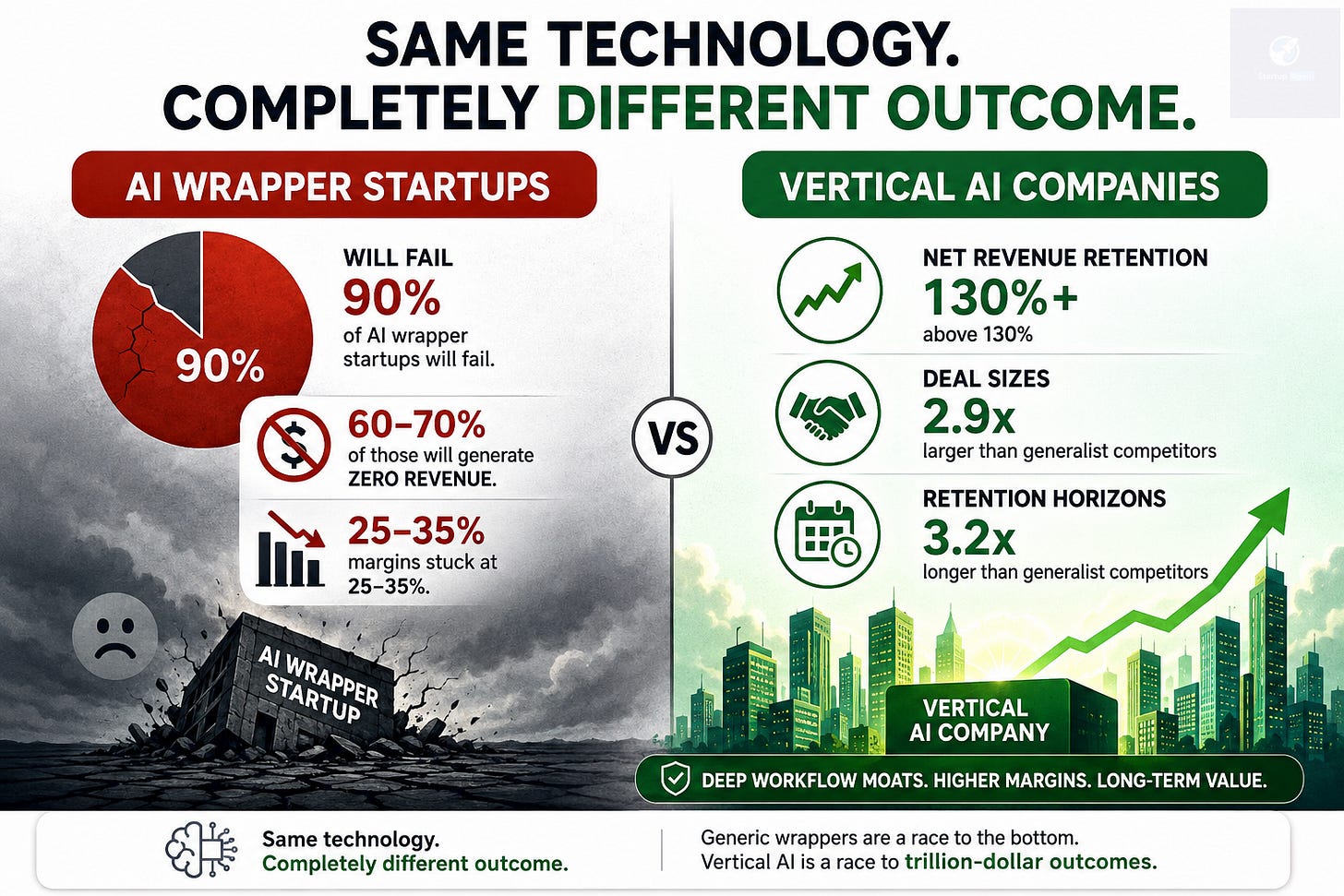
The rise of vertical AI agents embedded within specific workflows is catalyzing a trillion-dollar market realignment, with vertical AI companies outperforming generalist competitors by posting net revenue retention rates above 130%, deal sizes nearly three times larger, and customer retention horizons over three times longer. According to a16z, 30 to 40% of the $450 billion vertical SaaS market will be reshaped by AI agents by 2028, growing at 18 to 22% CAGR—two to three times faster than horizontal SaaS. This transition from AI as a mere tool to autonomous agents operating within real workflows is creating durable competitive moats and commanding premium valuation multiples of 15x to 20x ARR, compared to 3x to 4x for generic AI features.
By mid-2026, agentic AI adoption has become a strategic imperative, with over half of enterprises deploying AI agents in production and nearly a quarter actively scaling these deployments. This widespread integration enables companies not only to accelerate existing tasks but to vastly expand operational capacity relative to team size, shifting the operational mindset from questioning what is possible to deciding what should be pursued. However, this productivity surge paradoxically may increase workloads rather than reduce them, as the sheer volume of achievable tasks grows, underscoring evolving dynamics in workforce engagement and management.