AI agents take the stand: legal workflows enter the age of autonomous lawyering
The gist
AI agents are shaking up the legal world, automating everything from contract review to multi-step workflows, and turning lawyers into strategic supervisors instead of document wranglers.
What to know
- By mid-2026, hybrid human-AI legal workflows have become standard, balancing AI speed with human oversight to slash litigation risk.
- GenAI-powered SaaS platforms like Harvey AI and GC AI are driving 50–80% productivity gains by embedding AI directly into tools like Microsoft Word.
- Agentic AI systems—from Smokeball’s Archie to LegalOn’s multi-agent teams—now handle complex legal processes autonomously, with governance and human sign-off still essential to keep trust and accountability intact.
Centaur Lawyering in Action
Hybrid human-AI workflows are empowering non-lawyers to spot legal risks instantly, while sophisticated models still rely on human judgment to catch subtle errors and ensure accuracy.
Early adoption of large language models (LLMs) in legal workflows has primarily focused on democratizing access to legal insights by enabling users—regardless of expertise—to quickly identify unusual or problematic elements in documents such as contracts and real estate papers. As Nick Cammarata highlights, simply dragging a legal PDF into an AI tool and asking “anything weird here?” empowers non-lawyers to gain basic protections at minimal cost. This practical use case underscores the shift toward hybrid human-AI workflows, where AI’s rapid processing complements human judgment, a synergy aptly described by Liron Shapira who compares it to combining the heart of doctors with the brain of AI, emphasizing that the “centaur” model currently offers the best balance between speed and accuracy.
While AI tools have shown significant promise in boosting productivity and creativity—evidenced by an OpenAI survey where 95% of over 5,000 ChatGPT Enterprise users reported saving hours weekly and 75% expanded their skill sets—there remain critical limitations that prevent AI from fully replacing lawyers in complex tasks. Current models excel at spotting potential issues but struggle with legal subtleties, formatting inconsistencies, and factual accuracy, leading to plausible yet incorrect clauses and omitted details. Consequently, hybrid workflows with human oversight have become essential, especially in high-stakes areas like contract review and discovery, where 28% and 37% of in-house teams respectively rank AI as valuable but still rely on lawyers to validate outputs and mitigate risks.
To address AI’s shortcomings and enhance reliability, developers are advancing sophisticated hybrid systems that integrate LLMs with legal knowledge graphs, jurisdiction-specific retrieval, and independent citation checks, creating agent workflows that chain tasks such as intake, clause comparison, and exception reporting—all with transparent audit trails. This approach is becoming best practice, particularly in discovery, where courts are expected to issue guidance on AI-assisted processes within two years. These hybrid models employ lightweight classifiers and retrieval-augmented generation (RAG) explanations combined with targeted human spot-checks, ensuring defensibility and reducing litigation risks while maintaining transparency.
By mid-2026, the landscape of AI use in legal workflows revealed a growing divide between lay users employing generic AI tools to draft contracts—often producing mediocre outputs requiring lawyer revision—and the more nuanced hybrid human-AI collaborations that leverage interdisciplinary teams of lawyers, linguists, and engineers. This balanced 'triangle' of expertise is crucial for managing confidentiality, domain-specific legal linguistics, and technological innovation, ensuring that AI-generated work meets practical standards even if it remains 'good enough' rather than perfect. As one practitioner noted, mediocrity is acceptable in 80% of cases, reflecting a pragmatic acceptance of AI’s current role in handling commoditized legal tasks while preserving human oversight for quality assurance.



Vertical AI Reshapes Legal SaaS
Specialized, deeply integrated GenAI platforms like Harvey AI and GC AI are slashing legal workflow times and embedding themselves as the new operating systems for in-house teams.
By late 2025, the emergence of GenAI-powered vertical SaaS platforms marked a pivotal shift in legal technology, as domain-specific AI wedges like Harvey AI began delivering immediate, context-aware value that drastically cut time-to-value from months to minutes. These specialized tools achieved productivity gains of 50-80% in narrow legal workflows, far surpassing generic horizontal AI solutions, and served as critical entry points for expanding into adjacent workflows and data infrastructure, effectively positioning themselves as vertical operating systems within the legal sector.
Recognizing the distinct needs of in-house legal teams, startups like GC AI emerged by late 2025 to tailor AI solutions specifically for their high-volume, repetitive contract review workflows, addressing a $300 billion annual spend previously underserved by traditional legal AI. GC AI’s deep integration into familiar tools such as Microsoft Word exemplifies the broader trend of embedding AI seamlessly into lawyers’ daily environments, enhancing adoption by meeting users where they already work rather than forcing disruptive platform changes.
From 2024 onward, vertical SaaS platforms like Legora and Eve leveraged advances in AI to deeply automate unique legal workflows, such as risk flagging, key term review, and plaintiff lead qualification, achieving rapid accuracy improvements and transforming service delivery models from billable hours to fixed fees with faster turnaround times. These domain-specific solutions capitalized on post-ChatGPT AI capabilities to move beyond generic NLP, enabling automation of labor-intensive, high-volume tasks and driving significant efficiency gains that reshaped legal market dynamics.
By mid-2026, leading legal tech companies like LexisNexis and Smokeball demonstrated the maturation of vertical AI through deep integration of domain-specific skills and agentic AI architectures directly into core legal workflows and familiar platforms such as Microsoft Word and Outlook. Lexis+ AI’s layering of custom skills on foundational models enabled tailored legal research with verifiable citations, while Smokeball’s AI assistant Archie evolved to multi-step reasoning with over 81% client AI adoption, underscoring how vertical AI agents are not just augmenting insight generation but autonomously operating within specialized legal workflows to drive exponential adoption and retention.




Agentic AI Goes Autonomous
Legal tech is rapidly evolving from prompt-based tools to autonomous AI agents that execute multi-step legal tasks across platforms with minimal human input, fundamentally changing how law is practiced.
The transition to agentic AI marks a fundamental evolution from simple, prompt-based tools to autonomous systems capable of executing complex, multi-step legal workflows with minimal human intervention. As early as late 2025, experts like Mark Andrusko envisioned AI agents that not only identify and research problems but also implement solutions while keeping users in the loop, effectively acting as high-agency employees. By 2026, companies such as LegalOn Technologies and Anthropic expanded this vision by deploying specialized AI agents that autonomously handle tasks like contract review, document drafting, and continuous monitoring, dramatically increasing productivity and reducing routine legal work by up to 85%. This shift enables AI to operate seamlessly within existing work environments, moving beyond isolated chat interfaces to embedded workflows inside tools like Slack, Outlook, and Microsoft Word, as demonstrated by Smokeball’s agentic AI assistant Archie, which saw prompt usage grow over 241% in 2026.
Agentic AI systems are increasingly designed as collaborative networks of specialized agents that autonomously pass tasks among each other with clear ownership, resembling a factory line of legal expertise. This approach, highlighted by LegalOn’s five AI agents and Notion’s custom AI agents, allows for asynchronous management of workflows that span extended periods, with agents maintaining long-term memory and adapting dynamically to new information. Human roles evolve from direct task execution to high-level supervision and intervention only when necessary, ensuring lawyers remain in control while offloading repetitive and complex multi-step processes to AI. As Ivan Zhao of Notion describes, these agents function like a team of AI-powered interns working 24/7, enabling legal professionals to scale their work and focus on strategic decisions.
The rise of agentic AI in legal workflows is underpinned by a new infrastructure paradigm that 'gives agents a box'—dedicated environments such as filesystems and sandboxes where agents can autonomously read, write, and modify work products. This concept, popularized by companies like Cursor, Anthropic, and Cloudflare, is critical for enabling reliable, autonomous multi-step task execution and is growing rapidly with 100% month-over-month expansion. Salesforce’s multi-layered agentic AI stack, integrating large language models with federated data and application layers like Slack, exemplifies how these architectures facilitate complex autonomous workflows that collaborate with humans, transforming legal and business processes from passive systems of record to dynamic, agent-driven operations.
By mid-2026, agentic AI systems have begun to transform traditionally labor-intensive and under-innovated legal tasks such as discovery, contract review, and litigation processes through autonomous multi-step workflows. Platforms like CoCounsel and Westlaw’s AI Deep Research orchestrate multiple AI agents to produce comprehensive, well-reasoned reports and manage discovery with transparent chain-of-thought reasoning, while Shoosmiths’ Apollo applies firm-specific playbooks to flag contract issues, saving junior lawyers 3 to 5 hours per document. These advances not only accelerate legal processes but also enhance trust and learning by providing explainable outputs, signaling a shift from AI as a reactive assistant to an autonomous collaborator that can handle complex legal workflows at scale.




Startups Pivot to AI-First
Legal tech startups are abandoning legacy systems for agentic AI workforces, driving record adoption, funding, and enterprise-scale deployments that embed AI deeply into everyday legal processes.
The evolution of legal tech products has been marked by bold startup pivots and rapid growth driven by agentic AI's ability to embed deeply into workflows. For instance, Eve's early 2023 pivot to focus solely on their legal AI product yielded astonishing conversion rates—40% from cold outreach to demos and 90% from demos to pilots—by offering law firms unprecedented live demos of AI-powered workflows that accelerated the case intake funnel beyond human limitations. Similarly, Filevine transitioned from traditional case management to an AI-native legal operating system, leveraging vectorized databases and advanced AI techniques to automate data ingestion and outpace competitors like Harvey and Lora, signaling a broader market shift toward AI-first legal platforms.
This product evolution is accompanied by a cultural and strategic shift in how startups design and deploy AI systems, moving from isolated tools to orchestrated agentic AI workforces embedded within enterprise workflows. Notion’s launch of custom AI agents after a year of development exemplifies this trend, enabling leaders to manage AI teams that integrate with tools like Snowflake for superhuman insights and automation. Likewise, startups such as Advocacy and Lio have raised significant funding—$3.5M and $30M respectively—to build AI agents that autonomously execute multi-step legal and procurement tasks, embedding context-aware intelligence deeply into workflows and reshaping legal tech culture from siloed automation to continuous, autonomous process management.
Enterprise-scale adoption of agentic AI in legal workflows is accelerating rapidly, with companies like Harvey evolving from AI assistants to comprehensive platforms coordinating specialized agents and human reviewers to complete full legal processes. This expansion includes serving Fortune 500 clients and categorizing legal work by levels of AI autonomy, reflecting a maturing market that embraces deep workflow integration. Concurrently, startups like Irys.ai demonstrate strong market validation with 100% enterprise retention and user engagement driven by sophisticated AI reasoning, while Microsoft’s pivot to proprietary AI models and embedded autonomous agents like Scout within Microsoft 365 apps highlights a broader industry trend toward seamless, secure AI integration at scale.
The broader market dynamics underscore a decisive shift from generic AI SaaS to vertical AI agents that deliver domain-specific, autonomous workflow execution, driving superior growth, retention, and valuation multiples. By mid-2026, over half of enterprises had AI agents in production, with vertical SaaS growing at 18-22% CAGR and commanding 15x to 20x ARR multiples compared to 3x to 4x for generic AI products. Exemplars like Sierra, Harvey, and Avoca illustrate this trend by performing multi-step, jurisdiction-specific legal tasks or critical after-hours functions autonomously, marking a cultural and product evolution from AI tools that merely generate insights to AI agents that act as integral, autonomous workers within legal workflows.





Governance Anchors AI Trust
Even as AI agents automate complex legal work, law firms and platforms are doubling down on human oversight, transparent audit trails, and responsible governance to maintain trust and accountability.
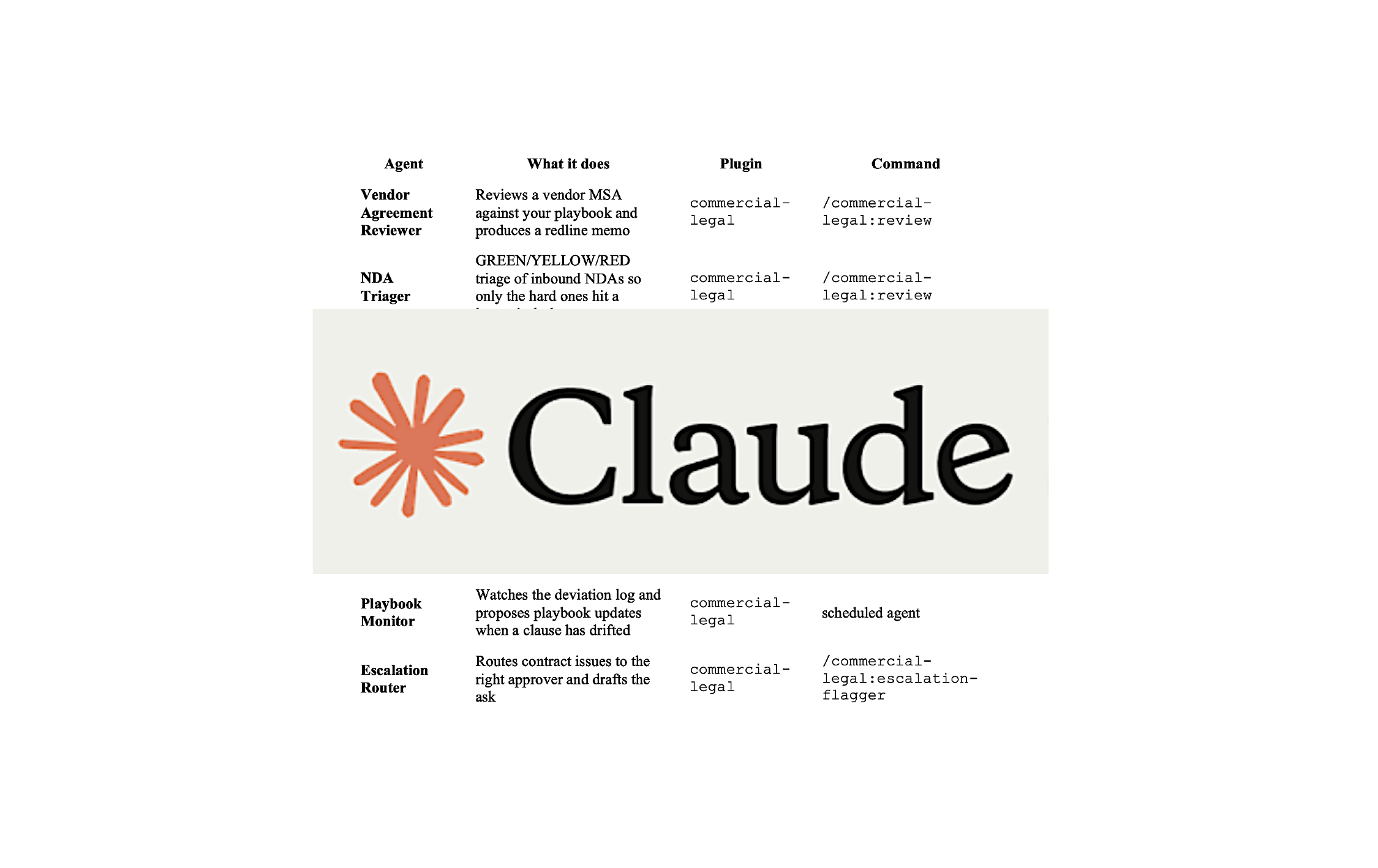
By early 2026, leading platforms like LegalOn and Claude for Legal underscored the indispensable role of human oversight in AI-augmented legal workflows, ensuring that while AI agents automate complex, multi-step tasks, ultimate control and professional accountability remain with legal practitioners. LegalOn’s customizable AI agents operate within secure environments tailored to client standards, promoting transparency and auditability, while Claude for Legal’s 90+ agents incorporate source attribution, jurisdiction onboarding, and explicit review gates to prevent errors and hallucinations, reflecting a broader industry commitment to responsible AI governance.
Despite AI’s growing capability to automate routine tasks such as contract review and legal research, human judgment remains irreplaceable, especially in nuanced areas like M&A where interpersonal knowledge and strategic decision-making are critical. As noted in May 2026 analyses, while AI expedites drafting and data assembly, the lawyer’s role in verifying citations, interpreting complex scenarios, and providing final advice grows more valuable, reinforcing a collaborative 'human in the loop' model that balances efficiency with professional accountability.
The legal sector’s rapid shift from debating AI adoption to embedding it responsibly into practice highlights governance as a central concern, with accuracy, transparency, and trust driving acceptance. Surveys from June 2026 reveal that 66.8% of legal professionals prioritize output reliability and prefer retaining final decision-making authority, while 51.8% emphasize alignment with internal standards to manage unforeseen risks. This evolving mindset is echoed by firms like Shoosmiths, whose Apollo system not only flags contract issues transparently but also serves as a learning tool for junior lawyers, embodying AI’s role in augmenting rather than replacing human expertise.
Cutting-edge AI legal tools from LexisNexis, StrongSuit, and CaseDocker demonstrate how integrating transparency, auditability, and human oversight into AI workflows enhances defensibility and professional confidence. Features such as LexisNexis’s Shepherd Verify actively cross-check AI outputs against authoritative databases to prevent hallucinations, while StrongSuit structures research as incremental deliverables with clear checkpoints, enabling attorneys to maintain control and assess progress. Meanwhile, CaseDocker’s unified platform automates repetitive tasks and documents every workflow stage, ensuring compliance and security without sacrificing the nuanced judgment that only legal professionals can provide.

Autonomous Agents Redefine Work
AI-driven multiagent systems are set to overhaul legal workflows by 2028, powering algorithm-to-algorithm transactions and transforming lawyers into strategic partners as routine work disappears.
By 2028, AI-driven autonomous multiagent systems are set to revolutionize legal workflows, transforming them into fully automated operations that eliminate traditional handoffs and redefine work execution. Gartner forecasts that $15 trillion in B2B transactions will flow through AI exchanges, with up to 90% of buying occurring algorithm-to-algorithm, signaling a fundamental shift from human-managed processes to continuous, scalable legal operating systems. This evolution is exemplified by platforms like RentAHuman, which rapidly inverted traditional employer-employee dynamics by having thousands sign up to work for AI agents, underscoring the profound transformation in legal work structures and industry relationships.
Microsoft’s 2026 launch of its proprietary AI model family, 'MAI,' alongside the deeply integrated 'Scout' AI agent within Microsoft 365, exemplifies the emergence of AI as a core operating system embedded seamlessly into user workflows. Scout’s proactive, autonomous management of tasks—anticipating needs, learning user habits, and executing multi-step processes without explicit commands—heralds a new era where AI agents shift from reactive assistants to autonomous collaborators, reshaping legal and office productivity. Importantly, Microsoft’s rigorous governance frameworks ensure trust and oversight as these agents gain unprecedented access to sensitive workflows, addressing the risks inherent in such autonomy.
AI’s integration into legal workflows is poised to dramatically elevate lawyer productivity by automating routine tasks such as real-time email monitoring, document redlining, and client communications, thereby slashing turnaround times and enabling simultaneous management of multiple deals at scale. As one expert noted, AI systems will autonomously connect to data rooms, review documents, and draft diligence memos overnight, reducing deal costs and allowing lawyers to focus on higher-value, creative, and strategic work. This mirrors the transformative impact spreadsheets had on accounting in the late 1970s, shifting legal professionals from manual toil to becoming better strategic partners to their clients, though it also raises the bar for legal expertise and adoption.
The future user interface for AI-driven legal workflows is dissolving traditional boundaries, with agentic AI embedding itself directly into existing tools rather than requiring separate apps or dashboards. As product designer Andrew Sims describes, 'the interface is melting,' transitioning screens into supervisory layers while AI handles execution autonomously. This dynamic, AI-generated interface can be personalized on demand—adjusting for accessibility, language, or modality—fundamentally transforming how users interact with software. Business leaders must now rethink work design and employee-machine interaction models, anticipating a landscape where AI-driven workflows reach workers seamlessly and reshape the very nature of legal work environments.