AI agents take the trading floor: retail platforms race to balance automation with oversight
The gist
AI agents have stormed the retail trading floor, forcing platforms to juggle explosive automation demand with a brand new playbook for security and oversight.
What to know
- Bitget’s AI trading tools rocketed past 1 million users and $1.22 billion in volume by early 2026, proving retail traders want integrated AI workflows now.
- Open standards like the Model Context Protocol (MCP) are going mainstream, enabling secure, agent-driven trading on platforms like Spotware, ThinkMarkets, and Capital.com.
- Brokers are rolling out tiered trust models—ranging from human-in-the-loop approvals to ring-fenced AI sub-accounts—to keep client funds safe as AI trading goes fully mainstream.
Bitget’s AI Ecosystem Surge
Bitget’s rapid rollout of integrated AI trading tools—spanning analysis, execution, and risk management—has fundamentally shifted retail trader behavior toward seamless, automated workflows protected by layered account safeguards.
By early 2026, Bitget emerged as a frontrunner in retail AI trading adoption, rapidly attracting 460,000 users to its multi-layered AI platform that integrates market analysis (GetAgent), automated execution (GetClaw), developer access (Agent Hub), and strategy formulation (Gracy AI). This comprehensive system not only streamlined trading workflows but also embedded risk management through isolated sub-accounts, safeguarding user funds while enabling automation, signaling a robust foundation for AI-driven retail trading.
Bitget’s AI trading ecosystem experienced explosive growth within weeks, surpassing 1 million users and generating over $1.2 billion in cumulative trading volume across 58 distinct AI-powered tools. This rapid scaling underscores strong retail appetite for diverse AI trading functionalities, with the platform’s unified approach fostering deep engagement and signaling a mainstream shift toward integrated AI workflows in retail trading.
The early adoption metrics from Bitget, including 450,000 GetAgent users and 460,000 Gracy AI users during initial rollouts, reflect a significant behavioral shift among retail traders toward AI tools that reduce manual friction. Industry analysis anticipates that within 12 to 18 months, retail trading will evolve from isolated AI assistance to seamless, workflow-native systems that unify analysis, execution, and risk management, marking a pivotal transformation in how retail investors engage with markets.
Complementing Bitget’s success, Deriv’s AI-powered market analysis platform TradersView demonstrated rapid early traction by attracting 20,000 active users within its first week through an open-access, no-login-required model. By consolidating AI-generated trade signals, live price analysis, economic calendar data, and trending news, TradersView exemplifies the growing retail demand for integrated, accessible AI trading tools, particularly in emerging markets outside the EU and UAE.



MCP Standard Reshapes Platforms
Open protocols like the Model Context Protocol are unlocking secure, agent-driven trading across platforms, with vendors like Spotware and ThinkMarkets exposing live execution to external AI while baking in granular risk controls.
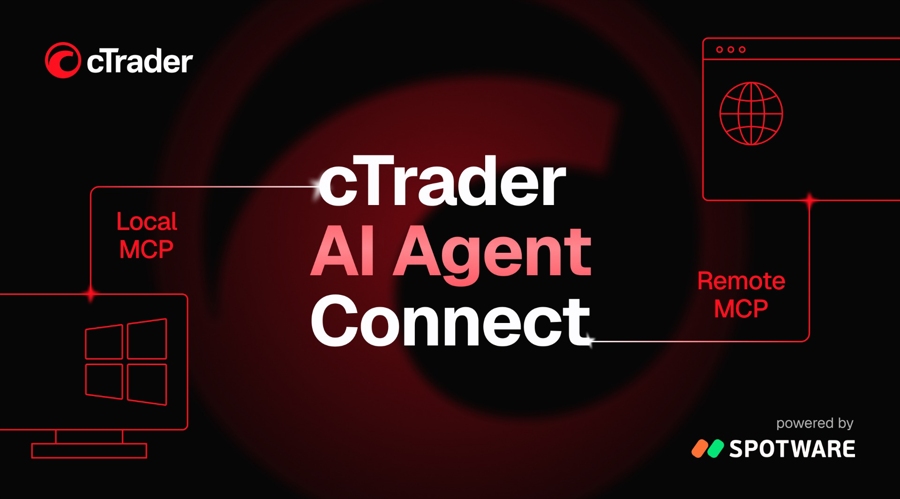
By mid-2026, the Model Context Protocol (MCP) emerged as a pivotal open standard enabling seamless AI integration within retail trading platforms, with Spotware Systems leading the charge through its launch of cTrader AI Agent Connect. This official vendor-supported implementation distinguished itself by offering dual MCP servers—remote and local—that facilitate interoperability with multiple AI clients like Claude Code and ChatGPT Codex, while uniquely exposing trade execution directly to external large language models (LLMs), a bold move unmatched by competitors such as MetaQuotes and Devexperts.
Shortly after, ThinkMarkets advanced the MCP ecosystem with ChelseaAI, a server that allows any AI language model—including Anthropic’s Claude and Grok—to execute live CFD trades on ThinkTrader accounts, while embedding rigorous security controls. These include granular permission settings, circuit breakers, hard trading limits, session expiration, and audit logs inaccessible to AI, ensuring that AI assistants can trade without ever accessing or handling client funds. CEO Nauman Anees heralded this launch as a major milestone in adopting open standards to foster secure, agentic AI trading.
Capital.com’s adoption of an MCP plugin for its MENA clients in June 2026 further underscores the protocol’s growing industry traction, enabling AI-assisted trading on a CMA-regulated platform with live market data and sentiment analysis compatible with tools like Claude Desktop and Cursor. To mitigate risks such as tool poisoning and infinite loops, Capital.com enforces a two-step human confirmation process for AI-initiated trades, reflecting a cautious yet progressive embrace of AI-driven trading that simultaneously signals potential obsolescence for traditional trading apps.
Meanwhile, Webull’s April 2026 introduction of an MCP server in the U.S. market democratizes AI-driven trading by enabling natural-language commands to interact with its OpenAPI and trading infrastructure. This innovation lowers technical barriers for retail investors, allowing AI agents to query market data, manage orders, and view account details without programming knowledge. Webull positions MCP as a strategic tool to reshape investor engagement and empower the next generation of self-directed investors through AI-enhanced accessibility.

Evolving Trust: AI Trading Tiers
Retail brokers are deploying nuanced trust models—from human-in-the-loop order approvals to fully autonomous AI sub-accounts—to balance innovation with client fund security as AI agents move from theory to live execution.
By mid-2026, retail trading platforms had crystallized a tiered trust model for AI integration that balances autonomy with stringent risk management. This model spans from read-only data access, where AI agents can analyze but not trade, to AI-generated trade drafts requiring explicit human approval, as exemplified by Interactive Brokers’ integration of Anthropic’s Claude AI across 4.75 million accounts. Here, every AI-suggested order awaits client sign-off, underscoring a cautious human-in-the-loop approach that prioritizes oversight over automation. Meanwhile, platforms like Bitget and Robinhood pushed the envelope by enabling fully autonomous AI trading within isolated, risk-limited sub-accounts or ring-fenced agent accounts, protecting user funds while allowing AI to execute trades independently. This stratification reflects a nuanced evolution in trust, where granular permission controls and segregated account structures serve as bulwarks against operational risks.
Security and regulatory safeguards have become foundational in AI-driven trading, with platforms embedding multiple layers of protection to mitigate emerging risks. ThinkMarkets’ ChelseaAI, for instance, permits AI to execute trades but strictly prohibits any access to client funds, complemented by granular permission settings that clients can adjust at will. Additional risk controls such as circuit breakers, hard trading limits, session expirations, and audit logs inaccessible to AI agents create a robust compliance framework that preserves account integrity. Similarly, Capital.com’s launch of the Model Context Protocol (MCP) server for MENA clients integrates AI agents directly with live market data and sentiment analysis while enforcing a mandatory two-step human confirmation process to prevent issues like tool poisoning and infinite trading loops. These measures illustrate the industry’s proactive stance in embedding regulatory and security safeguards as AI trading platforms scale rapidly.
The rapid adoption of AI trading agents—powered predominantly by Anthropic’s Claude—across at least ten retail brokers within the first half of 2026 marks a pivotal shift from theoretical AI market analysis to live order execution. This swift integration underscores the market’s confidence in AI capabilities while simultaneously highlighting the critical importance of calibrated trust tiers and risk management frameworks. As platforms navigate this transition, the coexistence of fully autonomous AI trading in segregated sub-accounts alongside human-in-the-loop models reflects a strategic balancing act: accelerating innovation without compromising client security or regulatory compliance.
AI Embedded in Every Workflow
Major brokers like Interactive Brokers and Leverate are weaving AI chatbots and analytics into every layer of trading, blending multilingual insights and automated research with strict client oversight to drive responsible adoption.
By mid-2026, Interactive Brokers (IBKR) pioneered the integration of AI agents directly into retail trading workflows by embedding Anthropic’s Claude chatbot into its platform, enabling clients to leverage AI for market research, portfolio analysis, and trade instruction generation across over 170 global markets. This integration, accessible via a certified connector marketplace without additional fees, emphasizes a human-in-the-loop model requiring explicit client approval before any AI-generated trade executes, underscoring IBKR’s commitment to secure and responsible AI adoption while planning phased expansion into more asset classes.
Expanding on its AI strategy, Interactive Brokers incorporated multiple AI platforms including ChatGPT, Gemini, and Grok, advancing toward agentic trading capabilities that empower autonomous trade execution and market analysis. This evolution marks a significant step toward fully autonomous investing, reflecting the broader financial services sector’s embrace of AI assistants to enhance decision-making and operational efficiency within retail trading workflows.
Simultaneously, firms like Leverate and Acuity Trading have deepened AI integration by embedding chat assistants and advanced analytics directly into trading platforms, offering real-time multilingual market insights and back-office analytics that help brokers optimize client engagement and retention. Leverate’s Chief Commercial Officer Shmulik Kordova highlighted this trend, stating, 'AI is becoming part of everything we build at Leverate,' while Acuity Trading’s combination of AI-driven data processing with analyst-led research delivers predictive analytics and automated chart pattern recognition to support active traders’ decision-making.
In a contrasting approach to frictionless AI adoption, Deriv launched TradersView, an AI-powered market analysis platform accessible without login, consolidating trade signals, live price data, economic calendars, and trending news to empower retail traders globally. Garnering 20,000 active users and producing over 500 AI market analyses within its first week, TradersView’s rapid traction validates the growing appetite for integrated AI tools that enhance retail trading workflows by simplifying access to comprehensive market intelligence.

AI-Native Brokerage Arrives
B2PRIME’s all-in-one AI Assistant transforms the brokerage platform into a context-aware market interpreter, democratizing institutional-grade insights and empowering retail traders with real-time, actionable intelligence.
By mid-2026, B2PRIME has taken a pioneering leap toward AI-native brokerage models by embedding an AI Assistant directly within its flagship B2TRADER platform. This integration transforms the traditional trading environment from a mere execution tool into an intelligent workspace that delivers real-time market analysis, sentiment signals, and price outlooks all within a single interface, eliminating the need for traders to juggle multiple external resources. This seamless embedding of AI intelligence enhances trading efficiency and user experience by providing consolidated insights such as an AI Score, 12-month price forecasts, and suggested actions, effectively turning the platform into a context-aware market interpreter.
B2PRIME’s AI-native brokerage approach also democratizes access to institutional-quality market intelligence, significantly lowering barriers to entry for retail traders. Historically, sophisticated market analysis demanded costly subscriptions or extensive self-education, but the AI Assistant now delivers professional-grade insights at the moment of need, making advanced trading strategies accessible to a broader audience. This shift not only enhances inclusivity but also redefines the role of brokerage platforms by embedding intelligence that supports informed decision-making in real time.
AI Agents Disrupt Trading Apps
The rise of agent-driven interfaces and natural-language trading is dismantling traditional apps, as platforms enforce new safeguards like two-step confirmations to balance frictionless access with robust investor protection.
The rapid mainstream adoption of AI-driven retail trading is underscored by Bitget's milestone of over 1 million users and $1.22 billion in cumulative trading volume across more than 58 AI-powered tools, signaling a robust retail appetite for AI integration. Complementing this trend, early engagement metrics from platforms like Get Agent and Gracie AI, each boasting nearly half a million users in their initial rollout, reflect a broader behavioral shift toward faster, more frictionless trading experiences that are reshaping investor engagement.
Industry evolution is accelerating from isolated AI assistance toward fully integrated, workflow-native trading ecosystems that seamlessly combine market analysis, execution, and risk management. Bitget anticipates this transition within the next 12 to 18 months, a timeline echoed by brokers like Interactive Brokers and Robinhood, which are progressively enabling varying degrees of AI autonomy—from human-approved order drafting to fully autonomous trading within ring-fenced sub-accounts—thereby laying the groundwork for AI-native brokerage models that redefine market structure.
The deployment of AI agents as primary market access points, exemplified by Capital.com's MCP server and Webull's natural-language trading interface, is poised to disrupt traditional trading app ecosystems by streamlining research and execution while lowering barriers for retail investors. However, this shift is tempered by regulatory safeguards such as two-step trade confirmations to mitigate risks like tool poisoning and infinite loops, reflecting a cautious industry approach that balances innovation with investor protection amid evolving AI-native trading frameworks.