AI agents take the wheel: 2026 ushers in era of autonomous content creation (with humans riding shotgun)
The gist
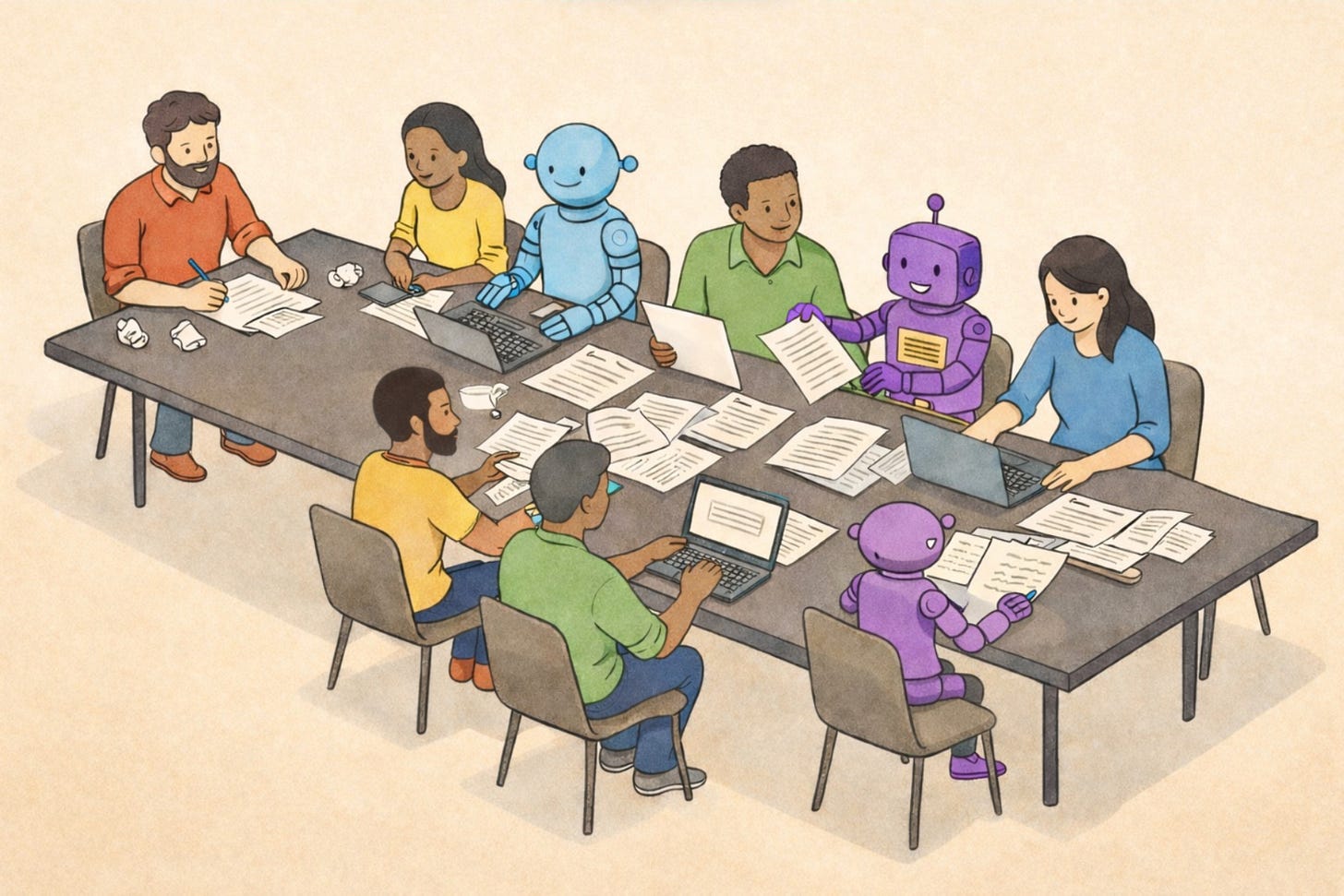
By 2026, AI agents have taken over the heavy lifting in content creation, leaving humans in the crucial role of quality control and creative direction.
What to know
- AI multi-agent systems now automate up to 90% of writing workflows, slashing production times from days to hours while specialized agents handle SEO, formatting, and content repurposing.
- Human oversight remains non-negotiable, with best practices requiring at least 20% original input to preserve author voice, originality, and factual accuracy.
- Platforms like Google’s NotebookLM (powered by Gemini 3.5 and Antigravity) and AiPPT.com now deliver fully integrated, multimodal content ecosystems across education, marketing, and media.
AI Research Assistants Evolve
NotebookLM and open-source rivals now autonomously manage complex research, transforming passive reading into interactive, multimedia learning experiences.
By mid-2026, AI research and learning assistants have evolved from simple document summarizers into sophisticated, interactive ecosystems exemplified by Google’s NotebookLM and Open Notebook. NotebookLM, powered by the Gemini 3.5 model and Antigravity infrastructure, now autonomously manages research workflows by integrating Google Search for source discovery, enabling secure cloud-based code execution, and supporting over 100 software skills to streamline complex analysis and content creation. This transformation allows users—from students to professionals—to upload diverse materials including PDFs, websites, and YouTube links, and receive multimedia learning aids such as podcast-style audio overviews, cinematic video summaries, interactive mind maps, and customizable flashcards, effectively turning passive reading into dynamic exploration and study.
The integration of advanced AI capabilities in NotebookLM and similar tools marks a paradigm shift in knowledge management by enabling users to offload not just simple tasks but complex, multi-step projects. As noted in case studies, AI now automates content structuring, formatting, and educational material creation with quality that rivals or surpasses human effort, allowing creators to focus on refinement rather than generation from scratch. This progression encourages more ambitious prompt design and responsibility delegation to AI, reflecting a maturation from incremental improvements in basic tasks to handling intricate workflows such as data analysis, report generation, and multimedia content synthesis within unified platforms.
Open Notebook emerges as a compelling open-source counterpart to Google’s offerings, emphasizing user control and flexibility by enabling local deployment of AI models for document analysis and podcast generation. With nearly 30,000 GitHub stars, it supports powering via hosted models like OpenAI’s or fully local large language and voice models, catering to users prioritizing privacy and customization. This approach complements the cloud-based, feature-rich environments of commercial tools, illustrating a diverse ecosystem where AI-powered learning assistants adapt to varied user needs and technical preferences.
Platforms like AiPPT.com further demonstrate the expanding scope of AI learning assistants by integrating content analysis, organization, and iterative editing within a unified workspace, facilitating seamless project management and reuse. This reflects a broader trend toward consolidating disparate research and educational workflows into cohesive environments where AI agents not only assist with knowledge synthesis but also actively support content creation and presentation, enhancing productivity and creative iteration in educational and professional settings.





Multi-Agent Workflows Reshape Writing
Specialized AI agents and advanced prompt engineering have replaced entire freelance teams, slashing costs while keeping human expertise at the heart of ideation and quality control.
By early 2026, AI multi-agent systems have revolutionized content creation workflows by automating up to 90% of the writing pipeline, dramatically reducing production time from multiple days to a single day for in-depth articles, as demonstrated in workflows like NA10 and those used by Reworld Media. These systems deploy specialized agents tailored to distinct article types—listicles, comparisons, and guides—and integrate SEO optimization agents that meticulously handle metadata, URLs, and tags, ensuring content is both high-quality and search-engine friendly. Despite this automation, human input remains indispensable, particularly in the initial research and ideation phases, where deep domain expertise and original insights seed AI-generated drafts, preserving authenticity and creative depth.
Human oversight continues to be a critical pillar in AI-augmented content workflows, primarily to mitigate risks like hallucination and inaccuracies that AI tools still produce, especially in sensitive fields such as health, finance, and legal content. Experts emphasize that while AI accelerates drafting and SEO optimization, the intellectual and editorial judgment remains firmly in human hands, with senior writers performing final proofreading and quality control to ensure brand voice consistency and factual reliability. As noted in 2026 case studies, this human-in-the-loop approach not only safeguards content integrity but also leverages AI as a powerful assistant rather than a replacement, enabling creators to focus on higher-value tasks like original research and nuanced storytelling.
The sophistication of AI-augmented content creation in 2026 lies in the strategic orchestration of multiple specialized tools and prompt engineering that transform complex tasks—ranging from drafting and SEO to repurposing and distribution—into streamlined, scalable workflows. Systems like the ChatGPT-based multi-agent pipeline that replaced entire freelance teams demonstrate cost reductions of 70–90% while maintaining or improving content quality and SEO performance by assigning distinct expert roles to AI agents. Moreover, advanced prompt techniques, such as section-by-section drafting with first-sentence handoffs, preserve the author's unique voice and ensure thematic alignment, while batching methods enable creators to produce a month’s worth of content in focused sessions, dramatically compressing production cycles without sacrificing creativity.
Beyond writing, AI multi-agent systems have expanded into journalistic and marketing domains by conducting interactive, voice-enabled interviews that capture authentic voices and organize complex ideas into coherent outlines, significantly boosting efficiency in producing feature articles, newsletters, and executive thought leadership content. Tools like WRITER embed brand governance directly into AI workflows, reducing compliance review times by up to 85% and cutting reliance on external agencies, thereby enabling large-scale, compliant content production. Meanwhile, creative campaign platforms such as Innovid’s NIVO AI integrate specialized agents for creative, delivery, and measurement tasks, automating grunt work by about 80% while maintaining a humanized interface that fosters essential human interaction and oversight within content ecosystems.






Preserving Human Voice in AI Era
Writers rely on structured oversight and brand guidelines to keep content original and authentic as AI democratizes drafting but risks homogenizing expression.
By early 2026, AI had emerged as a powerful drafting assistant that helps writers overcome creative blocks by generating initial content to refine, thus advancing their thinking and creativity. However, this democratization of writing capabilities also brings challenges in preserving the distinct human voice and originality, as AI tends to normalize expression, making it easier for many to produce similar content. As one interviewee noted, AI 'makes it easier for everyone to say the same thing,' underscoring the need for deliberate human input to maintain uniqueness and authenticity.
Human oversight remains indispensable in AI-assisted writing workflows to safeguard content accuracy, author voice, and originality. Megan McArdle’s approach at The Washington Post exemplifies this balance, using AI primarily as a research assistant and copyeditor rather than a text generator, with multiple rounds of rigorous human edits and fact-checking to catch AI hallucinations and errors. This human-in-the-loop model echoes historical creative practices, such as Andy Warhol’s use of assistants, where final authorship is retained through human creative control and judgment.
Sustainable AI-augmented content creation hinges on structured, role-based systems that assign expert identities to AI and embed comprehensive brand voice guidelines to preserve authenticity. As detailed in a 2026 case study, building a layered production pipeline—from research and ideation to SEO and distribution—combined with a brand voice document containing identity, tone contrasts, reader profiles, and prohibited phrases, prevents generic or off-brand outputs. WRITER’s enterprise marketing infrastructure further demonstrates how embedding style guide enforcement into AI workflows can reduce compliance review time by 85%, exemplifying effective human-AI collaboration.
Best practices for maintaining author voice and content quality involve granular human-AI interaction techniques such as section-by-section drafting with human-written first sentences, ensuring AI-generated continuations align with the author’s perspective. Maintaining at least 20% original human experience or observation in content is critical to differentiate AI-assisted work and build trust. Additionally, developing repeatable AI writing systems with organized prompt libraries and standard operating procedures enables writers to focus on creativity while ensuring consistent quality and oversight, with compounding productivity gains visible after approximately 90 days of iterative refinement.


Role-Based AI Transforms Teams
Staged, agent-driven pipelines now automate everything from SEO to formatting, letting humans focus on originality while AI handles the heavy lifting across industries.
By early 2026, scalable AI systems had revolutionized content creation across education, marketing, and media by automating up to 90% of manual writing workflows while preserving essential human input in research and ideation phases. For example, a technical article that once took two to three days to produce could now be completed in about one day through multi-step AI workflows with validation gates ensuring quality control, as demonstrated in agentic pipelines that keep the author as the indispensable seed of originality. This balance between human creativity and AI efficiency underscores the translation strength of large language models, which excel at converting pre-thought ideas into polished prose but rely on human insight to avoid generic outputs.
Advanced scalable AI content ecosystems employ role-based multi-agent architectures that assign specialized AI agents distinct tasks such as writing different article types, SEO optimization, internal and external linking, and content formatting. The NA10 workflow, for instance, leverages three specialized writing agents tailored to listicles, comparisons, and guides, complemented by a dedicated SEO agent that meticulously applies guidelines on metadata and keyword usage. This modular approach not only streamlines collaboration within content teams but also automates complex integrations like SER analysis and database crawling, significantly reducing manual coordination and accelerating production cycles.
In marketing, scalable AI systems have effectively replaced entire freelance teams by deploying ChatGPT in distinct expert roles—strategist, writer, SEO analyst, and social repurposer—within a staged production pipeline. This role-based model cuts content costs by 70–90% without sacrificing quality or search performance, provided operators move beyond basic prompt engineering to Tier 2 capabilities that embed brand voice and narrative structure, while humans safeguard original research and cultural nuance. Crucially, supplying AI with comprehensive brand voice documents ensures content alignment and prevents generic outputs, transforming AI from a mere assistant into a strategic content partner.
Beyond writing, scalable AI systems are reshaping educational and media content production through integrated ecosystems like Google’s NotebookLM and AiPPT.com’s four-mode AI presentation suite. NotebookLM bundles diverse documents and multimedia into dynamic knowledge units, enabling role-based AI content teams to create specialized notebooks for domains ranging from Shakespearean literature to financial analysis, with partners like The Atlantic and Zillow showcasing its versatility. Similarly, AiPPT.com unifies AI presentation modes with embedded tools and permission controls, streamlining workflows and boosting productivity across sectors. These platforms exemplify how AI-driven content ecosystems not only automate grunt work but also foster creativity, collaboration, and brand governance at scale.

AI Agents Become Workflow Backbone
Integrated, multimodal AI agents like Gemini Spark and Project Solara are redefining productivity by actively managing tasks and connecting tools across the digital workspace.
By mid-2026, the AI writing tools landscape had matured beyond raw generation capabilities, which were now considered baseline infrastructure rather than premium features. Tools like Claude, Perplexity, Surfer SEO, Jasper, and Lex distinguished themselves by focusing on workflow integration, interface design, and robust citation infrastructure—critical for domains like health and finance where hallucination poses serious risks. This shift underscored that effective AI adoption hinges not just on individual tools but on the architecture connecting multiple AI capabilities within a writer’s workflow, enabling measurable productivity and quality gains.
The industry-wide pivot toward AI agent-first models became unmistakable with Google’s introduction of Gemini Spark—a 24/7 personal AI agent embedded in Workspace apps—and Microsoft’s Project Solara, which integrates AI agents across workplaces and personal devices. These developments illustrate a broader trend where AI agents actively manage digital workflows, enabling users to delegate complex tasks and streamline knowledge work. Complementing this, Google’s NotebookLM upgrade with the Gemini 3.5 model and 'Antigravity' agentic infrastructure transformed research workflows by autonomously initiating projects and building source repositories, highlighting the rise of autonomous AI assistants in enterprise environments.
Multimodal AI ecosystems are reshaping knowledge work by seamlessly combining voice, text, and image capabilities. Google’s 2026 Workspace updates introduced conversational voice tools for Gmail, Docs, and Keep alongside AI-powered image creation in Google Pics, enabling more natural and creative interactions. This convergence is echoed in industry-wide innovations, with new AI image models and voice partnerships driving a transformative 'hot agent summer' that enhances content intelligence platforms, boosts accessibility, and accelerates productivity through personalized draft replies and instant access to related documents.
The practical impact of AI tools in 2026 is best understood through the functional problems they solve rather than brand hype, emphasizing the need for a clear vocabulary to navigate the AI landscape. Writing tools remain the highest-leverage category, serving as the universal business currency and central entry point for AI adoption due to their integration across diverse workflows. Moreover, effective AI use increasingly involves operating stacks—combinations of multiple AI tool types—that compound benefits and accelerate human creativity. Modern AI writing assistants now maintain voice, context, and tone across long documents, acting as multipliers that transform creative workflows, such as turbocharging ebook writing into rapid, structured sprints.
