AI at scale: why governance, not gimmicks, is driving real enterprise value
The gist
In the enterprise AI race, disciplined governance and operational rigor—not shiny features—are what drive real, measurable business value.
What to know
- Companies like Zuora, Snowflake, and HubSpot are proving that robust AI governance, cross-functional collaboration, and embedding domain expertise unlock productivity and reduce costs by up to 60%.
- The Minimal Viable Output (MVO) approach—validating reliable model outputs before productization—prevents wasted effort on features that can't deliver value, as seen at Webflow and XK.
- A persistent skills gap, especially among middle managers, and the challenge of achieving near-perfect reliability remain the biggest roadblocks to scaling trustworthy AI across organizations.
Blueprints Before Building
AI-native teams now define models, actions, and memory upfront, staging rapid experiments to avoid wasted work on features that quickly become obsolete.
Operationalizing AI begins with a disciplined focus on foundational components—models, tools, and memory—before a single line of code is written. As outlined in 2025 by leading practitioners, every AI agent’s success hinges on clearly defining its core capabilities (such as text or image generation), the APIs and actions it can perform, and the contextual memory it leverages for personalization and metrics. This upfront clarity not only streamlines subsequent development but also ensures that teams avoid the pitfall of building features that are quickly commoditized by new model updates, as Jaclyn’s team learned when months of image editing work were rendered obsolete overnight. The recommended approach: think ambitiously, but ship fast by tightly scoping initial releases, positioning them as experiments or betas, and staging audience exposure from internal testers to public launch.
A pivotal shift in AI product development is the adoption of the Minimal Viable Output (MVO) framework, championed by teams at Webflow and XK in late 2025. Rather than following the traditional sequence of ideation, PRD writing, and design before engineering, these organizations insist on validating that model outputs are stable and correct as the very first step. As Rachel from Webflow puts it, 'If you don’t have desired outputs, you don’t really need to spend any time to productize the AI feature.' This inversion of the build order not only accelerates iteration but also prevents wasted effort on features that can’t deliver reliable value, ensuring that subsequent UI and productization efforts rest on a solid AI foundation.
Rapid, data-driven prototyping has become a hallmark of AI-native organizations, fundamentally altering the cadence and nature of product development. As Ravi Mehta and case studies from Sage reveal, starting with data schemas and leveraging AI to generate realistic prototypes allows teams to iterate in hours rather than weeks, blurring the lines between prototyping and production. This acceleration enables product managers to focus on high-value, human-speed activities like customer discovery and strategic alignment, while AI handles documentation, design, and even code generation. However, this newfound speed also demands new modes of collaboration and coordination to ensure that individual experimentation translates into organizational value and that teams remain aligned amid the breakneck pace.
As AI systems become more complex, operationalization requires a layered approach to workflow management, robust evaluation, and a relentless focus on product judgment. By early 2026, frameworks like the AI Workflow Stack—encompassing Input, Context, Reasoning, Actions, and Evaluation—have become essential for product managers, who must now obsess over input quality, clarify ambiguous requests, and define what constitutes acceptable failure. Continuous evaluation replaces traditional QA, with PMs owning the definition of success metrics and safety guardrails. This evolution underscores that operationalizing AI is less about adding features and more about managing dynamic, unpredictable systems that demand ongoing oversight and critical decision-making.
Scaling AI from experimentation to enterprise value also hinges on structured, organization-wide frameworks and the integration of domain expertise. Info-Tech Research Group’s 12-step 'AI Playbook,' released in early 2026, exemplifies this trend by guiding IT leaders through a year-long process that embeds governance, accountability, and measurable outcomes into every stage of AI adoption. Meanwhile, AWS and others stress that generic AI is rarely sufficient for real-world value—embedding domain knowledge at multiple layers, leveraging agentic architectures, and exposing SaaS and API assets through protocols like MCP and A2A are now recognized as critical for operational success. This holistic, disciplined approach ensures that AI initiatives move beyond pilots and fragmented strategies to become deeply woven into the fabric of organizational workflows.




Upskilling, Not Just Upgrading
Even tech-savvy managers face steep learning curves with AI, forcing companies to overhaul workflows and formalize tribal knowledge to bridge organizational skill gaps.
Organizational transformation for AI adoption is far more than a technical upgrade; it demands a fundamental rethinking of workflows, roles, and knowledge management. Early efforts, as described by Carrie Tolorico, revealed that even tech-savvy middle managers required extensive upskilling and handholding, exposing deep skill gaps that could stall progress if unaddressed. This challenge is compounded when organizations overestimate AI's reliability—failures like the Humane Tech PIN and Rabbit R1, which misdelivered orders 10% of the time, underscore the risks of assuming AI can operate at near-perfect levels without robust change management and human oversight.
By late 2025 and into 2026, leading organizations like Zuora, Snowflake, and Zapier demonstrated that successful AI integration hinges on cross-functional collaboration, robust knowledge management, and new governance frameworks. Zuora’s three-stage AI governance process, for instance, balanced experimentation with security and compliance, while Snowflake’s centralization of data teams under a chief data officer broke down silos and enabled rapid upskilling across sales engineering. Zapier’s approach—treating AI as a force multiplier rather than a headcount reducer—illustrates how automating coordination and administrative friction can boost productivity and reshape hiring strategies, with AI-powered agents reducing onboarding time and freeing engineers to focus on high-value work.
A critical aspect of organizational change is the capture and operationalization of institutional knowledge, which often exists as undocumented 'tribal knowledge' scattered across repositories, Slack threads, and employees’ heads. Companies are increasingly formalizing these patterns—embedding triggers, recommended resources, and creator attributions into AI workflows—to ensure that AI solutions reflect unique organizational standards and best practices. This process, involving vector databases and semantic search, not only preserves company wisdom but also enables AI agents to deliver contextually relevant outputs, as seen in the integration strategies at firms like Grov and in the 'Playbooks' feature of Sandstone.
The transition from isolated pilots to enterprise-wide AI integration is marked by a shift from managing outputs to managing complex, adaptive systems—requiring continuous evaluation, new roles, and a culture of rapid learning. Product managers now find themselves bridging gaps between AI components, defining acceptable failure, and ensuring smooth data flow across teams, as highlighted in the evolving responsibilities at Anthropic and in the AI workflow stack every PM is expected to master by 2026. This evolution is supported by internal usage as a litmus test for adoption, cross-functional training, and the embedding of AI into high-friction workflows, all of which drive organizational buy-in and sustainable change.






AI as a Productivity Multiplier
Leading firms drive measurable business impact by aligning AI with KPIs and workflow automation, resisting the urge to simply add headcount and instead scaling operational excellence.
Early on, companies like Pigment demonstrated that operationalizing AI for measurable value means more than just automating tasks—it’s about strategically investing in AI to drive core business efficiencies and productivity. By implementing AI platforms that automate up to 80% of RFP responses, Pigment significantly boosted Solutions Consultants’ output, while leadership resisted the temptation to simply expand headcount, instead prioritizing AI to optimize workflows and scale impact. This approach set the tone for a new era where AI is not a bolt-on, but a lever for operational excellence and sustainable growth.
As AI adoption matured through late 2025 and into 2026, the focus shifted decisively toward aligning AI initiatives with core business KPIs and real user needs, as seen across companies like Chime, HubSpot, and Salesforce. Chime slashed ad production time by 60% and reduced customer support costs by 60% per interaction by embedding AI into marketing and support workflows, while HubSpot measured AI’s impact through metrics like Monthly Recurring Revenue per human engagement, demonstrating that AI-driven automation frees employees for higher-value work. Salesforce’s addition of 6,000 enterprise customers in a single quarter underscored that measurable ROI and workflow automation—rather than flashy features—are what drive adoption and lasting value.
However, delivering operational excellence with AI requires more than efficiency gains; it demands robust governance, integration with existing workflows, and a relentless focus on data quality. Zuora’s three-stage AI governance process, for example, balances experimentation with security and measurable business impact, while Smartsheet’s research warns that 70% of operations professionals still rely on ungoverned 'shadow AI,' risking security and failing to achieve full productivity gains. The lesson is clear: without enterprise-grade governance, connected data, and alignment with organizational goals, AI initiatives risk automating confusion instead of creating value.
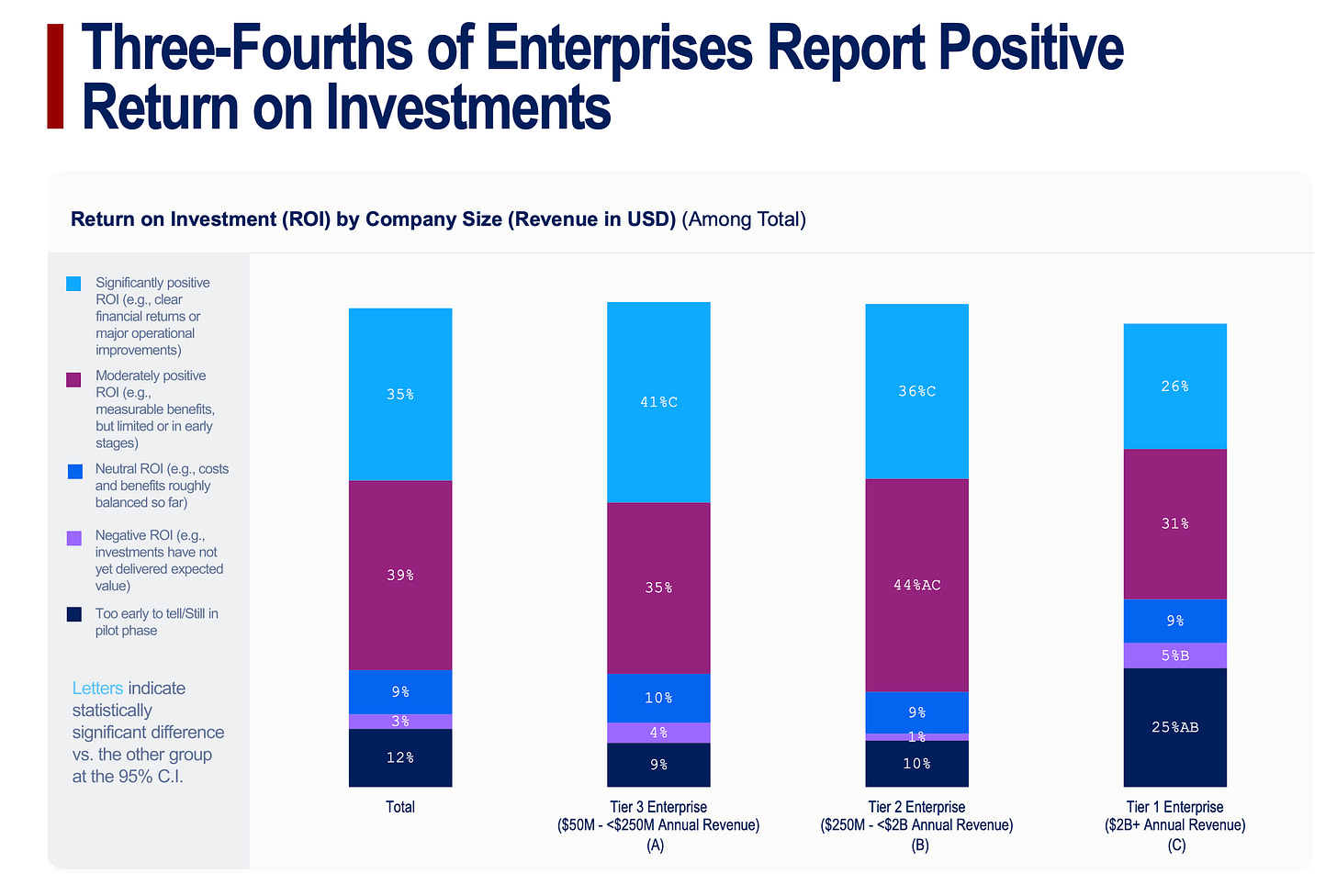
By early 2026, the conversation around AI’s business value had matured: companies recognized that true ROI comes not from headcount reduction, but from boosting productivity per employee and enabling growth with leaner teams. Studies from Wharton and McKinsey revealed that while 74% of businesses measuring generative AI ROI report positive returns, the real gains are seen in higher output per headcount, improved gross margins, and the ability to do more with the same resources. As Sabrina, a European tech leader, put it, 'the expectations for what you can do with headcount has definitely gone up,' highlighting a new standard for operational excellence in the AI era.





Trust Built on Transparency
Enterprises are embedding governance, auditability, and explainability into AI systems from day one, turning organizational knowledge into a structured asset to combat shadow AI and build trust.
Building trust in operational AI hinges on robust governance frameworks, security measures, and user-centric design that address the persistent risks of shadow AI and fragmented knowledge. Enterprises like Zuora and Salesforce have demonstrated that embedding governance from the outset—through processes such as three-stage AI governance reviews and immutable audit trails—not only prevents rogue AI deployments but also enables safe experimentation and rapid adoption at scale. As highlighted by Smartsheet’s research, the lack of integrated governance leads to widespread shadow AI use (with 70% of operations professionals relying on unapproved tools), creating significant security and compliance vulnerabilities that undermine organizational trust and effectiveness.
Transparency and observability are emerging as non-negotiable pillars for trustworthy AI, with leading organizations implementing end-to-end monitoring, reasoning traceability, and clear communication of AI’s capabilities and limitations. Companies like Affirm and Grov exemplify best practices by making AI decisions and their rationales accessible and human-readable, while Anthropic and Sandstone focus on seamless, intuitive user experiences that foster collaboration and reduce friction. This shift toward open, explainable AI not only accelerates incident resolution and compliance but also ensures that both employees and customers can understand, trust, and effectively interact with intelligent systems.
Treating organizational knowledge as a capital asset—designed, structured, and maintained—has become essential for unlocking AI’s full potential and mitigating the cognitive debt caused by fragmented information. The rise of enterprise graphs and vector databases, as seen in companies like Salesforce and Sandstone, enables durable, shareable, and actionable context across domains, supporting both compliance and operational excellence. By systematically capturing internal governance patterns, workflows, and decision rationales, organizations not only prevent knowledge silos and redundant work but also empower AI agents to act in alignment with company-specific standards, reducing the risk of misinformation and enhancing overall trust.
User-centric design is increasingly recognized as a linchpin for AI adoption and trust, requiring seamless integration into existing workflows, clear privacy controls, and recovery mechanisms that prioritize real-world ambiguity over the 'happy path.' As evidenced by Affirm, Anthropic, and Apple, the most successful AI deployments are those that balance convenience and 'magic' with transparency, consent, and the ability for users to easily opt out or escalate to human support. This approach not only reduces friction and customer fatigue but also addresses the growing demand for personalization, privacy, and control in AI-powered experiences.



The Human Bottleneck
AI’s real-world impact is capped by persistent skill gaps and the harsh reality that even minor reliability failures can derail adoption among non-technical staff and end users.
A persistent challenge in real-world AI deployment is the skill gap among average employees, especially middle managers who, despite not being tech-illiterate, require extensive support to effectively use and integrate AI tools. Carrie Tolorico observed that Gen X and older millennial managers often need significant handholding during AI demos, underscoring a gulf between tech-savvy teams and the broader workforce. This gap slows down adoption and integration, revealing that the promise of AI is often bottlenecked not by the technology itself, but by the readiness of those expected to wield it.
The gap between AI capability and real-world reliability remains a stark lesson for companies scaling AI in production. While AI-powered assistants like Humane Tech PIN and Rabbit R1 can perform tasks such as ordering food, their 10% failure rate—like sending orders to the wrong address—proves catastrophic in consumer settings where near-perfect accuracy is non-negotiable. This disconnect between what AI can do in controlled demos and what it must deliver in the wild highlights the underestimated challenge of achieving the reliability required for sustainable business value.