AI chaos or catalyst? why bolting bots to broken systems backfires—and how agentic AI is forcing companies to reinvent themselves
The gist
Bolting AI onto broken systems creates chaos, but companies reengineering their operations for agentic AI are seeing explosive gains—and rewriting the rules of business in the process.
What to know
- Superficial AI adoption often amplifies dysfunction, as seen with failed rollouts like Humane Tech PIN and Rabbit R1, instead of delivering real transformation.
- Agentic AI is driving a management revolution, with companies like Zapier and Notion appointing 'agent managers' and orchestrating networks of hundreds of AI agents across teams.
- AI-native organizations such as Vercel and Box are investing in robust context engineering, governance, and new leadership roles like Chief Agent Officer to unlock true ROI at scale.
AI Magnifies Dysfunction
Bolting advanced AI onto broken workflows amplifies chaos, exposing deeper organizational misalignments and leadership blind spots.
Superficial AI adoption consistently fails because it attempts to bolt powerful new technologies onto fundamentally broken or uncoordinated systems, without addressing the root dysfunctions embedded in organizational structures. As one 2025 analysis put it, 'Most companies are celebrating AI for its obvious talents... But they are applying this incredible new power source to the same broken system that created their problems in the first place.' Without a unified organizational context and a reimagined architecture for coordination—spanning composition, governance, and decision-making—AI cannot deliver transformative value, and instead amplifies existing inefficiencies.
Rather than eliminating friction, isolated AI tools often accelerate chaos by speeding up individual tasks while leaving legacy workflows and incentive structures untouched. This creates new bottlenecks—one team races ahead while the next is left scrambling, or AI-generated reports pile up with no one able to act on them. As seen in failed enterprise rollouts, such as the infamous Humane Tech PIN and Rabbit R1, incremental automation delivers only partial solutions—often 80% effectiveness—while the remaining gaps lead to catastrophic errors and widespread project failures.
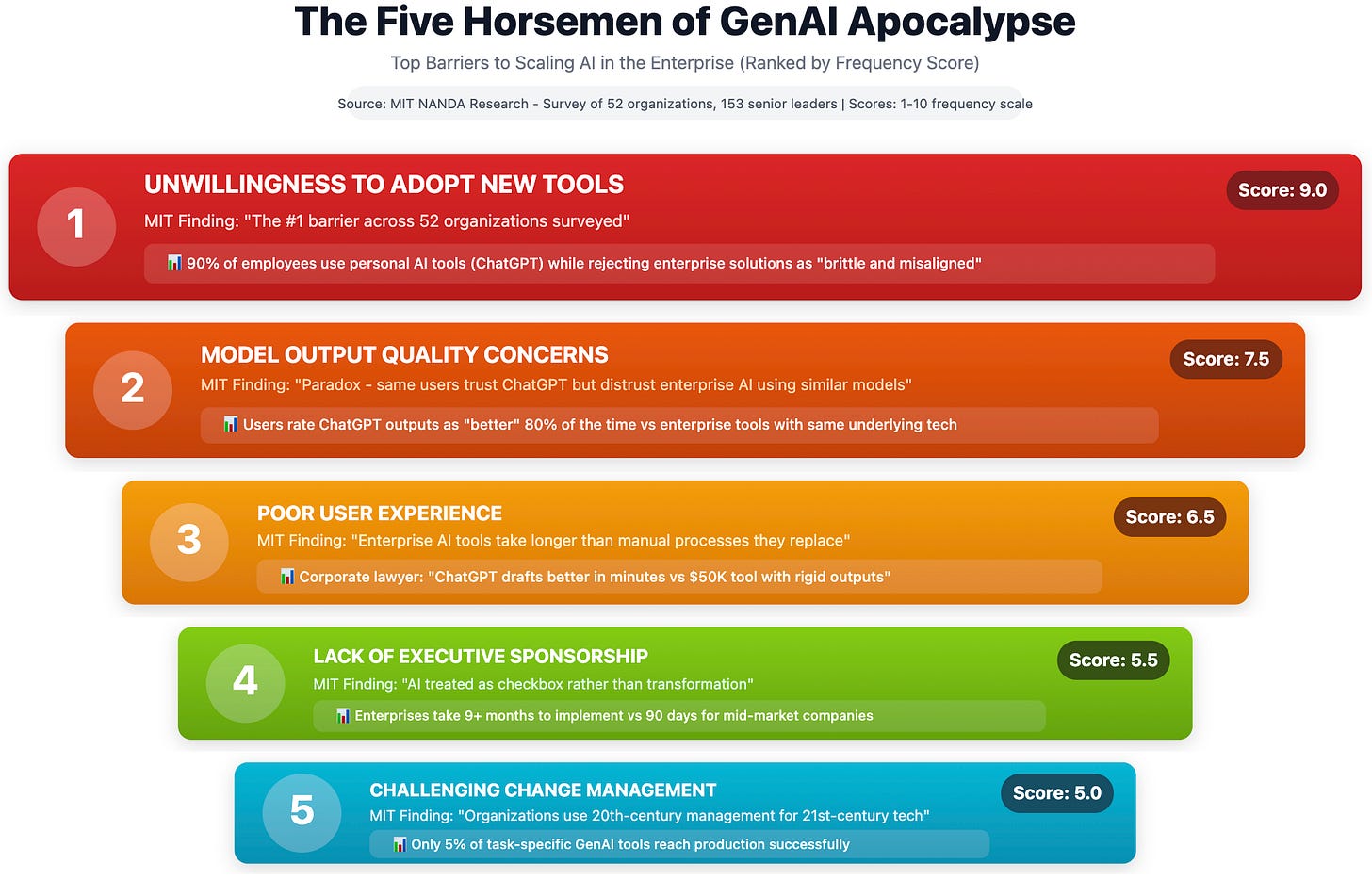
The root cause of these failures isn’t technological immaturity, but a fundamental misalignment between AI tools and real-world workflows. Employees routinely reject enterprise AI as 'brittle, overengineered, and completely misaligned with how we actually work,' a sentiment echoed in 2025 user feedback. This disconnect is compounded by a lack of executive understanding and sponsorship, with leaders often greenlighting AI initiatives they don’t fully grasp, and by underestimating the skill gap among average employees—especially middle managers—who require significant handholding to adopt new systems.
True AI-driven transformation demands a wholesale rethinking of business structures and workflows, not just layering AI atop existing processes. The Uber Freight example illustrates this: rather than helping truckers do their old jobs faster, the platform redefined roles, governance, and execution, making old skills obsolete and unlocking entirely new forms of coordination. As with the electrification of factories—a process that took decades and required reinventing operations—AI’s most dramatic impact will only materialize when organizations are willing to redesign themselves from the ground up.
By early 2026, it’s clear that many organizations still lack the foundational infrastructure and integration needed to realize AI’s full potential, with legacy systems posing a persistent barrier. Superficial adoption, often driven by vendor hype and a misunderstanding of what constitutes true product differentiation, leads companies to invest in tools that neither align with unique workflows nor deliver real ROI. As Denis Čahuk warns, the real competitive advantage lies not in being first to adopt AI, but in knowing where your differentiation lives and focusing AI to accelerate commodity layers while protecting your core.





System-Level Reinvention Wins
Transformative ROI emerges only when companies reengineer operations as interconnected systems, turning AI from a task accelerator into a driver of compounding business value.
A fundamental lesson emerging from early agentic AI deployments is that true operational transformation requires organizations to move beyond simply accelerating existing tasks. As illustrated by Jerrell's case study, the real value comes from reengineering operations into coordinated, system-level architectures where AI orchestrates interconnected functions—such as route planning, inventory, diagnostics, and customer data—rather than just making manual lookups faster. This holistic redesign, which reframes the goal from incremental speed to compounding business value, has led to outcomes like a 40% increase in upsell conversion and fewer repeat service visits, underscoring the imperative to use AI as a lever for end-to-end process innovation rather than mere task automation.
Rise of the Agent Manager
Agentic AI is redefining management, demanding new roles and skills focused on orchestrating networks of AI agents and elevating human judgment at decision points.
Agentic AI is fundamentally transforming both human and managerial roles, shifting the emphasis from direct execution to orchestration, oversight, and critical thinking. As organizations like Notion, Zapier, and Monday.com have discovered, success in the AI era depends less on having the most advanced models and more on the willingness to rethink authority, decision-making, and workflow design to align with AI capabilities. This evolution demands managers who can bridge the gap between AI tools and human work practices, ensuring that technology is not just layered onto old processes but integrated in ways that enhance both productivity and employee engagement.
The rise of agentic AI has catalyzed the emergence of new roles such as 'agent managers,' 'AI strategists,' and 'directors,' whose primary responsibilities revolve around orchestrating networks of AI agents, maintaining quality standards, and translating strategic intent into coordinated action. Companies like Zapier and Notion have restructured teams to include these positions, with leaders now tasked with monitoring agent performance in real time, iteratively tuning outputs, and fostering knowledge sharing across functions. This shift is mirrored in industry-wide trends, with McKinsey reporting a sevenfold increase in demand for AI fluency among managers and one in four companies appointing a Chief AI Officer, signaling a broad recognition that effective AI oversight is becoming a high-status, high-impact management function.
While AI agents automate routine coordination and execution, the value of human judgment, creativity, and accountability has only intensified. As AI-generated outputs proliferate, humans are increasingly responsible for defining precise goals, verifying outcomes, and making critical decisions at the boundaries of uncertainty—tasks that AI cannot fully automate. This repricing of human skills is evident in organizations like Pearson and Linear, where doctors and engineers are now primarily reviewers and validators of AI work, and in the evolving expectations for managers to set clear priorities, maintain feedback loops, and ensure that rapid iteration does not devolve into incoherent or misaligned outputs.
The rapid adoption of agentic AI is also forcing a reimagining of learning and career progression, as automation compresses traditional apprenticeship pathways and thins entry-level roles. To avoid eroding organizational capacity for long-term adaptation, companies must intentionally redesign learning architectures—shifting from accidental exposure to structured development of judgment and escalation skills. This is especially crucial as AI agents move from back-office support to front-and-center leadership roles, redrawing org charts and challenging workplace identities that once relied on credentials and gatekeeping, as seen in the rise of AI-native startups and the evolving responsibilities of product managers and marketers.



AI-Native by Design
True AI-native organizations are rebuilding from the ground up—investing in deep context engineering, federated governance, and outcome-driven cultures that embed AI at every level.
Building AI-native organizations demands a fundamental reimagining of both technical infrastructure and organizational workflows, moving far beyond simply layering AI onto existing processes. As echoed by leaders from Atlan, Zapier, and Box, this transformation requires robust context engineering—embedding AI agents with deep access to organizational data, workflows, and decision protocols—so agents can act autonomously and reliably. Companies like Vercel and Basis exemplify this shift, investing early in internal agent teams and context protocols, while Zapier’s orchestration of over 800 AI agents highlights the scale and technical foundation now required for true AI-native operations.
Robust governance frameworks have become non-negotiable as organizations scale agentic AI, with new roles such as Chief Agent Officer and Director of Machine Policy and Governance emerging to address the complexities of autonomous systems. Enterprises like JP Morgan, Goldman Sachs, and New Relic are adopting federated governance models, combining central oversight with distributed execution to manage risk, accountability, and compliance. This evolution is also driving the adoption of new financial metrics and portfolio management practices, as seen in Oracle’s use of Remaining Performance Obligations (RPOs), and is reflected in the rapid increase in governance platform adoption—from 14% to nearly 50% between 2025 and 2026, according to ModelOp.
The shift from project-based to product- and outcome-driven structures is now a hallmark of AI-native organizations, with companies like Zuora, Vercel, and Linear embedding AI agents across all functions and measuring impact through new metrics focused on speed, quality, and business outcomes. This transformation is not just technical but cultural: Atlan’s phased approach—forming AI taskforces, shifting hiring practices, and rethinking org charts—demonstrates how embedding AI skills and curiosity into every layer of the organization is essential. As Ramp’s CPO Geoff Charles notes, every function must now onboard and collaborate with AI agents, pushing companies to achieve high output with leaner, cross-functional teams.
Context engineering has emerged as a critical discipline, enabling AI agents to synthesize insights from diverse, often unstructured, data sources and deliver nuanced, context-aware outputs that drive real business value. Organizations like Box and Zapier stress the importance of onboarding agents with specific context and tools, while Vercel and MCP-powered enterprises leverage context graphs and model context protocols to ensure agents reflect organizational conventions and strategic priorities. This focus on context not only reduces coordination costs across teams, as Yue Zhao observes, but also unlocks competitive advantage by enabling AI to move from generic automation to deeply customized, outcome-oriented execution.





ROI Hinges on Alignment
Sustainable AI value depends on shifting metrics beyond pilots, aligning leadership around business-wide impact, and ruthlessly focusing AI on core differentiators—not vendor hype.
Unlocking ROI from agentic AI demands a shift from narrow, pilot-focused metrics to broader, business-wide impact measures—encompassing productivity, employee retention, and operational efficiency. As the Wharton study highlighted, 74% of businesses reported seeing ROI from generative AI when these expanded definitions were used, in stark contrast to the more modest figures found in studies focused solely on profit. This broader lens is especially critical for smaller companies, which, as Box CEO Aaron Levie observed, can more nimbly reengineer workflows and realize returns faster than their larger, less agile counterparts.
Leadership alignment and robust measurement frameworks have emerged as the linchpins for overcoming adoption plateaus and scaling sustainable AI value. Studies consistently show that VPs and above are more optimistic about AI ROI—81% report positive returns versus 69% of middle managers—underscoring the importance of getting senior leaders on the same page and communicating clear, outcome-focused goals throughout the organization. Without this alignment, as seen in both the Wharton and MIT studies, organizations risk stalling in the pilot phase, with middle management twice as likely to report it's 'too early to tell' if AI is delivering value.
The most persistent pitfalls in AI adoption are not technical but organizational and economic, fueled by vendor hype and a widespread failure to distinguish between core differentiators and commodity processes. Denis Čahuk warns that non-technical founders often treat all software as unique, missing opportunities to use AI for the 80% of problems that are already solved and should be automated. Sustainable ROI, he argues, comes from focusing top talent on what makes a company unique while using AI to accelerate everything else—ensuring that leadership is aligned around rapid iteration on true differentiators, not just early adoption.
By early 2026, leading organizations like Zapier, HubSpot, and Bank of America are demonstrating that scalable, sustainable business value from AI agents is unlocked through deep integration, rigorous governance, and a relentless focus on operational metrics tied to core business outcomes. Zapier, for example, orchestrates over 800 internal AI agents to automate everything from onboarding to customer support, tracking impact through productivity and customer KPIs rather than superficial usage stats. Meanwhile, Bank of America's 'Erica' handled over 3 billion customer interactions—equivalent to 11,000 full-time employees—while XPO Logistics cut transportation costs by 53% through AI-driven operational efficiencies, proving that the real ROI lies in transforming workflows, not just accelerating tasks.