AI chip packaging powers record gains—but margin squeeze and geopolitics cloud the boom
The gist
AI chip packaging is powering record-breaking gains for semiconductor giants, but looming margin squeezes and geopolitical crosswinds threaten to cool the rally.
What to know
- Advanced 3D packaging tech from TSMC, Intel, and OSAT leaders like Amkor and ASE is driving a seismic shift in AI chip performance and supply chains.
- Amkor posted a 27% revenue leap in Q1 2026 and expects AI packaging sales to nearly triple this year thanks to surging demand and global capacity expansions.
- Despite a 127% year-to-date stock surge for Lam Research and bullish analyst upgrades, margin pressures and US-China export controls cast a shadow over the boom.
3D Packaging Reshapes Chips
TSMC, Intel, and advanced equipment vendors are pushing chip packaging into a new era with 3D and glass substrate breakthroughs, making substrate suppliers and OSATs like Amkor and ASE critical to both performance and supply chain resilience.
By early 2026, the semiconductor packaging landscape is undergoing a transformative shift from traditional 2D lithography to sophisticated 3D packaging and glass substrate technologies, with TSMC's CoWoS leading the charge and Intel aggressively pursuing glass core substrates as the next foundational standard. This evolution is underpinned by specialized equipment providers like Besi and Kulicke & Soffa, whose hybrid bonding and thermo-compression bonding technologies are critical enablers for the complex interconnects demanded by next-generation AI chips.
The advanced packaging ecosystem's backbone includes OSAT giants ASE Technology and Amkor Technology, which not only manage massive volume production but also serve as strategic geopolitical hedges amid supply chain diversification away from China and Taiwan. While ASE maintains a strong market position with a Price to Earnings ratio around 33, Amkor's footprint in the United States and Vietnam grants it a strategic premium, reflecting investor confidence in its role as a steady compounder amid global tensions.
Taiwan's trio of leading IC substrate suppliers have emerged as pivotal players in the AI chip supply chain, buoyed by extended order visibility stretching two to three years due to the booming AI data center buildout and surging demand for HPC and networking chips. AMD’s expansion beyond CoWoS into embedded fan-out wafer-level packaging (EFB) further elevates the importance of these substrate manufacturers, positioning them as essential enablers of next-generation AI compute performance within an increasingly complex semiconductor ecosystem.
The global market for advanced packaging technologies, particularly fan-out panel-level packaging (FOPLP) and glass substrate packaging, is set for rapid expansion fueled by AI and high-performance computing demands, with industry leaders like Samsung and SK Hynix advancing to 5nm and 8nm nodes while actively engaging in supply and investment strategies. Complementing these technological strides, advancements in packaging standards such as JEDEC's SPHBM4 and surging memory demand are projected to propel the semiconductor market to an estimated $1.5 trillion by 2026, underscoring the critical role of packaging innovations in driving overall industry growth.

OSATs Anchor AI Supply Chains
ASE and Amkor’s geographic footprints and advanced packaging dominance are turning them into essential pillars for Western tech firms seeking both growth and geopolitical security as AI demand skyrockets.
ASE Technology and Amkor Technology stand as the dominant OSAT players in the AI-driven packaging market, with ASE leading global volume and Amkor serving as a strategic geopolitical hedge for Western supply chains. ASE trades at a solid P/E of around 33 with projected revenue growth near 12% annually, while Amkor commands a premium valuation due to its manufacturing footprint in the US and Vietnam, boasting nearly 9% revenue growth and 34% earnings growth potential. This positioning underscores Amkor’s critical role as Western companies seek to diversify supply chains away from China and Taiwan.
Amkor Technology has emerged as a standout growth story within the OSAT segment, fueled by AI-focused advanced packaging solutions. In Q1 2026, Amkor posted a 27% year-over-year revenue increase to a record $1.68 billion, driven primarily by its Advanced Products segment—which includes High-Density Fan-Out and 2.5D packaging platforms—accounting for 81% of sales. Management forecasts AI packaging revenue to nearly triple in 2026, supported by ramping new CPU programs and capacity expansions in Korea, Vietnam, and Arizona, positioning Amkor as a key player in the chiplet-based AI accelerator ecosystem alongside competitors like ASE and AMD. However, despite robust top-line growth, margin pressures persist amid competitive and cost challenges.
Semiconductor equipment suppliers are capitalizing on the AI packaging boom with advanced packaging becoming a critical growth driver. Lam Research anticipates over 50% revenue growth in 2026 from its advanced packaging business, fueled by high-bandwidth memory, AI accelerators, and chiplet architectures. This surge is mirrored by Applied Materials and KLA, with Applied Materials projecting similar growth and KLA expecting its advanced packaging process control revenues to rise from $635 million in 2025 to about $1 billion in 2026. Investor confidence is reflected in Lam Research’s 127% year-to-date share surge and a forward P/E of 50.78, well above the industry average.
Applied Materials is strategically positioned to lead the semiconductor equipment sector’s advanced packaging growth, leveraging a broad and diverse portfolio spanning chemical vapor deposition, etch, digital lithography, and e-beam metrology. Its strategic collaboration with SK hynix via the EPIC Center enhances its role in next-generation DRAM, HBM, and 3D advanced packaging development, reinforcing its competitive edge against peers like Lam Research and Camtek. Reflecting this, AMAT shares have surged 115.7% year to date, trading at a forward price-to-sales ratio of 11.26X, with fiscal 2026 and 2027 earnings growth estimates of 28% and 32%, respectively, underscoring strong investor confidence amid the AI packaging boom.

Equipment Stocks Ride AI Wave
Record-breaking rallies for Applied Materials, ASML, and Lam Research reflect investor confidence that AI-driven wafer fab spending is fueling a broad, structural upcycle across the semiconductor equipment sector.
By mid-2026, semiconductor capital equipment stocks, including industry leaders Applied Materials, ASML, and Lam Research, consistently hit record highs, propelled by robust AI-driven demand. This surge reflects a broader investor conviction that the AI boom is catalyzing unprecedented wafer fabrication equipment spending, underpinning the sector's growth trajectory.
Analysts from top firms like Cantor Fitzgerald, Citi, and Susquehanna have repeatedly raised price targets and sales forecasts for key semiconductor equipment companies, signaling sustained bullish sentiment. Notably, Cantor Fitzgerald's C.J. Muse and Citi's Atif Malik highlighted expanding wafer fab equipment investments through 2026 and beyond, while Susquehanna's Mehdi Hosseini cited positive channel checks as evidence of strong market fundamentals.
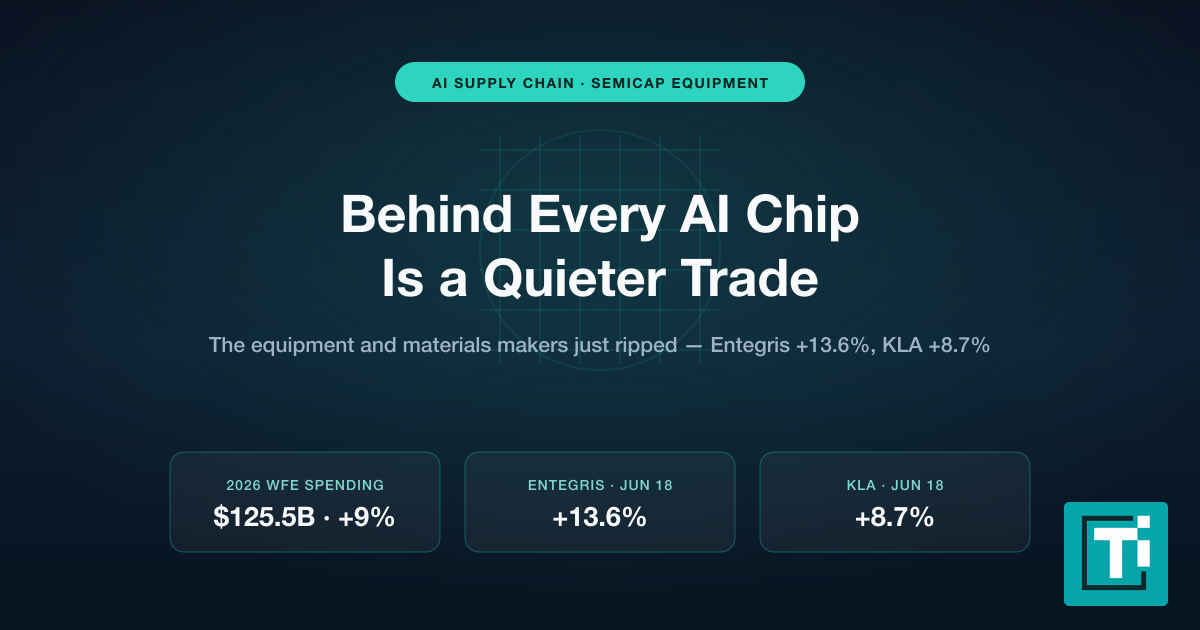
The rally in semiconductor equipment stocks extends beyond headline players to firms such as Entegris, KLA, and Semicap, illustrating a broad-based market enthusiasm for the infrastructure enabling AI chip production. This 'quieter trade' behind every AI chip underscores a growing recognition that semiconductor manufacturing capacity expansion is a critical, yet often overlooked, driver of the AI revolution.
Advanced Packaging Drives Revenue
Lam Research, KLA, and Applied Materials are seeing explosive growth as advanced packaging—especially 2.5D and 3D architectures—becomes the linchpin of next-generation AI hardware and a magnet for multi-billion dollar investments.
By mid-2026, advanced packaging technologies have emerged as a pivotal growth engine for semiconductor equipment providers, with Lam Research projecting over 50% revenue growth driven by AI accelerators, high-bandwidth memory (HBM), and chiplet-based architectures. This momentum is echoed by KLA, whose process control and inspection solutions for advanced packaging are set to grow from $635 million in 2025 to nearly $1 billion in 2026, underscoring the critical role of yield enhancement and defect reduction in sustaining multi-generational customer engagements.
Amkor Technology’s strategic focus on 2.5D packaging and high-density fan-out platforms is fueling robust AI-driven revenue growth, with advanced products accounting for 81% of sales and computing-related packaging revenues expected to triple in 2026. Their extensive pipeline—boasting over a dozen active 2.5D engagements—and capacity expansions across Korea, Vietnam, and Arizona position Amkor to capitalize on the shift toward package-level integration, particularly combining logic chips with HBM, which is becoming essential as transistor scaling plateaus.
Applied Materials is leveraging its broad portfolio spanning chemical vapor deposition, etch, physical vapor deposition, digital lithography, and e-beam metrology to drive innovation in 2.5D and 3D chiplet stacking, critical for next-generation AI computing infrastructure. Their collaboration with SK hynix at the EPIC Center to develop next-gen DRAM, HBM, and 3D advanced packaging, combined with the acquisition of ASMPT’s NEXX business, enhances their materials engineering capabilities, enabling the creation of larger, more energy-efficient AI accelerators and supporting a projected 50%+ growth in advanced packaging revenues in 2026.
Margins and Geopolitics Loom Large
Persistent margin pressures, fierce competition, and tightening US-China export controls threaten to undermine the AI packaging boom, exposing the sector’s vulnerability to cyclical risks and policy shocks.
Despite the robust surge in AI chip demand fueling growth in semiconductor packaging and equipment sectors, these industries grapple with persistent margin pressures and intense competition that threaten profitability. This dynamic is compounded by the sector's inherent vulnerability to cyclical downturns, which could destabilize gains made during the AI boom. By early 2026, analysts warned that even as companies ramp up production to meet AI-driven needs, the underlying cyclical nature of semiconductor markets remains a significant risk factor.
Geopolitical tensions, particularly the tightening US-China export controls, cast a long shadow over the semiconductor packaging and equipment supply chain amid the AI boom. These restrictions not only risk disrupting the flow of critical materials and technologies but also intensify uncertainty for industry players navigating a complex global landscape. As highlighted in mid-2026 analyses, such export controls could impede the sector’s ability to capitalize fully on AI-driven demand, underscoring the fragility of this high-stakes trade.