AI coding agents spur new supply chain security race
The gist
AI coding agents are rapidly amplifying software supply chain risks, forcing a high-stakes scramble for real-time, autonomous defenses that can outpace both human error and machine-driven exploits.
What to know
- AI coding agents now use open-source dependencies 50% more than human developers, multiplying the attack surface for slopsquatting and typosquatting exploits.
- The Axios NPM breach exposed 300GB of credentials and showed how a single compromised package can endanger millions of downstream users.
- New security models treat AI agents as revocable, least-privilege identities and combine tools like GPT-4 with real-time threat data to spot and contain zero-day threats faster than ever.
Autonomous AI, Autonomous Risk
AI agents now require real-time, self-adaptive governance frameworks as their autonomous actions outpace traditional security controls and human oversight.
Governing agentic AI behavior is evolving beyond traditional human-in-the-loop models to emphasize autonomous policy enforcement that prevents exfiltrative, destructive, or malicious actions without constant user intervention. As AI agents increasingly operate in background and cloud environments, reliance on user prompts becomes impractical, driving the need for finer-grained policies and self-learning governance capabilities that adapt based on historical decisions, ensuring safer autonomous operation.
Effective control of AI agents requires embedding security, privacy, and compliance checks directly into AI coding workflows, a strategy David Cross terms 'shifting down to the agents.' This proactive approach is supported by robust infrastructure pillars—dedicated threat intelligence feeds, trusted repositories, enforced build policies, and deliberate update timing—that collectively mitigate supply chain risks in the agentic era. However, policy enforcement alone is insufficient; without real-time detection and monitoring, policies become mere speed bumps easily circumvented by developers or agents.
The dynamic and autonomous nature of agentic AI expands attack surfaces at runtime in ways traditional security frameworks like STRIDE cannot fully address, necessitating new governance models such as CSA's MAESTRO and MITRE ATLAS. These frameworks decompose agent systems into layered components and map AI-specific adversary techniques, enabling more precise policy enforcement and risk assessment. Given that agents can autonomously modify code and dependencies within seconds—far faster than manual threat modeling—real-time governance enforcement remains a critical yet underdeveloped capability, with only 7% of organizations implementing it despite 73% adopting AI tools.
Agentic AI coding assistants autonomously selecting and installing packages without human review pose novel governance challenges that demand enforced controls such as lockfile pinning, sandboxed execution, and least-privilege identities to contain risky behaviors. This structural shift—from human to AI actors in dependency management—increases exposure to attacks like slopsquatting, where adversaries exploit AI hallucinations of package names to inject malware. Escalation and containment mechanisms must therefore adapt to agentic workflows by incorporating pre-install validation and approval gates, which have been shown to improve dependency safety threefold across ecosystems like PyPI and npm.
AI Dependency Blind Spots
AI coding assistants’ appetite for open-source code is outstripping existing validation tools, forcing continuous, automated monitoring of dependencies and new governance for opaque AI assets.
Grounding AI coding assistants with real-time, trusted software supply chain intelligence is essential to accurately map and govern AI dependencies, ensuring both security and compliance. Tools like Sonatype Guide exemplify this approach by integrating Sonatype's component and vulnerability data directly into developer workflows, such as IDEs and build pipelines, enabling AI tools to make informed, policy-compliant dependency recommendations rather than relying on guesswork or outdated information.
The surge in AI coding agents’ reliance on open-source software—approximately 50% more than human developers—significantly increases the complexity of supply chain governance. This expanded footprint introduces risks like hallucinated or non-existent package names, which attackers exploit through typosquatting, complicating the tracing and validation of dependencies and underscoring the urgent need for continuous, automated validation mechanisms within AI-assisted development environments.
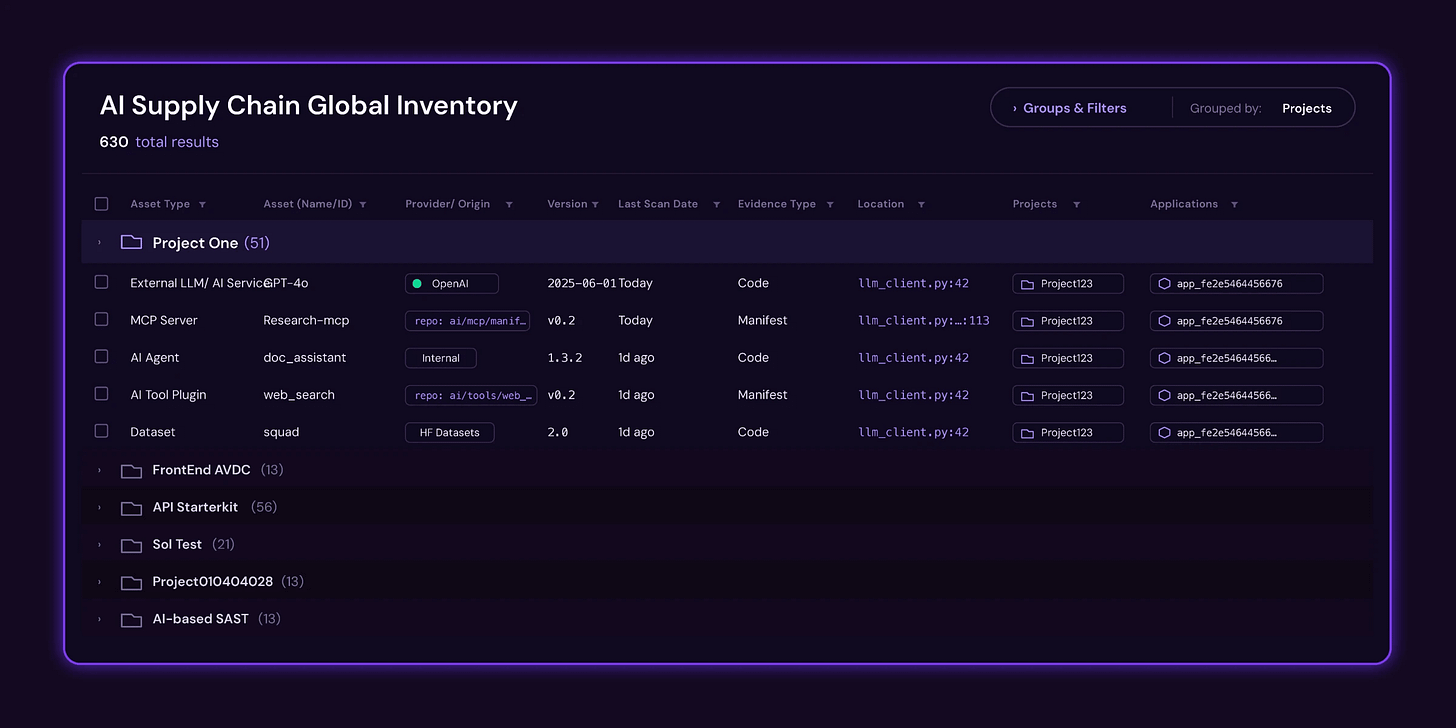
AI-driven software supply chains have evolved beyond traditional components to include foundation models, datasets, AI agents, and orchestration frameworks, all of which demand expanded governance frameworks. Unlike conventional software, these AI assets often resist inspection or validation by existing tools such as SCA or SBOMs, requiring security leaders to establish provenance, validate model integrity pre-adoption, manage runtime AI behaviors, and implement continuous lifecycle monitoring to effectively mitigate emerging risks.
Agent Skills: Hidden Attack Vectors
Malicious AI agent skills and sophisticated supply chain attacks are embedding persistent threats that evade both traditional detection and prompt-based defenses.
Agent skills within AI-driven supply chains have emerged as a critical vulnerability due to their elevated default privileges and ability to embed malicious behavior persistently, even surviving removal attempts. An audit of nearly 4,000 skills on Claw Hub revealed that over 12% harbored critical issues, including 76 malicious payloads, underscoring the widespread risk in these AI skill ecosystems. Compounding detection challenges, traditional natural language prompted methods fail to reliably identify such malicious skills, leaving supply chains exposed to stealthy compromises.
Supply chain attacks targeting popular open source libraries have surged by an order of magnitude, with attackers exploiting sophisticated social engineering tactics such as brand impersonation and prolonged collaboration to compromise maintainers. The Axios NPM package, boasting 100 million weekly downloads and 175,000 dependent packages, exemplifies the catastrophic downstream impact when a single widely used library is breached, enabling rapid propagation of malicious code to millions of users. Attackers often gain entry by stealing tokens from maintainers’ machines post-malware installation, allowing them to publish malicious packages under trusted accounts, as seen in the Axios compromise attributed to the team PCP.
Compared to prompt injection attacks, which are finicky and unreliable in exfiltrating data, supply chain compromises offer attackers a far more lucrative and scalable vector, exemplified by the Axios breach that resulted in the theft of 300 gigabytes of credentials. Defenders are responding by deploying layered mitigation strategies including tools like Socket for GitHub and Socket Firewall, alongside policies such as enforcing minimum release ages in package managers to avoid immediate integration of potentially malicious code. This evolving defense landscape is further empowered by AI-driven detection capabilities like GPT-4, which can analyze and flag suspicious code within minutes, shifting the asymmetry in favor of defenders who historically had to be perfect while attackers only needed one successful exploit.
AI’s dual-edged influence intensifies supply chain risks by enabling attackers to craft highly personalized phishing lures and automate subtle malicious code insertions, thereby increasing the frequency, ease, and concentration of attacks across open source and crypto ecosystems. The traditional trust model in open source, reliant on the scarcity and goodwill of developers, is undermined as large language models facilitate underhanded competitive tactics and sophisticated exploits, such as the $270 million hack of the DeFi platform Drift. This AI-driven escalation demands multi-layered, adaptive defenses as attackers leverage AI to amplify both technical and social engineering attack vectors.



AI-Driven Defenses and New Attack Surfaces
AI-powered detection and evolving agent communication protocols are reshaping defense strategies, demanding identity-centric controls and next-gen infrastructure to counter rapidly escalating threats.
AI-powered vulnerability detection is revolutionizing multi-layered defense strategies by enabling real-time, scalable analysis that goes beyond traditional vulnerability databases. Companies like Socket have harnessed models starting with GPT-4 to create what they describe as an "infinitely scalable army of interns," capable of catching sophisticated attacks within minutes by analyzing subtle code changes rather than just known vulnerabilities. However, human oversight remains crucial to validate AI findings and reduce false positives, ensuring a balanced approach between automation and expert judgment.
The rapid acceleration of AI-driven attacks, exemplified by Anthropic’s Mythos model which can autonomously discover and exploit zero-day vulnerabilities in mere hours, has exposed the limitations of traditional zero trust models. Experts now advocate for shifting security focus from broad perimeter defenses to protecting critical assets under the assumption that outer layers and endpoints are likely compromised. This adaptive approach prioritizes safeguarding crown-jewel resources and demands identity governance frameworks that treat AI agents as distinct, revocable identities with tightly controlled, least-privilege access to mitigate risks from their autonomous and sometimes unpredictable behaviors.
Emerging AI agent communication protocols such as the Model Communication Protocol (MCP) and agent-to-agent (A2A) interactions introduce complex new network security challenges that require advanced detection capabilities and updated infrastructure. Security leaders like O’Shea Bowens emphasize the need for next-generation routers and switches to support protocols like Verified Infrastructure Response Protocol (VIRP) and programmable data planes, while also adapting organizational processes to manage AI-specific network behaviors. This evolution underscores the necessity of integrating AI-aware detection with aligned KPIs to justify investments and effectively counter AI-accelerated threats.
The explosive pace at which AI uncovers software vulnerabilities—Microsoft patched 622 flaws in one month, and 360 Digital Security’s AI agent found nearly 1,000 unknown bugs—has outstripped traditional manual security reviews, making AI-native tools indispensable for real-time vulnerability triage and mitigation. This surge compels organizations to embed AI-powered security reviews early in DevSecOps pipelines, as seen with NowSecure’s integration of AI-driven analysis and continuous testing via GitHub Actions, balancing speed with rigorous human oversight. Additionally, evolving prioritization metrics now incorporate asset criticality and runtime context, moving beyond simplistic severity scores to manage risk effectively in AI-accelerated environments.