AI data centers fuel U.S. grid crunch, emissions surge
The gist
America’s AI data center boom is straining the power grid, triggering a surge in emissions and a scramble for quick, often fossil-fueled, fixes.
What to know
- AI data centers’ electricity demand in the U.S. is projected to leap from 2% to nearly 12% of total power use by 2030, requiring 100 gigawatts of new capacity—about as much as the entire power consumption of Thailand.
- Regulatory delays and grid bottlenecks are driving operators to onsite power solutions, with 72% of planned capacity relying on natural gas, risking a 20% spike in U.S. power sector emissions.
- Despite a $100 billion rush into innovative power and hybrid grid models, America’s slow energy infrastructure build-out and fragmented regulations are putting AI competitiveness at risk—especially compared to China’s rapid expansion.
AI's Power Appetite Surges
AI data centers are driving a 7-10x acceleration in U.S. electricity demand growth, straining grids, spiking prices, and forcing tech giants into costly, unproven power deals.
AI data center electricity demand in the U.S. is surging at an unprecedented pace, projected to grow from about 2% of total demand a few years ago to nearly 12% by 2030, equating to over 600 terawatt-hours annually—roughly the entire power consumption of a country like Thailand. This explosive growth, driven primarily by AI workloads and hyperscale facilities, is outstripping the grid's historical growth rate of 2% per year by a factor of 7 to 10, with annual increases of 15–20% expected through the decade. As PJM Interconnection highlights, this translates to adding the equivalent of a 'Baltimore's worth' of new electric customers every year, underscoring the scale and urgency of the challenge.
The rapid pace of AI data center construction and power demand is outstripping the capacity and expansion speed of existing electricity infrastructure, forcing a fundamental rethink of power strategies. Traditional AC grid power mismatches with data centers’ DC power needs, leading to inefficiencies and reliance on multiple conversions, which on-site fuel cell technology and dedicated generation projects aim to simplify. However, long lead times for new large-scale generation—such as nuclear plants or natural gas turbines—cannot keep pace with the 12–24 month build cycles of data centers, creating a critical supply gap that drives operators toward behind-the-meter and off-grid solutions despite the grid’s reliability advantages.
This infrastructure bottleneck is not only straining power grids but also inflating electricity prices and operational costs, with utilities in regions dense with AI data centers already experiencing significant price hikes and increased risk of rolling blackouts. The scarcity of power causes expensive AI chips to sit idle, translating into millions of dollars in lost value monthly. In response, hyperscalers like Microsoft, Google, and Amazon are investing heavily in dedicated power generation deals and innovative energy solutions, including fuel cells and small modular reactors, though many of these projects have timelines extending into the 2030s, leaving near-term demand unmet.
The scale of AI data center power demand is driving a structural shift in site selection and project planning, with power availability now the primary criterion for new developments. Companies like Equinix are planning years ahead, balancing a large pipeline of projects with the reality that only about half have secured sufficient power certainty. Meanwhile, the rise of multi-gigawatt mega campuses—some requiring dedicated 9+ gigawatt natural gas plants—and the growing reliance on behind-the-meter power solutions reflect an industry adapting to grid constraints by bundling compute with integrated power generation, a competitive advantage especially pronounced in North America compared to Europe’s more uncertain power sourcing strategies.


Regulatory Gridlock Stalls Progress
Permitting delays, local opposition, and transmission bottlenecks are forcing data centers off-grid, as regulatory inertia outpaces both technology and demand.
The expansion and modernization of the electric grid necessary to support AI infrastructure face profound challenges stemming from regulatory inertia, permitting delays, and transmission constraints. These bottlenecks create multi-year lead times—often five to seven years or more—for new transmission lines, with some interregional projects effectively stalled indefinitely, as noted by experts like Andy Lubershane and Jigar Shah who emphasize that the real shortage is in transmission capacity rather than generation. This regulatory sluggishness forces developers to reconsider traditional grid reliance, with many data centers turning to off-grid or hybrid power solutions such as solid-state fuel cells and dedicated gas-fired plants to circumvent the slow pace of grid upgrades.
Permitting delays and local opposition, including NIMBYism and outright bans on new data center developments in some states, compound the grid expansion challenge by creating social license hurdles that further slow infrastructure deployment. Despite federal efforts like the Energy Permitting Reform Act and the SPEED Act aiming to streamline approvals, state and local regulatory bottlenecks remain a significant drag, as highlighted by Google and other industry voices. This regulatory fragmentation leads to a paradox where communities resist new infrastructure even as energy prices rise, leaving data centers in limbo and sometimes resorting to temporary bridge power solutions that underscore the systemic dysfunction.
Supply chain constraints exacerbate the regulatory bottlenecks, with critical equipment like gas turbines and transformers facing multi-year backlogs that limit the speed at which new power plants and grid connections can come online. GE Vernova’s report of being sold out on gas turbines through 2030 exemplifies this hard cap on capacity expansion, which, combined with lengthy grid connection queues—where projects wait an average of over five years—creates a perfect storm delaying AI data center power availability. This mismatch between the rapid buildout timelines of data centers and renewables versus the glacial pace of transmission infrastructure risks stalling the AI energy transition and forcing reliance on fossil fuels during peak demand events.
Innovative regulatory approaches and technological solutions offer some hope to alleviate grid bottlenecks without massive new transmission builds. Concepts like 'non-firm' connection agreements and grid-enhancing technologies could unlock hundreds of gigawatts of stuck capacity, as the International Energy Agency suggests, potentially easing the backlog of over 2,500 GW of projects worldwide. However, the increasing penetration of variable renewable energy introduces new stability challenges, making regulatory and engineering innovation essential to prevent large-scale outages and ensure reliable power delivery to AI data centers amid this complex transition.



Onsite Power Revolution
Data centers are rapidly shifting to onsite and hybrid power solutions—like fuel cells and modular turbines—to bypass slow grid connections and meet AI’s unique energy needs.
The surge in AI data center demand has triggered a significant shift toward behind-the-meter and onsite power generation, driven primarily by prolonged grid interconnection delays and the unique power quality requirements of digital facilities. By late 2025, planned onsite power capacity had skyrocketed from under 2 GW to 48 GW, representing about one-third of all planned data center capacity, as operators seek to bypass multi-year grid connection timelines that can stretch up to seven years in states like Virginia. This pragmatic move addresses the mismatch between traditional grid AC power and the DC power needs of AI data centers, reducing reliance on complex conversion equipment and improving operational stability.
Fuel cells and other solid-state power technologies have emerged as pivotal onsite solutions tailored to AI data centers’ demands, offering faster deployment, real-time load following, and compatibility with zero-carbon fuels like hydrogen. Bloom Energy’s CEO KR Sridhar highlights that fuel cells simplify power conversion from a six-step grid process to a single step, likening current grid adaptations to 'building a faster horse and buggy when we really need a car for the AI era.' These technologies, alongside modular systems such as aeroderivative turbines and reciprocating engines from companies like GE Vernova, Cummins, and Nebius, form a diverse toolkit enabling scalable, resilient, and efficient onsite power generation.
Despite the critical role of the traditional grid, the future of AI data center power infrastructure is evolving into hybrid models that blend grid connection with significant onsite generation to overcome capacity constraints and transmission bottlenecks. Utilities are transitioning from sole suppliers to integrators and orchestrators within these hybrid ecosystems, facilitating a more flexible power landscape. This approach allows data centers to use onsite generation as a bridge or complement to grid power, optimizing cost, reliability, and sustainability amid regulatory and social challenges that delay grid expansion.
Natural gas dominates the near-term onsite power landscape for AI data centers due to its abundant supply, proven technology, and rapid deployment capabilities, despite raising significant environmental concerns. Facilities like the 4.5 GW Homer City Energy Campus exemplify this trend, potentially becoming major carbon emission sources. Hyperscalers prioritize power availability and speed over environmental goals, often entering multi-decade contracts that risk carbon lock-in. However, regions such as Texas and Louisiana may leverage geological advantages for carbon capture and storage to mitigate emissions, while longer-term strategies consider integrating renewables, battery storage, and emerging technologies to balance sustainability with urgent power demands.



Natural Gas Locks In Emissions
With 72% of new onsite power projects fueled by natural gas, AI’s energy boom risks locking the U.S. into higher emissions and undermining clean energy ambitions.
The rapid growth of AI data centers has intensified the tension between urgent power demands and environmental commitments, with many operators turning to onsite, off-grid natural gas generation to bypass lengthy grid interconnection delays. Companies like Bloom Energy advocate for resilient, captive power solutions such as solid-state fuel cells that can be deployed rapidly and integrate future zero-carbon fuels, offering a potential pathway to balance reliability with emissions reduction. However, the predominance of natural gas in behind-the-meter power—accounting for roughly 72% of planned projects including large-scale facilities like the 4.5 GW Homer City Energy Campus—raises significant concerns about carbon lock-in and undermines climate goals by potentially increasing U.S. power sector emissions by up to 20%.
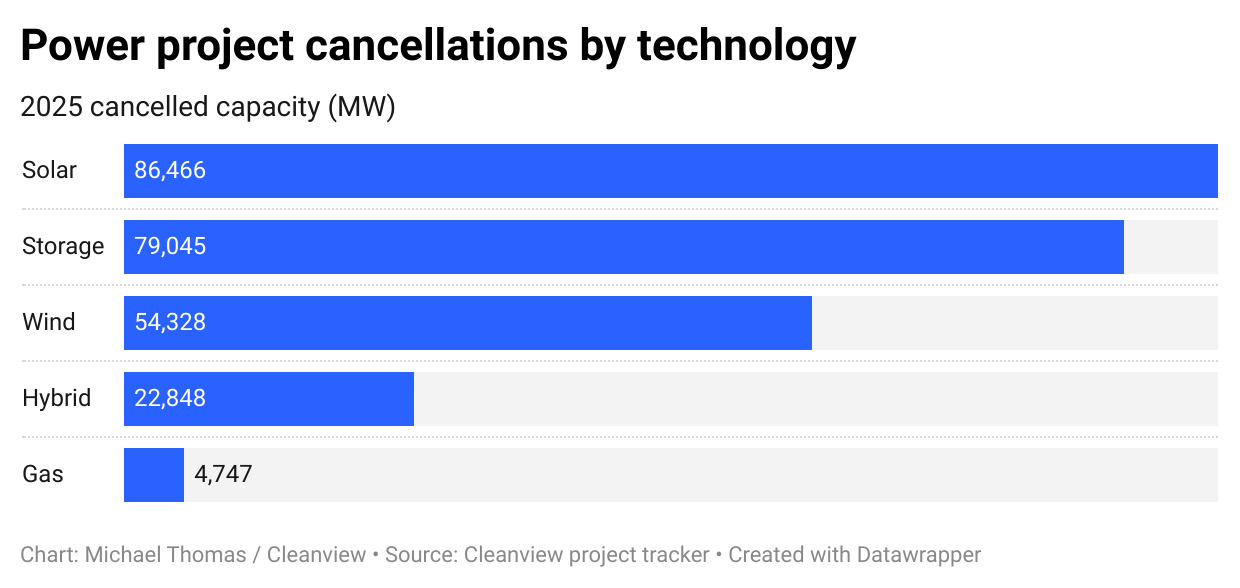
Policy and regulatory landscapes have exacerbated the challenge of aligning AI data center growth with clean energy goals, as evidenced by the cancellation of nearly 1,900 power projects in 2025—93% of which were clean energy—due to federal policies under the Trump administration that rolled back environmental protections and phased out clean energy tax credits. This contradictory stance fast-tracks data center construction for national security while simultaneously imposing roadblocks on renewable projects, leading to increased reliance on fossil fuels and higher electricity prices for consumers. States like Ohio and regions such as New York and New England have seen significant clean energy project cancellations, further complicating the transition away from fossil fuels amid surging demand.
The U.S. energy infrastructure struggles to keep pace with AI-driven demand due to prolonged permitting timelines, local opposition, and grid bottlenecks, forcing a tradeoff between rapid deployment and environmental stewardship. While nuclear power is projected to become a backbone of the energy mix within a decade, and renewables like solar and wind dominate new utility-scale capacity additions, the immediate need for reliable, 24/7 power leads to continued dependence on natural gas and coal, especially during extreme weather events. This dynamic is further complicated by political and regulatory challenges, including local NIMBYism and state-level resistance, which hinder the siting of new infrastructure despite widespread complaints about rising energy costs.
Contrasting approaches between the U.S. and China highlight the environmental and policy tradeoffs in energy sourcing for AI data centers. While China leverages a diversified energy portfolio with substantial investments in coal, renewables, nuclear, and gas—resulting in large spare capacity to meet surging demand—the U.S. is rapidly expanding gas-fired power capacity, now nearly tripling China's in development for data centers alone. This U.S. surge, driven by the need for speed and reliability, risks locking in decades of carbon emissions and volatile fuel costs, challenging climate commitments from major tech firms like Amazon and Microsoft, and fueling growing public opposition amid concerns over environmental and economic impacts.

Global Race for Grid Dominance
China’s streamlined grid expansion and mineral control are outpacing U.S. efforts, as American data centers grapple with years-long delays and dependence on foreign supply chains.
China’s streamlined grid expansion and mineral control are outpacing U.S. efforts, as American data centers grapple with years-long delays and dependence on foreign supply chains.
Policy Paradox Fuels Uncertainty
Federal fast-tracking of AI data centers clashes with regulatory barriers that stall renewables, driving up prices and deepening reliance on fossil fuels in critical tech hubs.
The United States faces a profound strategic challenge in maintaining AI leadership due to systemic energy infrastructure bottlenecks rooted in complex regulatory frameworks and entrenched local opposition. Unlike China, which has rapidly expanded its grid capacity—now tripling U.S. levels since 2010—and aggressively secured critical minerals and renewable energy assets, the U.S. struggles with multi-jurisdictional veto powers and NIMBYism that delay permitting and construction, often stretching timelines from months in China to several years domestically. This regulatory paralysis not only hampers the build-out of new generation capacity but also perpetuates reliance on foreign processing of critical minerals, such as rare earth separation outsourced to China despite domestic mining at Mountain Pass, undermining energy sovereignty essential for powering AI data centers.
The accelerating demand for AI data center power in the U.S.—projected to exceed 600 terawatt-hours by 2030 and drive roughly 100 gigawatts of new electricity demand—has exposed critical mismatches between rapid compute infrastructure deployment and sluggish energy capacity expansion. While tech giants like Microsoft and Google are investing in innovative solutions including nuclear plant restarts and small modular reactors, the lead times for new power sources, especially clean energy, remain long, often exceeding a decade, forcing a near-term reliance on natural gas turbines that face manufacturing backlogs and lock in fossil fuel dependence. This energy bottleneck is compounded by a severe shortage of transmission infrastructure, with high-voltage line construction plummeting and societal resistance to new lines (NIMBYism) further limiting grid expansion, pushing data centers toward behind-the-meter generation and hybrid off-grid solutions to meet urgent power needs.
The U.S. energy policy landscape reveals a strategic contradiction where federal efforts to fast-track AI data center construction coexist with regulatory and political barriers that stifle clean energy project development, leading to the cancellation of nearly 1,900 power projects totaling 266 gigawatts in 2025—93% of which are renewables. This paradox, exemplified by the Trump administration’s simultaneous promotion of data centers as national security priorities and imposition of roadblocks on solar and wind farms, risks escalating electricity prices and undermining grid reliability, especially in key data center hubs like Virginia, Ohio, and Indiana. Meanwhile, states like Texas benefit from a more agile regulatory environment that attracts AI infrastructure but face market pressures from rising electricity costs, illustrating the delicate balance between rapid capacity expansion, affordability, and environmental goals.
Maintaining U.S. competitiveness in the global AI race increasingly hinges on strategic coordination among hyperscalers, grid operators, and policymakers to address the unprecedented scale and uncertainty of data center power demand. Initiatives like PJM’s Critical Issues Fast Path, endorsed by state governors and the White House, aim to improve load forecasting, allocate costs fairly, and accelerate interconnection studies, reflecting recognition that data centers must bear their energy infrastructure costs to protect residential consumers from soaring prices. Simultaneously, private sector investments exceeding $100 billion, led by Amazon, Microsoft, Nvidia, and others, are driving innovative energy solutions including dedicated generation and fuel cells, signaling a shift toward integrated power-compute models that may define future competitive advantage amid regulatory complexity and infrastructure constraints.