AI data centers go modular for rubin racks
The gist
AI data centers are racing into a new era of modular, cable-less super-racks as NVIDIA, Supermicro, and Vertiv unleash vertically integrated platforms that shatter old limits on power, cooling, and deployment speed.
What to know
- NVIDIA’s Rubin system debuts in early 2026, fusing six silicon products into a seamless rack delivering up to 260 TB/s of interconnect bandwidth for advanced AI workloads.
- Supermicro’s liquid-cooled Data Center Building Block Solutions with Rubin tech boost throughput per watt 10x and slash AI token costs by 90% versus previous Blackwell systems.
- Vertiv, Schneider Electric, and new mega-factories bring rapid, plug-and-play power and liquid cooling to AI clusters as military and enterprise deployments hit new density records.
NVIDIA's Rack-Scale Revolution
NVIDIA is transforming AI infrastructure from discrete chips to fully integrated, cable-less rack platforms, locking in performance gains and redefining data center economics.
By early 2026, NVIDIA decisively shifted from marketing discrete AI components to delivering vertically integrated, rack-scale AI data center platforms with its Rubin platform. This system unifies six critical silicon products—including Rubin GPUs, Vera CPUs, NVLink 6 Switches, ConnectX-9 SuperNICs, BlueField-4 DPUs, and Spectrum-6 Ethernet Switches—into a modular, cable-less rack architecture designed for 220 kW-class deployments. This transition reflects NVIDIA’s strategic move to commercialize AI infrastructure as a complete 'factory' rather than isolated chips, enabling unprecedented interconnect bandwidths such as 3.6 TB/s per GPU and 260 TB/s per rack, thereby tightly coupling heterogeneous computing resources for advanced AI workloads.
NVIDIA’s vertically integrated approach extends beyond hardware to encompass software co-design, networking, and cooling innovations that collectively redefine AI data center efficiency and scalability. The Rubin platform’s Superchip packaging, which combines two Rubin GPUs and one Vera CPU interconnected via NVLink C2C, exemplifies this tight integration, while the BlueField-4 DPU transforms storage into an active participant in AI inference pipelines. Moreover, the platform’s modular MGX rack architecture introduces liquid cooling and dynamic power steering at the rack level, shifting reliability and serviceability considerations from individual nodes to the entire system, thus optimizing performance for always-on agentic AI and long-context models.
By controlling six silicon domains and integrating compute, memory, networking, and storage at the rack scale, NVIDIA creates significant competitive moats that raise switching costs and foster platform lock-in. This comprehensive control enables NVIDIA to define rack-level system specifications and supply chain pathways, making it difficult for competitors to disrupt performance or total cost of ownership by targeting single components. Early adopters like Nebius and CoreWeave validate this strategy, with CoreWeave’s June 2026 cloud deployment of the NVL72 Vera Rubin rack marking a milestone in real-world testing and accelerating adoption beyond traditional hyperscalers to emerging AI infrastructure providers.
The Vera CPU plays a pivotal role not as a conventional server processor but as a host and orchestration engine for complex AI workloads such as agentic AI and reinforcement learning, which require CPU-based environments to manage model actions, data coordination, and tool invocation. Coupled with the BlueField-4 STX and ConnectX-9 SuperNIC, this CPU-centric orchestration integrates tightly with NVIDIA’s AI Enterprise software stack and semantic data center design philosophy, positioning the Rubin platform as not merely faster hardware but as a holistic AI factory ecosystem that redefines how data centers operate at scale.
Supermicro’s AI Factory Leap
Supermicro’s validated, liquid-cooled rack systems slash AI deployment times and costs, enabling rapid scaling and flexibility for ever more complex workloads.
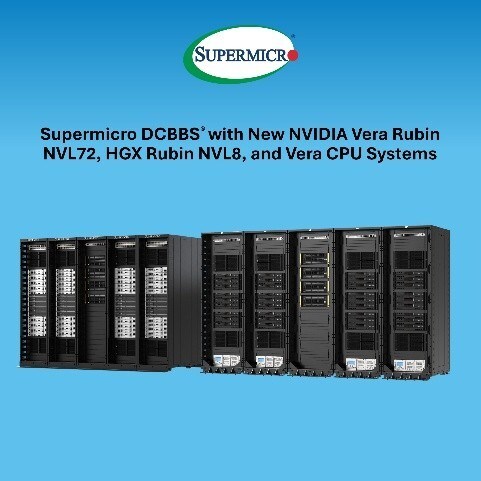
By early 2026, Supermicro has significantly accelerated AI data center deployment through its integration of NVIDIA’s Rubin platform into its liquid-cooled Data Center Building Block Solutions (DCBBS) infrastructure. This collaboration yielded next-generation systems like the Vera Rubin NVL72 and HGX Rubin NVL8, which deliver up to 10 times the throughput per watt and reduce token costs to a tenth compared to previous NVIDIA Blackwell solutions, marking a leap in both performance and cost-efficiency.
Supermicro’s modular and validated DCBBS infrastructure plays a pivotal role in scaling AI factory rollouts by mitigating integration risks and lowering total cost of ownership. Through pre-engineered rack solutions that seamlessly integrate power, cooling, and networking, the platform offers customers a streamlined path to rapid deployment, ensuring that complex AI data centers can be built with greater speed and reliability.
The new Supermicro systems are engineered for flexibility and high-performance AI workloads, supporting diverse configurations that combine Rubin GPUs, Vera CPUs, and next-generation x86 processors. Complemented by AI-native storage solutions that extend GPU memory, these systems are optimized for large-scale inference and Mixture-of-Experts models, enabling data centers to handle increasingly complex AI tasks with agility and scale.

Vertiv’s Mega-Factories Power Asia
Vertiv’s $3.25 billion Malaysian mega-factory and strategic acquisitions are supercharging regional supply chains and enabling near-instant deployment of high-density AI clusters.
Vertiv has strategically expanded its manufacturing and engineering capabilities to accelerate localized production of advanced power and liquid cooling systems essential for high-density AI data centers. Anchored by a robust financial position—with $5 billion in liquidity and a low net leverage of 0.2x following investment-grade ratings in early 2026—the company is scaling its footprint in key regions such as Malaysia and Italy to meet surging demand. This expansion supports an integrated platform that spans AC/DC power management, liquid- and air-cooled thermal products, and modular solutions, enabling faster, optimized deployments as infrastructure density intensifies.
In a bold move to enhance thermal management capabilities, Vertiv acquired ThermoKey and Strategic Thermal Labs, significantly boosting its in-house manufacturing and engineering capacity for liquid cooling solutions tailored to AI data centers. These acquisitions not only improve lead times and customization options but also position Vertiv to address the complex, integrated power and cooling demands of hyperscale and colocation projects, reinforcing its competitive edge in the AI-driven data center market. However, these expansions introduce execution and supply chain integration risks that the company must carefully manage.
By early 2026, Vertiv inaugurated a $3.25 billion, 236,000-square-foot mega-factory in Johor, Malaysia, designed to accelerate AI data center infrastructure deployment across the Asia-Pacific region by up to 85%. This facility integrates end-to-end manufacturing, assembly, and rigorous testing of advanced products like CoolChip coolant distribution units, Power Modules, Power Skids, and SmartRun overhead infrastructure, dramatically reducing on-site deployment times and risks. CEO Giordano Albertazzi emphasized the plant’s role in supporting Asia’s rapid AI infrastructure growth, creating up to 500 skilled jobs, and enhancing regional supply chain resilience amid rising demand.
Vertiv’s manufacturing expansion extends to Italy, where it plans to double chiller output at its Tognana campus by the end of 2026 and establish a new large-scale testing laboratory by early 2027. This site will evolve into a comprehensive hub for R&D, manufacturing, integrated testing, and customer engagement, including a Customer Experience Center and Vertiv Academy training facilities. CEO Albertazzi highlighted that AI-driven thermal demands necessitate faster deployment and uncompromising reliability, underscoring how these investments underpin Vertiv’s raised 2026 sales guidance and strengthen its position in the rapidly growing AI data center cooling market.


Schneider & NVIDIA Set the Standard
Schneider Electric and NVIDIA’s co-designed reference architectures integrate power and liquid cooling controls, setting a new benchmark for plug-and-play, high-efficiency AI data centers.
In a pioneering collaboration, Schneider Electric and NVIDIA have co-engineered the industry’s first AI infrastructure reference designs that seamlessly integrate power management with liquid cooling controls, dramatically enhancing deployment speed, efficiency, and operational reliability. Their NVIDIA GB300 NVL72 design supports high-density AI clusters consuming up to 142 kW per rack, specifically optimized for next-generation Blackwell GPUs, and provides comprehensive technical frameworks covering power, cooling, IT space, and lifecycle management to meet the rigorous demands of modern AI workloads.
These reference architectures empower data center operators to accelerate AI infrastructure rollouts without compromising uptime or performance, thanks to integrated plug-and-play control systems built on the MQTT protocol. Schneider Electric’s ongoing partnership with NVIDIA not only delivers validated, scalable, and energy-efficient solutions but also anticipates future AI growth by incorporating advanced digital twin simulations, enabling proactive infrastructure optimization and ensuring readiness for evolving AI demands.
Military AI Gets Modular Muscle
The Naval Postgraduate School’s adoption of NVIDIA’s DGX GB300, powered by Vertiv’s modular infrastructure, signals a new era of agile, defense-grade AI supercomputing.
In July 2026, the Naval Postgraduate School became a pioneering site for defense-focused AI infrastructure with the commissioning of NVIDIA's DGX GB300 supercomputer, a powerhouse featuring 72 Blackwell Ultra GPUs and 36 Grace CPUs. Donated by NVIDIA and supported by Vertiv, DDN, and VAST Data, this deployment not only advanced U.S. military AI capabilities but also underscored the critical role of integrated infrastructure in enabling such high-density computing environments.
This deployment transformed AI education and research for over 2,100 military students and faculty by powering vital applications like weather modeling, cybersecurity, and digital twin simulations, effectively positioning AI as a strategic backbone for modern defense operations. The initiative highlights how integrated AI data center solutions are not just technological upgrades but foundational shifts in operational readiness and strategic training.
Vertiv's role in delivering a modular, repeatable infrastructure solution—encompassing power, liquid cooling, rack systems, and lifecycle services—demonstrates how coordinated physical infrastructure can accelerate AI deployment while mitigating integration risks. As Vertiv CEO Gio Albertazzi emphasized, this approach creates a scalable foundation for future AI growth, illustrating a new standard for deploying complex AI systems efficiently.
The project also illuminates the often-overlooked challenge of meeting the substantial power and cooling demands of next-generation AI systems. Charlie Boyle, NVIDIA's VP of DGX systems, aptly noted that building an 'AI factory' requires a holistic engineering approach where compute, power, and physical infrastructure are seamlessly integrated, reinforcing that successful AI deployments hinge on more than just raw computing power.