AI data centers hit europe’s grid power Wall
The gist
The global AI data center boom is crashing into a wall of power grid delays, labor crunches, and regulatory roadblocks—threatening to stall a $2 trillion industry just as demand soars.
What to know
- Up to 40% of global AI data center projects face multi-year delays or cancellation due to power shortages, grid connection bottlenecks, and transformer waits stretching to 100 weeks.
- Acute labor shortages, especially for specialized electrical and HVAC roles, are forcing builders to embrace modular construction and offsite manufacturing to keep projects moving.
- States like New York are imposing bans and local opposition is rising, while hyperscalers and utilities scramble to invest over $500 billion annually in new power assets and efficiency strategies.
Power Grid at Breaking Point
AI data centers are overwhelming global power and cooling systems, driving a $2 trillion infrastructure arms race as grid delays and equipment shortages force operators into costly workarounds.
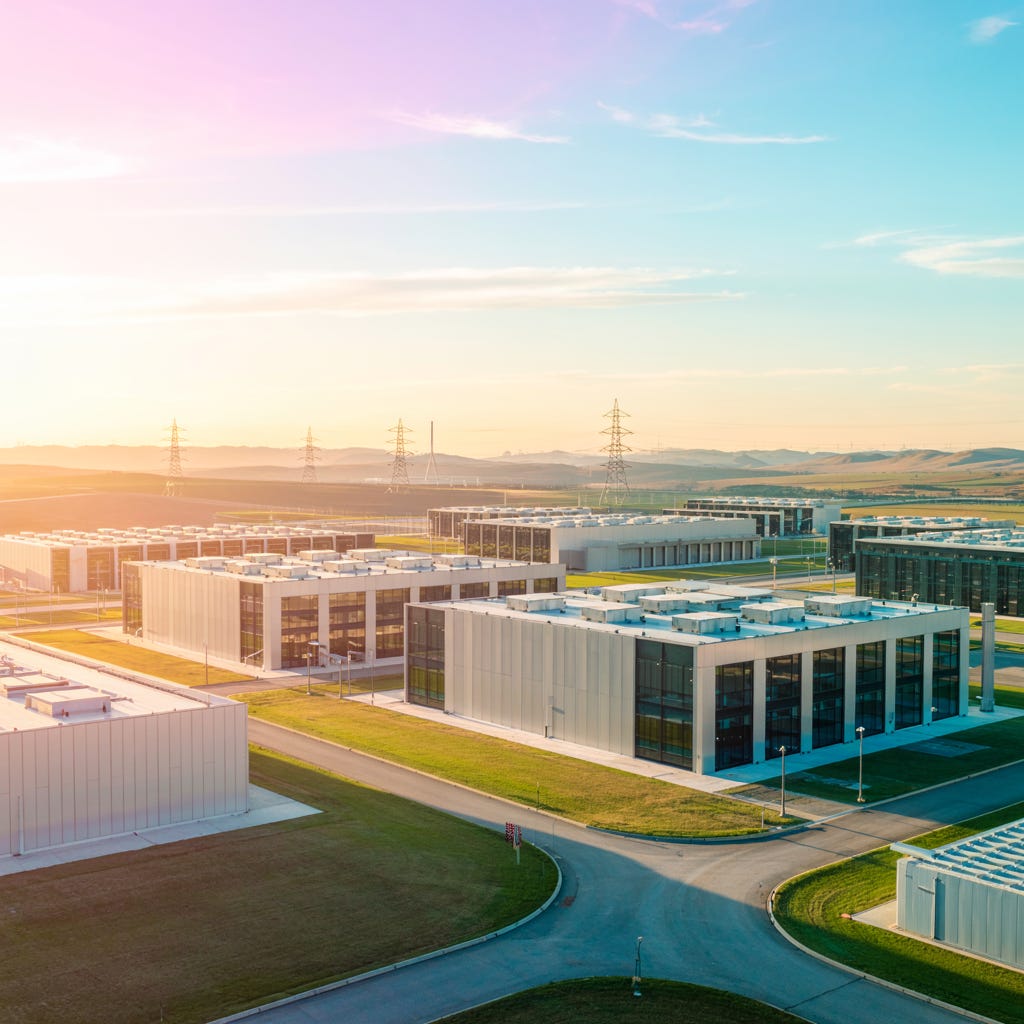
The global AI data center boom, marked by hyperscalers' aggressive giga-watt scale commitments such as Bridge Data Centers’ 2GW APAC pipeline, is pushing power grids and cooling infrastructures to their limits. This surge is intensifying water usage concerns and straining electrical grids worldwide, fueling a $2 trillion AI infrastructure race that is reshaping capital markets and investor sentiment amid growing fears of systemic bottlenecks.
Power availability has emerged as the decisive constraint in AI data center development, eclipsing capital access as the primary gating factor. Industry experts like DC Byte’s Colby Cox highlight that securing executable power, including grid capacity and onsite generation, is critical as multi-gigawatt projects become the norm and rack densities soar beyond 100 kW, necessitating advanced cooling solutions and fundamentally altering facility design.
The infrastructural bottlenecks are causing widespread project delays and cancellations, with Bernstein warning that up to 40% of the global AI data center pipeline is at risk through 2027 due to grid connection queues stretching 3-4 years in key markets like Northern Virginia and Frankfurt. Long lead times for critical equipment such as transformers—now at 80-100 weeks—compound these delays, forcing operators to pivot toward secondary markets, retrofits, or onsite natural gas generation despite environmental and performance challenges.
Beyond technical constraints, political and labor challenges are mounting, with states like New York imposing moratoria on data center development to protect grids and communities, while the shortage of skilled electrical workers hampers the construction of complex microgrids. BloombergNEF’s Mark Daly underscores that grid interconnection delays and fierce competition for labor and power equipment are intensifying risks, underscoring the multifaceted nature of the power and cooling crisis reshaping the AI data center landscape.



Labor Shortage Drives Innovation
A severe global shortage of specialized construction talent is fueling soaring costs and delays, pushing the industry toward modular builds and offsite manufacturing to keep pace with AI demand.
The unprecedented surge in AI data center demand is severely straining global construction capacity, with Turner & Townsend’s 2026 report revealing that over 70% of markets face tightening or overstretched contractor availability. This shortage is especially acute in mechanical, electrical, and plumbing trades, where nearly 90% of markets report critical labor deficits, driving up costs and escalating schedule risks in complex AI data center projects.
Filling specialized roles such as senior electrical leads, HVAC experts versed in cutting-edge cooling technologies, and commissioning engineers remains a formidable challenge, underscoring the technical sophistication of AI data centers. Lisa Duignan, director of global data centers at Turner & Townsend, highlights these positions as the most difficult to staff, reflecting the sector’s demand for niche expertise amid a tight labor market.
To counteract labor shortages and capacity constraints, the industry is increasingly embracing modular construction and offsite manufacturing, which can reduce onsite labor demand by 20-40%. Wannie Park, CEO of Pado AI, notes that prefabrication of electrical skids, cooling modules, and power rooms not only accelerates build times but also enhances quality, with modular designs now scaling beyond containerized units to 10-megawatt-plus configurations.
Beyond modularization, developers are deploying advanced BIM coordination and launching data center-specific apprenticeship programs to build a skilled workforce pipeline, while strategically expanding into secondary markets to manage capacity. However, these markets often lack specialist labor and supplier ecosystems, requiring careful evaluation of labor depth alongside land, energy, and network factors. Lisa Duignan emphasizes that success hinges on agility and capital to leverage standardized designs, offsite manufacturing, and supply chain partnerships to accelerate delivery schedules amid these constraints.
Local Pushback Reshapes Expansion
Community resistance and regulatory hurdles, intensified by resource and environmental concerns, are forcing data center builders to negotiate complex local politics and rethink where—and how—they expand.
Regulatory and community opposition, often fueled by concerns over power and water shortages, noise, and land use, have become formidable socio-political barriers slowing AI data center deployment despite soaring demand. States like New York have enacted moratoriums, including a one-year ban on data centers consuming 50 megawatts or more, while companies such as Blackstone have canceled projects in Virginia due to local resistance. These challenges are compounded by the necessity to locate data centers in remote areas to mitigate environmental impacts, which introduces costly and time-consuming requirements for resilient, long-distance connectivity infrastructure, further complicating regulatory approval and deployment timelines.
While permitting delays and community resistance are tightly linked to resource constraints, experts like Tony O’Sullivan emphasize that with strategic investments in power generation and cooling infrastructure, many regions can support data center growth without becoming bottlenecks. Such developments not only alleviate grid stress but also bring well-paid, skilled jobs and infrastructure improvements to often remote communities, suggesting that socio-political opposition may be mitigated through transparent local benefits. However, the debate increasingly revolves around who ultimately bears the costs of necessary infrastructure upgrades—power plants, transmission lines—and how the economic benefits are distributed, raising broader questions about equity and the long-term social contract surrounding AI infrastructure expansion.
Community backlash against AI data centers has intensified, exemplified by contentious projects near Utah’s Great Salt Lake where residents feel developments were 'railroaded through with basically no public consent.' This mistrust is exacerbated by perceived conflicts of interest, such as local politicians owning nearby real estate, which complicates regulatory processes and deepens skepticism. Reflecting the national scale of these tensions, data center development has emerged as a rare bipartisan issue in the U.S., uniting disparate political factions around concerns that transcend typical divides and signaling broader socio-political challenges that could shape the trajectory of AI infrastructure deployment.


New Playbook for AI Buildout
Startups, modular strategies, and utility M&A are redefining how AI data centers get built and financed, as investors and operators race to balance speed, resilience, and profitability in a volatile market.
Innovative mitigation strategies are reshaping the AI data center construction landscape, with startups like YC-backed Provision deploying AI-driven document analysis to enhance risk management and transparency in an industry long plagued by opacity. Concurrently, AI-powered project management and investment frameworks are becoming indispensable as stakeholders confront escalating delays and regulatory hurdles in the $2 trillion AI infrastructure race. Nate Garrison highlights this shift, emphasizing that investors now scrutinize not just capital expenditure but the speed and efficiency of monetization, underscoring a market increasingly focused on operational performance amid mounting complexities.
Modular and distributed data center construction is emerging as a pivotal strategy to meet evolving AI infrastructure demands, particularly with the anticipated pivot toward edge computing. As Matt Dmytryszyn notes, this next phase prioritizes smaller, geographically dispersed facilities closer to end users, which entails distinct infrastructure and investment profiles. Case studies like Sandersville demonstrate the efficacy of greenfield development combined with modular, movable components such as immersion modules and air-cooled units, enabling scalability and asset redeployment while maintaining operational continuity through phased build cycles and strong local partnerships.
The market dynamics underpinning AI data center expansion reveal a complex interplay between unprecedented capital expenditure and strategic investment shifts, particularly in utilities and infrastructure suppliers. Hyperscalers are funneling over half a trillion dollars annually into data center CapEx—representing 20% of sales and 60% of operating cash flow—forcing reliance on external financing. This surge has sparked a wave of utility M&A, exemplified by Constellation Energy’s $16 billion acquisition of Calpine and Blackstone’s $1 billion Virginia Power Plant deal, as companies favor purchasing existing power assets to circumvent supply constraints and capitalize on rising energy prices. Meanwhile, chipmakers, memory providers, and cooling system suppliers emerge as near-term winners, with Microsoft leveraging its enterprise relationships to convert compute spending into durable subscription revenue streams.
Despite abundant capital inflows, the AI data center sector faces a cautious outlook driven by technological uncertainty and sustainability concerns. Investors are increasingly prioritizing firms with robust, long-term business models capable of demonstrating revenue acceleration, high returns on invested capital, and labor productivity gains, as Meta and Microsoft report strong demand amid supply constraints. However, companies like Oracle and Cor Weave confront rising debt costs and financing challenges, exacerbated by the sector’s inherent risks including a looming 'maturity wall'—where typical 3-7 year investment horizons clash with rapid AI technology evolution—complicating project planning and risk assessment. Ultimately, the critical bottleneck remains the capital-intensive power and cooling infrastructure at the core of data centers, not merely site acquisition, underscoring the need for strategic capital deployment and operational excellence.