AI data centers ignite U.S. power grid crisis, forcing energy rethink and unlikely tech-utility alliances
The gist
America’s AI data center boom is colliding head-on with a creaky, bottlenecked power grid—forcing Big Tech and old-school utilities into unlikely alliances as the nation scrambles to keep the lights (and servers) on.
What to know
- AI data centers’ electricity demand is projected to triple from 4% in 2024 to nearly 12% by 2030, straining a grid already facing 7–12 year project delays.
- Tech giants like Microsoft and Google are teaming up with energy firms on hybrid, behind-the-meter, and nuclear solutions to bypass sluggish grid expansions and regulatory red tape.
- Despite $103 billion in utility investments, U.S. grid buildout lags far behind demand—risking price spikes, national security, and global AI leadership as China surges ahead.
Gridlock Paralyzes U.S. Energy
America's tangled regulatory maze and NIMBY resistance stall vital grid and mineral projects for a decade, leaving AI data centers stranded and U.S. competitiveness at risk.
By late 2025, the U.S. energy infrastructure was caught in a regulatory and procedural quagmire that severely hampered its ability to meet the surging electricity demand driven by AI data centers. Projects like the rebuilding of Baltimore's Francis Scott Key Bridge stalled for over a year amid layers of environmental reviews, community consultations, and legal challenges, illustrating a system where federal, state, and local regulations combined with NIMBY opposition create delays stretching infrastructure timelines to 7–12 years or more. This paralysis is compounded by a service economy entrenched in process management rather than production, with lawyers and consultants effectively managing the art of not building, while critical mineral processing capacity remains a chokepoint as domestic ores are shipped abroad for refinement, further undermining U.S. competitiveness.
The exponential growth of AI-driven electricity demand is outpacing the U.S. grid’s capacity expansion, with data centers consuming over 4% of national electricity in 2024 and projected to reach nearly 12% by 2030, according to McKinsey. Despite hyperscalers like Microsoft and Google investing in advanced nuclear and solar projects, these initiatives face decade-long timelines, leaving immediate energy needs unmet. This mismatch has led to regional electricity price spikes and power scarcity, especially in AI data center clusters, as utilities struggle to supply the rapidly increasing load, while the long lead times and intermittency issues of renewables prevent hyperscalers from fully decoupling from the grid.
The U.S. faces a critical bottleneck in grid transmission and interconnection capacity, with timelines for new transmission lines stretching from five to seven years, and in some cases effectively infinite due to interstate and regional regulatory hurdles. This slow pace clashes with the rapid deployment speed of data centers, which can come online within 12–24 months, creating a severe mismatch that throttles AI infrastructure growth. Additionally, social license issues have intensified, with some states imposing blanket bans on new data center developments and community pushback causing project cancellations years after announcements, highlighting the growing tension between local opposition and national energy demands.
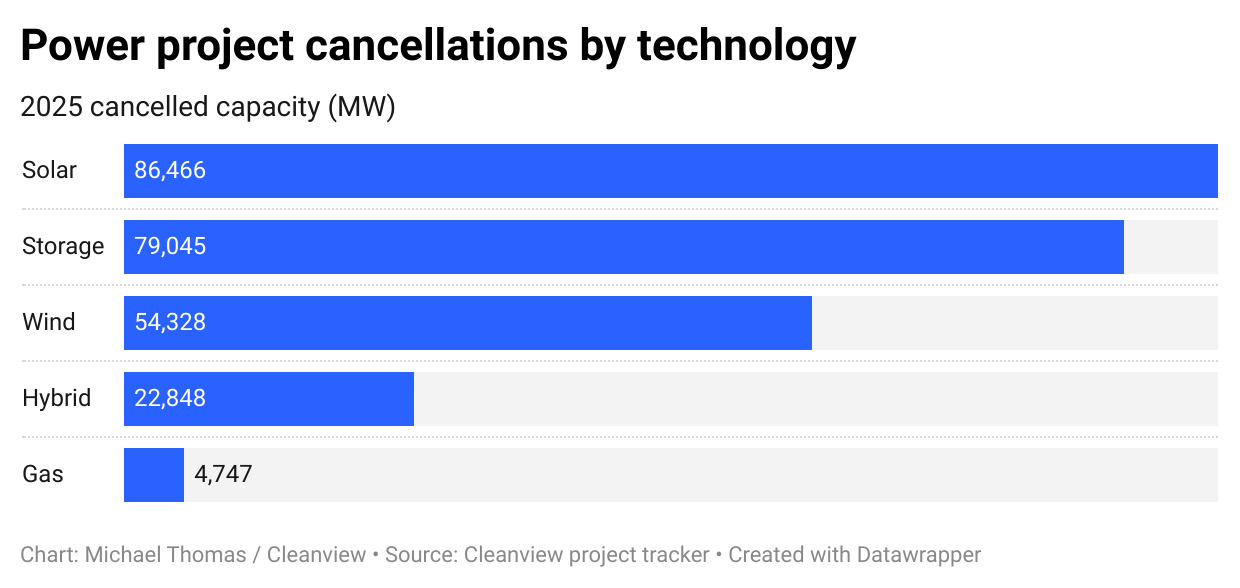
The year 2025 saw an alarming wave of cancellations totaling 266 GW of power projects—roughly a quarter of the U.S. current generation capacity—with 93% of these cancellations hitting clean energy initiatives like utility-scale solar, battery storage, and wind. Policies under the Trump administration, including tariffs, funding cuts, and the phasing out of clean energy tax credits, have exacerbated this trend, undermining the renewable buildout critical to meeting soaring AI demand. This contradictory stance—fast-tracking power-hungry AI data centers while simultaneously erecting barriers to renewable energy development—risks higher electricity prices, grid reliability issues, and ceding global competitiveness to countries like China, which aggressively expand their energy infrastructure with fewer regulatory constraints.





Permitting Reform Stumbles
Despite bipartisan legislative efforts and federal streamlining, entrenched local opposition and sluggish implementation continue to choke off energy infrastructure needed for AI's explosive growth.
Federal efforts to streamline energy infrastructure permitting have seen mixed progress, beginning with the Trump administration’s executive orders easing nuclear project approvals and freeing federal lands for data centers, aiming to bypass restrictive state and local regulations. However, persistent local bottlenecks and NIMBY opposition continue to slow buildout, underscoring the complex interplay between federal ambitions and decentralized regulatory realities that threaten to stall critical AI-driven infrastructure expansion.
Legislative and regulatory reforms have emerged as pivotal levers to accelerate transmission and pipeline projects vital for meeting surging AI energy demands. The bipartisan Manchin-Barrasso Energy Permitting Reform Act and the SPEED Act represent significant milestones, targeting interregional transmission planning and permitting overhauls to cut decade-long delays. Yet, despite these advances, actual implementation lags, with uncertainty around FERC Order 2020’s future and underutilized DOE authorities from the 2005 and 2007 Energy Policy Acts, reflecting a slow-moving policy environment grappling with entrenched political and procedural hurdles.
By early 2026, a notable political realignment has surfaced, as big tech companies—once promising unrealistic net-zero goals—now actively collaborate with the energy sector to address AI data centers’ massive power needs, including efforts to build or revive nuclear facilities. This pragmatic alliance is reshaping energy policy debates, with leaders from technology and industrial sectors poised to bridge divides between traditional utilities and emerging energy demands, signaling a more unified front to tackle infrastructure bottlenecks amid rising consumer and environmental pressures.
The urgency of expanding America’s energy backbone is underscored by massive utility investment plans, such as the $1.4 trillion spending spree through 2030 and Duke Energy’s record $103 billion growth strategy, which highlight the scale of infrastructure needed to support AI and electrification. Yet, these expansions face intense scrutiny over affordability, environmental impact, and siting challenges, fueling political debates that balance economic priorities against consumer costs and climate goals. As one analyst framed it, the future of transmission development may hinge less on emissions reductions and more on economic and geopolitical imperatives, demanding bold federal leadership akin to the highway system to overcome fragmented regulatory landscapes.



Tech and Utilities Join Forces
Big tech and legacy energy firms have forged pragmatic alliances, rapidly deploying behind-the-meter and hybrid power solutions to bypass grid delays and keep AI data centers online.
By early 2026, the once adversarial relationship between legacy energy firms and big tech companies has transformed into a strategic alliance driven by the soaring power demands of AI data centers. This collaboration has prompted tech giants to engage deeply with energy infrastructure realities, moving beyond earlier net-zero promises that underestimated actual consumption. As one analyst observed, 'They've become really smart about energy very quickly,' signaling a hopeful shift toward more pragmatic and constructive energy dialogues between industrial and technology leaders.
Williams Companies exemplifies industry innovation by investing over $5 billion in behind-the-meter power solutions and hybrid grid architectures that directly serve hyperscale AI data centers. Leveraging its vast 33,000-mile natural gas pipeline network, Williams circumvents traditional grid expansion delays—which can stretch from six to eight years—by delivering natural gas power generation units onsite. Their Socrates project, a 500MW facility in Ohio launched in early 2025, showcases this approach by enabling rapid deployment of AI infrastructure power needs within two years, a timeline previously deemed 'unheard of.'
The broader energy sector is embracing hybrid power architectures that blend grid connectivity with behind-the-meter generation to overcome the severe bottlenecks in transmission capacity buildout, which currently take five to seven years or more. This hybrid approach not only addresses the 'infinite years' delays in new transmission line construction but also mitigates social license challenges, such as state bans and community pushback against new data centers. As highlighted by Power HF and Silicon Valley 101 forums, despite higher costs, behind-the-meter solutions are favored for their speed and modularity, marking a critical evolution in powering AI infrastructure.
Enbridge's strategic partnerships with tech giants like Google, Amazon, and Meta illustrate the industry's pivot toward integrated energy solutions combining traditional gas pipelines with renewable solar projects. Their development of massive solar farm campuses, such as the Sequoia solar farm in Texas and a Meta data center complex near San Antonio, exemplifies how hybrid energy portfolios are being deployed to meet AI data center demands while sidestepping conventional grid delays. CEO Greg Ebel emphasized, 'In all of our businesses... we are hooking up or building projects for data centers for AI,' underscoring the sector's commitment to innovative, scalable energy delivery.


Transmission Buildout Hits Snags
Even as high-voltage line construction inches forward and regional mega-projects are approved, political interference and slow timelines keep America’s grid dangerously behind AI’s demands.
The U.S. transmission grid has seen a modest resurgence in high-voltage line construction, with mileage jumping from a mere 55 miles in 2023 to approximately 880 miles in 2024, largely completing projects initiated over a decade ago. This slow progress underscores persistent political and regulatory hurdles, despite key policies like FERC Order 2023 mandating 20-year transmission planning. As one analyst lamented, the nation’s transmission buildout remains 'embarrassingly' inadequate given the doubling demand driven by AI data centers and renewable integration, with future momentum uncertain amid shifting federal priorities.
Major regional transmission projects signal a strategic pivot toward a clean energy future capable of supporting hyperscale AI facilities. The Southwest Power Pool’s approved 765kV backbone, estimated at $8.6 billion, exemplifies this trend by connecting abundant Great Plains renewables to new industrial and data center loads. Similarly, MISO, PJM, and ERCOT are planning their own 765kV lines—the highest voltage AC transmission in decades—while long-range plans in California, New York, and New England aim to add thousands of miles of new lines annually. However, political interventions, such as the DOE’s cancellation of the Greenbelt Express loan guarantee, highlight ongoing challenges despite broad commitment to infrastructure expansion.
Williams Companies is pioneering an innovative infrastructure model that bypasses traditional grid delays by directly integrating natural gas power generation with hyperscale AI data centers. With over $5 billion invested, Williams leverages its extensive 33,000-mile pipeline network and gas turbine operations to deliver behind-the-meter power solutions in under two years—dramatically faster than the typical six to eight-year grid expansion timeline. Projects like the 500MW Socrates facility in Ohio and revived pipeline initiatives in the Northeast, including the Constitution Pipeline, underscore Williams’ strategy to meet AI-driven energy demand with speed and reliability, even amid regulatory complexities.
The scale and ambition of infrastructure investments to support the AI era are reaching unprecedented levels, with industry giants and investment firms mobilizing record capital. Duke Energy’s $103 billion five-year plan targets 20 gigawatts of diverse power generation and grid modernization explicitly designed to onboard hyperscale AI customers like Amazon and Microsoft rapidly. Meanwhile, EQT’s $4 trillion AI infrastructure strategy, including EdgeConneX’s plan to add over 10 gigawatts of global data center capacity, reflects a coordinated push to build the physical backbone essential for AI’s exponential growth. Central to these efforts is the urgent need for permitting reform, championed by figures like Senator Alan Armstrong, to accelerate project approvals and unlock the full potential of U.S. energy resources.

Modernization Faces Old Hurdles
Breakthroughs in grid tech and huge capital injections are undermined by supply chain gaps and a fragmented system, threatening reliable power for AI even as new financing models emerge.
By early 2026, innovations in transmission technology such as robotic cable coating—exemplified by a German company deploying robots to reduce electricity loss—are addressing long-standing inefficiencies in energy delivery. However, the energy grid still suffers from critical bottlenecks like transformer shortages and a fragmented approach that fails to integrate generation, transmission, and consumption seamlessly, a gap that threatens to undermine the reliable power supply essential for AI data centers.
The surge in AI-driven data center demand has catalyzed unprecedented capital flows, including a landmark $100 billion investment round led by Amazon, SoftBank, Microsoft, and Nvidia, which is fueling infrastructure buildout with a focus on energy supply and storage. Innovative financial models are emerging where hyperscalers directly fund electric generation—such as partnerships with Williams Companies—to insulate retail consumers from inflationary electricity costs, reflecting a strategic shift in how AI energy needs are financed and operationalized.
Grid modernization is increasingly reliant on advanced technologies and regulatory innovations to unlock capacity without costly new transmission lines; for instance, non-firm connection agreements could free up around 900 GW globally, while grid-enhancing technologies promise another 900 GW. Yet, the slow pace of infrastructure development—where transmission projects can take 5 to 15 years—creates a backlog exceeding 2,500 GW, including 150 GW of data centers, risking delays in AI infrastructure deployment and underscoring the urgent need for smarter, faster grid solutions.
Battery storage technologies are evolving from mere backup systems to integral components of AI data center power architectures, as demonstrated by Ampace's AI-ready PU Series battery platform which uses semi-solid cell technology to maintain stability during rapid load changes. Complementing this, AI-driven grid resilience solutions like Overstory leverage satellite data to manage vegetation and prevent fires, a major cause of outages, with utilities rapidly adopting these tools, signaling a transformative convergence of AI and energy tech that enhances reliability and scalability for gigascale AI infrastructure.




China Surges, U.S. Stalls
While U.S. energy projects languish in red tape and policy contradictions, China races ahead in grid expansion and mineral control, threatening America’s AI and national security ambitions.
The United States faces a crippling regulatory labyrinth that delays critical energy infrastructure projects by 7 to 12 years, in stark contrast to China’s rapid 18-month development cycle. This systemic paralysis, fueled by overlapping federal, state, and local reviews combined with stakeholder veto powers, not only hampers timely upgrades but also undermines national security and global AI leadership, as exemplified by the year-long inaction following the 2024 Francis Scott Key Bridge collapse. Meanwhile, China capitalizes on this inertia by swiftly securing critical minerals and expanding energy processing capacity, betting that the U.S. cannot overcome these entrenched obstacles within the urgent timeframes demanded by the AI era.
Amid surging AI-driven electricity demand, the U.S. government underscores energy dominance as a cornerstone of national security, with the White House citing energy 23 times in its national security plan and emphasizing the strategic imperative to supply allies and reduce reliance on adversaries. However, contradictory policies under the Trump administration have led to the cancellation of 1,891 power projects in 2025—93% of which are clean energy—threatening the sustainable energy supply needed for AI infrastructure. While data centers are fast-tracked as national security assets, simultaneous roadblocks on solar and wind projects risk higher electricity prices and slow AI development, revealing a policy tension between immediate AI infrastructure needs and long-term clean energy goals.
By early 2026, China’s aggressive energy investments have propelled it to generate 10,000 terawatt hours—40% more than the U.S. and EU combined—bolstered by massive expansions in coal, renewables, nuclear, and battery capacity. This diverse fuel mix has created significant spare capacity, positioning China to challenge U.S. dominance in AI data center leadership, especially as the U.S. grapples with power bottlenecks and a policy shift from decarbonization toward supply security. Meanwhile, the U.S. remains hamstrung by political and regulatory fears around nuclear and solar energy, even as it faces critical energy scarcity exacerbated by dependence on Chinese-controlled solar panel supply chains, threatening its ability to maintain global AI competitiveness.
The environmental footprint of AI’s energy consumption is staggering, with just eleven gas-powered AI data centers in the U.S. potentially emitting up to 129 million tons of CO2 annually—surpassing the emissions of entire countries like Morocco and Jordan. The rapid escalation from 4 GW to nearly 100 GW of behind-the-meter gas power capacity in three years underscores the environmental challenges of current U.S. energy strategies for AI infrastructure. Even if actual emissions fall short of projections, they remain significant enough to outpace nations such as Norway, raising urgent concerns about reconciling AI’s explosive growth with sustainable energy policies.
Companies like Enbridge are strategically expanding North American energy infrastructure to meet AI’s surging power demands, integrating renewable projects alongside gas pipelines to serve hyperscale data centers operated by Google, Amazon, and Meta. This bi-national energy delivery network, moving nearly one-third of North American oil and 20% of U.S. natural gas across 43 states and eight Canadian provinces, strengthens regional energy security amid shifting geopolitical dynamics, including reduced risk premiums following Middle East conflicts. Enbridge’s role exemplifies how infrastructure investments directly underpin national security and global AI leadership by ensuring reliable, diversified energy supply amid intensifying global competition.