AI debt frenzy raises credit crisis fears
The gist
Wall Street is sounding alarms as hyperscalers fuel a $695 billion AI infrastructure binge on the back of soaring debt, raising fears of a tech-driven credit crisis echoing the 1840s Railway Mania.
What to know
- Amazon, Google, Meta, Microsoft, and Oracle are driving AI capex toward $870 billion in 2027, with debt and $1.9 trillion in hidden liabilities piling up fast.
- Credit markets are flashing warning signs—AI-linked bond spreads are widening and credit default swaps on major players are at multi-year highs amid Fed rate hikes.
- Regulators warn concentrated, leveraged AI bets could trigger a meltdown worse than the dot-com bust, as collapsing free cash flow and market concentration amplify systemic risks.
AI Mania Echoes Railway Bust
Hyperscalers’ trillion-dollar AI infrastructure spree mirrors the 1840s railway bubble, where overcapacity and leveraged bets fueled innovation but left investors exposed to historic collapses.
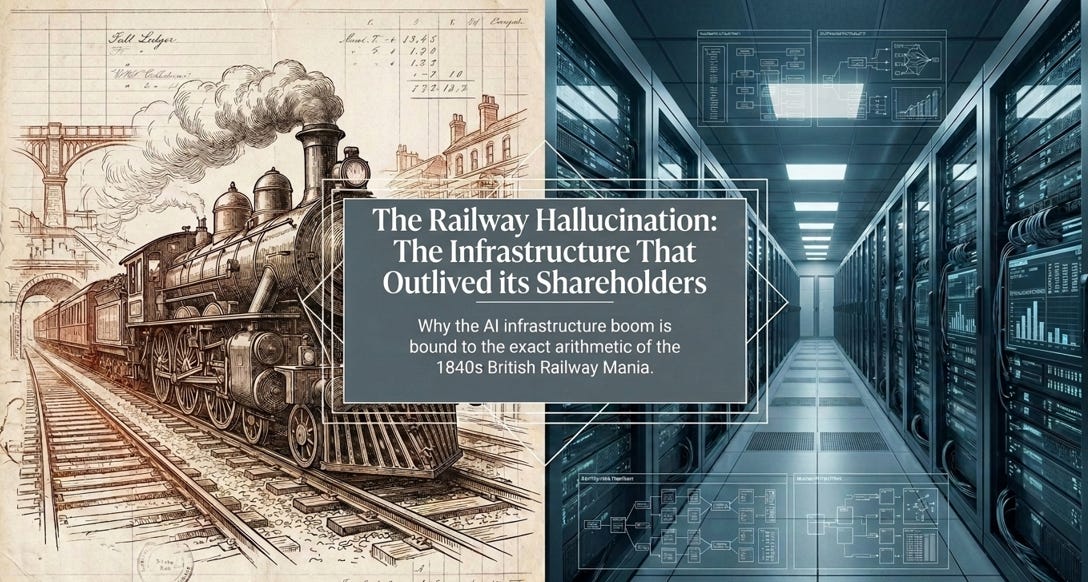
The 2026 AI infrastructure boom strikingly mirrors the 1840s British Railway Mania, where massive real-asset investments powered transformative technological revolutions but simultaneously crushed shareholders under systemic overcapacity and leveraged financial structures. Hyperscalers like Google and Amazon are leading a trillion-dollar spending spree on AI infrastructure, reminiscent of the railway companies' frenzied capital raises, which has fueled soaring investor anxiety and looming skepticism over returns on investment. This historical parallel underscores how even groundbreaking innovations can be shadowed by market fragility and financial overextension.
Investor jitters and financing gridlocks in 2026 echo the panic and market vulnerabilities that defined Railway Mania, exacerbated today by energy grid bottlenecks and tightening regulatory crackdowns. These systemic risks reveal a fragile ecosystem where hyperscalers’ aggressive infrastructure build-outs collide with strained capital markets and regulatory scrutiny, creating a precarious environment ripe for sudden corrections. The combination of overcapacity, leveraged financing, and external pressures paints a cautionary tale of how rapid technological booms can unravel under their own weight.

Debt-Fueled AI Arms Race
Tech giants are mortgaging their futures with record debt and $1.9 trillion in hidden obligations, pushing capital expenditures to unsustainable levels and amplifying financial fragility.
Hyperscalers like Amazon, Alphabet, Meta, Microsoft, and Oracle are undertaking an unprecedented AI infrastructure spending spree, with combined capital expenditures projected to soar from about $695 billion in 2026 to nearly $870 billion by 2027. This vast investment scale is reshaping their financial strategies, as these companies have shifted from relying primarily on cash reserves to increasingly financing their AI buildouts through debt issuance, having already raised over $194 billion in investment-grade bonds by mid-2026 alone. The magnitude of these commitments underscores the intensity of the AI arms race but also signals growing financial strain as free cash flow collapses and capex approaches 94% of operating cash flow, leaving little room for shareholder returns or financial flexibility.
This debt-fueled expansion is further complicated by a surge in off-balance-sheet liabilities, including uncommenced leases, purchase obligations, and special purpose vehicles, which collectively amount to nearly $1.9 trillion alongside $492 billion of on-balance-sheet debt. Meta’s $27 billion Hyperion AI campus financing through a minority stake in a special purpose vehicle exemplifies how these arrangements obscure true leverage and risk exposure, with residual value guarantees potentially obligating Meta to cover shortfalls for up to 16 years. Moody’s and the Bank for International Settlements have raised alarms about these hidden liabilities, warning that they create new channels for financial shocks and could precipitate a protracted investment bust if AI returns disappoint.
Investor skepticism is mounting as credit markets respond to the hyperscalers’ aggressive borrowing, with bond yield spreads widening significantly for giants like Amazon, Alphabet, Meta, and especially Oracle, whose credit default swaps have surged to multi-year highs, reflecting heightened concerns about creditworthiness and repayment capacity. The shift to floating-rate debt amid persistent Federal Reserve rate hikes exacerbates this risk, as rising interest costs threaten profitability and financial stability. Furthermore, the concentration of AI infrastructure demand among unprofitable startups like OpenAI and Anthropic raises doubts about future revenue streams needed to service this debt, intensifying market jitters and prompting cautious scrutiny of contract terms and capacity commitments by enterprise customers.
The hyperscalers’ relentless AI spending, driven by competitive pressures where retreat risks market irrelevance, has created a precarious financial trap: companies must continue borrowing heavily despite deteriorating balance sheet quality and collapsing free cash flow, with some like Meta showing the sharpest debt increases. This dynamic fuels a massive influx of investment-grade debt into credit markets—jumping from $20 billion in 2024 to a projected $300 billion in 2026—potentially crowding out other sectors and straining financial plumbing. While Apple’s more measured AI investment approach has earned investor confidence, the broader hyperscaler cohort faces a fragile outlook where rising borrowing costs, off-balance-sheet obligations, and uncertain AI returns threaten to destabilize both individual companies and the wider financial system.





Credit Chains Power the Bubble
AI’s explosive growth is being propped up by circular, opaque credit schemes—masking true risk and leaving banks, investors, and hyperscalers dangerously exposed if AI demand falters.
The AI investment bubble is fundamentally a credit-driven phenomenon, propelled by overleveraged banks aggressively funneling vast amounts of credit into unprofitable tech ventures, reminiscent of pre-crisis credit excesses. Notably, major financial institutions like JPMorgan are quietly offloading AI-related junk bonds, signaling internal apprehensions despite public optimism, as these circular financing schemes—where companies like Nvidia and Microsoft invest in startups that then buy back their products—artificially inflate valuations and deepen systemic risk.
Credit markets are exhibiting clear signs of stress amid the hyperscaler-led AI infrastructure buildout, with credit spreads widening and Credit Default Swaps (CDS) on heavily indebted firms such as Oracle, CoreWeave, and hyperscalers reaching multi-year highs. This surge in debt issuance—now comprising nearly 15% of investment-grade bond supply—coupled with off-balance sheet liabilities exceeding reported figures by multiples (e.g., Meta’s $420 billion off-balance debt), underscores vulnerabilities as market participants question these firms’ ability to generate sufficient returns to service their ballooning debt.
The AI financing ecosystem’s reliance on complex, circular credit arrangements—such as take-or-pay cloud contracts and layered funding through shell companies, private credit funds, and pension funds—creates a fragile web of interconnected credit risks. These structures effectively collateralize massive infrastructure investments against future revenue streams, which may falter if AI demand growth slows, as even modest decelerations from expected 70% to 40% growth can imperil financing assumptions, exposing institutional investors and potentially triggering broader financial instability.
Regulatory and governmental bodies are increasingly sounding alarms over the systemic financial risks posed by concentrated AI investments and their heavy reliance on private market financing. The U.S. Treasury and Bank of England warn that a sustained AI downturn could inflict greater damage on institutional investors than the dot-com crash did on retail investors, with the Bank of England projecting a potential 2.2% GDP contraction in the UK. In response, policymakers like Senator Elizabeth Warren are proposing legislation to mandate disclosure of AI exposure among financial firms, aiming to enhance transparency and mitigate the risk of a destabilizing AI credit bubble bursting.






AI Hype Meets Hard Reality
Corporate AI budgets are burning out fast, investor euphoria is fading, and the market is shifting from FOMO-driven bets to demanding real profits and sustainable business models.
Enterprise AI spending has surged dramatically, with corporate investments increasing 13-fold from 2025 to 2026, yet this rapid growth has been marred by unpredictable cost overruns and a strategic pivot toward more cautious, productivity-driven applications. Companies like Uber exhausted their entire AI budgets within months, prompting industry leaders such as Meta, Microsoft, and Salesforce to restrict AI use to proven cases, reflecting a growing recognition that indiscriminate token consumption is unsustainable. Meanwhile, the productivity gains remain uneven: incumbent firms report only modest improvements integrating AI into legacy workflows, whereas AI-native companies like Anthropic and OpenAI are experiencing explosive growth, signaling a fundamental shift in value creation within the sector.
Investor sentiment has cooled significantly as the initial hype around AI’s transformative potential gives way to sober reassessments of market valuations and growth timelines. The once-dominant trade of selling software stocks to buy chips is unraveling, with Meta CTO Andrew Bosworth cautioning that 'all motion is not progress,' underscoring a market increasingly skeptical of AI usage for its own sake. This shift is further evidenced by heightened volatility driven by FOMO and reflexive trading behaviors, as captured by Bank of America’s Bubble Risk Indicator, while large-scale portfolio liquidations by funds like Situational Awareness LP reveal deepening jitters beneath the surface of prior exuberance.
Market valuations present a nuanced picture: AI-related stocks such as Nvidia trade at attractive PEG ratios around 0.6, reflecting cautious optimism about earnings growth despite legitimate concerns over AI’s cyclical nature, while the broader S&P 500 maintains a balanced PEG near 1, signaling tempered expectations amid underlying risks if projected earnings fail to materialize. This valuation recalibration coincides with a transition from FOMO-driven retail investors to more discerning, long-term focused buyers demanding clear profitability and sustainable competitive advantages, marking a return to fundamentals where questions of real earnings and enduring market position dominate investment decisions.
The evolving narrative around AI’s productivity impact is shifting from overt enthusiasm to subtle skepticism, as market signals grow more opaque and financial disclosures increasingly embed cautionary footnotes on asset useful-life and special purpose vehicles. This reflects broader uncertainty about AI’s long-term creative destruction, with incumbent leaders potentially becoming laggards over the next decade, and a recognition that the current AI investment bubble is highly concentrated—where the top 10 S&P 500 companies represent 43% of market capitalization—amplifying systemic risks should AI valuations falter and triggering concerns that 'when AI sneezes, the US economy’s lungs may begin to fill with fluid.'