AI drug discovery hits the trial bottleneck
The gist
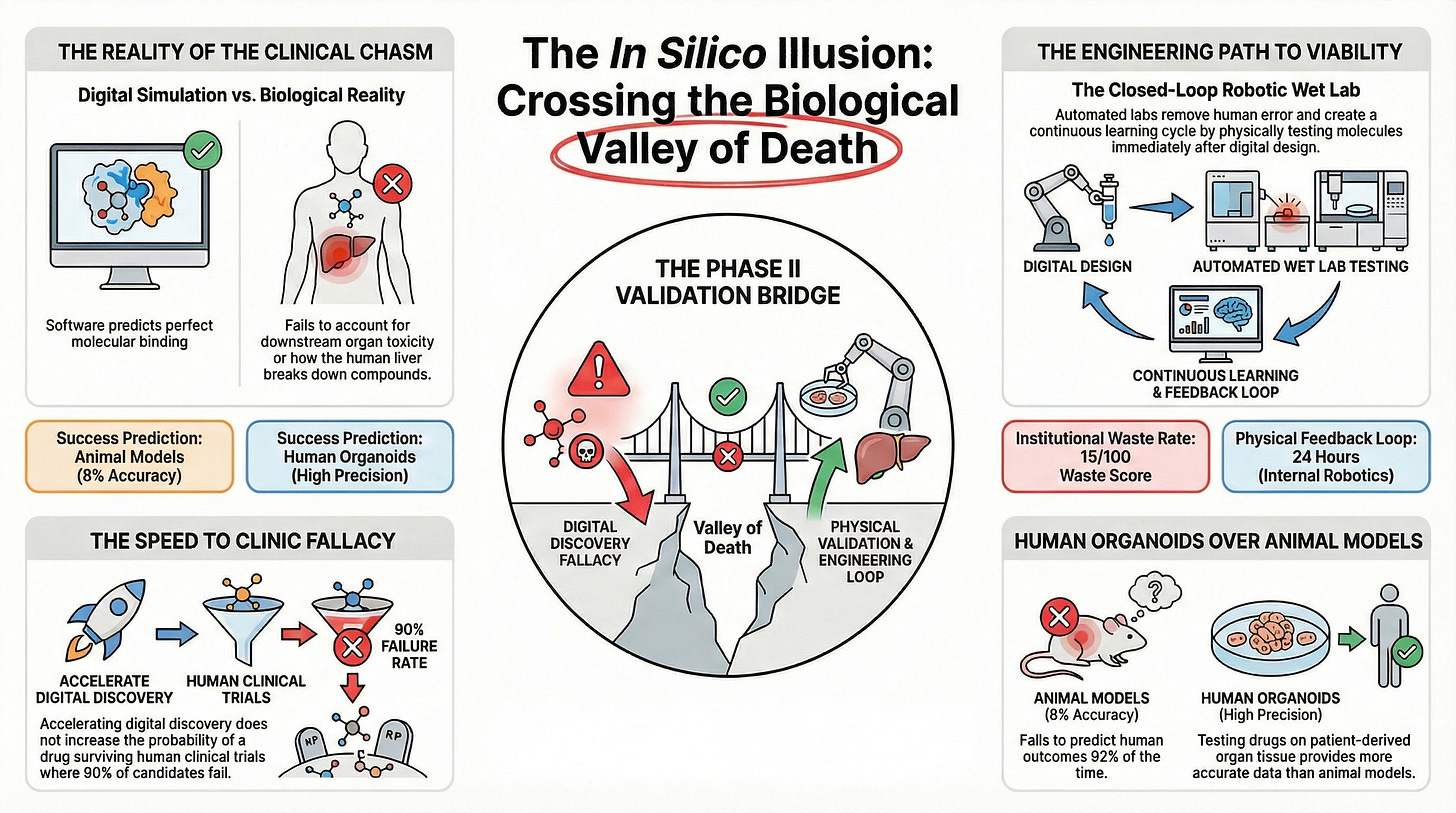
AI is revolutionizing early drug discovery, but clinical trials remain the stubborn, expensive speed bump that even the smartest algorithms can’t bypass.
What to know
- By late 2025, AI platforms like Nabla Bio’s JAM-2 and Chai Discovery’s Chai-2 slashed antibody discovery timelines from months to weeks, boasting ~39% hit rates.
- Despite this acceleration, AI-designed drugs still fail in Phase II/III trials at nearly the same rate as traditional candidates, with costs soaring from $50M to $300M+ per trial.
- Virtual cell models and FDA-cleared blood biomarkers like pTau181 are transforming neurology research, but integrating AI with rigorous clinical validation is essential to truly cut R&D timelines.
AI’s Early-Stage Revolution
AI-driven multi-agent systems and novel data modeling are redefining molecular discovery, but translating these breakthroughs into clinical wins demands context-aware biology and cross-disciplinary integration.
By late 2025, AI had firmly established itself as an indispensable tool in early drug discovery, particularly excelling in molecular design and target identification where it enables the creation of medicines previously deemed impossible. This progress is fueled by advances in molecular machine learning and the integration of multi-omics data, which together elevate ambitions for Target Product Profiles (TPPs) by enabling the design of more potent and innovative compounds. As one expert noted, the alpha of discovery lies in harnessing novel datasets and modeling tools to push the boundaries of what can be achieved at the earliest stages.
The evolution of AI-driven drug discovery is marked by the emergence of collaborative multi-agent systems that unify diverse AI technologies—such as large language models (LLMs), scientific foundation models like AlphaFold, and embodied AI robotics—to seamlessly bridge in silico exploration and wet lab experimentation. This heterogeneous ecosystem transcends vendor, cloud, and vertical silos, enabling a holistic pipeline that addresses scientific, regulatory, and business challenges simultaneously, thereby accelerating early-stage decision-making and enhancing efficacy prediction.
Despite AI’s transformative potential, challenges remain in translating early-stage insights into clinical success, particularly in improving efficacy prediction during phase two trials where failure rates remain high. While AI excels at high-throughput hypothesis testing and molecular optimization—as demonstrated by Schrödinger’s billion-compound screenings and rapid personalized mRNA vaccine development using ChatGPT and AlphaFold—current structural confidence metrics often fail to predict functional outcomes accurately. This underscores the need for context-aware modeling approaches and integrated multi-omics data to better simulate biological complexity, such as whole-cell models, to refine target validation and patient stratification.
By mid-2026, industry leaders acknowledge that while AI adoption in early discovery and target identification is widespread—nearly 60% of pharma companies use AI in these areas—the technology has yet to deliver the dramatic R&D timeline reductions initially promised. AI currently excels at optimizing existing molecular sequences but struggles to generate effective drug candidates de novo, and only a minority of companies feel fully prepared to integrate AI beyond early discovery. Nonetheless, the promise of AI to drastically lower drug development costs by reducing late-stage failures remains compelling, with experts cautioning that transformational breakthroughs often require iterative progress rather than immediate blockbuster success.




Clinical Trials: The Unyielding Hurdle
Despite a flood of AI-generated drug candidates, human biology and regulatory rigor keep clinical validation slow, costly, and largely immune to computational shortcuts.
Despite AI's remarkable ability to accelerate early-stage drug discovery by generating vast numbers of promising candidates, the fundamental bottleneck remains the lengthy, costly, and biologically complex process of clinical validation in humans. As noted in late 2025 analyses, the drug development funnel is flooded with good ideas thanks to AI, but proving safety and efficacy through human trials—mandated by stringent regulatory frameworks like the FDA's three-phase testing—cannot be bypassed or significantly shortened by computational methods alone. While regions such as China experiment with lowering approval barriers to speed access, the U.S. and other regulators maintain high standards that preserve long timelines, underscoring that AI's impact is largely confined to early discovery rather than late-stage validation.
By early 2026, it became clear that AI-driven drug candidates fail in clinical trials at nearly the same rate as traditional drugs, largely due to AI's inability to fully model the intricate realities of human biology, including off-target effects, metabolic breakdown, and disease heterogeneity. Experts highlighted that speeding up molecule generation without improving biological understanding only creates a larger, more expensive backlog of failed candidates in costly Phase II and III trials, which can range from $50 million to over $300 million per trial. This disconnect emphasizes that the true competitive advantage in pharma lies in clinical development and biomarker strategies, not early discovery, and that AI offers no shortcuts through regulatory scrutiny or the operational complexities of human trials.
Throughout 2026, analyses reinforced that AI's potential to compress clinical trial timelines is fundamentally limited by biological complexity, regulatory requirements, and the physical realities of drug development. Even with improvements in trial design, patient matching, and data workflows, AI can only marginally accelerate trials, as recruitment, endpoint observation, and regulatory oversight impose irreducible time constraints. For example, osteoporosis Phase III trials remain enormous and costly despite high success rates and strong preclinical models, illustrating how slow, low-frequency endpoints and heterogeneous disease biology stymie acceleration. Meaningful progress depends more on regulatory acceptance of surrogate endpoints and innovative frameworks like Australia’s Clinical Trial Notification system than on AI alone.
Looking ahead, the persistent challenge in clinical validation stems from a profound lack of comprehensive, multimodal human data and the inherent complexity of human biology, which limits AI’s predictive accuracy for clinical efficacy. Experts argue that clinical development remains pharma’s central bottleneck because it is not merely a modeling problem but a missing-data and feedback-loop problem requiring extensive prospective trials across diverse therapeutic areas. Even if future AI models achieve high accuracy, regulators will demand repeated clinical proof before approving drugs without traditional trials. This long-term horizon, estimated at five to ten years before AI can meaningfully reduce laboratory experiments, underscores that despite AI’s promise, the costly, multi-year human trial process remains the gatekeeper to drug approval and market success.




Antibody Design at Warp Speed
AI platforms are compressing antibody discovery from years to weeks and unlocking new drug classes, yet in vivo validation and manufacturing hurdles still delay clinical translation.
AI-driven platforms have revolutionized early-stage drug discovery by enabling the design of novel therapeutic modalities that were previously impossible, leveraging advances in molecular machine learning and expansive new data sets. This transformative potential is most evident in preclinical molecular design, where AI tools accelerate innovation, yet the impact diminishes in later clinical phases due to persistent challenges in efficacy prediction and regulatory hurdles, particularly in phase two trials where failure rates remain high.
By early 2026, AI-powered de novo antibody design platforms such as Nabla Bio’s JAM-2 and Chai Discovery’s Chai-2 have dramatically compressed discovery timelines from the traditional 12-24 months to mere weeks, achieving impressive hit rates around 39% and even enabling novel functional activities like GPCR agonism. Despite these breakthroughs, critical gaps remain, including the absence of in vivo validation, untested immunogenicity risks, and unproven scalability in manufacturing, underscoring that clinical translation of these AI-designed biologics is still years away.
AI-driven protein design is pushing the boundaries by computationally generating and experimentally testing millions of novel proteins, including those targeting previously undruggable classes such as multipass membrane proteins, ion channels, and heteromeric receptor agonists. This iterative pipeline, exemplified by platforms like 'X design,' integrates wet lab feedback to refine models, while simultaneously optimizing manufacturability traits—solubility, thermal stability, aggregation, and immunogenicity—thereby accelerating the progression from initial hits to viable development candidates.
While AI antibody design platforms demonstrate remarkable capabilities, their proprietary nature—seen in JAM-2, Chai-2, and Origin-1—and the necessity for extensive downstream optimization such as affinity maturation and format engineering highlight that a high hit rate does not equate to a ready drug candidate. Moreover, the lack of public evidence for large-scale production, such as CHO cell manufacturing, and the requirement for thousands of designs per target in open platforms like RFAntibody emphasize ongoing hurdles in translating AI-generated molecules into clinically viable therapeutics.
Virtual Cells and Blood Biomarkers
High-fidelity in silico models and blood-based biomarkers like pTau181 are transforming neurology research, promising more predictive preclinical data and faster, less invasive diagnostics.
Virtual cell models are emerging as a transformative alternative to traditional animal models, which have long hindered drug development due to their inability to replicate key human disease features. For instance, Alzheimer’s research relying on mouse models failed to capture critical pathology like tau protein tangles and neuronal death, contributing to a staggering 99.6% clinical trial failure rate despite $42.5 billion invested. By integrating RNA and proteomic expression data, these high-quality in silico models promise to enhance predictive accuracy and accelerate therapeutic discovery, especially when combined with AI-driven approaches.
Blood-based biomarkers, particularly phosphorylated tau isoforms such as pTau181 and pTau217 alongside amyloid-beta 42, have catalyzed a paradigm shift in Alzheimer’s diagnosis by enabling scalable, minimally invasive assessments through routine blood draws. The FDA’s recent clearance of the first pTau181 blood test marks a significant milestone, facilitating broader clinical use including in primary care settings. This regulatory momentum not only streamlines diagnostic workflows and reduces delays but also complements AI models by providing timely, human-relevant data to support early-stage drug development and clinical validation.
Beyond modeling and biomarkers, regulatory and clinical trial innovations are poised to further accelerate drug development. The FDA’s move to reduce required clinical trials from two to one for certain drugs hints at a future where, in special cases, trials might be minimized or even eliminated. Such shifts could synergize with AI-powered virtual cell models and advanced biomarkers, creating a more efficient pipeline that expedites bringing effective therapies to patients.



AI Targets Brain Health Frontiers
AI-powered diagnostics and next-gen biomarkers are enabling earlier, more precise interventions in Alzheimer’s and dementia, while lifestyle-driven brain age reversal signals a new era in prevention.
By mid-2026, AI-driven approaches in neurology are reshaping Alzheimer’s research and brain health management, moving beyond the traditional amyloid hypothesis to target tau protein and other complex disease mechanisms. Companies like Biogen are advancing tau-focused drugs such as Diranersen into late-stage trials despite mixed clinical data, reflecting a persistent commitment to innovative therapeutics. Concurrently, AI-powered diagnostics and cognitive assessments from firms like Linus Health are setting new benchmarks for early detection and subtype differentiation of cognitive impairments, enabling more precise and personalized interventions that surpass conventional screening methods.
AI’s role extends beyond drug discovery into early detection and prevention, as demonstrated by Fountain Life’s advanced testing revealing that 25% of members had an accelerated brain age, which improved by 26% following lifestyle interventions. This aligns with evidence that nearly 45% of dementia cases are preventable, underscoring AI’s potential as a force multiplier in integrating global therapeutics and personalized brain health strategies to extend healthy cognitive lifespan.
The integration of AI with novel biological models and biomarkers is accelerating translational research and clinical precision. Humanized mouse models replicating Alzheimer’s and Parkinson’s pathologies, including amyloid, tau, and alpha-synuclein aggregation, are validated against patient data to improve drug efficacy prediction. Meanwhile, blood-based biomarkers like phosphorylated tau isoforms (pTau181, pTau217) have gained FDA clearance, enabling scalable, less invasive early diagnosis and complementing established CSF and PET methods. These advances collectively enhance patient selection and outcome measurement in clinical trials, addressing critical bottlenecks such as blood-brain barrier drug delivery.
Pioneering AI applications in longevity research are also modeling individual aging trajectories and generating novel drug candidates targeting neurodegeneration, as exemplified by Insilico Medicine’s use of generative adversarial networks to simulate biological aging and identify molecular targets. Additionally, companies like Oligomerix are developing oral tau inhibitors supported by NIH grants to offer cost-effective, easy-to-administer alternatives to antibody therapies, addressing the urgent need posed by the projected doubling of Alzheimer’s prevalence by 2060. This convergence of AI-powered drug discovery, predictive modeling, and scalable diagnostics heralds a new era of personalized neurology and longevity interventions.





Beyond Algorithms: Enterprise Overhaul
True acceleration in drug development hinges on integrating AI with experimental rigor and organizational transformation, shifting pharma from IT upgrades to holistic, cross-functional change.
By early 2026, it became clear that accelerating early-stage drug discovery with AI, while valuable, does not inherently improve clinical trial success rates, as highlighted in the $150M Phase II JTBD Gap analysis. The prevalent AI-driven 'agentic' workflows often optimize for parameters like binding affinity but overlook critical biological complexities such as organ toxicity and solubility, resulting in sophisticated false positives. This underscores the necessity of tightly integrating AI predictions with rigorous experimental and clinical validation to navigate the chaotic, non-deterministic nature of biology—a sentiment echoed by CellType's shift from treating biology as deterministic software to recognizing its physical complexity.
The lion’s share of drug development costs and failures—ranging from $50 million to over $300 million per Phase II and III trial—occur well beyond early discovery, emphasizing that AI’s transformative value must extend into clinical validation bottlenecks. Advanced simulations that integrate AI with experimental validation hold promise to dramatically shorten development timelines from the traditional 10-12 years down to 5-6 years by enabling earlier failure identification and more precise clinical trial design. This potential leap forward, discussed in mid-2026 analyses, signals a pivotal shift in how AI can reshape the entire drug development lifecycle.
Realizing AI’s full promise in drug development demands more than technological innovation; it requires profound organizational transformation. As companies like CellType and others recognize, the reinvention of processes must transcend IT departments, fostering cross-functional collaboration and embedding AI agents within hybrid human-machine workforces. This wave of acculturation and upskilling is essential to redesign workflows and decision-making logic from within, ensuring that AI integration is not just a tool but a fundamental enterprise evolution.
