AI giants bet on deployment teams
The gist
AI giants like Microsoft and OpenAI are ditching pure model hype for a multibillion-dollar blitz to embed AI deep in the heart of enterprise workflows.
What to know
- By mid-2026, leaders including Microsoft, TCS, OpenAI, and Anthropic will pour $8-10 billion into deployment-focused teams to operationalize AI inside businesses.
- The biggest hurdles aren’t technical—organizational roadblocks, unclear ownership, and culture clashes are driving a hiring spree for thousands of Forward Deployed Engineers.
- U.S. hyperscalers will drop over $750 billion on AI infrastructure in 2026 alone, betting that data centers and compute power—not just smarter models—are the new AI battleground.
AI Services Go Mainstream
Tech giants are transforming into service providers, embedding massive Forward Deployed Engineering teams to drive real business outcomes and reshape how enterprises operationalize AI beyond just building smarter models.
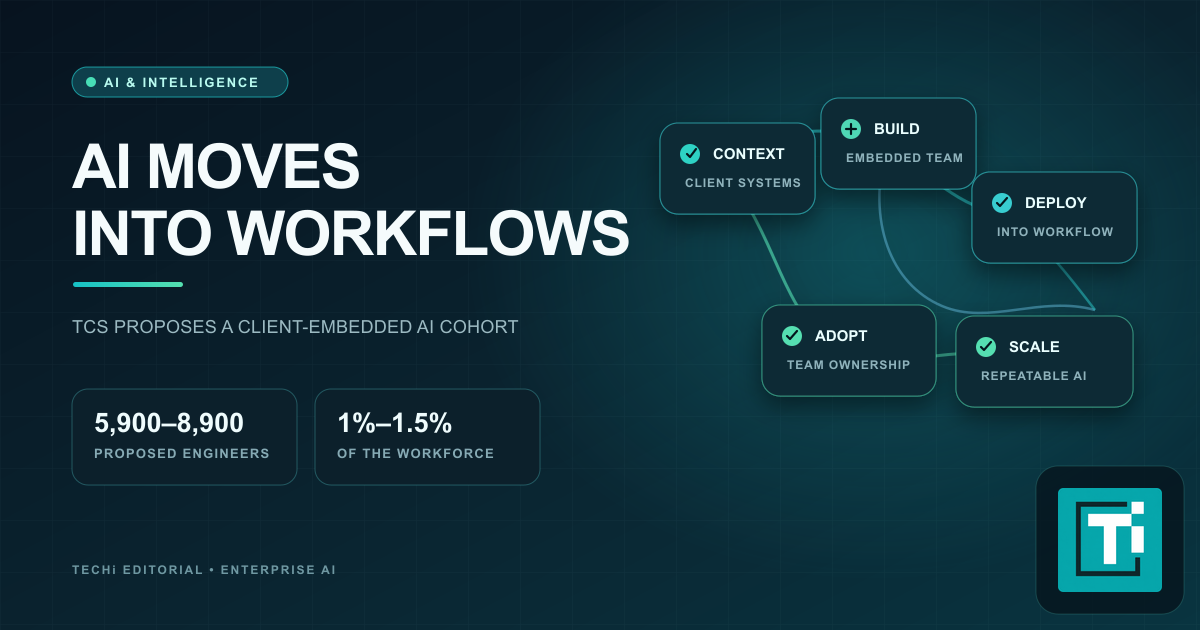
By mid-2026, leading AI companies such as Microsoft, TCS, OpenAI, and Anthropic have collectively committed $8-10 billion to a strategic pivot from pure AI model innovation toward embedding AI directly into enterprise workflows. This shift is embodied by the creation of large-scale Forward Deployed Engineering (FDE) teams and dedicated deployment units—Microsoft’s $2.5 billion 'Microsoft Frontier Company,' OpenAI’s $4.1 billion deployment entity, and TCS’s plan to deploy up to 8,900 FDE engineers—aimed at overcoming organizational and operational barriers to adoption and driving measurable business outcomes rather than just technological promise. These investments mark a decisive industry move to operationalize AI at scale within enterprises, emphasizing tangible impact over model creation alone.
This massive infusion of capital and talent into deployment-focused teams reflects a broader recognition that enterprise AI success hinges more on quality implementation and integration than on the underlying AI models themselves. As Eddie Siegel, chief technologist at Anthropic’s Ode deployment company, puts it, 'model selection matters, but it’s not where the majority of calories are spent,' underscoring that embedding AI into core business processes with executive buy-in is the critical factor for transformation. Chris Taylor, Ode’s CEO, emphasizes this by noting that their work often represents the top one or two priorities for company CEOs, highlighting how AI deployment has become a strategic business imperative rather than a mere technical experiment.
Interestingly, this industry shift also entails a cultural and business model transformation, with traditional AI technology vendors—historically reluctant to enter the services domain—now embracing service-oriented deployment models to co-create solutions with customers. As one analysis notes, 'these tech companies who've always said I don't want to be in the services business, now they have to get a little bit into the services business,' leveraging Forward Deployed Engineers to fill capability gaps and ensure AI delivers measurable results. However, companies like OpenAI and Anthropic aim to balance this by building scalable, open-technology deployment capabilities rather than becoming costly, single-technology service providers, signaling a nuanced evolution in how AI integration services are delivered.



Talent, Not Tech, Is Scarce
The true bottleneck for enterprise AI is a shortage of deployment specialists and leadership alignment, not model quality—prompting multimillion-dollar hiring wars for Forward Deployed Engineers who can bridge organizational divides.
A predominant barrier to enterprise AI adoption lies not in the technology itself but in deep-rooted organizational challenges such as unclear ownership, misaligned incentives, and teams unstructured for AI integration. Microsoft's $2.5 billion investment, deploying 6,000 Forward Deployed Engineers directly within enterprise clients, underscores the critical need for embedding specialized talent to navigate these internal complexities and operationalize AI effectively. This shift from traditional coordination roles, increasingly automated by AI, toward deployment specialists highlights a fundamental transformation in workforce roles necessary to embed AI into business processes.
Leadership alignment and cultural transformation emerge as linchpins for successful AI adoption, with many enterprises faltering due to fragmented, bottom-up initiatives lacking CEO-driven strategic vision. As Kristoff Schweitzer emphasizes, AI adoption transcends technology, demanding holistic change management where thousands of employees must adapt how they run processes, learn, and are incentivized. Furthermore, AI literacy at the C-suite level is foundational, enabling executives to frame the right questions and define clear ownership, which McKinsey and other analyses identify as essential to overcoming organizational inertia and achieving measurable business outcomes.
The scarcity of skilled Forward Deployed Engineers capable of embedding AI models into complex, real-world workflows represents a critical talent bottleneck, with MIT reporting that 95% of enterprise AI projects fail to deliver measurable returns due to this gap rather than model quality. Leading AI companies like OpenAI and Anthropic are investing billions to build large-scale deployment teams, offering compensation packages up to $1 million including equity to attract this rare talent. This acute shortage underscores that the true competitive advantage lies in integrating AI into unique organizational workflows, not merely acquiring software, necessitating a strategic focus on talent acquisition and retention.
Successful AI adoption demands redefining workforce roles and organizational structures to prioritize training, workflow redesign, and human accountability over headcount reduction. As AI automates routine coordination tasks, enterprises are shifting human capital toward complex decision-making and strategic planning, while leaders must delineate clear boundaries for AI autonomy to maintain accountability. This dual challenge—systematically leading transformative change while excelling at core operations—requires rare organizational capabilities, with named individuals responsible for AI outcomes ensuring that technology augments rather than replaces human judgment.


CEOs Must Lead the Charge
AI success now hinges on CEO-driven strategies and C-suite literacy, as organizations realize that measurable impact depends more on executive alignment and disciplined change management than on technical prowess alone.
By early 2026, it became clear that successful AI transformation hinges on CEO-driven strategies that align AI initiatives with clear business growth areas and competitive advantage, rather than indiscriminate technology deployment. As one analysis emphasized, leaders must deeply understand where value is created across the value chain and embed themselves in the nuances of AI’s impact on organizational structure, products, and markets to unlock meaningful outcomes.
This strategic leadership imperative extends beyond technology to encompass evolving operating models and accountability frameworks that prioritize measurable business outcomes. Kristoff Schweitzer, CEO of BCG, highlights that AI adoption is fundamentally a holistic change management challenge requiring shifts in processes, incentives, learning, leadership, and culture—elements that CEOs must actively steer to realize financial impact and safeguard their own leadership tenure, with half of CEOs acknowledging their job stability depends on getting AI right.
Integral to this transformation is cultivating AI literacy across the C-suite and embedding disciplined change management practices that enable organizations to simultaneously excel in current operations while systematically driving AI-enabled innovation. The scarcity lies in human judgment to frame the right questions and maintain accountability for AI-generated outputs, as successful enterprises adopt customer-centric methods like Amazon’s Working Backwards approach to ensure AI initiatives are rigorously aligned with desired business outcomes.
A common pitfall remains treating AI adoption as a mere technology upgrade relegated to the CTO’s domain, which overlooks the necessity of rethinking talent, organizational structures, and leadership vision. This lack of situational awareness undermines transformation efforts, underscoring that executive leadership must integrate AI deeply into strategic priorities and operational models to fully harness its transformative potential.



Infrastructure Becomes the Moat
A historic $750 billion surge in AI infrastructure spending is consolidating power among hyperscalers, making compute scale—not just algorithms—the decisive factor in the next wave of tech dominance.
U.S. hyperscalers including Amazon, Alphabet, Microsoft, Meta, and Oracle are spearheading an unprecedented surge in AI infrastructure investment, committing over $750 billion in 2026 alone. This historic scale of capital expenditure, reminiscent of the late-1990s telecom boom, underscores AI's strategic role as a foundational driver of future economic transformation and competitive positioning in the tech landscape.
Despite the staggering capital outlays, AI-related revenues currently lag behind these investments, creating a tension between the scale of infrastructure spending and the realization of measurable business outcomes. Market watchers, including @gmukunda, emphasize that the true validation of these investments hinges on forthcoming broad productivity gains, which will also influence valuations of AI-centric firms like Anthropic.
The AI industry is witnessing a structural shift where compute power and infrastructure scale have become the critical competitive moat, driving massive investments in chips, data centers, and power grid modernization. This capital intensity mirrors the semiconductor sector’s evolution, where escalating costs and complexity are consolidating the market around a few dominant players capable of sustaining these investments, as exemplified by Microsoft and TCS’s $8-10 billion deployment units addressing enterprise adoption barriers.
Hyperscalers strategically funnel much of their AI investments into cloud compute infrastructure via mechanisms like cloud credits, creating a closed-loop ecosystem that simultaneously fuels AI innovation and expands cloud revenue streams. This infrastructure-centric approach is further amplified by the Jevons Paradox effect, where declining token costs lead enterprises to dramatically increase AI usage, driving exponential growth in compute demand and shifting economic value toward foundational infrastructure providers and orchestration tools.
The dramatic rise in AI compute value—from $10,000 servers to million-dollar equivalents—reflects a fundamental market shift from software to hardware dominance, necessitating massive data center redesigns. Investments exceeding $700 billion in 2026, with projections reaching trillions over the next five years, are focused on ultra-short data transmission within chips and racks, requiring advanced power architectures and cooling solutions, thereby redefining the physical and economic infrastructure of AI deployment.