AI hardware land grab hits grid limits
The gist
AI's trillion-dollar power play is redrawing the tech map, as the industry pivots from code to concrete in the fiercest infrastructure gold rush of the century.
What to know
- Hyperscalers are spending over $500 billion a year on semiconductors, data centers, and power—set to top $7.6 trillion globally by 2031.
- Scarce materials, power grid delays (5–7 years!), and a shrinking skilled workforce are choking the AI buildout and creating outsized winners in hardware and energy.
- Micron (+770%), Intel (+483%), and AMD (+343%) are crushing benchmarks, while global megafunds from South Korea ($576B) and Abu Dhabi ($50B) fuel a historic land grab for AI’s physical backbone.
Hardware Over Software Supremacy
AI’s next decade will be won by those who can physically build, power, and deploy massive infrastructure, not just write better code.
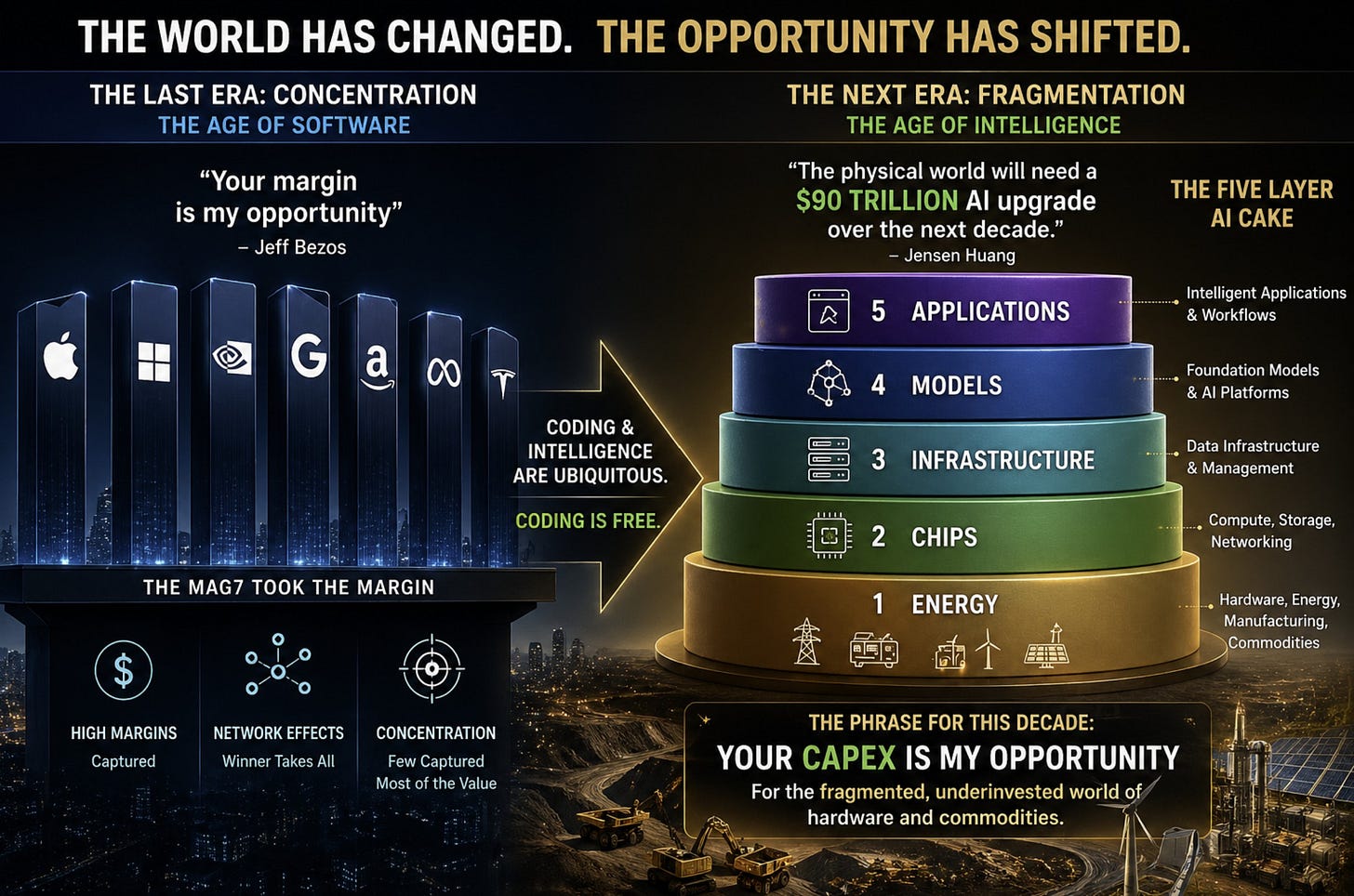
By early 2026, the AI revolution marked a decisive pivot from the asset-light, software-centric models that dominated the previous decades toward a capital-intensive buildout of physical infrastructure essential for scaling intelligence. This transition underscores a new competitive frontier where success hinges not merely on writing superior code but on mastering the construction, powering, cooling, and deployment of foundational hardware layers. As one analysis put it, “The next decade will not be defined only by who writes the best code. It will be defined by who can build, power, cool, connect, manufacture, and deploy the physical infrastructure required for intelligence to enter everything,” highlighting the profound shift in industry dynamics and investment focus.
This paradigm shift has reoriented investment strategies from chasing software margin capture to seizing opportunities embedded in capital expenditures on foundational AI infrastructure. The familiar mantra of “your margin is my opportunity” has been supplanted by “your CapEx is my opportunity,” reflecting how the enormous and continuous spending by hyperscalers—exceeding $500 billion annually and projected to surpass $600 billion in 2026—is reshaping the investment landscape. Yet, institutional investors have been slow to recalibrate, creating a decade of benchmark arbitrage as portfolios remain tethered to legacy software-heavy indices, even as value migrates downward to the physical layers that underpin AI’s rapid advance.
At the heart of this capital-intensive transformation lies a sprawling ecosystem of physical infrastructure components—semiconductors, advanced packaging, data centers, optical networks, power and cooling systems, robotics, and even the reindustrialization of global supply chains—that collectively form the backbone of AI scalability. This shift reverses two decades of capital flight from cyclical, hardware-heavy sectors toward asset-light SaaS and cloud businesses, as AI’s insatiable demand for compute and data platforms pulls value down the stack. The application layer, while still relevant, is thinning in influence as the deepest physical constraints and control points concentrate value in semiconductors, inference engines, and the sprawling compute infrastructure beneath.


Planet-Scale AI Buildout
A $7.6 trillion capital surge is transforming global industries as AI infrastructure spending eclipses the GDPs of entire nations and ripples far beyond chips.
The AI infrastructure buildout represents an unprecedented expansion in human history, driven by massive capital expenditures that are reshaping the physical economy at a planetary scale. Companies like NVIDIA have seen annual revenues soar to $216 billion—surpassing the GDP of over 160 countries—highlighting the sheer magnitude of this investment cycle. Goldman Sachs projects a staggering $7.6 trillion will be poured into AI infrastructure globally from 2026 to 2031, spanning semiconductors, data centers, power, cooling, and manufacturing, underscoring that this is not merely a tech upgrade but a fundamental rebuild of the world's computing backbone.
This trillion-dollar capex cycle extends far beyond semiconductor chips, encompassing a broad spectrum of industries including industrials, real estate, utilities, and the energy grid. The AI hardware value is roughly split evenly between compute components and supporting infrastructure such as networking, power, and the physical data center buildout, with networking and power each accounting for about 15-20% of the value. This diversification reflects AI’s pervasive impact, as investors increasingly look beyond chipmakers like Nvidia to beneficiaries in media, healthcare, and other sectors, driving multiplier effects that have contributed to earnings growth rates of 26-27% in recent cycles.
Data center construction is a critical pillar of this buildout, with the global market expected to nearly double from $144 billion in 2025 to $324 billion by 2031, growing at a 14.46% CAGR. Hyperscale and colocation data centers dominate this surge, requiring specialized infrastructure such as GPU-ready environments, liquid cooling, and resilient power systems to support AI workloads. Major initiatives like the U.S. $500 billion Stargate project and Alibaba’s $69 billion AI infrastructure program exemplify this trend, while regional investments in APAC, Europe, and North America further emphasize the global scale of the expansion.
The momentum behind AI infrastructure investment is accelerating rapidly, with tech M&A activity soaring to $566 billion in 2026, up from $334 billion in 2025, signaling urgent boardroom commitments to avoid being left behind. Large-scale capital raises such as Abu Dhabi’s MGX $50 billion tech fund and Starwood Capital’s $10.2 billion data center property fund, alongside major projects like ByteDance’s largest data center outside China and Binance’s $39 billion renewable-powered facility in Brazil, illustrate the vast and diverse financial flows fueling this trillion-dollar buildout. This investment frenzy underscores that AI’s next frontier lies overwhelmingly in the physical economy, which accounts for 99.5% of global GDP, far beyond the less than 0.5% represented by software today.






Critical Bottlenecks Define Winners
Scarce materials, energy constraints, and a shrinking skilled workforce are creating outsized winners—and persistent chokepoints—throughout the AI supply chain.
By mid-2026, the AI physical infrastructure landscape is sharply defined by deep, specialized bottlenecks in critical materials and components such as indium phosphide and NPN substrates, exemplified by AXT Inc.'s staggering 8,300% stock surge as it capitalized on this scarcity. These constraints create a persistent tension in the AI capital expenditure ecosystem, where those supplying the scarce physical inputs continue to reap outsized earnings from the relentless spending of AI developers, underscoring the importance of identifying these choke points to unlock emerging investment opportunities.
Energy supply has emerged as a paramount bottleneck for AI data center expansion, shifting the narrative beyond semiconductors and software. Sylvia Jablonsky, CIO at Defiance ETFs, emphasizes that AI's growth is now an 'energy supply story,' with companies innovating in energy technologies and novel data movement methods—such as photonix firms—poised to benefit from the surging power demands of AI workloads and sprawling data centers.
Despite the rapid pace of AI data center construction, physical infrastructure deployment is severely hampered by protracted power grid connections, permitting delays, and construction inefficiencies. While data centers can be erected within 12 to 18 months, connecting them to power grids often takes five to seven years, causing over a quarter of 110 projects slated for 2025 to face delays. This bottleneck is exacerbated by a shrinking skilled workforce in the global construction industry—where 440,000 unfilled U.S. AEC sector vacancies nearly double 2019 levels—highlighting an urgent need for AI-driven automation to modernize this labor-intensive and inefficient sector.
The AI revolution in drug discovery starkly contrasts with the pharmaceutical manufacturing sector's outdated, paper-based infrastructure, revealing a critical gap in scaling AI innovations physically. Despite over $485 billion invested in AI pharma by 2026, manufacturing facilities remain anchored in 1970s-era processes, underscoring a broader challenge where acute labor shortages in construction, energy, and advanced manufacturing sectors are pushing AI automation from theoretical promise to urgent necessity to overcome human capital constraints.


Global Capital Flows Redrawn
Sovereign wealth funds and megafunds are fueling a worldwide land rush for AI’s physical backbone, redrawing the map of tech power and influence.
Sovereign wealth funds and megafunds are fueling a worldwide land rush for AI’s physical backbone, redrawing the map of tech power and influence.
CapEx Is the New Alpha
As AI infrastructure spending explodes, investors who follow capital expenditures into chips, power, and grid modernization are leaving software-only portfolios behind.
By mid-2026, investors have recognized that the AI revolution is not merely a software phenomenon but a capital-intensive infrastructure expansion reshaping financial paradigms. Companies like Micron (+770%), Intel (+483%), and AMD (+343%) have dramatically outperformed traditional benchmarks, underscoring the critical importance of tracking capital expenditures in AI chips, data centers, and energy sectors. This buildout, described as the largest infrastructure expansion in human history, demands investors pivot towards physical constraints and CapEx flows, as emphasized by the massive investments from tech giants and the unprecedented growth in supporting sectors such as cooling, power distribution, and advanced energy solutions.
Energy supply and power infrastructure have emerged as pivotal bottlenecks in AI’s physical economy integration, shifting investor focus beyond semiconductors to utilities and industrial companies. With data center power demand forecasted to surge by 50% by 2027 and potentially 165% by decade’s end, firms like Bloom Energy, Vertiv, Eaton, and Quanta Services have seen explosive revenue growth and backlog surges, reflecting the critical role of grid modernization and thermal management in sustaining AI infrastructure. As Sylvia Jablonsky of Defiance ETFs notes, 'this is not just a software story for AI anymore... It’s an energy supply story,' highlighting the strategic imperative to invest in the physical systems enabling AI’s scale.
The evolving financial paradigm in AI infrastructure is characterized by sustained multi-year capital commitments from hyperscalers and semiconductor companies, supported by strong recurring revenues from AI software providers. Intel’s strategic pivot to integrated platform solutions and foundry services illustrates the complexity of balancing heavy CapEx with returns on invested capital amid intense competition. Meanwhile, companies like Vertiv and Vicor exemplify how addressing physical constraints—such as heat dissipation and power delivery—translates into robust revenue growth, expanding backlogs, and high valuation multiples, though investors must remain vigilant to execution risks and geopolitical factors that could influence long-term outcomes.
Geopolitical tensions, government initiatives, and shifting market dynamics are increasingly shaping AI infrastructure investment strategies, compelling investors to track capital flows across traditional sector boundaries. South Korea’s $576 billion AI program and Abu Dhabi’s massive tech funds exemplify how global capital is mobilizing to capture AI’s physical ecosystem growth, while rising energy prices and supply chain bottlenecks inject both risk and opportunity. As Goldman Sachs highlights, the next AI boom is rooted in the physical economy, with an estimated $7.6 trillion to be invested globally from 2026 to 2031, signaling a long-term transformation in how capital is allocated amid technological and geopolitical complexities.