AI inference hits memory Wall, not compute ceiling
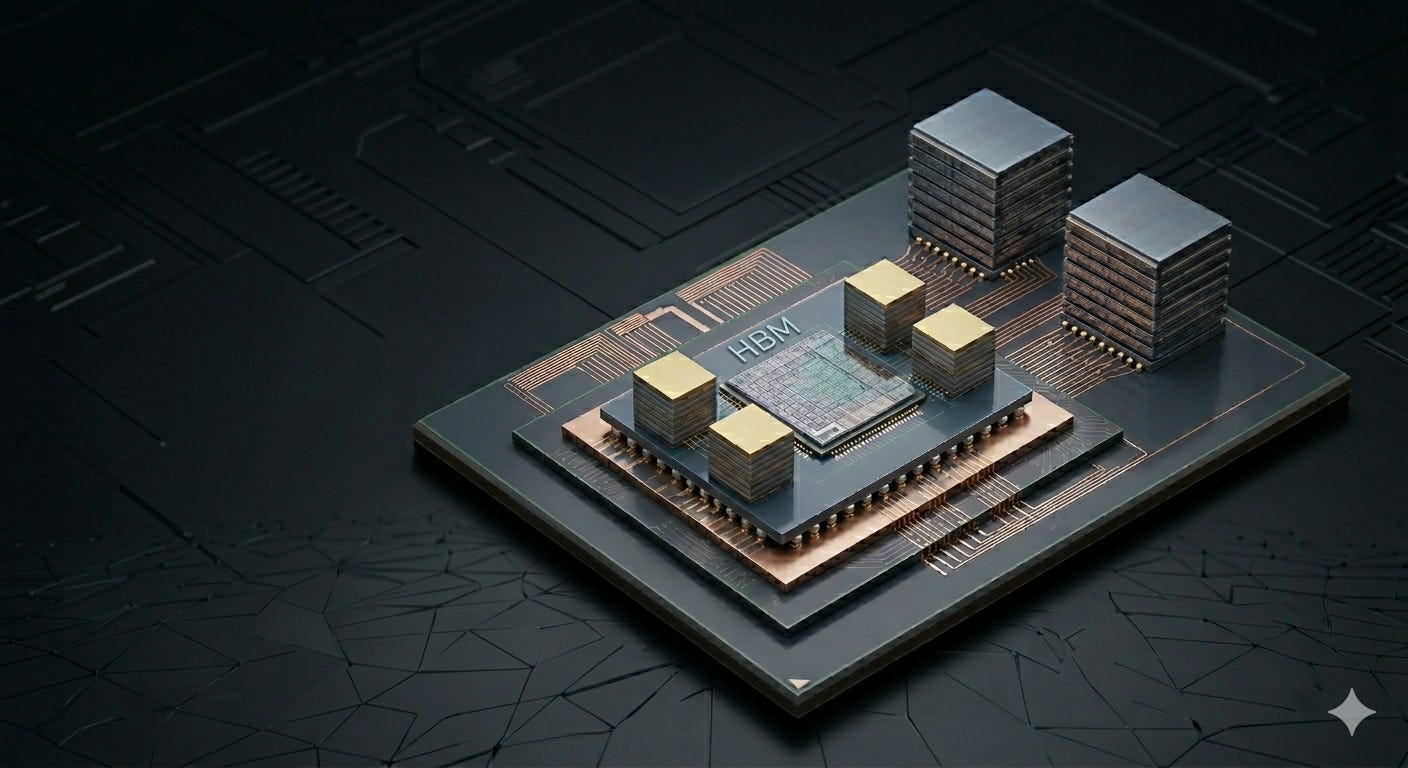
The gist
AI inference just smashed into the memory wall—leaving 99% of compute power idle and making memory tricks the new kingmaker.
What to know
- NVIDIA’s MLPerf v6.1 and Grace Blackwell benchmarks show recent AI inference speed gains come from clever software and memory optimizations, not just faster chips.
- Even top-tier GPUs like the H100 run at only ~1% of their theoretical peak during token generation, as memory bandwidth—not compute—becomes the real bottleneck.
- Techniques like quantization, KV-cache compression, and smarter cache routing now drive performance, with TensorRT Edge-LLM on Jetson AGX Thor running 6.4x faster than llama.cpp.
NVIDIA’s Bandwidth Breakthrough
NVIDIA’s leap to rack-scale architectures and aggressive memory optimizations shattered the inference bottleneck, delivering up to 50x performance gains by targeting bandwidth, not just bigger chips.
By June 2026, NVIDIA was no longer describing inference as a straightforward compute-scaling problem but as a performance regime where gains stall unless the real limiter is addressed. Jensen Huang’s framing was blunt: token generation was bandwidth-constrained, and “NVIDIA’s answer was Grace Blackwell NVLink72: 72 chips ganged into the world’s first rack-scale computer, solving for the actual bottleneck and landing a 50x gain in two years,” while he argued Jensen would rather run low MFU and be over-provisioned than hit 100% and fight Amdahl’s Law on every workload.
That diagnosis was reinforced by September benchmarks: NVIDIA’s MLPerf Inference v6.1 Edge Agentic results (mid/late-2026 timeframe) show large end-to-end latency/throughput gains from software and memory-footprint optimizations on Blackwell-class hardware, aligning with a market discovering that raw silicon alone was no longer enough. NVIDIA reports TensorRT Edge-LLM on Jetson AGX Thor (Blackwell) achieved “52.33 tokens per second” and completed “all 1,007 turns… in 24 minutes and 36 seconds,” which is “6.4x faster than the llama.cpp reference run,” and the submission “uses NVFP4 quantization for weights and activations, FP8 KV cache, tree-based multi-token prediction… and KV cache reuse across agent turns.”
MLPerf v6.1 then generalized the point beyond a single NVIDIA demo: results published September 16, 2026 quantified that software-only optimization on already-purchased hardware produced large throughput gains, implying performance improvements were increasingly constrained by factors other than raw compute. The benchmark analysis said it was “published September 16, 2026” and that “software optimization alone… delivered 8 to 36 percent throughput gains in five months,” while multiple independent submitters reported double-digit to mid-30% improvements on identical Blackwell hardware across prior MLPerf rounds, reinforcing that the limiting factor was not new silicon but the inference stack.

Decode Bottleneck: Bytes, Not FLOPs
AI inference now stalls at memory bandwidth, with GPUs idling at 99% during decode as engineering pivots to squeezing more out of every byte through quantization, cache compression, and smarter memory placement.
The core problem in decode is arithmetic intensity: an H100 offers “989 TFLOPS / 3,350 GB/s ≈ 295 FLOPs per byte,” with “everything above ~150” tending compute-bound, but autoregressive decode at FP16 delivers only about 1 FLOP per byte. That leaves generation structurally on the wrong side of the roofline, so the GPU is not starved for math but for data, and memory bandwidth growth has plainly failed to keep pace with available compute.
The utilization penalty is extreme: “The chip is running at roughly 1% of its theoretical peak during decode,” meaning “99% of the compute silicon is idle” while the memory bus is saturated, and even “at INT4 (the most aggressive common quantization): 4 FLOPs per byte,” decode remains nowhere near the H100’s threshold. That is why inference engineering has shifted toward reading fewer bytes per token through weight quantization, low-bit KV-cache compression, and architecture choices that shrink KV bytes per token.
Once long contexts and concurrency enter the picture, the bottleneck becomes not just bandwidth but how KV state is resident, paged, and routed across the serving stack. PagedAttention and continuous batching exist to amortize weight streaming and reduce KV fragmentation, while cluster operators increasingly treat memory placement as the scarce resource—an outlook reinforced by warnings that “the memory bandwidth of the DGX H200 is extremely constraining,” with pod-level bandwidth far below the aggregate HBM figures often implied by peak-compute marketing.