AI literacy gets a reality check: schools shift from using it to judging it
The gist
AI literacy in K–12 is shifting from “Can students use AI?” to “Can they catch it when AI gets confidently wrong?”
What to know
- Experts say students now need epistemic literacy: the skill to verify AI outputs that can sound authoritative while mangling quotes, citations, or evidence.
- Educators want AI to preserve thinking, not replace it—best practice is after the first draft or in Socratic mode, so students still do the cognitive struggle that builds retention.
- Teachers are adopting AI faster than schools are training them: 60% of U.S. K–12 teachers use it, 68% of those users got no institutional training, and only about half of districts offered AI PD by fall 2024.
Trust, Not Just Answers
**AI literacy is shifting from using tools to judging them, because students now have to know when a model is reliable and when it can quietly invent quotes, citations, or evidence.**
The new baseline for students is no longer just knowing facts, but knowing when to trust them. Analysts argue that AI literacy has to include "epistemic literacy"—the ability to tell which questions AI can answer reliably and which require independent verification—because generative systems are strong at summarizing and brainstorming but weak where education most needs precision: quotation, citation, and exact evidence. That distinction matters because an AI can sound authoritative while inventing a quote or subtly altering a source, turning a convenient shortcut into a permanent error in the academic record.
Students also need to preserve the cognitive friction that makes learning stick. Heather Schwartz warns that when AI hands over "a really beautiful and elegant answer," students can become "a passive consumer of work that was already cognitive work that was done by someone else," and RAND data suggest the concern is already visible: more than two thirds of students think AI use will hurt their critical thinking skills. The emerging consensus is not anti-AI, but anti-shortcut—use the tool after the first draft, not before it, so students still have to struggle through synthesis, build judgment, and avoid the "crutch effect" that can make them look stronger with AI and weaker without it.
That is why educators like Khan Academy learning chief Kristen DiCerbo are pushing a three-part agenda: fundamentals, AI literacy, and critical thinking. The point is not to fetishize struggle, but to calibrate it—sometimes AI should act Socratically, asking "why do you think that?" and sometimes it should simply give the answer, depending on the learning moment. However, that only works if students also learn how to ask better questions in the first place, because AI tutoring breaks down when learners cannot frame a problem, and the real risk may be weak implementation rather than overuse: students need structured, guided practice, not just more apps and more answers.
The broader shift is toward systems that help students reason, not just receive. Khan Academy’s use of LLMs as judges to evaluate 20,000 student interactions a day points to a future where AI can support feedback at scale, but only if schools redesign workflows around evidence-based evaluation rather than raw generation. In that model, students are still learning the fundamentals—but they are also learning how to interrogate outputs, manage fragmented digital workflows, and turn AI from an answer machine into a thinking partner.


Learning Needs Friction
**Educators are trying to stop AI from becoming a thinking substitute by keeping students in the struggle long enough for reasoning, retention, and real understanding to take hold.**
The new consensus is that AI helps learning only when it preserves the student’s thinking, not when it replaces it. As Stanford’s Jeremy Schwartz puts it, the danger is cognitive offloading: if a 13-year-old plugs a math problem into ChatGPT and gets back a polished explanation, the student may be consuming someone else’s reasoning instead of doing the “cognitive struggle” that builds transfer and retention. That’s why Schwartz and Khan Academy’s learning team argue for AI after the first draft, or in a Socratic mode that asks, “and why do you think that?” rather than handing over the answer.
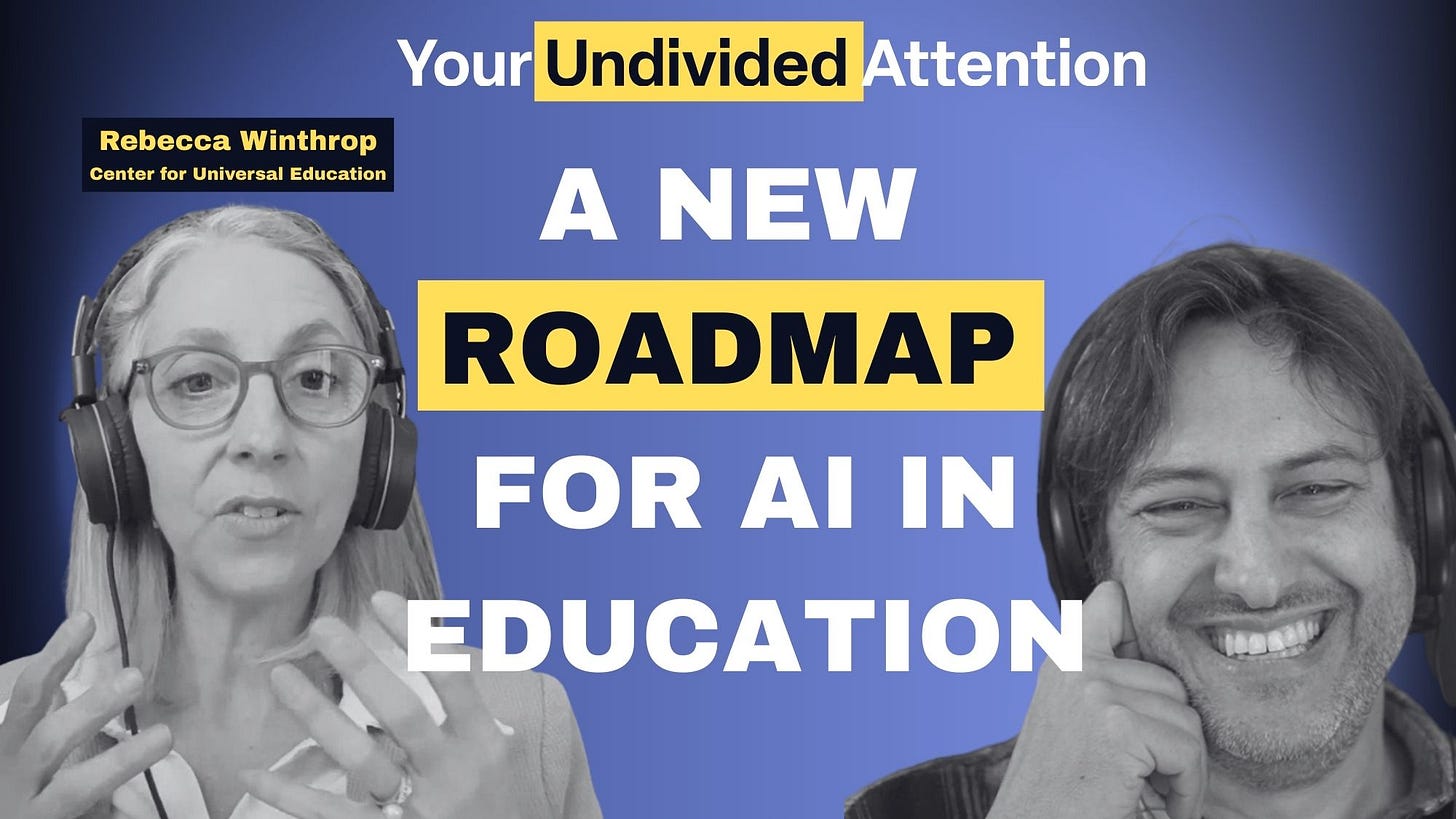
The homework problem is less about cheating detection than about how easily AI blurs the line between help and outsourcing thought. Rebecca Winthrop warns that schools are already behind a world where kids encounter AI everywhere—from social feeds to search overlays and AI companions—while teachers are using it heavily for lesson prep, grading, and assessment, but student use remains uneven and largely unstandardized. That mismatch makes overreliance hard to police and easy to normalize, especially when a tool can revise, personalize, and merge with a student’s own ideas without leaving obvious traces.
The practical response is shifting from trying to catch every prompt to proving that learning actually happened. A how-to guide on teen AI use argues that it’s “impossible” to monitor each assignment for AI, so schools and parents should ask students to explain work in their own words, defend their reasoning, and apply the idea in a new context; the goal is to measure what stuck, not who typed what. That also means building a culture of transparency—where students can say they used AI without being punished—while still being coached to use it for skill-building rather than just delivering a finished product.
The deeper warning is that AI can look successful in the short run while quietly weakening learning once the crutch is removed. Schwartz notes that students may show gains while the tool is available, but “once you take away the crutch,” some perform worse than peers who never had access at all; more than two-thirds of students already believe AI will hurt their critical thinking, which he calls a “canary in the coal mine.” Winthrop’s broader “premortem” logic is the same: don’t assume the infinitely patient tutor will save education—design guardrails, curriculum, and teacher support now so AI amplifies productive struggle instead of replacing it.

![[ Center for Humane Technology ]](https://substackcdn.com/image/fetch/$s_!uhgK!,w_256,c_limit,f_auto,q_auto:good,fl_progressive:steep/https%3A%2F%2Fsubstack-post-media.s3.amazonaws.com%2Fpublic%2Fimages%2F5f9f5ef8-865a-4eb3-b23e-c8dfdc8401d2_518x518.png)
Teachers Are Improvising
**K–12 teachers are adopting AI far faster than districts are training them, leaving classrooms to rely on individual workarounds instead of a coordinated plan for safe, effective use.**
Teachers are already moving faster than the system built to support them: a 2026 analysis found that 60% of U.S. K–12 teachers are using AI, yet 68% of those users have received no institutional training, and by fall 2024 only about half of districts offered any AI professional development at all — usually optional. That mismatch matters because the TALIS findings suggest training is not a nice-to-have but a predictor of effective classroom use; without it, AI adoption becomes a patchwork of individual workarounds rather than a coherent instructional strategy.
The appeal is obvious, which is why the gap keeps widening: among teachers already using AI, 92% call it useful and 58% say it has eased burnout, but confidence in the technology’s broader value remains shaky, with Pew finding just 6% of teachers think AI does more good than harm and 25% saying the opposite. In other words, educators are not rejecting AI — they are improvising around it, often because schools have normalized rapid tech adoption since COVID but never built the training, planning, or support systems needed to make the next wave safe and sustainable.
The risk is that ad hoc adoption turns into avoidable failure. The Los Angeles Unified chatbot ‘Ed’ launched on March 20, 2024 and was shut down 86 days later after reports that student data was being processed on servers in Japan, Sweden, the U.K. and France, violating district privacy rules — a reminder that schools need the equivalent of tiered approval gates, sandboxed workflows, and clear permissions before AI becomes embedded in daily practice. As with Amazon’s warning that ‘when adoption becomes the metric, caution becomes friction,’ schools should measure implementation by safety and learning quality, not by how many teachers clicked ‘use AI.’
The classroom version of that lesson is visible in teachers’ own materials: one AP teacher described building 50 slides, with half devoted to ‘how not to use AI,’ because ‘AI spits out code like it’s nothing, and you’re not learning anything if AI writes your program for you.’ That kind of labor underscores the real implementation challenge — not whether AI exists, but whether schools give teachers curriculum guidance, safer workflows, and enough structure to keep students doing the thinking instead of offloading it to the machine.


Bilingual in AI
**The new curriculum goal is to make students fluent in both the model and the discipline, so AI becomes a tool for verification and judgment rather than a shortcut around learning.**
The emerging curriculum model is less about teaching students to out-type the chatbot and more about making them bilingual in both AI and the underlying discipline. At Stanford, that means training future physicians to understand foundation models well enough to judge their limits, biases, and failure modes while still mastering the clinical judgment AI can’t supply; as one speaker put it, students need to know both “how they are trained” and “what it is to be a practicing physician.” In practice, that also means shifting class time away from rote memorization — the kind AI can already compress, like drug doses — and toward mechanisms, reasoning, and the kind of productive struggle that turns vocabulary into real communication.
Schools are also being pushed to redesign assessment and workflow so AI becomes a tool for verification, not a vending machine for answers. Khan Academy’s Kristen DiCerbo frames the key question as when AI should be Socratic — “and why do you think that?” — and when it should simply help, while the platform now uses LLMs as judges to evaluate 20,000 student interactions a day. That kind of system matters because the real danger is cognitive offloading: if students let AI do the thinking, they don’t learn, so schools need routines that require students to explain, check, and defend their work rather than just submit whatever the model spits out.
The bigger institutional lesson is that AI adoption fails when schools treat it as a bolt-on instead of redesigning the whole system around human judgment. The nursing STEWARD framework warns that hospitals often ask only “What can we automate?” and end up with alerts that quietly become verdicts, compressing deliberation and leaving frontline staff to absorb the risk; schools can make the same mistake if they add AI without a mandatory interpretation moment, clear override authority, and explicit accountability. In other words, productive use depends on designing for the non-algorithmic knowledge that lives in teachers and students — the judgment no training dataset can capture.
Finally, schools need the support infrastructure to make good AI use routine, not heroic. Across edtech, the “5% problem” shows that even proven tools often stall at low adoption — only about 5% of students reached Khan Academy’s benchmark in earlier efforts, and Khanmigo has climbed only to about 12% — because access, workflow, and time are all friction points. The fix is not another standalone chatbot but dedicated experimentation time, streamlined platforms, and teacher support that turns AI literacy into deliberate practice; as one analysis put it, “time spent on AI learning is a leading indicator,” while another noted the practical reality that teachers may juggle “40 different education technology tools” at once.