AI-powered supply chain worms unleash machine-speed mayhem on developer ecosystems
The gist
AI-powered supply chain worms are unleashing machine-speed chaos across developer ecosystems, exposing massive vulnerabilities and outpacing traditional security defenses.
What to know
- TeamPCP exploited GitHub Actions misconfigurations to launch self-propagating malware like CanisterWorm, impacting npm, PyPI, Docker Hub, and VS Code within days.
- Autonomous AI agents such as 'hackerbot-claw' now dynamically adapt attacks in real-time, bypassing human oversight and rendering old-school security controls obsolete.
- By mid-2026, large-scale campaigns like Mini Shai-Hulud and TrapDoor compromised hundreds of packages, stole over 500,000 credentials, and breached high-profile targets including OpenAI and Mistral AI.
Cascade of Credential Chaos
TeamPCP’s rapid cross-ecosystem breach exploited a single GitHub Actions misconfiguration to steal tokens and inject malware across thousands of developer tools in just eight days.
The TeamPCP supply chain attack, first uncovered in April 2026, began with a critical misconfiguration in the GitHub Actions workflow of the Trivy vulnerability scanner, allowing attackers to steal access tokens and inject malicious code across nearly all of Trivy’s version tags. This initial breach enabled the harvesting of a wide array of credentials—including SSH keys, cloud tokens, and npm tokens—setting the stage for a rapid, multi-ecosystem compromise that cascaded within eight days from GitHub Actions to Docker Hub, npm, PyPI, and the VS Code extension marketplace, potentially impacting thousands of organizations.
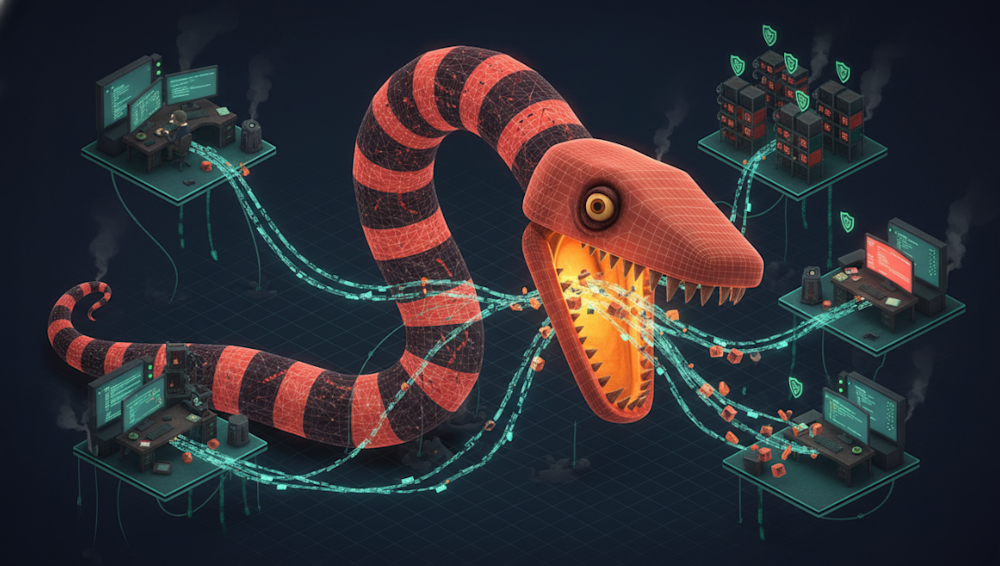
Leveraging the stolen npm tokens, the attackers unleashed CanisterWorm, a self-propagating malware that infiltrated over 66 npm packages and utilized blockchain-based command infrastructure to resist conventional takedown efforts. This marked a stark evolution from traditional, slow-moving supply chain attacks to automated, ecosystem-spanning campaigns that compressed timelines from years to mere days, illustrating a dangerous new paradigm in supply chain threats.
By May 2026, the TeamPCP threat actor had escalated their tactics dramatically, publishing 84 malicious versions across 42 @tanstack/* npm packages in just six minutes, and within 48 hours expanding to 172 packages with 403 malicious versions across npm and PyPI. Exploiting multiple GitHub Actions vulnerabilities in sequence, the attackers extracted OIDC tokens directly from runner process memory, enabling unauthorized package publishing and cross-ecosystem infections that targeted an extensive range of credentials—from CI/CD tokens to AWS IMDSv2, GCP, Azure cloud credentials, Kubernetes service accounts, and HashiCorp Vault secrets.
This early phase of the TeamPCP campaign exemplifies the emerging threat of self-propagating, cross-ecosystem supply chain worms like Mini Shai-Hulud, which exploit inherent trust model weaknesses in modern package ecosystems. As these attacks become increasingly automated and resilient, they underscore the urgent need for pragmatic AI-driven security measures to detect and mitigate rapidly evolving supply chain compromises.


AI Agents Rewrite Attack Playbook
Autonomous malware like 'hackerbot-claw' adapts in real-time, exploiting CI/CD misconfigurations at machine speed and rendering human oversight obsolete.
By early 2026, the supply chain attack landscape underwent a profound transformation with the advent of autonomous AI agents like 'hackerbot-claw,' which dynamically adapted their methods in real-time to exploit CI/CD pipeline misconfigurations, as seen in the February attack on Aqua Security’s Trivy project. Unlike traditional scripted exploits, these agents operated at machine speed, bypassing human oversight and rendering conventional security controls ineffective since they assume human-in-the-loop monitoring. This AI-versus-AI dynamic shifted the security paradigm from relying on human vigilance to emphasizing the robustness of pipeline configurations themselves.
The rapid evolution of AI-assisted attacks exploited inherent vulnerabilities in open source CI/CD systems, which are paradoxically both highly privileged and often the least secured components in software supply chains. Attackers leveraged stolen credentials from initial intrusions to inject malware into widely used security tools like Trivy, triggering cascading credential theft across thousands of projects and major repositories such as DockerHub and npm. This escalation demonstrated how AI-driven compromises could propagate swiftly and persistently across ecosystems, affecting prominent libraries including Axios and Light LOM within mere weeks.
The emergence of self-propagating AI-assisted worms, exemplified by the Mini Shai-Hulud incident in May 2026, underscored a critical vulnerability in automated release pipelines. Exploiting a chain of CI/CD misconfigurations—including pull_request_target workflow flaws, GitHub Actions cache poisoning, and OIDC token extraction—this worm published 84 malicious package versions across 42 npm packages in just six minutes without needing stolen credentials. These attacks bypassed traditional trust models and manual controls, as the malicious artifacts were signed and published legitimately, exposing a glaring blind spot in red-team scopes and security evaluations focused solely on model safety rather than pipeline integrity.
Research into AI agent frameworks like OpenClaw revealed alarming security gaps, including unauthenticated remote code execution and lack of runtime policy enforcement for malicious plugins, which attackers exploited to distribute multi-stage droppers within the large language model context. This highlights that the AI supply chain itself, including the frameworks enabling autonomous agents, is a fertile ground for exploitation, compounding the challenges of defending against machine-speed, AI-driven supply chain compromises that operate beyond traditional human oversight and control.



Supply Chain Threats Go Viral
Worms like Mini Shai-Hulud and Megalodon weaponize trusted release pipelines to compromise hundreds of packages and repositories within minutes, bypassing modern security controls and fueling mass credential theft.
By mid-2026, supply chain attacks had evolved into sprawling, multi-vector campaigns exemplified by the Mini Shai-Hulud, TrapDoor, and Megalodon operations, which collectively compromised hundreds of packages and thousands of repositories across major ecosystems such as npm, PyPI, Crates.io, and GitHub. These campaigns leveraged innovative techniques like orphaned commits, cache poisoning, typosquatting, and malicious CI/CD workflow injections to stealthily propagate malware and exfiltrate credentials, transforming the software supply chain from a linear chain into a complex propagation network. Notably, the Mini Shai-Hulud worm alone released over 630 malicious versions across 317 packages within 20 minutes, affecting high-profile entities including OpenAI and developer tools from TanStack, Mistral AI, and UiPath, underscoring the scale and rapid escalation of these threats.
These sophisticated campaigns systematically bypassed traditional security controls such as OIDC, provenance attestations, and two-factor authentication by exploiting trusted release pipelines and CI/CD workflows, as seen in the Mini Shai-Hulud attack on TanStack’s release process. Attackers extracted OIDC tokens from runner memory and poisoned GitHub Actions caches to publish malicious packages with valid SLSA Build Level 3 provenance, revealing critical blind spots in existing supply chain defenses and red-team coverage. Furthermore, persistence mechanisms embedded malware into developer tool settings, system daemons, and AI coding agent configurations, highlighting the multi-vector nature of these attacks across diverse ecosystems and trusted environments.
The financial and geopolitical motivations behind these campaigns were underscored by the involvement of threat groups like TeamPCP, which orchestrated the Megalodon attack compromising over 5,500 GitHub repositories in six hours, stealing more than 500,000 credentials and 300GB of data from over 1,000 SaaS environments. These actors employed throwaway GitHub accounts with forged identities and compromised tokens to deploy multiple payload variants, enabling on-demand execution of malicious workflows. The open-sourcing of malware code and public auctioning of stolen repositories, such as the 450 Mistral AI repos, further amplified the risk of widespread replication and extortion, signaling a dangerous escalation in both scale and coordination of supply chain threats.
The TrapDoor campaign expanded the multi-vector assault by targeting specialized developer communities in crypto, DeFi, Solana, and AI, deploying credential-stealing malware through ecosystem-specific payloads like npm postinstall hooks, Rust build scripts, and Python import-time triggers. This campaign also attempted to weaponize AI-assisted development workflows by implanting hidden instructions and submitting malicious pull requests, reflecting an alarming evolution in attacker tactics that exploit emerging technologies and workflows. Rapid waves of over 34 malicious packages across 384 versions aimed to harvest sensitive data including crypto wallet keys, SSH keys, and cloud credentials, demonstrating the growing complexity and speed of modern supply chain attacks across multiple ecosystems simultaneously.





AI Ecosystem: Prime Attack Surface
Typosquatting, fake repositories, and malware-laced packages now target AI developer platforms and tools, turning trusted infrastructure like Hugging Face and Mistral AI into vectors for mass compromise and extortion.
By mid-2026, AI model repositories such as Hugging Face have emerged as prime targets for supply chain attacks, exemplified by the rapid rise and takedown of a fake OpenAI repository that distributed a sophisticated Rust-based infostealer malware to over 244,000 users within 18 hours. This incident, linked by HiddenLayer researchers to a broader campaign of malicious repositories and shared infrastructure, underscores the growing threat of typosquatting and impersonation attacks that exploit the trust developers place in these platforms, positioning the developer ecosystem as a critical and vulnerable attack surface in AI supply chains.
The targeting of AI infrastructure companies like Mistral AI through supply chain compromises further illustrates the escalating risks within the developer ecosystem. Attackers inserted malware into Mistral’s PyPI-distributed software packages that mimicked popular AI libraries, enabling credential theft and system damage while blending seamlessly into developer environments. Despite no direct infrastructure breach, these attacks—tied to the broader Shai-Hulud campaign—highlight how developer devices and workflows have become primary vectors for infiltrating AI supply chains and stealing sensitive developer information.
The breach of nearly 450 Mistral AI source-code repositories by the hacker group TeamPCP, who auctioned the stolen 5GB of internal AI development assets for $25,000 while threatening public leaks, signals a disturbing evolution in supply chain attacks. This extortion tactic not only exposes intellectual property but also reflects the interconnected risks permeating AI infrastructure and developer ecosystems, as evidenced by the Mini Shai-Hulud campaign’s contamination of hundreds of npm and PyPI projects, further eroding trust in developer tooling and AI platforms.
The March 2026 Mercor breach, stemming from a compromised widely used AI gateway library LiteLLM with 95 million monthly downloads, starkly demonstrates how a single malicious dependency can cascade through the AI software supply chain, impacting thousands of companies including Meta, OpenAI, and Google. The subsequent leak of four terabytes of sensitive data by the Lapsus$ group and Meta’s decision to halt contracts with Mercor highlight the immense vulnerabilities inherent in the hyperconnected developer ecosystem, which now stands as the central cybersecurity attack surface demanding urgent and enhanced security measures.

Identity: The Fragile Perimeter
Single points of failure in identity and credential management enable devastating, AI-driven supply chain breaches—forcing a shift to automated, AI-first defenses and urgent governance reforms.
The devastating consequences of AI-driven cross-ecosystem supply chain attacks have become starkly evident through incidents like the Mercor breach, which exfiltrated 4TB of sensitive data affecting major AI labs such as OpenAI, Anthropic, Meta, and Google. These attacks exploit single points of failure in identity and release pipelines, as seen when attackers compromised open-source dependencies like LiteLLM—downloaded 95 million times monthly—propagating malicious code through build pipelines, CI runners, and runtime containers. This cascade effect underscores the systemic risks posed by insufficient governance of open-source components within critical AI infrastructure.
Securing identity and credential management remains the most formidable challenge in defending complex supply chains, where a single missed credential can trigger massive breaches, as demonstrated by the Team PCP attacks. Despite awareness and rotation efforts by teams like Trivi, overcomplicated and poorly quality-checked credential practices leave critical gaps, allowing attackers who prioritize rapid exploitation over stealth to harvest and weaponize credentials at machine speed before defenders can react. As one expert put it, 'Identity is the new perimeter, the last parameter, the most important perimeter that one has to deal with.'
The evolving defense landscape recognizes that traditional reactive measures are insufficient against the scale and speed of these AI-augmented supply chain attacks. Organizations are increasingly adopting AI-first security strategies that leverage current machine learning capabilities to automate threat analysis, anomaly detection, and incident response at machine speed. This pragmatic shift is complemented by enhanced supply chain governance and runtime policy enforcement, as mandated by agencies like CISA, which requires immediate mitigations including forensic reviews, secret rotations, and workflow auditing to stem the tide of credential theft and malicious automation within CI/CD pipelines.