AI ‘SaaSpocalypse’ rattles software stocks as geopolitics and bubble fears collide
The gist
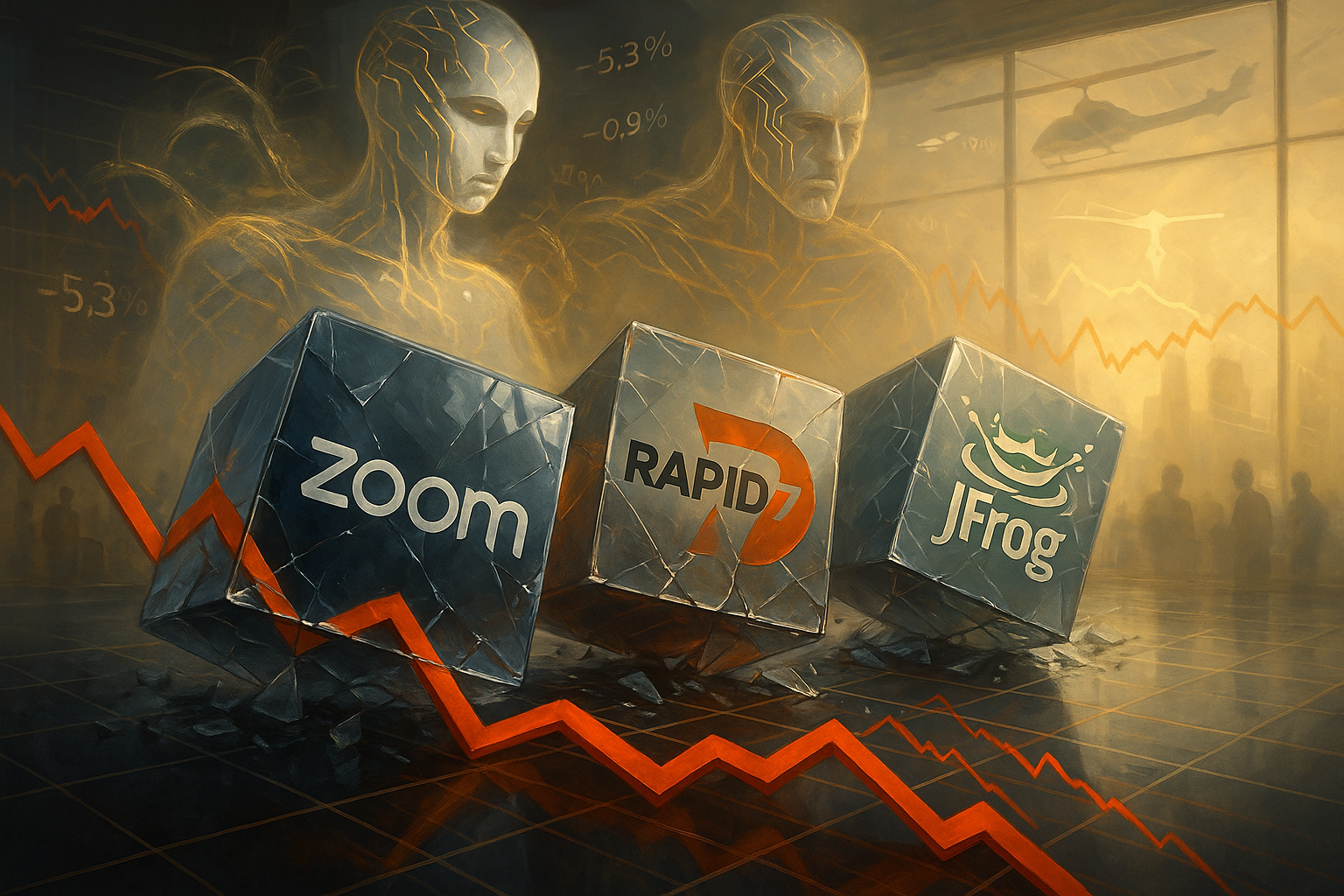
AI-powered disruptors like Anthropic’s latest Claude models are fueling a dramatic selloff in software stocks as investors panic over the end of the per-seat SaaS era and mounting market risks.
What to know
- Workday, Oracle, and Bandwidth shares tumbled up to 7% as ultra-cheap AI agents threaten traditional subscription models.
- Geopolitical shocks near the Strait of Hormuz and rising interest rates have deepened the software sector’s rout, hitting long-duration assets like Palantir and Accenture.
- Investor sentiment is split—hyperscalers and AI-integrated 'software plus' firms attract capital, while legacy SaaS giants like Salesforce and Adobe see steep declines despite strong results.
AI Agents Upend SaaS Models
Anthropic’s latest AI models have reignited a sector-wide selloff as ultra-cheap AI agents threaten the core economics of traditional enterprise software subscriptions, forcing companies to rethink their entire revenue strategies.
The release of Anthropic's advanced AI models, Claude Fable 5 and Claude Mythos 5, has reignited fears that traditional per-seat SaaS subscription models are becoming obsolete, driving a renewed and widespread selloff in enterprise software stocks. This 'SaaSpocalypse' thesis, initially triggered by the January launch of Claude Cowork which caused a staggering $285 billion rout in software valuations, is reinforced by the fact that AI agents available for as little as $20 a month can now perform complex, multi-step knowledge work, challenging the justification for costly enterprise subscriptions. Companies such as Workday, Oracle, Palantir, and others have seen share declines around 3%, while more volatile names like Bandwidth and Five9 have experienced drops exceeding 7%, underscoring sector-wide valuation pressures amid these AI-driven disruptions.
Investor sentiment remains cautious despite intermittent rebounds in software stocks fueled primarily by retail and options trading rather than institutional buying. Portfolio managers who reduced exposure during the initial SaaSpocalypse are largely waiting for a meaningful pullback before re-entering, reflecting persistent uncertainty over the long-term viability of legacy SaaS revenue models in an AI-dominated landscape. This hesitancy is evident even as some firms, like Lead Edge Capital, identify pockets of resilience in data management SaaS and advocate for 'software plus' business models that integrate AI capabilities to innovate beyond traditional subscription frameworks.
The market's anxiety over AI-driven cannibalization of per-seat subscriptions is compounded by real-world signals and macroeconomic headwinds, including geopolitical tensions such as the Iranian attack near the Strait of Hormuz and rising interest rates that disproportionately affect long-duration software assets. Accenture's near-20% single-day drop after citing AI compressing demand for traditional IT services served as a stark confirmation of these fears, further pressuring enterprise software valuations. Nonetheless, some companies like Salesforce are proactively adapting by acquiring usage-based billing platforms such as m3ter to monetize AI-driven actions rather than seats, suggesting a potential pathway for offsetting legacy revenue erosion if successfully scaled.

Geopolitics Intensifies Tech Rout
The downing of a US helicopter near the Strait of Hormuz has amplified macroeconomic headwinds, triggering deeper software stock declines as investors brace for higher rates and escalating global risks.
The recent downing of a US Apache helicopter near the Strait of Hormuz, which President Trump attributed to an Iranian attack, has sharply escalated geopolitical tensions, prompting retaliatory strikes and injecting fresh uncertainty into the enterprise software market. This incident not only heightens geopolitical risk but also reinforces investor concerns about sustained higher interest rates, as such conflicts typically bolster the Federal Reserve's cautious stance amid a strong labor market, exemplified by 172,000 nonfarm payroll jobs added in May. Consequently, software stocks—valued as long-duration assets dependent on future cash flows—face amplified vulnerability, with companies like Workday, Oracle, and Palantir experiencing intensified selloffs as investors recalibrate risk amid these compounded macroeconomic headwinds.
The convergence of geopolitical turmoil and macroeconomic pressures is compounding existing challenges from AI-driven disruption in the software sector, deepening investor caution and valuation pressures across the board. As firms like Zscaler, Dynatrace, and Nutanix grapple with this dual squeeze, the market's sensitivity to prolonged higher interest rates—now more likely due to geopolitical conflict and robust economic data—exacerbates the selloff. This dynamic underscores how external shocks, such as the Apache helicopter incident, serve as catalysts that intensify the sector-wide revaluation already underway amid fears that AI innovations like Anthropic’s Claude models threaten traditional subscription revenue models.


Bubble Fears Meet Market Reality
Sky-high private AI valuations and soaring infrastructure costs are fueling a speculative frenzy in tech, while even strong-performing software firms face plunging stocks as investors question what’s real and what’s hype.
Investor sentiment is marked by heightened caution and skepticism amid fears of an AI-driven valuation bubble that surpasses even the dot-com era, with OpenAI and Anthropic privately valued near $900 billion each—exceeding the $780 billion total market cap of all US venture-backed IPOs from 1995 to 2000. Experts like William Goldman remind us that platform transitions are fraught with false starts and uncertainty, underscoring the unpredictability of AI’s long-term market impact and fueling concerns about speculative enthusiasm and valuation disconnects.
The enterprise software sector exemplifies this valuation disconnect and investor caution, as strong fundamentals from companies like Adobe—reporting 11% revenue growth and all-time high earnings—fail to buoy stock prices, which have plunged 47% year-over-year amid fears of AI disruption. Meanwhile, high-growth firms such as Palantir surged 135% last year, illustrating a polarized market where speculative enthusiasm coexists with broad skepticism, leading some analysts to question whether solid performers are undervalued bargains or value traps.
Market volatility and valuation pressures are compounded by the costly nature of AI infrastructure, requiring massive capital outlays—estimated at $5 trillion—amid rising interest rates and tighter financing conditions. This environment sustains speculative enthusiasm only as long as investors continue subsidizing AI operations without clear returns, prompting warnings from experts like Chris Davis who advocate for investing in established tech giants with strong cash flows rather than high-risk AI pure plays, highlighting the psychological bubble around AI investments despite the technology’s transformative potential.
Despite the turbulence, contrarian voices like Vijay Morolia see current low valuations in powerful software stocks as rare buying opportunities, arguing that market emotions have overtaken facts and that AI adoption will be gradual rather than abrupt. However, the path to equilibrium remains uncertain, with ongoing volatility reflecting the market’s struggle to price in AI’s disruptive potential accurately, suggesting that further corrections may precede a more stable valuation landscape as investors reconcile speculative enthusiasm with underlying economic realities.






Winners, Losers, and Cautious Bets
Institutional investors are shifting capital toward adaptable ‘software plus’ firms and AI infrastructure giants, while legacy SaaS players and retail traders are left navigating a fractured, volatile landscape.
Institutional investors are adopting a nuanced stance amid the AI-driven upheaval in enterprise software, selectively backing SaaS firms that demonstrate resilience through innovative 'software plus' models and regulatory tailwinds, particularly in European fintech. Lead Edge Capital’s Brian Lobdell highlights this selective optimism, emphasizing a long-term view that values adaptability and evolving market dynamics over wholesale sector abandonment.
Market reactions reveal a stark divergence between AI infrastructure giants and traditional SaaS incumbents, with companies like Palantir, Microsoft Cloud, and Oracle Cloud Infrastructure posting robust revenue growth—135%, 39%, and 84% respectively—while legacy players such as Salesforce and Adobe endure steep valuation declines despite solid earnings. This bifurcation reflects investor preference for hyperscaler-driven AI investments amid constrained IT budgets, as a CIO survey indicates only 3% overall IT budget growth but over $660 billion earmarked for AI infrastructure.
Investor sentiment is fragmented across institutional and retail spheres, with some cautioning against chasing AI hype and instead advocating for value in strong multi-sided network businesses currently undervalued due to capital flight into AI trades. As one analyst advises, resisting speculative mania is a competitive advantage, underscoring a split between speculative enthusiasm for rapid AI gains and prudent long-term investment strategies that recognize ongoing volatility and sector-wide valuation pressures.
Within subsectors, performance disparities underscore the complexity of AI adoption: cybersecurity firms like Datadog, CrowdStrike, and Palo Alto Networks maintain near year-to-date highs due to perceived defensibility, while traditional SaaS companies reliant on per-seat subscription models—Adobe, Salesforce, Intuit, DocuSign—face sustained selloffs and skepticism despite solid fundamentals. Meanwhile, emerging AI-enabled competitors such as Figma and Canva gain market share but struggle with poor stock performance, illustrating uneven investor confidence and the gradual, uneven pace of disruption as enterprise switching costs slow adoption.