AI shops, humans decide: trust gap stalls agentic commerce revolution
The gist
AI shopping assistants are everywhere, but consumers still demand human oversight—and a lack of trust is holding back the agentic commerce revolution.
What to know
- By early 2026, over half of shoppers used AI for research, but only 4% completed purchases through AI, showing people trust bots for advice, not action.
- A whopping 85% of consumers still prefer human interaction and 73% stay loyal to brands that guarantee real-person support, highlighting the 'AI Paradox.'
- Security fears run deep: in MENA, 62% prioritize safe payments and 28% abandon carts over trust issues, pushing brands to simplify policies and offer fast 'undo' options to keep customers on board.
AI Powers, Humans Prevail
AI excels at research and routine shopping, but emotionally charged and complex purchases remain firmly in human hands as shoppers use bots for guidance, not final decisions.
AI is predominantly reshaping the practical and mid-range shopping landscape by streamlining research, optimizing pricing, and automating routine purchases, while leaving impulse buys and high-consideration items like cars and houses largely untouched due to their need for immediate decisions or human expertise. For instance, AI agents aggregate consumer feedback from platforms such as TikTok and Reddit to tailor recommendations, and continuously scan for the best prices on repeat purchases, enabling consumers to save time and money. This nuanced role reflects a balance where AI enhances efficiency without fully replacing human involvement, especially for complex or emotionally driven purchases.
By early 2026, AI had transitioned from a novelty to an integral part of the shopping journey, with 52% of consumers using AI tools and nearly half initiating their shopping with AI-enhanced research. Retail giants like Walmart partnered with ChatGPT to enable direct purchases through AI, while 97% of U.S. retailers planned AI integrations for customer service and pricing, signaling widespread industry adoption. However, despite this momentum, real-world agent commerce adoption remains cautious, exemplified by Target being the only major retailer with a chatbot app in app stores as of March 2026, highlighting a gradual but steady embrace of AI-driven commerce.
AI's transformative power is most evident in the discovery and research phases of shopping, where it acts as a 'personal friend' guiding consumers through clarification, simplification, personalization, and persuasion layers to build trust. This role revives a more thoughtful shopping experience by informing intent before purchase, as consumers use AI to research, compare, and learn about products while retaining human judgment for final decisions. Notably, AI chatbots reduce friction and improve decision quality, with 29% of consumers more likely to shop on sites featuring them, yet only 4% complete purchases directly within AI platforms, underscoring AI’s supportive rather than substitutive function.
The evolving AI shopping ecosystem is marked by contrasting integration strategies and emerging risks: Amazon’s AI voice assistant embedded in its marketplace achieves 3.5 times higher conversion than traditional search, reflecting the power of vertical integration, while Google pursues a horizontal open protocol approach for agentic commerce. Meanwhile, Shopify’s AI-powered shopping agents promise autonomous product discovery and purchasing but raise concerns about diminished brand storytelling and the reliability of product information, as AI increasingly relies on ad-driven content. These dynamics suggest that while AI is expanding its scope in shopping, maintaining trust and balancing automation with human engagement remain critical challenges.






Trust Tax on Brands
Brands face a new pressure to prove AI reliability and emotional sensitivity, as even minor bot missteps can quickly erode consumer trust and loyalty.
By early 2026, AI had become the default entry point for many consumers beginning their shopping journeys, with over half using AI tools for research and deal discovery. However, this shift from novelty to necessity imposed a 'trust tax' on brands, as customers now judge AI-driven experiences primarily on reliability and transparency rather than innovation. When AI agents misinterpret or overconfidently present inconsistent brand policies or product details—as highlighted by PayPal and others—consumer trust erodes quickly, underscoring the critical importance of clear, human-centered communication in AI commerce.
Emotional resistance remains a formidable barrier to fully autonomous AI commerce, fueled by consumers’ preference for human interaction and skepticism about AI’s ability to handle complex, sensitive decisions. Studies reveal that 85% of customers prefer speaking to a real person, and 73% show greater loyalty to companies guaranteeing human support, illustrating the 'AI Paradox' where automation’s efficiency clashes with the emotional need for connection. This tension is evident in regional behaviors too; for example, despite high AI tool usage in the UAE and Egypt, fewer than 40% trust AI to complete payments, reflecting persistent privacy and security concerns that brands must address to avoid alienating customers.
Regional and demographic variations profoundly shape trust and adoption of AI-driven shopping agents. In MENA, while openness to AI agents is high, privacy concerns dominate, with 55% citing it as a barrier and 62% prioritizing secure payments, leading to measurable behaviors like cart abandonment and brand switching due to security fears. Similarly, European consumers show uneven trust, with 41% distrusting any AI shopping agent provider and banks emerging as the most trusted developers. Moreover, willingness to delegate purchases skews by product category and income, with mundane or high-tech items more likely to be entrusted to AI than health or groceries, and higher-income consumers expressing greater comfort with AI agents.
The persistent 'trust tax' brands face when prioritizing automation over human connection is compounded by consumers’ emotional resistance rooted in enjoyment of shopping and broader cultural backlash against digital automation. Research shows that even successful AI purchases often trigger anxiety or frustration, with many consumers feeling disconnected from the experience. This emotional barrier is heightened by AI’s current inability to autonomously complete transactions effectively, as demonstrated by Elizabeth Seagrin’s failed attempts with ChatGPT and Claude, and by widespread concerns about fraud and identity verification. Consequently, experts emphasize that the winning strategy lies in augmenting human agents with AI support rather than replacing them, building transparent, secure, and emotionally resonant trust frameworks to bridge the gap between hype and reality.



AI Agents Rewrite Retail
AI-driven platforms now control the shopping journey, forcing brands to fight for visibility and trust in a landscape where bots—not just consumers—choose what gets bought.
By early 2026, AI agents have emerged as the new gatekeepers in the retail landscape, mediating the customer journey and challenging traditional direct brand-customer relationships. Adobe’s data showing a 693.4% surge in chatbot-driven traffic and Walmart’s integration of ChatGPT for direct purchases illustrate how the shopping experience increasingly occurs off brand-owned sites, forcing retailers to proactively define AI behavior, tone, and escalation paths to maintain control and trust, lest they 'inherit the mess,' as NVIDIA warns.
This AI intermediation introduces significant risks to brand loyalty and trust, as consumers often blame brands—not the AI—for errors or confusing information. Studies reveal that over 27% of customers could be lost due to distrust, with 68% suspecting AI agents may not act in their best interests and 40% experiencing anxiety over automated purchases. Consequently, brands must simplify policies, clarify product details, and design fast 'undo' options, treating policies as integral to the product to mitigate what Horizon Media terms the 'Trust Tax.'
Retailers face a fragmented AI commerce ecosystem where multiple platforms and agentic protocols coexist, requiring operational flexibility beyond single rigid integrations. As Dust’s $40M funding underscores, AI assistants now act as buyers deciding brand shortlists, while Google’s shift to answer-based search—with 60% of queries ending in direct answers rather than clicks—threatens brand visibility. To stay relevant, marketers must audit and optimize presence across SEO, AI-enhanced search answers, and AI-generated responses, adapting to a marketplace where brands compete not just for attention but to be selected by algorithms.
Despite initial fears that AI-driven commerce would decimate retailer traffic and retail media revenues, consumer adoption has been slower and more nuanced than expected. Andrew Lipsman highlights that while retailers anticipated rapid traffic loss, consumer behavior lags technology adoption, prompting a strategic retreat from fully autonomous AI commerce models—exemplified by ChatGPT abandoning instant checkout and Walmart integrating AI as an app rather than a direct commerce agent. This evolving landscape demands that retailers and marketers rethink engagement strategies to maintain trust and loyalty amid AI’s growing role as a personal shopper during discovery rather than solely at purchase.



Security Sets the Standard
Robust identity checks, clear policies, and instant 'undo' features are now the baseline for AI commerce, with markets like MENA and China revealing just how high the bar is set.
By early 2026, the foundation of secure agentic commerce hinges on robust identity verification, consent protocols, and fraud protection mechanisms, as emphasized by PayPal's insistence that trust is the 'price of admission' for AI-driven transactions. Clear, consistent policies must be crafted with precision since AI agents directly interpret and present brand information, making policy clarity essential to maintain customer trust and limit liability. Moreover, a swift and reliable 'undo' function is critical to address errors in AI-initiated purchases, reinforcing consumer confidence in this emerging commerce paradigm.
The Middle East and North Africa (MENA) region has emerged as a pivotal testbed for agentic commerce, where security and payment safety are paramount to consumer adoption. Despite 97% of MENA consumers demanding invisible, frictionless payment methods, 62% prioritize secure payment processes, with 28% having abandoned purchases over security fears. Mastercard’s Agent Pay launch in the UAE exemplifies efforts to integrate AI into payments securely, while privacy concerns—cited by 55% of consumers—underscore the urgent need for transparent identity and data protection frameworks to build trust.
The rapid rollout of Alipay’s AI-delegated shopping in China spotlights the complex security and identity challenges inherent in agentic commerce, including trust, dispute resolution, and consumer protections. This contrast with slower adoption in Western markets—hampered by fragmented data and stringent regulations—illustrates how regulatory environments and infrastructure critically shape consumer confidence. Experts advocate for clear regulations, consumer education, and customizable AI parameters to balance innovation with safety, highlighting the indispensable role of governance in this evolving landscape.
A core technological hurdle remains the establishment of a secure, verifiable identity link connecting consumers, their devices, and AI agents, as traditional internet security frameworks treat non-human actors as threats. Initiatives like Experian’s Agent Trust framework and Skyfire’s open standards aim to create interoperable identity and payment layers, issuing tokens that validate identity and mitigate fraud risk in real time. This collaboration among Experian, Visa, Cloudflare, and others is vital to closing the trust gap, especially as false declines currently contribute to an estimated $430 billion in lost global sales annually, undermining consumer confidence and agentic commerce growth.
Despite widespread AI tool usage in shopping—85% in the UAE and 91% in Egypt—consumer trust in AI to complete payments remains low, with only 32% and 38% respectively willing to let AI agents handle checkout. Financial scams, particularly on social media where up to 46% of fraud occurs, exacerbate these concerns. Consumers overwhelmingly expect banks, regulators, and payment providers to lead fraud prevention, with real-time alerts and trusted payment logos identified as key features to enhance security perceptions. Interestingly, many consumers also see AI as a critical ally in fraud detection, signaling a dual role for AI in both enabling and securing agentic commerce.
In Europe, banks are widely regarded as the most legitimate entities to develop AI shopping agents, with 27% favoring their involvement, underscoring the importance of trusted financial institutions in addressing identity and payment security challenges. However, consumer trust remains a significant barrier, as 41% of Europeans do not trust any actor to provide a purchasing agent. This skepticism varies regionally, with Northern European countries like Norway and the Netherlands showing higher awareness and readiness compared to France and Belgium, suggesting that infrastructure maturity and regulatory clarity are key to fostering confidence and secure deployment of AI-driven commerce.

The Human Touch Endures
Despite AI’s rise, consumers and retail workers demand real human connection, making hybrid models and associate empowerment the key to successful AI integration.
By mid-2026, it became clear that consumers are not ready to surrender the entire shopping experience to AI; instead, they prefer AI to assist with discovery and research, preserving a human element in the process. This nuanced interaction reflects a 'return to thoughtful discovery' where AI informs intent before it fully forms, enhancing rather than replacing human decision-making. However, trust remains a critical barrier, especially when AI acts autonomously, as customers require a much higher confidence level to let AI 'do things for you in the background' compared to simple chatbot interactions.
A strong consumer backlash against AI-only customer service has emerged, underscoring the enduring value of human interaction. A 2026 AnswerConnect study found that 85% of customers prefer speaking to a real person, with 73% showing greater loyalty to companies guaranteeing human support. This 'AI Paradox' reveals that while automation cuts costs, 57% of customers report decreased trust when businesses rely heavily on AI, especially in emotionally charged or complex situations where empathy is crucial. Industry leaders like AnswerConnect’s CEO Natalie Ruiz emphasize that AI’s failure is not technological but stems from removing the human understanding customers crave, advocating for AI to augment rather than replace human agents.
Retail associates remain indispensable in realizing AI’s potential, as their engagement and trust directly influence AI-driven customer experience success. Despite AI’s ability to automate manual tasks and improve scheduling and task guidance, challenges persist in integrating AI tools and securing associate buy-in. Early adopters report that treating associates as partners through unified workflow platforms enables AI to streamline administrative burdens, allowing staff to focus more on personalized customer interactions and satisfaction. This human-AI partnership is crucial to overcoming the 'associate gap' and ensuring AI investments translate into enhanced service rather than alienation.
Beyond trust, cultural factors fuel resistance to fully automated shopping, as many consumers genuinely enjoy the physical and social aspects of shopping. Sarah Marzano highlights that 'people actually enjoy shopping in a lot of cases,' and this enjoyment creates friction against delegating the entire process to AI. This sentiment is part of a broader 'friction maxing and analog lifestyle' backlash, where consumers value tangible, real-world experiences and view physical shopping as a beneficial activity. Consequently, AI adoption may bifurcate, with customers willing to let AI handle mundane purchases like paper towels but preferring personal involvement for meaningful or enjoyable items.


MENA and China Lead, Cautiously
Digital-first economies in MENA and China are racing ahead with AI shopping, but deep-rooted privacy and security concerns keep full consumer trust out of reach.
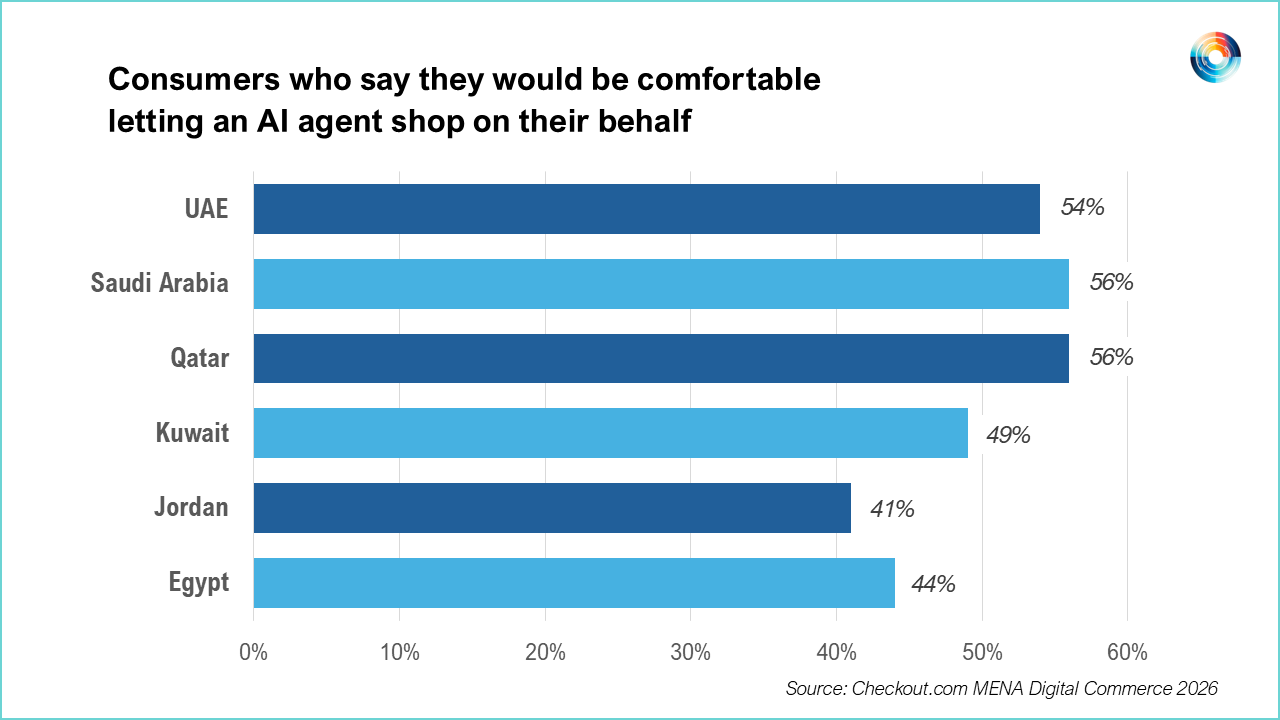
By mid-2026, the MENA region has emerged as a pioneering market for AI-driven shopping, with half of consumers comfortable delegating purchases to AI agents—peaking at 56% in Saudi Arabia and 54% in the UAE. This enthusiasm is propelled by advanced digital economies and widespread digital wallet usage, exemplified by Saudi Arabia surpassing its Vision 2030 cashless target ahead of schedule and 64% of MENA consumers using digital wallets monthly. However, trust remains a critical hurdle: 55% of consumers cite privacy concerns as the main barrier, and payment security dominates priorities, with 62% demanding safe transactions and nearly a third abandoning carts over security fears, underscoring the delicate balance between rapid adoption and consumer confidence.
Despite high AI shopping engagement in MENA—85% in the UAE and 91% in Egypt—trust sharply declines when AI agents attempt to complete payments, with only about a third of consumers comfortable allowing AI to finalize checkouts. Social commerce, while dominant (69% in the UAE, 85% in Egypt), doubles as a hotspot for financial scams, accounting for up to 46% of fraud cases, which fuels consumer demand for institutional fraud protection. Reflecting this, only a minority of consumers feel responsible for fraud prevention, instead placing trust in banks and regulators, while simultaneously viewing AI as a promising future ally in fraud detection, with over 85% expecting AI to enhance security measures.
China’s rapid AI commerce adoption, exemplified by Alipay’s 100 million users leveraging AI-delegated shopping, highlights how integrated technological ecosystems and cultural acceptance can accelerate AI commerce uptake. This contrasts sharply with Western markets, where fragmented data infrastructures and stringent regulations slow adoption. Experts emphasize that region-specific regulatory frameworks and consumer education are essential to build trust and safely harness AI’s potential, underscoring the need for tailored approaches rather than one-size-fits-all solutions.
In Europe, AI shopping adoption reveals stark regional disparities: Northern countries like Norway and the Netherlands show high awareness (76% and 68%, respectively), while Southern Europe lags behind (38% in France, 44% in Belgium). Trust remains the foremost barrier, with 41% of Europeans distrusting any AI shopping provider and viewing banks as the most legitimate developers of AI agents. Moreover, Europeans are more willing to delegate AI purchases in electronics and high-tech sectors (45%) than in sensitive categories like health and groceries (16%), reflecting cautious consumer segmentation. This cautiousness is further influenced by e-commerce maturity, as seen in Germany’s higher weekly online shopping rate (36%) compared to France (19%), which correlates with faster AI adoption.