AI sparks CPU comeback: AMD and intel ride agentic wave as data center market doubles
The gist
AI’s insatiable appetite is fueling a stunning CPU comeback—propelling AMD and Intel to record highs as data center chip demand and market value go supernova.
What to know
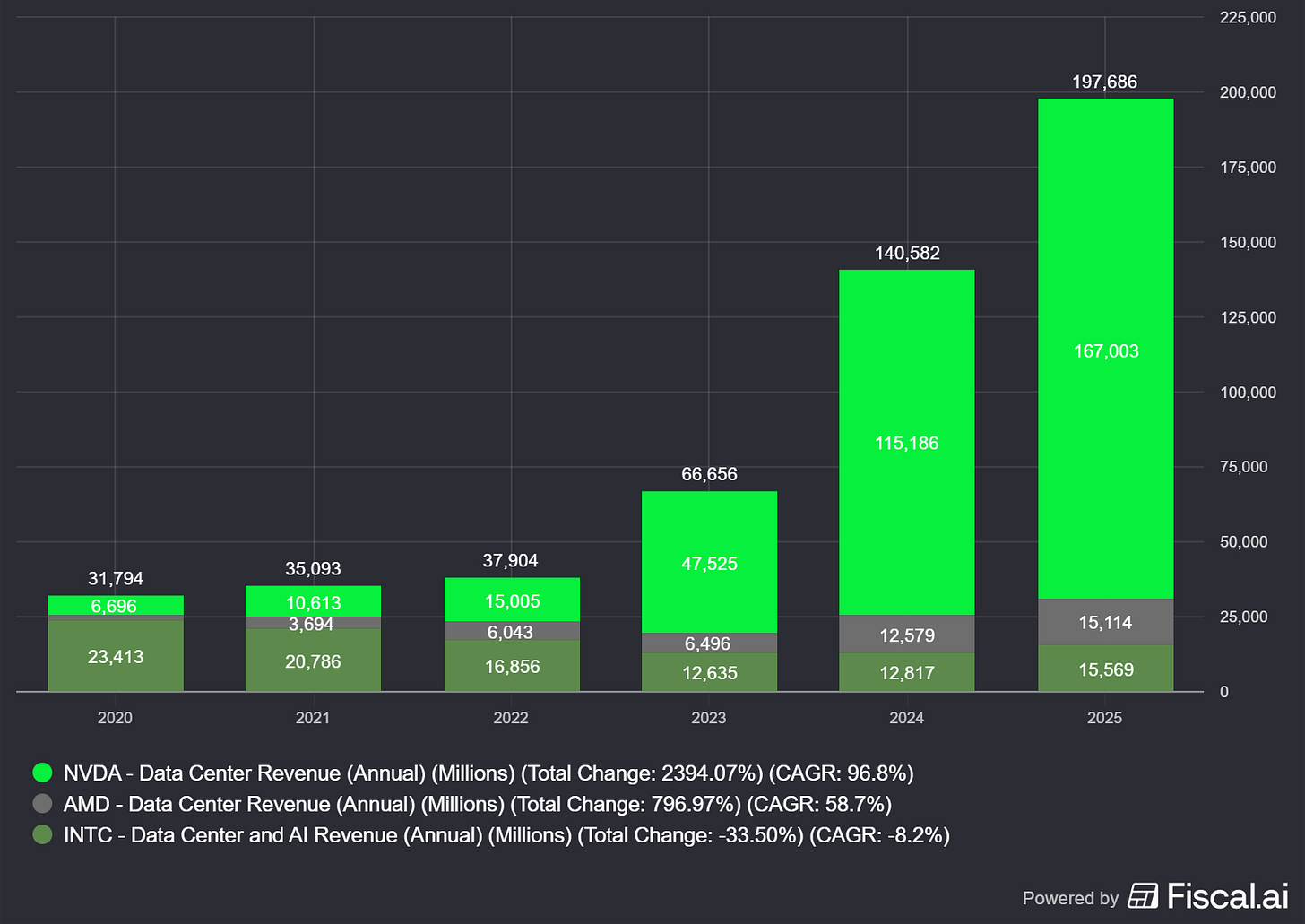
- AI-driven CPU demand is set to nearly double the data center market to $125B+ by 2030, with AMD targeting 50%+ server share and Intel’s Data Center revenue up 22% YoY.
- Severe supply chain crunches—especially at TSMC’s 3nm lines—have hiked CPU prices up to 20% and triggered aggressive, multi-year capacity expansions from chipmakers.
- The agentic AI boom is flipping the CPU-to-GPU script, making CPUs the new stars for orchestration and inference and sending Intel stock up 22% and AMD up 12% in April 2026.
CPUs Regain Data Center Glory
Agentic AI and inference workloads are reversing the CPU-to-GPU balance, fueling AMD’s quest for server dominance and cementing CPUs as the backbone of next-gen data centers.
By late 2025, the data center total addressable market (TAM) was projected to nearly double to $1 trillion by 2030, fueled primarily by AI infrastructure investments and hyperscaler capital expenditures. AMD, recognizing this massive opportunity, aimed to expand its server CPU market share from about 40% to over 50%, with AI-driven workflows expected to generate an additional $30 billion in CPU revenue by 2030. CEO Lisa Su notably debunked the myth that AI renders CPUs irrelevant, emphasizing CPUs as the cash flow engine amid this explosive growth.
Entering 2026, the surge in CPU demand became unmistakable, driven by massive x86 server upgrades and the rise of agentic AI inference workloads that require CPUs for system orchestration and persistent context. Morgan Stanley forecasted an incremental $32.5–$60 billion CPU TAM within a broader server CPU market exceeding $100 billion, highlighting a fundamental shift in data center chip spending beyond GPUs toward CPUs and memory. This transition benefits not only CPU vendors like Intel and AMD but also a wide ecosystem including foundries and advanced packaging providers.
Intel CEO Lip-Bu Tan and AMD CEO Lisa Su both underscored a dramatic shift in the CPU-to-GPU ratio in AI workloads—from roughly one CPU per eight GPUs to near parity or even CPU dominance—as AI inference and agentic AI multiply CPU-intensive tasks. This shift is driven by AI systems that, after heavy GPU training, run continuously on CPUs for user-facing applications, creating a surge in CPU workloads and shortages. AMD’s partnerships with OpenAI and Meta, along with its launch of the first desktop chip certified for Microsoft’s Copilot, exemplify the strategic moves capturing this CPU renaissance.
By mid-2026, AMD’s data center revenue soared 57% year-over-year, with CEO Lisa Su attributing the company’s massive upward forecast revision to AI-driven CPU demand growth. The annual server CPU market growth forecast was revised from 18% to over 35%, with expectations for the market to surpass $120 billion by 2030. This expansion transformed the CPU TAM from $25 billion to over $125 billion, shifting the industry from a share-taking to a share-grabbing environment. Despite supply constraints and extended backlogs into 2024, AMD’s deep hyperscaler collaborations and scalable CPU architectures position it to capitalize on this unprecedented AI-driven CPU market surge.





Intel’s AI-First Pivot Pays Off
Intel is prioritizing AI server chips over PCs, sacrificing historical profit margins to capture surging demand and reposition CPUs as the nerve center of AI infrastructure.
Intel has strategically pivoted to capitalize on the surging AI-driven demand for its Xeon server processors, despite facing early 2026 supply chain constraints that limited its ability to fully meet market needs. Under CEO Pat Gelsinger's leadership, the company has focused on maximizing revenue by diverting available supply to AI workloads, resulting in a significant revenue forecast upgrade to $13.8–$14.8 billion for Q2 2026 and a 14% surge in stock price. While profit margins remain below historical highs—hovering around 37.5% compared to past peaks of 60%—this improvement is driven by higher revenues rather than cost efficiencies, reflecting Intel's prioritization of market share and capacity utilization amid ongoing supply challenges. Additionally, Intel anticipates a contrasting decline in the PC market in H2 2026 due to memory chip shortages, underscoring the company's strategic shift toward data center and AI infrastructure segments as the primary growth drivers.
Intel’s CEO Lip Bu Tan has emphasized a transformative shift in AI workloads that increasingly favor CPUs over GPUs, with the CPU-to-GPU ratio moving from one CPU per eight GPUs to potentially eight CPUs per GPU. This evolution is fueled by the rise of AI inference and agentic AI workloads, where CPUs play a critical role in orchestration, task scheduling, and managing data flow, positioning Intel to reclaim strategic control over AI infrastructure. The company’s Data Center and AI segment reflects this trend, posting a 22% year-over-year revenue increase and a more than 150% rise in operating income, signaling a successful repositioning of CPUs as central to the AI compute stack beyond traditional GPU dominance.
AMD is riding the AI-driven surge in CPU demand with remarkable momentum, reporting a 57% increase in its data center segment revenue to $5.8 billion in Q1 2026 and forecasting an impressive $11.2 billion for Q2, well above Wall Street expectations. CEO Lisa Su attributes this growth to the expanding agentic AI and inference markets, which have dramatically expanded the total addressable server CPU market from $25 billion to over $125 billion, prompting analysts to upgrade AMD’s stock ratings amid intensifying competition with Intel. Strategic partnerships, including a $60 billion AI chip deal with Meta Platforms, and deep collaboration with hyperscalers bolster AMD’s positioning, although the company faces supply chain risks from TSMC capacity constraints and memory shortages that could impact its ability to sustain this rapid growth trajectory.


Supply Crunch Redefines Chip Power
Severe 3nm foundry bottlenecks and spiking CPU-to-GPU ratios have triggered price hikes and forced chipmakers into aggressive, long-term capacity expansions.
By early 2026, the CPU market has been roiled by severe supply chain constraints, particularly at foundries like TSMC where capacity bottlenecks on advanced 3nm production lines have extended lead times and tightened supply through 2027. Intel acknowledged these constraints as a key limiter to meeting soaring AI-driven server chip demand, with shortages peaking in Q1 before expected easing in Q2. This scarcity has driven CPU prices up by as much as 20% since March, especially for server-grade chips critical to AI workloads, underscoring the intense pressure on manufacturing pipelines amid unprecedented demand.
In response to these supply challenges, major players are aggressively expanding manufacturing capacity and tightening control over production. TSMC is scaling up its N3 capacity, while Intel is boosting its advanced-node manufacturing capabilities to alleviate bottlenecks. Meanwhile, AMD is navigating wafer supply constraints and memory shortages by planning demand up to two years in advance and securing expensive memory chips critical for data centers, enabling it to fulfill strong CPU orders despite industry-wide shortages. CEO Lisa Su emphasized their proactive approach, noting, 'We've seen this coming... if you're a memory chip supplier, you want to be selling this extremely expensive memory to me and to data centers.'
The surge in AI-related CPU demand has fundamentally shifted the industry’s supply dynamics, driven by a structural change in CPU-to-GPU ratios within agentic AI workloads—from a traditional one CPU to four or eight GPUs ratio to nearly one-to-one or higher. This unexpected spike caught many customers off guard, intensifying supply shortages and backlog extensions well into 2027. Srini Perjury of AMD highlighted this shift’s impact, explaining that CPUs now play a critical role managing AI inference workloads, which has increased their importance and exacerbated supply pressures across the board.
This AI-driven demand surge is not only inflating the total addressable market for CPUs—from $25 billion to over $125 billion—but also beginning to strain consumer CPU markets such as phones and PCs, as data center products take priority due to their higher margins. However, AMD’s advanced supply chain planning, with ongoing two-year demand forecasting and supplier assurances, has so far contained major disruptions in consumer segments. Investors remain keenly focused on AMD’s ability to scale production capacity sustainably, recognizing that supply chain constraints will continue to shape growth trajectories and valuation in this rapidly evolving market.




Agentic AI Reshapes Chip Spending
The rise of persistent, multi-agent AI is shifting billions in data center investment from GPUs to CPUs and memory, intensifying supply chain complexity across the semiconductor ecosystem.
By early 2026, the rise of agentic AI has fundamentally reshaped data center chip spending, driving a substantial shift from GPUs toward CPUs and memory components. Morgan Stanley projects a $32.5–$60 billion incremental CPU market by 2030, underscoring CPUs' expanding role in orchestrating autonomous AI workloads, managing persistent context, and coordinating multi-agent systems. This evolution has broadened the semiconductor supply chain’s focus beyond GPUs to include foundries, advanced packaging, and interconnects, reflecting the increasing complexity and integration demands of AI infrastructure.
Intel’s strategic emphasis on AI inference and agentic workloads highlights the CPU’s resurgence as the central computing element in the AI era, particularly as workloads migrate from training-heavy GPU dominance to inference-centric tasks requiring sophisticated orchestration. Intel CEO Lip Bu Tan notes a significant shift in CPU-to-GPU ratios—from one CPU per eight GPUs to nearly one per four, with forecasts suggesting a potential inversion to eight CPUs per GPU—driven by CPUs’ critical functions in data flow management, memory handling, model switching, and task scheduling across multi-agent environments.
The proliferation of smaller, concurrent open-source AI models and agentic systems has amplified CPU demand well beyond initial GPU training phases, as CPUs continuously handle multi-user, multi-agent inference workloads that require persistent reasoning, token generation, and memory-intensive operations. Industry leaders like Jensen Huang emphasize that AI’s need to 'think' and 'reason' during inference has increased compute demands by roughly 10,000 times, while analysts warn of looming CPU shortages fueled by underinvestment and the shift of reinforcement learning and simulation tasks from GPUs to CPUs.
Beyond data centers, CPUs are reclaiming prominence in consumer and edge devices, driven by AI agents’ growing role in interacting with diverse software ecosystems—from browsers to creative tools—thereby skyrocketing CPU demand for orchestration and multi-agent coordination. AMD’s launch of the world’s first desktop chip certified for Microsoft’s Copilot exemplifies this trend, signaling an expanding CPU footprint in AI-powered software environments and reinforcing the centrality of CPUs in both server and client-side AI workloads amid ongoing supply constraints.


Wall Street Bets on CPU Surge
Intel’s record-breaking AI CPU revenues and bullish forecasts have supercharged its stock—and AMD’s—despite looming PC market risks and margin pressures.
Intel's stock experienced a dramatic surge in April 2026, climbing over 22% to an all-time high as AI-driven demand for its Xeon server CPUs and related memory products shattered revenue expectations. The company forecasted quarterly revenues between $13.8 billion and $14.8 billion, well above analyst estimates of $13 billion, with earnings per share nearly doubling projections at 20 cents versus 9 cents. Despite this robust top-line growth, profit margins remained subdued relative to historical peaks—hovering around 37.5% compared to past highs near 60%—indicating that margin expansion was primarily fueled by revenue increases rather than operational efficiencies. This financial performance underscored investor confidence in Intel’s pivotal role in the AI infrastructure build-out under CEO Pat Gelsinger’s leadership, who has been credited with optimizing supply chains to capture every available CPU sale, a strategy dubbed the “Lit Bhutan effect.”
Investor sentiment, while buoyed by Intel’s AI CPU momentum, was tempered by concerns over softness in the PC market anticipated in the latter half of 2026 due to memory chip inventory depletion, which could weigh on Intel’s client group sales. Nonetheless, the broader market enthusiasm was palpable, with Intel’s optimistic guidance for server CPU growth fueling confidence not only in CPU manufacturers but also in data center equipment providers. This optimism was amplified by analyst upgrades and bullish commentary from outlets like Bloomberg Podcasts and Motley Fool Money, which highlighted tangible financial gains from Intel’s AI compute strategy and a strengthened earnings outlook.
The ripple effects of Intel’s strong AI CPU earnings extended beyond its own stock, igniting a 12% surge in AMD shares despite no company-specific news. Analysts swiftly upgraded AMD’s ratings and price targets, recognizing the expanding significance of CPUs in the AI era alongside GPUs. Market observers noted that this enthusiasm reflected heightened competition between Intel and AMD, suggesting potential shifts in CPU market share as AI advancements reshape demand dynamics and intensify the rivalry within the data center processor landscape.