AI startups rewrite the playbook: lean teams, founder-led growth, and the endless race for product-market fit
The gist
AI-powered startups are scaling faster and leaner than ever, rewriting the startup playbook with ultra-compact teams, relentless experimentation, and a constant chase for product-market fit.
What to know
- Linktree froze hiring at 190 and Gamma hit $100M ARR with just 50 people by making AI agents core team members.
- Founder-led, content-driven go-to-market strategies are replacing traditional SaaS playbooks, as startups race to exploit fleeting AI-powered distribution channels.
- In the AI era, product-market fit is a moving target—startups like Juicebox must continuously reinvent as customer expectations and retention benchmarks skyrocket.
AI Teammates Redefine Scale
Startups are swapping headcount for AI agents, embedding automation into core workflows to boost velocity and talent density—yet even the leanest teams must eventually balance efficiency with strategic hiring as complexity grows.
AI is fundamentally reshaping startup execution by enabling leaner, more talent-dense teams that can achieve remarkable operational scale without ballooning headcount. Companies like Linktree have treated AI agents such as 'Devin' as junior hires, with measurable output—contributing roughly two pull requests per engineer per week on tasks like bug fixes and dependency upgrades—allowing the company to freeze hiring at around 190 employees while still increasing shipping velocity. This shift not only boosts cost efficiency, as seen in Linktree's 25x cheaper moderation and 80% scaled customer support, but also signals a new era where AI teammates are integral to the core workflow, making high-velocity execution possible with fewer people.
The integration of AI into startup teams is driving a transformation in organizational models and hiring philosophies, prioritizing talent density and an AI-native mindset over traditional tenure or large-scale hiring. Startups like Gamma and Arcads exemplify this trend, with Gamma reaching $100 million ARR with just 50 employees and Arcads generating $10 million in annual recurring revenue with fewer than 10 people—demonstrating the power of small, highly skilled teams leveraging AI to out-execute much larger incumbents. This approach is reinforced by a growing emphasis on embedding engineering expertise across all business functions and leveraging AI to handle repetitive or low-leverage tasks, freeing top performers to focus on high-impact work and strategic innovation.
However, the promise of ultra-lean, AI-powered startups is tempered by the reality that scaling often reintroduces the need for larger teams and new roles, as customer expectations and operational complexity rise. While early-stage companies can achieve rapid growth with minimal headcount, as seen in the initial phases of many AI startups, post-Series A growth typically necessitates building out actual teams to manage increased workload and maintain quality. Leaders like Figma’s Dylan Field and recent analyses caution that, despite AI-driven efficiency gains, startups must balance lean execution with strategic hiring to avoid bottlenecks and capitalize on new opportunities, lest they fall behind more aggressively scaling competitors.
AI is also catalyzing a redefinition of roles and workflows, with startups experimenting with novel organizational structures that blur traditional boundaries. ElevenLabs, for example, has eliminated conventional Product Manager roles, empowering engineers to own the entire product lifecycle and merging product and marketing into agile 'growth' teams. This evolution is mirrored in the rise of new roles such as AI engineers, independent advisors, and AI strategists, as reflected in LinkedIn data, and in the emergence of solopreneur and micro-team models in sectors like crypto, where sub-five-person teams can ship complex products end-to-end. The net result is a startup landscape where creativity, agency, and cross-functional integration are not just encouraged but required for competitive advantage.




Distribution Is the New Moat
AI-powered platforms and viral content have upended go-to-market playbooks, forcing founders to master fleeting distribution channels and build trust through authentic storytelling instead of traditional SaaS tactics.
AI is fundamentally transforming go-to-market and product distribution by both disrupting traditional channels and creating new, rapidly evolving opportunities. The launch of OpenAI’s app store with an open SDK in late 2025, for example, marked a watershed moment—allowing startups to embed products directly into conversational AI experiences like ChatGPT, and offering a fresh first-mover advantage for those quick to adapt. However, as seen with earlier platform features such as Facebook Live and LinkedIn Events, these windows of opportunity are fleeting, and startups must move swiftly to experiment with and capitalize on emerging AI-powered distribution channels before they saturate and the advantage dissipates.
The AI era has ushered in a new phase of content-led, personalized distribution, where the emotional resonance and authenticity of founders often outweigh traditional audience-building tactics. Interest graph algorithms on platforms like TikTok and Twitter now enable even small or unknown accounts to achieve viral reach, democratizing distribution and allowing rapid, low-risk market validation through frequent content experimentation. This shift is reflected in the rise of founder-led storytelling and video vlogging, with entrepreneurs leveraging personal narratives to build trust and scale businesses—so much so that even executives at large companies feel pressure to adopt these authentic, content-driven go-to-market strategies.
As AI-powered tools supercharge online marketing and distribution, the ultimate competitive advantage has shifted from product innovation to distribution excellence. The internet’s core engine—quality information and trusted messengers—is being redefined by AI, which enables hyper-personalized outreach and data-driven matchmaking between startups and their ideal customers or operator networks. This evolution renders the traditional B2B SaaS GTM playbook increasingly obsolete, requiring founders to diagnose their unique distribution challenges and leverage bespoke pairings, rather than relying on generic hiring or broad pipeline-building tactics.
Channel saturation remains a persistent threat, as even the most productive go-to-market tactics inevitably lose effectiveness over time—a phenomenon described as the 'elephant curve' of growth. AI does not guarantee perpetual channel growth; rather, it heightens the need for ongoing creative experimentation and rapid adaptation to new channels and messaging. As Jason Cohen and others emphasize, startups must continuously explore and test novel distribution approaches, reposition their products, and dig deeper into customer motivations to sustain growth in an environment where every channel eventually declines.




PMF Becomes a Moving Target
Relentless customer demands and rapid AI breakthroughs mean product-market fit is now a never-ending pursuit, requiring startups to constantly reinvent and outpace rising retention benchmarks just to stay relevant.
In the AI era, product-market fit (PMF) has transformed from a milestone into a relentless treadmill, with customer expectations and competitive benchmarks rising at breakneck speed. As seen with Juicebox’s experience, signing demanding customers like AI labs and then rapidly expanding those relationships signals true market acceptance, but this threshold is constantly moving upward. Startups can no longer rest on initial wins—PMF is a dynamic, ever-evolving target that requires ongoing innovation and a deep understanding of shifting customer needs.
AI has dramatically compressed innovation cycles, turning what was once a gradual climb into a series of sudden spikes in customer expectations and competitive pressure. The explosive impact of technologies like ChatGPT exemplifies how quickly the PMF bar can be raised, forcing startups to iterate at unprecedented speed or risk obsolescence. This environment fosters a negative flywheel for those unable to keep pace, as even viral launches can quickly sour if products fail to deliver sustained value—highlighted by Juicebox’s post-launch retention struggles.
To survive on this accelerated treadmill, startups are embracing highly flexible, short-term planning cycles—often six months or less—and treating every new AI breakthrough as a trigger for immediate product reinvention. Leaders from companies like Squads and Perplexity emphasize that developer latency, rapid integration of research, and continuous feedback loops are now first-class metrics. The traditional model of scaling after PMF is disrupted; instead, teams must alternate between short bursts of growth and constant reinvention, demanding a unique blend of agility, intellectual honesty, and relentless focus on customer retention.
Retention and ongoing customer value have become the true north for growth, often outweighing acquisition in impact. As Jason Cohen and others argue, metrics like net revenue retention (NRR) and logo retention are critical levers, and even pricing strategy is inseparable from the quest for sustainable PMF. Startups like Terra Security demonstrate that rapid iteration, strong technical teams, and high conversion rates from demo to close can drive organic growth and retention, but only if they maintain a relentless focus on delivering real, evolving value to customers.


Sustainable AI Demands New Playbooks
Winning with AI at scale requires frontline teams to pair machine-driven speed with human accountability, continuous technical discovery, and a company-wide culture of rapid experimentation.
By early 2026, the imperative for scaling AI sustainably has shifted from simply driving efficiency to fundamentally transforming operating models around frontline productivity and rapid decision-making. The Constellation Research report, highlighted by Kahuna Labs, underscores that equipping customer-facing teams with context-aware AI tools is not just about automation, but about enabling faster, more resilient, and accountable actions that directly impact customers. This evolution demands that organizations embrace continuous technical discovery—Seepoint’s experience illustrates how, in a landscape where AI models and architectures evolve every few months, iterative experimentation and adaptability are now core to product development, ensuring that AI deployments remain relevant and innovative.
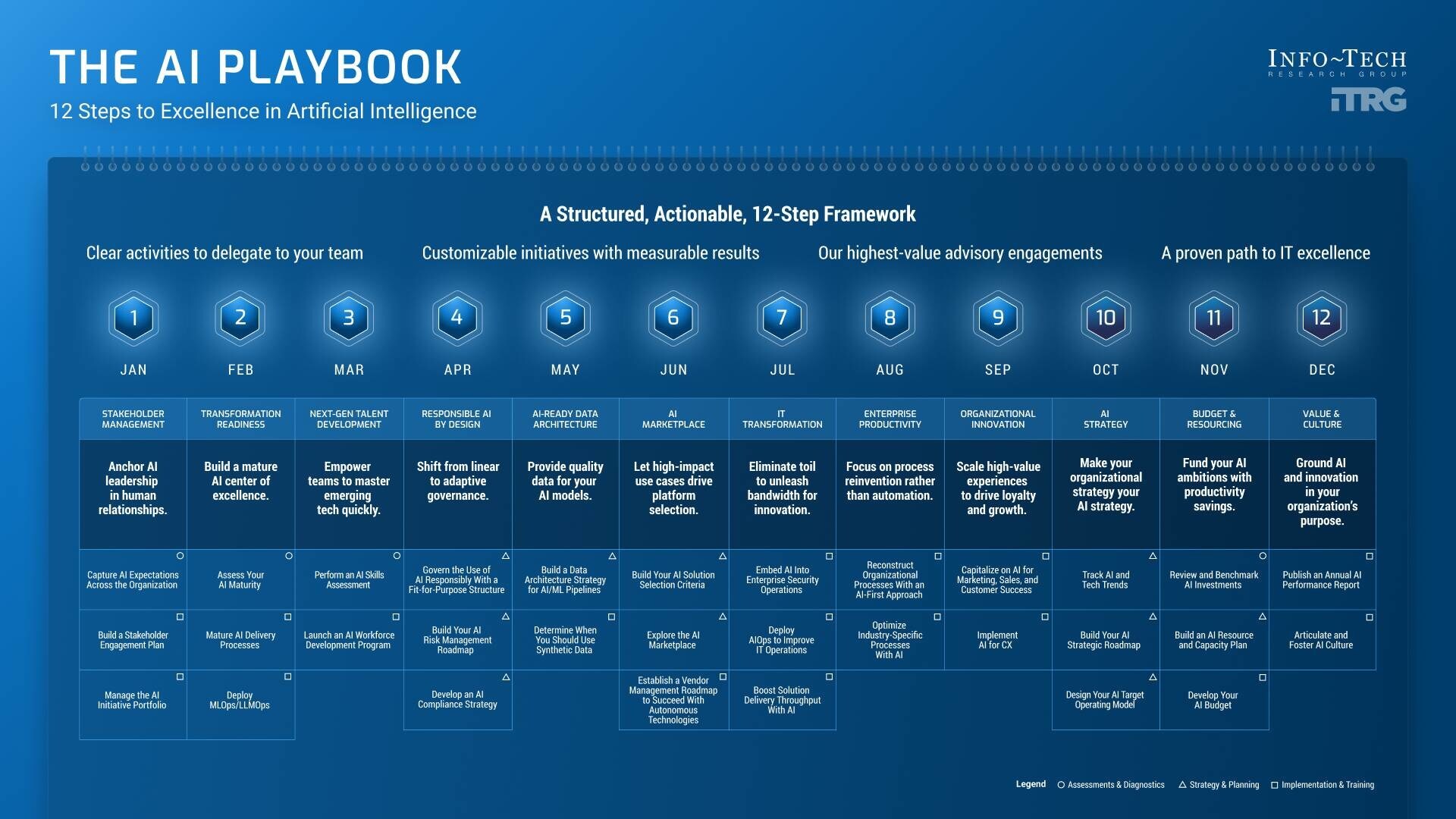
Operationalizing AI at scale is no longer just a technical challenge; it requires robust platforms that marry machine-scale execution with human oversight to ensure safe, effective deployment in complex environments. Kahuna Labs emphasizes that integrating human accountability and contextual relevance is essential for driving better customer outcomes, while Info-Tech Research Group’s 'AI Playbook' prescribes a 12-step framework focusing on structured governance, clear ownership, and measurable outcomes. This approach addresses persistent barriers—such as fragmented strategies, immature governance, and skill gaps—by recommending monthly focus areas and disciplined execution, enabling organizations to move beyond isolated pilots toward sustainable, enterprise-wide AI capabilities.
Startups like Seepoint are demonstrating that an AI-first culture—where teams are encouraged to dedicate time to exploring new tools and technologies—can dramatically accelerate product development and innovation. As Seepoint’s leadership notes, allocating even a week for deep dives into emerging AI capabilities has empowered their teams to achieve outcomes previously thought impossible, such as automating three core financial processes in just nine months with half the engineering resources. This cultural shift, coupled with the adoption of agentic software development, is enabling startups to move beyond incremental efficiency gains, using AI to build complex products faster and with leaner teams, thereby redefining the drivers of sustainable growth.
The operational challenge of scaling AI extends beyond technology to encompass comprehensive process automation, particularly in critical functions like finance. Seepoint’s AI-first approach to automating every core financial process reflects a broader trend: as startups scale, AI becomes indispensable for managing complexity and ensuring resilience. By moving past basic banking solutions and embracing end-to-end automation, these companies are not only streamlining operations but also positioning themselves for defensible, long-term growth in increasingly competitive markets.