AI supercharges biotech r&d—but human trials remain the $2.5 billion roadblock
The gist
AI is turbocharging early biotech R&D, but the real $2.5 billion hurdle is still the messy, unpredictable world of human clinical trials.
What to know
- AI-driven platforms like Terray’s EMMI and COATI have tripled drug potency optimization by late 2025, yet nearly 90% of phase II trials still flop due to human biology’s complexity.
- The 2025-2026 biotech market is punishing slow, speculative research—demanding clinical milestones within 9–18 months and rewarding companies with ruthless operational discipline and adaptive trial design.
- The FDA’s 2026 'one pivotal trial' policy is pushing biotechs to innovate their trials, but regulatory delays now mostly expose weak company execution—not bureaucratic red tape.
AI’s Early-Stage Limits
AI accelerates molecular discovery and target identification, but its true breakthrough hinges on integrating richer human data to overcome persistent phase II trial failures.
AI has become indispensable in early-stage drug discovery, enabling the design of novel molecules and targets previously deemed impossible, as highlighted by platforms leveraging molecular machine learning and expansive datasets. However, despite these advances, the most significant bottleneck remains the high failure rate in phase two clinical trials due to efficacy challenges, underscoring the need for integrating richer human data to improve predictive models. As one expert noted in late 2025, while AI excels at toxicity prediction in preclinical stages, its transformative impact hinges on better efficacy prediction through human data integration, a frontier that virtual cell models aim to address.
By late 2025, AI-driven platforms such as Terray’s EMMI and molecular foundation models like COATI demonstrated a threefold increase in potency optimization efficiency, while quantum computing innovations like QuADD outpaced traditional AI diffusion models by generating superior drug-like molecules in a fraction of the time. Collaborative efforts, including BenchSci’s partnership with Mila and Animate Biosciences’ generative AI leveraging multi-omic data from regenerative species, exemplify how integrating AI with domain expertise accelerates the discovery of tailored therapeutics for complex diseases, including inflammatory and fibrotic conditions.
The convergence of AI with multi-omics data is reshaping the drug discovery pipeline by enabling comprehensive target identification, validation, and patient stratification across diverse modalities beyond small molecules, such as biologics and gene therapies. Experts emphasize that the critical questions now revolve around pinpointing the best targets and predicting patient responses pre-treatment, areas where AI’s impact is poised to be enormous. This holistic application of AI is expected to accelerate therapeutic development significantly within the next two to three years, potentially transforming how new drugs reach patients and reducing associated costs.
In longevity research, AI-driven breakthroughs are catalyzing a paradigm shift from merely slowing aging to actively reversing it, as demonstrated by David Sinclair’s patented partial epigenetic reprogramming methods and Life Biosciences’ imminent human trials. Advanced AI-powered virtual screening has compressed experiments that would traditionally take centuries into months, enabling the identification of single molecules capable of replacing complex chemical cocktails for age reversal. Complemented by innovations in protein structure prediction, autonomous AI-driven labs, and multi-omic biomarker discovery, these developments herald a transformative era in aging and therapeutic innovation despite persistent scientific and regulatory hurdles.





Biology’s Unyielding Complexity
Even with AI’s computational leaps, unpredictable human biology and entrenched regulatory steps keep phase II failure rates sky-high and overall drug development costs daunting.
Despite AI's rapid advances in early-stage drug discovery, the translation into successful human therapies remains severely constrained by the biological complexity and unpredictability of human physiology. Phase II clinical trials, which test drug efficacy in humans, continue to exhibit failure rates near 90%, underscoring a fundamental gap in our understanding of biology that AI alone cannot bridge. As noted in multiple analyses, including those by Elliot Hershberg and industry experts, the high costs—often reaching $2.5 billion per drug approval—and lengthy timelines of these trials dominate the capital burn in biotech, dwarfing early discovery expenses and limiting AI's impact on reducing overall development time or cost [1, 3, 6, 19, 28, 29].
Regulatory and operational frameworks further compound these clinical bottlenecks, with U.S. processes such as Investigational New Drug (IND) filings lagging behind more agile systems like Shanghai’s investigator-initiated trials, which can commence within weeks. While AI can marginally improve trial design elements—such as patient matching, site selection, and data workflows—it cannot circumvent the entrenched regulatory demands or the biological necessity for lengthy human validation. The FDA’s stringent three-phase clinical testing protocol remains a non-negotiable tollbooth, ensuring safety and efficacy but also prolonging timelines and costs, as highlighted by the recent FDA one-pivotal-trial policy emphasizing mechanistic and real-world evidence [4, 7, 11, 32, 36, 38, 40].
AI-driven molecule generation, often optimized for binding affinity, frequently produces compounds that fail in vivo due to unpredicted toxicities and complex off-target effects, revealing the limitations of computational models in simulating the chaotic, heterogeneous human biological environment. This digital-to-physical gap means that even with vast libraries of AI-generated candidates, pharmaceutical partners face enormous downstream validation costs and risks, as millions must be spent to identify a single viable drug. Experts argue that treating biology as a deterministic software system is misguided; instead, embracing its physical and chaotic nature is essential to overcoming the persistent bottleneck of clinical efficacy [21, 26, 27, 30, 31].
Certain sectors like longevity biotech exemplify the compounded challenges of clinical and regulatory hurdles despite robust venture capital interest and AI-driven innovation. Enrolling older patients introduces heightened safety concerns and complicates trial design, often deterring traditional drug companies and elongating timelines for companies such as Mitrix and New Limit, which anticipate multi-year waits before preliminary human trials. This illustrates that even with cutting-edge regenerative therapies and AI tools, the path to translating discoveries into effective healthspan-extending treatments remains fraught with scientific uncertainty and regulatory complexity [13, 14, 43].




Investors Demand Clinical Proof
Biotech funding now flows to companies that deliver fast, interpretable clinical milestones and operational discipline, sidelining slow-moving platforms and speculative science.
By late 2025, soaring drug development costs—now estimated at $2.5 billion per approval—have intensified investor demands for operational discipline and near-term clinical milestones, pressuring biotechs to rethink traditional trial designs and portfolio strategies. The competitive edge is shifting toward companies that can deliver rapid, interpretable clinical signals, as evidenced by the rise of investigator-initiated trials in Shanghai that outpace U.S. IND filings, forcing American founders to adapt or fall behind. This capital market reality is driving a strategic pivot away from commoditized infrastructure toward innovative modalities that require novel tools, underscoring a financing environment that rewards clear, fundable catalysts within 9 to 18 months and penalizes open-ended scientific narratives.
Entering 2026, the biotech financing landscape crystallized around operational efficiency and velocity, with investors prioritizing companies that can 'close the loop' between biomarker discovery and human proof-of-mechanism in under 18 months. Firms like Ginkgo Bioworks exemplify this shift by leveraging modular automation and AI to compress R&D timelines and reduce costs, enabling thousands of startups to meet heightened expectations for near-term clinical milestones. This new capital cycle favors mid-cap biotechs with pivotal catalysts within a year and sufficient cash runway, while early-stage companies face urgency to secure financing before liquidity tightens further, reflecting a market that rewards translational rigor and clinical success over speculative promise.
The capital markets’ increasing insistence on discrete, catalyst-driven financings has reshaped trial design and portfolio management, with endpoints, patient populations, and biomarkers now selected primarily to generate early, fundable signals that support timely capital raises. This financial engineering approach, championed by investors and corporate buyers alike, demands flawless operational execution—fast site activation, low screen failure rates, and timely database locks—to sustain repeated funding rounds. Consequently, biotech companies are adopting adaptive trial designs, interim data disclosures, and focused patient cohorts, while the market narrows its appetite to asset-centric firms with clear, near-term inflection points, sidelining sprawling platform bets and speculative long-horizon projects.
This tightening of capital and heightened selectivity has compressed valuations and raised the cost of capital, favoring companies with clear development paths, commercial precedents, and visible cash runway over early-stage or exploratory programs. IPO windows remain open but narrow, predominantly accessible to mid-stage assets with imminent catalysts, while M&A deals increasingly incorporate milestone-based payments and contingent value rights to mitigate risk. As Pfizer CFO Dave Denton notes, the industry’s focus has shifted toward execution within existing franchises rather than broad business development, reflecting a cautious capital allocation strategy that rewards operational discipline and near-term proof, ultimately redefining translational success as the ability to deliver timely, fundable clinical milestones rather than scientific novelty alone.
Operational Rigor Redefines Value
The biotech winners are those who build AI-native workflows and close the loop from discovery to human proof-of-mechanism in under 18 months, making speed and execution the new currency.
By late 2025, the biotech sector recognized that operational efficiency and rapid clinical feedback loops had become paramount, eclipsing the traditional emphasis on capital availability or sheer spending. As articulated in November 2025, translational success under a low-yield environment hinges on accelerating the timeline from IND to data readout, with every month saved compounding returns. This operational rigor is further underscored by the emerging valuation metric of closing the loop between biomarker discovery and human proof-of-mechanism within 18 months, signaling a shift where translational rigor and clinical data regain primacy in investor valuation models.
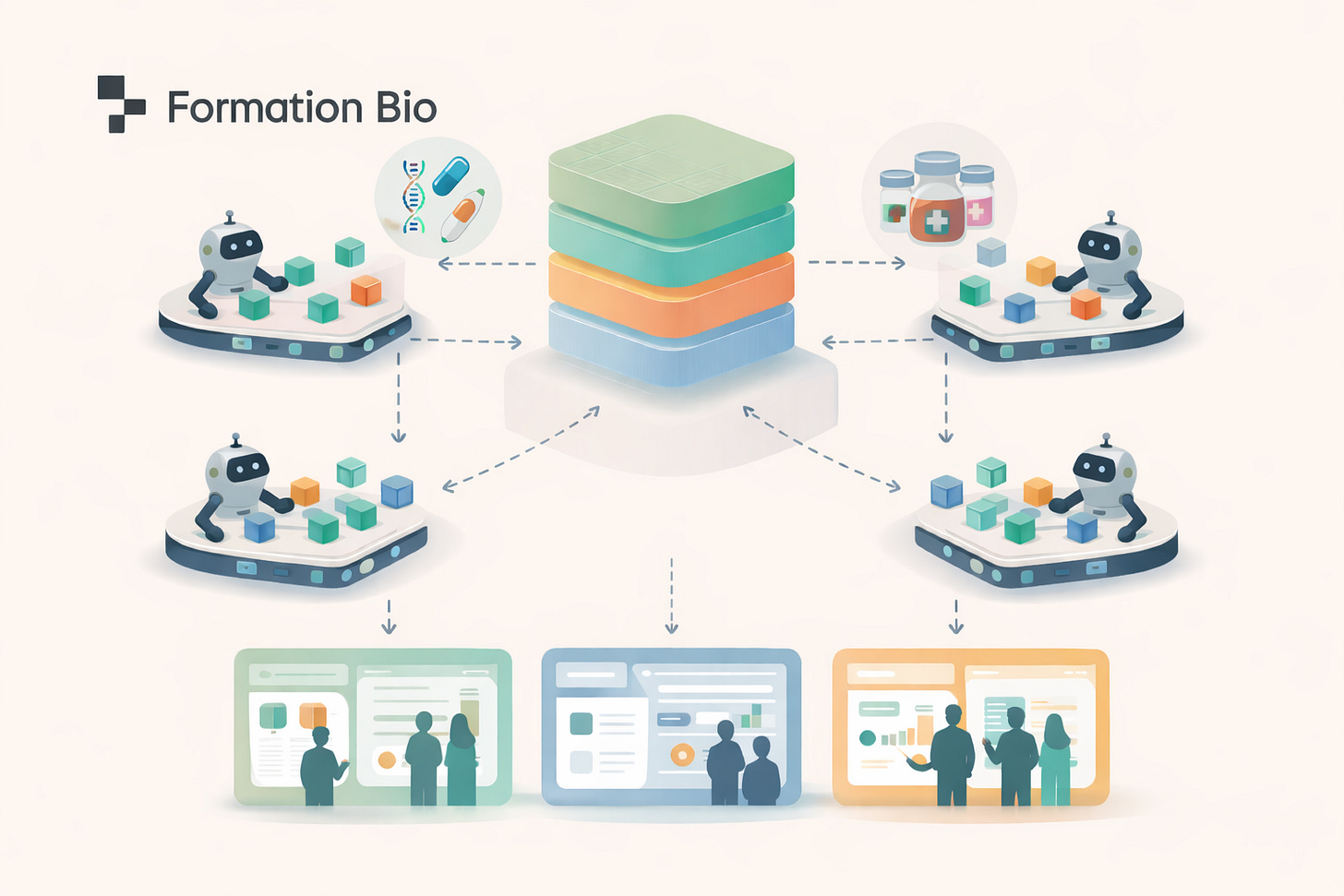
Companies like Ginkgo Bioworks and Benchling are pioneering AI-native operational models that integrate automation, standardized AI-ready datasets, and seamless AI integration directly into scientific workflows to enhance R&D scalability and clinical program execution. Ginkgo's modular robotic building blocks replace lengthy custom lab setups, democratizing high-throughput experimentation and collapsing traditional R&D timelines, while Benchling’s AI agents ingest legacy data trapped in disparate formats to prevent redundant experiments and reduce toil, thereby accelerating drug development and improving organizational efficiency.
Formation Bio exemplifies a new breed of AI-native biopharma companies that strategically embed AI across the clinical development continuum—from site startup acceleration to clinical trial design and execution—leveraging a hub-and-spoke organizational model to manage portfolio risk while maintaining centralized AI platform support. Their multi-model AI architecture, combining large language models with knowledge graphs and specialized ADME/toxicology models, enables more auditable and reliable asset evaluation, reflecting a deliberate shift from early discovery hype to addressing the critical bottleneck of clinical program execution where most drug candidates fail.
The operational innovation imperative in AI-native biotech extends beyond algorithmic sophistication to embrace clinical viability and risk mitigation, as companies like CellType recalibrate their value propositions to align with risk-averse CSOs by addressing the full clinical development journey. This includes integrating downstream steps such as synthesis, toxicity assays, and regulatory filings, and replacing vague AI marketing with machine-readable Customer Success Statements focused on measurable clinical outcomes. Such strategic realignment reflects the 2026 market reality where commoditized AI algorithms no longer confer competitive advantage; instead, integrated platforms that demonstrably reduce clinical risk capture enterprise value and meet Big Pharma’s demand for scalable, outcome-driven solutions.


AI Fuels Longevity Breakthroughs
AI-enabled gene therapies and bioelectronic innovations are propelling aging reversal from theory to near-term human trials, while computation slashes the cost and pace of longevity drug discovery.
By late 2025, AI-enabled breakthroughs in gene therapy have propelled longevity science into a new era, exemplified by David Sinclair’s patented method using non-cancerous Yamanaka factors (Oct4, Klf4, Sox2) to partially reverse epigenetic aging markers without inducing full pluripotency. This approach, validated in non-human primates and slated for human trials in early 2026 by Life Biosciences, marks a translational milestone in safely resetting cellular age by approximately 75%, with the eye chosen as an initial target due to its enclosed, safer environment and favorable FDA acceptance. Alongside gene therapies, innovative AI-driven bioelectronic interfaces, such as MIT’s injectable immune cell-electronic hybrids developed by Dina Sarcar, are pioneering non-genetic methods for precise neuronal stimulation, broadening the toolkit for age-related interventions.
The integration of AI into longevity research has revolutionized drug discovery and accelerated aging reversal efforts by enabling virtual screening of billions of chemical compounds—tasks that would have taken centuries and billions of dollars pre-AI—to identify molecules capable of mimicking complex gene therapies in more accessible forms like pills or topical applications. Harvard researchers highlight that AI’s ability to understand biological principles from atoms to proteins allows the distillation of multi-chemical cocktails into single-molecule candidates, drastically reducing reliance on costly animal testing and paving the way for democratized, affordable consumer treatments that could cost roughly $100 per month, a stark contrast to the prohibitive costs of gene delivery.
Longevity-focused investment strategies underscore the critical role of AI-enabled infrastructure—spanning novel sequencing technologies and advanced computational platforms—in accelerating the cadence of drug discovery and translating fundamental aging mechanisms into targeted therapeutics for age-related diseases. Collaborations like Biophytis and LynxKite’s expanded alliance leverage graph analytics, biological language models, and GPU-accelerated computation to develop novel drug candidates for sarcopenia and macular degeneration, exemplifying how AI-driven domain expertise integration is moving the field from general aging concepts to specific, cause-effect therapeutic interventions.
Parallel to clinical gene therapies, David Sinclair’s Paradigm 88 is pioneering a consumer-focused route to aging reversal by developing natural, safe molecules that activate the same biological pathways targeted by gene therapies, with preclinical studies demonstrating rejuvenation effects—such as improved strength, memory, and balance—in mice within four weeks of oral administration. This dual-path approach balances the decade-long FDA-regulated clinical trials with faster, democratized access to de-aging products like supplements, creams, or sprays, reflecting a paradigm shift from merely slowing aging to fundamentally resetting cellular age across tens of thousands of biological processes with surprisingly high safety and efficacy.



Regulation Reveals, Doesn’t Block
The FDA’s shift to a 'one pivotal trial' standard spotlights internal biotech execution as the main bottleneck, pushing companies to innovate trial designs and operational discipline rather than blame red tape.
By early 2026, the FDA had formalized a significant policy shift endorsing a 'one pivotal trial' default for drug approvals, emphasizing mechanistic, real-world, and model-based confirmatory evidence such as validated biomarkers, external controls, and in-silico simulations. This evolution encourages biotech startups—especially those leveraging AI-driven biomolecular modeling, RNA design, and data imputation—to innovate trial designs that meet these nuanced evidence standards, signaling a regulatory landscape that is adapting rather than obstructing innovation.
Despite perceptions, the FDA is increasingly recognized not as the bottleneck but as a revealing agent of internal weaknesses within biotech programs. Constraints on clinical trial speed and success are more tightly linked to company execution factors—such as trial design, endpoint selection, recruitment logistics, and operational discipline—than to regulatory review itself. As one analysis bluntly states, 'The FDA is not blocking progress. It is exposing weak programs,' underscoring that the real challenges lie within biotech firms’ operational capabilities rather than in FDA processes.
While AI contributes incrementally by optimizing drafting, site selection, patient matching, and data workflows, the primary levers for accelerating trials remain better surrogate endpoints and regulatory reforms. The Australian Clinical Trial Notification (CTN) framework is highlighted as a promising model for expediting early-phase trials without compromising safety, contrasting with the slower U.S. Investigational New Drug (IND) process. This suggests that regulatory innovation, alongside internal execution improvements, is key to overcoming clinical bottlenecks.
Transparency emerges as a critical theme in the evolving biotech regulatory environment, particularly regarding the use of patient data and AI-driven decision-making. Takeda emphasizes that patients must be clearly informed about how their anonymized data is utilized and who financially benefits, reflecting broader ethical imperatives. Moreover, transparency extends to AI models themselves, including their training processes and potential risks, ensuring trust and accountability in healthcare innovation.
