AI supercharges world cup scams: fake sites, malware, and crypto cons target fans as 2026 tournament nears
The gist
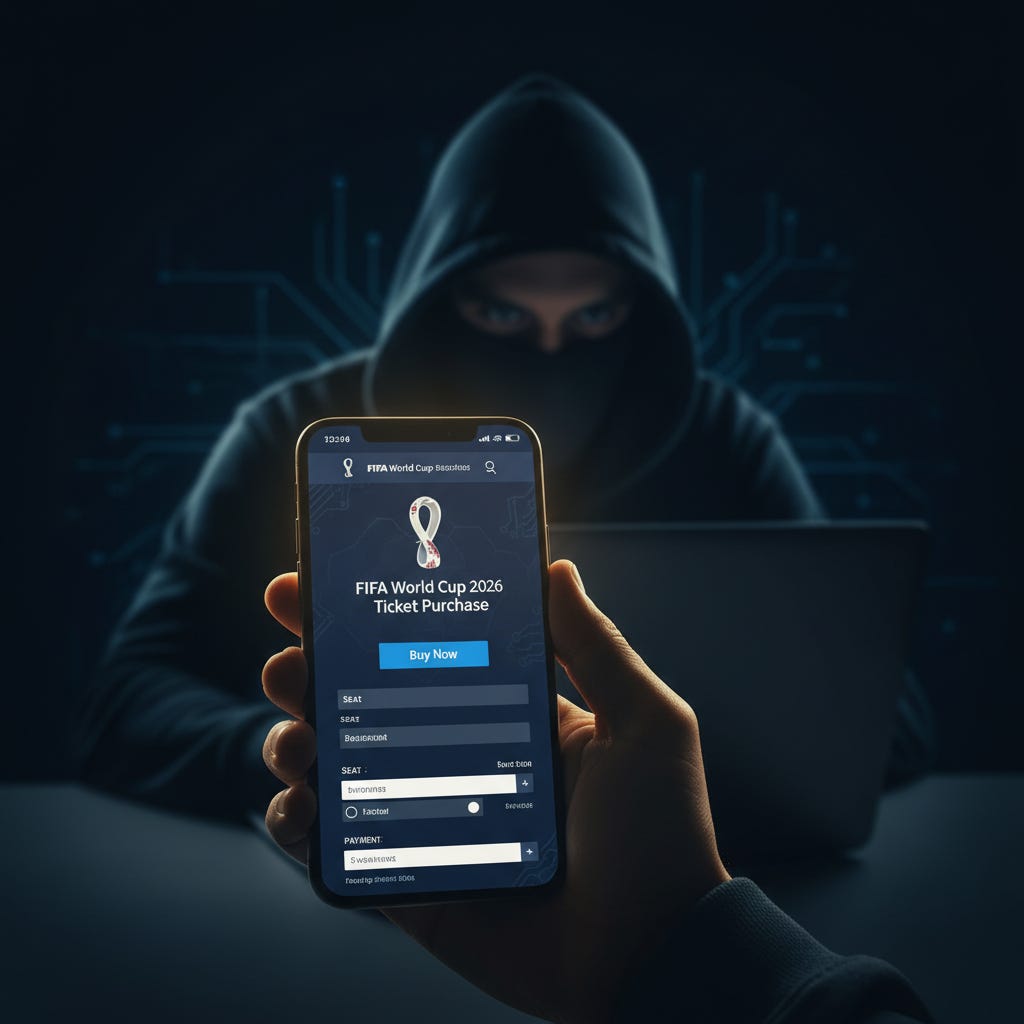
AI-powered scammers are hijacking the FIFA World Cup 2026 frenzy with a wave of fake sites, malware-laced apps, and crypto cons targeting millions of fans across North America.
What to know
- Over 4,300 fraudulent World Cup domains—including 300 by the Chinese 'Ghost Stadium' group—are actively stealing credentials and selling counterfeit tickets in the U.S., Mexico, and Canada.
- Hyper-realistic phishing sites, AI-generated promos, and malware-infected streaming apps are tricking fans and even turning devices into botnets for cyberattacks.
- Younger fans (18–34) are prime targets due to risky social media habits and payment app use, with experts urging exclusive use of official platforms and credit cards to avoid irreversible crypto scams.
Fraudulent Domains Surge
Cybercriminals are launching thousands of AI-powered, multilingual fake FIFA sites and ticketing scams, exploiting typosquatting and social media to outpace traditional fraud detection.
As the FIFA World Cup 2026 approaches, the scale and diversity of cyber and fraud threats have expanded dramatically, targeting fans across the U.S., Mexico, Canada, and beyond. Researchers at Group-IB have identified over 4,300 fraudulent domains impersonating fifa.com, with the Chinese-linked 'Ghost Stadium' group alone responsible for more than 300 pixel-perfect phishing sites in 11 languages designed to steal credentials and sell counterfeit tickets. These scams exploit the enormous demand from over six million attendees, leveraging typosquatting domains like ticktmaster.com and sophisticated social media campaigns that funnel victims into fake ticket sales and account takeovers, which together constitute the majority of reported ticket fraud cases.
Beyond ticket scams, the threat landscape encompasses a broad array of malicious activities including phishing websites, fraudulent apps, fake hiring pages, and malicious streaming services. Cybercriminals employ generative AI to create hyper-realistic fake tickets, promotional graphics, and even Google sign-in prompts embedded within fake FIFA recruitment sites like fifahiring.com, which have been blocked over 250 times since May 2026 by security products such as Norton. Additionally, malicious Android streaming apps carrying banking malware like Massiv and Perseus exploit accessibility permissions to harvest sensitive financial data, illustrating the multifaceted and evolving nature of the threats surrounding the event.
Scammers capitalize on the urgency and excitement of the World Cup by employing psychological tactics such as creating a fear of missing out (FOMO) and rushing fans into transactions without proper verification. This urgency is exploited through irreversible payment methods like cryptocurrency and peer-to-peer apps, which leave victims with little recourse once defrauded. Law enforcement agencies have highlighted the rise of fraudulent World Cup-themed crypto projects and tokens not affiliated with FIFA, further complicating the threat environment and underscoring the need for vigilance when navigating offers related to tickets, merchandise, or betting promotions.
The cyber and fraud threats around the FIFA World Cup 2026 are not isolated phenomena but part of a persistent, year-round playbook targeting major events globally. With one in three Americans having fallen victim to ticket scams in other contexts, the World Cup’s massive digital footprint—including over 7,000 World Cup-themed domains registered in just five months and more than 1,000 fake social media accounts impersonating FIFA—creates a fertile ground for scammers. This broad attack surface extends to phishing, fake QR codes for transport and parking, rogue public Wi-Fi networks, and counterfeit streaming sites, all designed to exploit fan enthusiasm and digital trust at an unprecedented scale.

AI Powers Scam Factories
AI-generated phishing sites and fake FIFA tokens are flooding the web at unprecedented speed, making it nearly impossible for fans to distinguish real from fake and leaving crypto victims with no recourse.
By mid-2026, cybercriminals had orchestrated an expansive and highly sophisticated AI-driven scam infrastructure targeting FIFA World Cup fans, with groups like the Chinese 'Ghost Stadium' gang deploying over 300 cloned FIFA-themed domains to steal credentials, resell counterfeit tickets, and harvest financial data. These campaigns leveraged subtle lookalike domains, typosquatting, and pixel-perfect clones of official FIFA portals, some lying dormant since 2025 to optimize timing and stealth, demonstrating a multifaceted approach that combined phishing, social engineering, and advanced malware deployment.
The rise of AI-enabled tactics has accelerated the creation of hyper-realistic fake websites and promotional content, enabling scammers to clone legitimate FIFA branding and login systems within hours, while also fabricating convincing customer reviews and fake tickets. This rapid, automated generation of scam assets, combined with social media manipulation—especially via Facebook and Instagram in-app browsers—has amplified the reach and believability of fraud campaigns, pushing victims toward irreversible payment methods like cryptocurrency and bank transfers that leave no recourse.
Cryptocurrency has emerged as a favored tool among fraudsters, who exploit its anonymity and transaction irreversibility by promoting fake World Cup-themed tokens and unlicensed digital assets, as well as demanding crypto payments for counterfeit tickets and merchandise. Malwarebytes and the FBI have highlighted campaigns marketing 'official community tokens' and leveraging social media to push these scams, underscoring how the intersection of AI-driven site cloning and crypto fraud magnifies financial risks for unsuspecting fans.
Beyond ticket scams, cybercriminals have employed advanced social engineering and AI sophistication to create polished fake FIFA hiring pages that mimic real recruitment processes, complete with cloned Google sign-in prompts and recruiter profiles lifted from LinkedIn. These tactics not only enhance credibility but also target business credentials to gain deeper access, while embedded malware such as banking trojans Massiv and Perseus in malicious streaming apps further compromise victims’ financial information, illustrating the layered complexity and persistence of these AI-driven fraud campaigns.






Fans’ Risky Behaviors Exposed
Younger fans and last-minute buyers are falling prey to sophisticated scams by trusting unofficial platforms, connecting to unsafe Wi-Fi, and relying on social media for ticket purchases.
Fans and event attendees, particularly those eager to secure last-minute tickets, represent the most targeted victims of scams leading up to the FIFA World Cup 2026. Scammers exploit the intense demand and emotional urgency by offering fake tickets, accommodation, and transport apps across Mexico, the US, Canada, and South Africa, often impersonating official partners like airlines or cloning FIFA ticketing websites to steal payment details. This vulnerability is exacerbated by risky behaviors such as purchasing from unofficial resale sites, trusting links from social media marketplaces or messaging apps, and rushing transactions without verifying sellers, with social media platforms like Facebook, Instagram, and TikTok accounting for over half of reported ticket fraud cases.
Younger demographics, especially those aged 18 to 34, are disproportionately exposed to ticket and betting scams due to their heavy reliance on social media and peer-to-peer payment apps for transactions. With 28% of victims aged 25 to 34 and 26% aged 18 to 24, these groups frequently engage in risky behaviors such as creating multiple betting accounts to exploit promotions and trusting unofficial platforms despite widespread mistrust of betting apps’ data protection. The rise of prediction markets among younger bettors further complicates the landscape, as scammers leverage social media influence and typosquatting domains mimicking official FIFA sites to ensnare this tech-savvy yet vulnerable cohort.
Risky digital behaviors among fans and bettors amplify their susceptibility to cyber threats during the World Cup, with a striking 73% willing to connect to public Wi-Fi networks solely based on venue names despite less than 40% being able to distinguish legitimate from fake networks. This eagerness to stay connected for streaming, score updates, and social sharing often leads to exposure to 'evil twin' Wi-Fi scams, phishing via QR codes, and malicious apps. Cybersecurity experts and firms like Acronis and ExpressVPN strongly advise avoiding sensitive transactions on public Wi-Fi and emphasize the importance of using official platforms, VPNs, and heightened vigilance against suspicious communications to mitigate these risks.
The sophistication of cybercriminal operations targeting World Cup fans is notable, with large-scale reseller-style campaigns deploying at least 40 fake sites managed through Chinese-language backends and leveraging AI to produce highly convincing fake ticket pages, emails, and QR codes. These scams capitalize on fans’ trust in polished visuals and official-looking communications, making it increasingly difficult to discern legitimate offers from fraudulent ones. The FBI’s warnings about typosquatting domains and the prevalence of scams through in-app browsers on Facebook and Instagram underscore the evolving complexity and scale of threats that require fans to exercise heightened skepticism and verify all digital interactions rigorously.


Payments Under Pressure
The World Cup’s expanded scale is straining global payment systems, with AI-driven fraud and transaction failures costing fans and businesses both money and trust.
By early June 2026, the FIFA World Cup's expansion to 48 teams across three host nations has significantly broadened the attack surface for fraudsters, triggering a surge in travel-related scams such as fake tickets and payment fraud, with consumers losing nearly $300 on average per incident. This escalation is compounded by AI-driven fraud attacks that are becoming faster and more sophisticated, demanding automated defenses and adaptable payment infrastructures to effectively counteract these evolving threats.
The tournament is catalyzing one of the largest surges in cross-border digital payments, which introduces heightened operational complexity and payment friction for travel, ticketing, and payment industries. According to a Nuvei and Edgar, Dunn & Company study, 82% of travelers switch payment methods after a failure, with 13% migrating to competitors and 5% abandoning purchases altogether, underscoring how payment failures during such high-profile events can erode revenue and customer trust.
Industry leaders emphasize that the World Cup serves as a real-time stress test for global payment infrastructure, where payment performance and fraud resilience are directly linked to customer trust and conversion rates. Justin Skagen of Arrivia highlights the criticality of robust systems amid soaring booking volumes and cross-border transactions, while Spreedly CEO Justin Benson notes the dual challenge merchants face: rising consumer expectations for seamless payments alongside increasing fraud and operational risks.

Outsmarting Ticket Scammers
Only official ticketing platforms and credit cards offer real protection, as AI-fueled phishing sites and typosquatting domains drive a spike in fraud targeting even savvy buyers.
To safeguard against the rampant ticket scams targeting FIFA World Cup 2026 fans, experts unanimously stress the importance of purchasing tickets exclusively through official platforms such as FIFA’s own portal, Ticketmaster, AXS, or their authorized resale marketplaces. Scammers exploit typosquatting domains—like ticktmaster.com or fiffa.com—that mimic legitimate sites, with fake websites accounting for 38% of ticket fraud reported to the BBB. Consumers are urged to manually type URLs rather than clicking on search ads, social media posts, or email links, as cybercriminals aggressively use AI to clone authentic FIFA brands within hours, creating pixel-perfect phishing sites that can easily dupe even cautious buyers.
Payment method choice is a critical line of defense against fraud, with credit cards strongly recommended due to their built-in fraud protection and chargeback rights. In contrast, irreversible payment methods such as wire transfers, Venmo, Zelle, Cash App, cryptocurrency, and gift cards are heavily exploited by scammers and offer no recourse once funds are sent. Malwarebytes’ global head of scam research bluntly advises, “If it has to do with crypto, just stop,” highlighting how crypto’s anonymity facilitates scam operations. This caution extends to avoiding off-platform payments, especially on social media or fake resale sites, where 52% of ticket fraud originates.
Enabling multi-factor authentication (MFA) and employing unique, strong passwords on ticketing and event-related accounts are vital to prevent account takeovers, a tactic increasingly used by cybercriminals who deploy fake login pages to hijack credentials and resell stolen tickets. Incidents like Coachella 2026 underscore the sophistication of these AI-driven scams, which produce polished phishing pages and convincing QR codes that can fool even vigilant users. Additionally, fans should avoid clicking login links in emails or texts, opting instead to log in directly through official sites to sidestep phishing traps.
Given the surge in cross-border digital transactions during the World Cup, consumers must exercise caution when connecting to public Wi-Fi networks, as 73% of fans surveyed by ExpressVPN admitted to trusting networks solely based on venue names, with less than 40% able to distinguish legitimate from fake hotspots. Experts recommend using quality VPNs and cybersecurity tools to secure data transmissions and avoid falling prey to rogue Wi-Fi networks and QR-code phishing attacks prevalent at stadiums. Remaining vigilant against suspicious communications, malicious streaming platforms, and fraudulent apps further fortifies fans’ digital defenses amid the event’s complex cyber threat landscape.
Streaming Apps Turn Hostile
Malicious streaming apps and fake World Cup sites are hijacking devices for botnets and ad fraud, exposing fans to malware, data theft, and relentless scam cycles.
By early June 2026, malicious streaming apps and devices have emerged as a critical vector for cyber threats surrounding the FIFA World Cup, extending far beyond traditional ticket and travel scams. Notably, Android apps laden with banking malware such as Massiv and Perseus exploit accessibility permissions to siphon sensitive financial data, while devices like the Superbox—marketed as affordable streaming solutions—covertly conscript users into botnets functioning as 'residential proxy services.' These botnets enable external actors to route traffic and orchestrate large-scale denial-of-service attacks, all while users remain largely unaware due to minimal impact on device performance.
Threat actors have demonstrated remarkable foresight by acquiring lookalike domains related to the 2026 World Cup years in advance, such as a Vietnamese operator who purchased a relevant domain in 2024 for $600. These domains serve as hubs for illegal streaming scams that embed software development kits (SDKs) designed to recruit users’ devices into botnets. This long-term pre-planning underscores a sophisticated, multi-layered approach that leverages the event’s global appeal to maximize malware distribution and illicit streaming operations.
The proliferation of fake 'free World Cup stream' websites reveals a sprawling, automated scam ecosystem that prioritizes ad fraud and malware distribution over actual content delivery. Analysis identified over 40 nearly identical sites using scripts to generate match-specific pages, funneling users into malicious ad networks that bombard them with fake virus alerts, bogus software updates, subscription traps, and crypto bait ads promising unrealistic returns. Often, the streams are pirated embeds that fail to work or loop endlessly, ensuring users remain trapped in a cycle of clicks that enrich cybercriminals while exposing fans to extensive fraud and data theft.
As the FIFA World Cup 2026 kicks off, cybersecurity firms like Acronis warn that the surge in digital activity is being exploited not only through counterfeit streaming sites and malicious apps but also via sophisticated AI-driven scams that steal personal and financial information. Cybercriminals leverage the event’s hype to conscript users covertly into botnets and deploy phishing attacks via rogue Wi-Fi and QR codes, emphasizing that vigilance must extend well beyond the familiar terrain of ticket and travel fraud to encompass the full spectrum of emerging cyber threats.