AI support hits trust ceiling, humans close deals
The gist
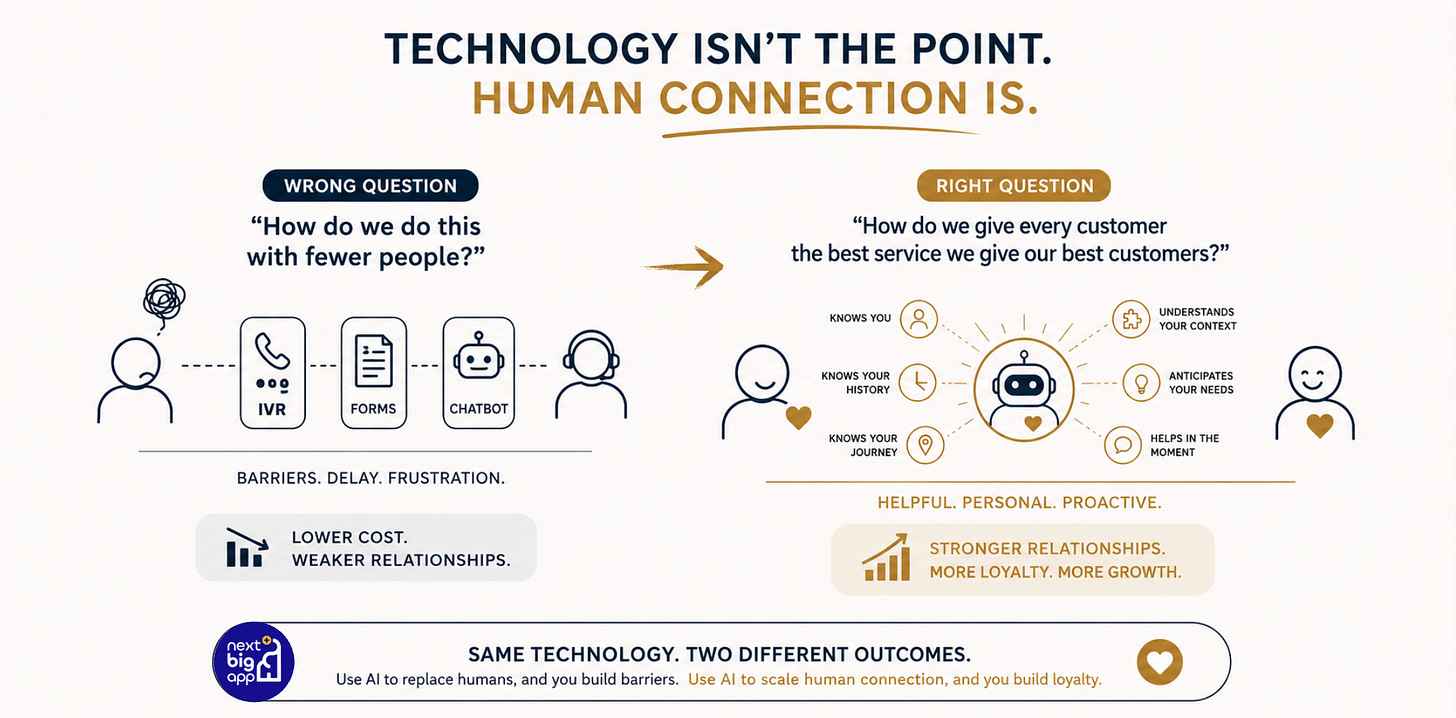
AI now resolves up to 80% of customer support issues for giants like Airbnb and LinkedIn, but it’s human empathy in complex moments that keeps customers loyal—and paying.
What to know
- By 2026, companies like Airbnb, LinkedIn, and Asiacell automate most routine inquiries, but reserve humans for 'mango moments' that demand empathy and discretion.
- Customers are demanding both transparency and access: 50% will ditch brands lacking human support, while 42% are willing to pay more for it.
- Outcome-based metrics and seamless AI-to-human handoffs are the new gold standard, with companies like Zendesk hitting 70-90% automation but doubling down on trust and satisfaction.
Empathy in the Age of AI
Leading brands like Airbnb and Jones Road show that while AI handles routine support, only human agents can deliver the empathy and judgment customers crave during critical 'mango moments.'
By early 2026, enterprises recognized that the strategic balance between AI automation and human empathy is crucial to preserving customer trust and satisfaction. The concept of 'mango moments'—critical interactions where human discretion and empathy are indispensable—illustrates that automation must be thoughtfully integrated rather than blindly applied. For example, Jones Road’s weekend delay in handling a simple customer request underscored that not all processes should be automated, and when automation is deployed, it requires partners who understand how to build effective AI teammates rather than sloppy systems.
Leading companies like Airbnb demonstrate that automating high-volume, low-complexity tasks with AI can significantly improve efficiency and customer satisfaction while preserving human involvement for complex cases. Airbnb’s AI-powered support agent manages roughly one-third of North American inquiries, enabling faster resolution of routine issues and freeing human agents to focus on escalations that require empathy and judgment. CFO Ellie Mertz emphasized that AI reduces routine contacts without eliminating escalation paths, highlighting the importance of measuring both deflection rates and customer satisfaction to ensure automation enhances rather than undermines trust.
Despite AI’s growing capabilities, there is a paradoxical resurgence in customers’ desire for authentic human connection, especially in complex or high-stress transactions like real estate. Industry voices such as Mike and Steve Brown note that while AI bots are effective at initiating conversations and identifying needs, customers increasingly crave genuine human empathy that AI alone cannot replicate. This has led to a strategic emphasis on using AI to empower agents—making them 'super agents'—without placing technology between agents and consumers, ensuring that human involvement remains central in critical moments.
The future of customer service lies in a nuanced partnership where AI handles routine, administrative tasks and provides rich contextual insights, while human agents retain autonomy to exercise empathy, curiosity, and discretionary judgment in complex situations. Analysts and leaders stress that over-automation with rigid AI guardrails frustrates customers and fails to resolve nuanced issues, making human intervention essential in 'mango moments.' As Pauline Pangan articulates, AI’s goal is to boost human productivity by up to 70%, not to replace humans, by acting as a 'business brain' that summarizes relevant data, enabling agents to deliver personalized, authentic experiences that build trust and loyalty.


Agentic AI Reshapes Roles
LinkedIn’s autonomous AI agents resolve 80% of common workflows, transforming support teams from reactive troubleshooters into proactive advisors who drive growth and customer retention.
By early 2026, LinkedIn exemplified the transformative potential of agentic AI by deploying autonomous agents that resolve common workflows end-to-end, enabling human agents to shift from reactive problem solvers to proactive trusted advisors focused on relationship building and upselling. This strategic integration not only boosted operational efficiency—evidenced by an increase in self-serve rates from 0% to 65% and direct AI resolution of 80% of customer questions—but also repositioned customer support from a cost center to a growth driver by intervening earlier in the customer journey to prevent churn and promote expansion.
Successful deployment of agentic AI hinges on meticulous operational integration and a pilot-to-scale approach that balances technical readiness with business outcomes. Industry leaders like Craig Walker of Dialpad and PwC emphasize foundational steps such as cleaning and maintaining accurate knowledge bases, analyzing ticket patterns, and running controlled pilots to demonstrate productivity gains before scaling. Moreover, embedding AI proactively at moments of user curiosity rather than frustration—such as LinkedIn’s integration within hiring workflows—enhances user experience and facilitates smoother adoption, while continuous quality control through daily transcript reviews ensures ongoing system refinement.
Agentic AI functions as an autonomous decision-making teammate by automating routine, high-volume tasks—ranging from scheduling appointments and password resets to complex multi-step workflows with contextual awareness—thereby freeing human agents to focus on nuanced, empathy-driven interactions. This collaborative model, championed by companies like Pylon and KPN, integrates real-time coaching, sentiment-aware routing, and managerial insights to enhance agent performance and customer satisfaction. As Amit Mathradas of Five9 notes, winning with AI requires preserving human involvement for high-value cases while automating routine work to improve trust, relevance, and outcomes.
The evolution of agentic AI is driving a paradigm shift in customer service from reactive support to proactive, outcome-driven engagement that spans sales, marketing, and service under unified AI-enabled operating models. PwC and OpenAI’s joint Center of Excellence exemplifies this trend by accelerating innovation and scaling AI solutions that act autonomously within enterprise workflows to deliver personalized, context-rich experiences at scale. Companies like Asiacell and Intercom demonstrate that with robust API integrations and strategic channel redirection, agentic AI can autonomously handle up to 80% of interactions, transforming customer service into a strategic growth channel while enabling human agents to tackle complex, high-stakes interactions.



Workflow-First AI Wins
Industry leaders like Kustomer and Amazon Connect prove that mapping and refining workflows before automating is essential to reduce delays, repeat contacts, and ensure AI delivers real business value.
By early 2026, industry leaders like Kustomer and Amazon Connect emphasized that successful AI adoption in customer service hinges on clarifying and optimizing underlying workflows rather than simply automating conversations. Tools such as Kustomer’s AI Setup Assistant and Amazon’s AI-powered task management demonstrate that mapping workflows, ensuring data quality, and embedding AI to nudge agents through complex tasks like refunds or order changes can significantly reduce delays and repeat contacts, thereby improving operational efficiency and customer satisfaction.
Organizational readiness extends beyond technology deployment to encompass a unified vision, strong governance, and cross-functional collaboration, as highlighted by Comcast’s Shri Nandan and PwC’s integrated AI front office model. This readiness involves maintaining up-to-date knowledge bases, running controlled pilots with a limited number of agents, and fostering mutual buy-in between AI providers and customers to ensure AI not only cuts costs but enhances service quality, reduces churn, and drives measurable ROI through continuous improvement and real-time coaching.
A process-first approach demands starting small with proofs of concept that focus on specific, high-impact operational friction points identified through detailed workflow mapping and customer behavior analysis. As noted by experts from McKinsey and Asiacell, analyzing large volumes of real customer interactions to cluster recurring needs enables targeted AI interventions, while continuous agile development and progressive API integrations evolve AI from simple FAQ bots into fully functional agents capable of handling complex tasks within well-defined workflows.
Ultimately, AI’s full potential in customer service is unlocked not through isolated technology rollouts but by fundamentally redesigning operational models and workflows to integrate AI as a decision-making teammate. This requires top-down leadership commitment, robust data governance, and a culture willing to experiment and adapt, as emphasized by Gartner, PwC, and industry practitioners. Organizations must treat AI deployment like a transformation of work—realigning roles, reskilling agents, and establishing clear metrics tied to business outcomes—to avoid accelerating inefficiencies and instead drive sustainable value.






Outcome Metrics Over Efficiency
Companies like Zendesk are redefining AI success with outcome-driven metrics—shifting focus from speed and volume to satisfaction, retention, and measurable business impact.
By 2026, customer service leaders recognized that traditional efficiency metrics such as average handle time and containment rates no longer suffice to gauge AI's true impact. Instead, outcome-based measurement frameworks focusing on customer satisfaction, resolution effectiveness, and financial impact have become essential. Companies like Zendesk, achieving 70-90% automation rates, demonstrate how AI offloads low-value tasks, enabling human agents to concentrate on complex interactions that drive loyalty and improved experiences, thus shifting support from a cost center to a strategic business asset.
Despite widespread AI adoption, a significant gap persists between investment and realized business value, with only 5% of firms achieving AI value at scale according to BCG's 2025 study. This disconnect is often due to superficial ROI assessments that focus on token usage or efficiency metrics rather than meaningful business outcomes. Industry leaders like Deutsche Telekom and HubSpot emphasize the necessity of outcome-driven frameworks that measure tangible results such as increased ticket handling capacity, proactive network management, and customer retention, moving away from traditional seat-based pricing toward value-based models.
Achieving reliable and scalable AI ROI requires a deep understanding of workflow friction and embedding AI directly into operational processes. Experts advocate for discovery-driven advisory approaches that identify specific workflow leaks—such as manual follow-ups or compliance risks—and prioritize KPIs like resolution time, cost per interaction, and revenue impact over superficial usage statistics. Rapid, iterative sprints of 8-12 weeks enable businesses to demonstrate incremental value quickly, while AI-driven personalized coaching enhances agent productivity and reduces turnover, illustrating how outcome-based metrics foster continuous improvement.
The integration of AI in customer service demands organizational readiness and cultural alignment to translate deployments into measurable business value. As Shri Nandan of Comcast notes, a conservative, staged rollout mitigates risks and supports consistent outcome-based measurement. Furthermore, human oversight remains critical to validate AI outputs and maintain trust, ensuring that ROI assessments reflect meaningful improvements rather than superficial gains. This balanced approach, supported by real-time analytics and operational insights, empowers leaders to make informed decisions that enhance both customer and agent experiences.



Transparency and Human Touch
Half of consumers will abandon brands without human support, driving companies to prioritize transparent AI disclosures and seamless handoffs to maintain trust and loyalty.
Customers consistently emphasize the importance of having transparent AI interactions paired with guaranteed human access, especially for complex or high-stakes issues. While AI can efficiently handle routine queries, as seen in LinkedIn’s approach to scaling rather than replacing agents to deepen the human touch, consumers remain wary of AI-only service models—with 50% willing to cancel services lacking human support and 42% ready to pay a premium for it. This demand for transparency and clear AI disclosure is echoed across industries, with 71% of consumers wanting to know when they interact with AI and organizations like Five9 and Genesys highlighting the critical need for seamless AI-to-human handoffs to maintain trust and avoid frustration.
AI tools are transforming agent workflows by automating repetitive and low-value tasks such as note-taking, ticket summarization, and routing, which significantly reduces agent burnout and turnover in high-stress roles. Companies like LinkedIn and KPN demonstrate how AI empowers agents with real-time coaching, personalized improvement plans, and contextual briefings that enable faster emotional recalibration and more empathetic, personalized service. This augmentation turns agents into 'super agents' capable of shifting support from reactive problem-solving to proactive, revenue-driving functions, with AI handling up to a third of workload reductions in B2B settings and boosting human productivity by as much as 70%.
Strategic AI deployment focuses on enhancing the customer experience by placing AI support proactively at moments of curiosity rather than frustration, as LinkedIn’s Hiring product exemplifies with AI chat surfacing during high-intent interactions to guide users effectively. This approach not only improves customer tone and outcomes but also dramatically increases self-service and resolution rates, with 80% of questions resolved via chat compared to under 30% a year prior. Additionally, AI-powered sentiment-aware routing and proactive outreach enable prioritization of human intervention for emotionally charged or at-risk customers, optimizing resource allocation and shifting support from reactive to preventative care.
The evolving customer service landscape underscores that trust and transparency are now embedded within every interaction, with customers closely scrutinizing AI’s handling of privacy, personalization, and data usage. Organizations face a growing imperative to align leadership perceptions with actual customer sentiment, as stark gaps exist—such as 84% of executives believing customers would recommend their company versus only 45% of customers agreeing. This reality drives a shift toward human-centered, success-oriented support models where AI facilitates efficiency but human empathy, judgment, and discretion remain indispensable, especially in relationship-driven contexts where customers feel truly seen and understood.

Hybrid Models, Human Edge
Next-gen customer service blends AI-driven automation and real-time coaching with human-centered design, enabling agents to focus on complex cases while AI powers proactive, personalized support.
By early 2026, hybrid customer service models had begun to leverage AI not only for automating routine tasks but also for providing real-time coaching and actionable improvement plans that enhance human agent performance and supervisory oversight. Companies like Asiacell demonstrated the power of combining AI agents with human teams, achieving automation of up to 79% of digital interactions while maintaining quality through continuous agile development and human-centered design. This approach aligns with evolving customer expectations for faster, more proactive problem resolution, where AI supports agents by recommending next best steps and alerting supervisors to high-value cases, thus fostering a more responsive and efficient service function.
The role of AI in customer service is rapidly evolving from simple FAQ bots to sophisticated multi-agent ecosystems capable of handling complex, multi-step workflows that integrate customer journey context and execute actions autonomously. Innovations in translation and voice technologies are expanding AI’s global reach and ability to manage diverse interactions, while companies like ServiceNow and Salesforce are pioneering architectures that embed AI specialists within governed workflows to ensure compliance and seamless human recovery paths. This shift toward agentic AI demands robust governance frameworks and new operational metrics—such as AI completion rates and transfer rates—to sustain high-quality experiences and prevent data inconsistencies.
Emerging hybrid models emphasize continuous orchestration between AI and human agents to deliver scalable, personalized customer experiences that break down traditional organizational silos. AI systems increasingly act as always-on growth channels by integrating customer context across sales, support, and retention, stepping in proactively during moments of friction to provide deeply personal assistance. This seamless collaboration is exemplified by AI handling up to 80% of conversations at companies adopting agentic CCaaS platforms, allowing human agents to focus on interactions requiring empathy and judgment. Ensuring smooth context sharing during handoffs and connecting contact centers directly to CRM and business processes transforms service into a strategic asset that informs marketing and sales.
Sustaining high-quality customer experiences in hybrid AI-human environments requires ongoing innovation in governance, infrastructure modernization, and workforce orchestration to overcome challenges such as fragmented systems and poor data quality. Industry leaders like Genesys emphasize that AI alone cannot fix broken customer experiences; instead, success depends on integrating AI, human agents, and data orchestration within a strategic framework that supports real-time forecasting and adaptive management of blended workforces. This comprehensive approach ensures that AI handles routine tasks efficiently while human agents remain indispensable for complex and sensitive interactions, preserving the essential human touch in customer service.