AI takes the wheel in healthcare finance as denials drive platform consolidation and outsourcing shakeup
The gist
**AI is seizing the reins in healthcare finance as soaring payer denials, vendor shakeups, and a mass pivot from offshore outsourcing force health systems to automate—or risk bleeding revenue.**
What to know
- By early 2026, 66% of healthcare leaders are banking on AI-powered denial management to combat denials, now the top financial threat outpacing operational inefficiencies.
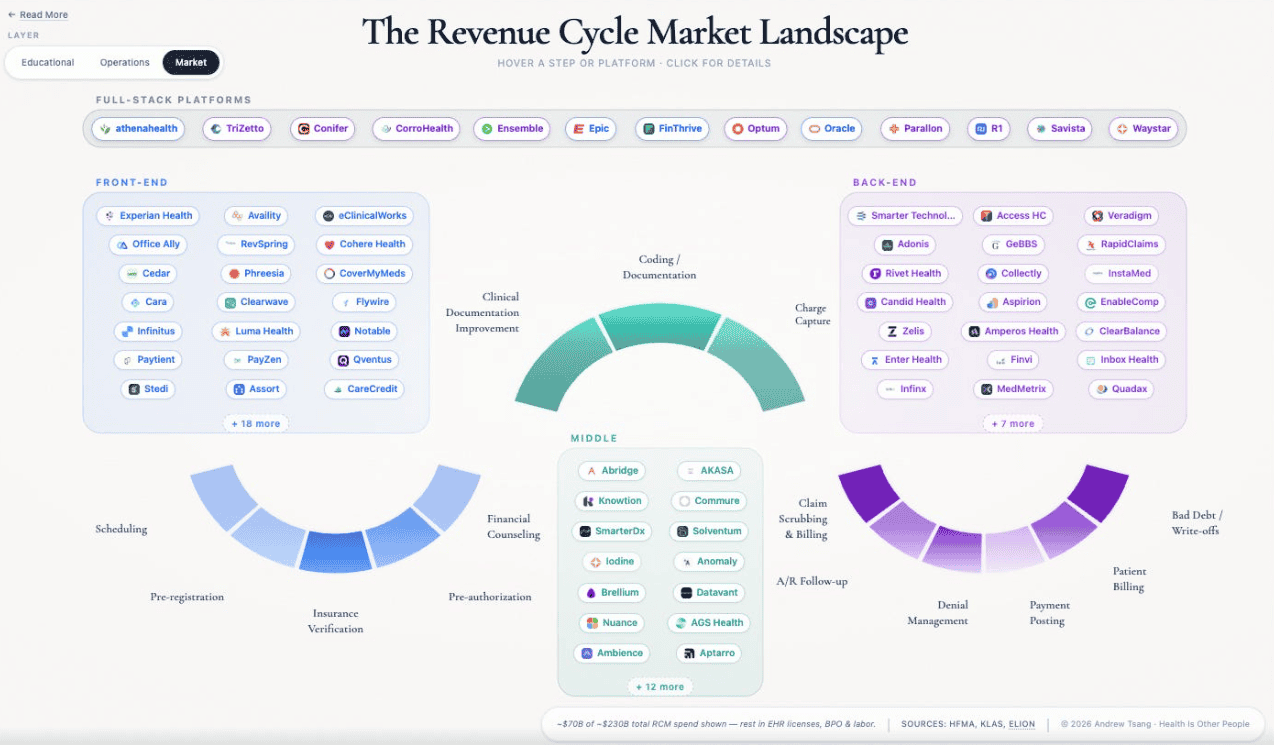
- The RCM market is consolidating fast, with platforms like Carlyle's Knack-Equalize merger and Adonis’s Epic Connection Hub leading a 57% push toward unified, AI-native solutions.
- A third of U.S. health systems plan to ditch offshore RCM contracts within 18 months, opting for domestic, auditable AI platforms that promise better compliance, cost savings, and speed.
Denials Reshape C-Suite Priorities
Payer denials have vaulted revenue cycle management to a boardroom issue, forcing leaders to pivot from reactive firefighting to AI-powered, proactive financial strategies.
By early 2026, payer denials and reimbursement pressures have eclipsed operational inefficiencies as the foremost threats to healthcare revenue growth, with nearly two-thirds of leaders pinpointing these issues as their largest financial barriers. This shift has elevated revenue cycle management from a back-office task to a critical executive-level concern, as over one-third of organizations now discuss denial impacts in strategic financial forums, underscoring the heightened urgency to address payer-driven risks.
In response to escalating denial-related revenue risks, healthcare organizations are channeling substantial administrative resources—often dedicating 50 to 75 hours weekly—to denial management, which detracts from proactive revenue optimization efforts. To counter this inefficiency, 66% of surveyed leaders have identified AI-powered automated denial follow-up and resolution as a vital capability in their 2026 revenue cycle management strategies, signaling a strategic pivot toward technology-enabled financial resilience.
The future of revenue cycle management is rapidly evolving with AI-driven real-time analytics that anticipate payer behavior and enable instant resolution workflows. As Akash Magoon, CEO of Adonis, articulates, next-generation RCM systems will detect denial trends as they emerge and prioritize claims based on financial risk, transforming reactive processes into proactive strategies that mitigate financial volatility.
Complementing this technological evolution, RevTech Partners’ 2026 launch of a Revenue Intelligence Platform exemplifies how integrating AI with decades of healthcare operational expertise can uncover hidden revenue leakage and provide actionable insights into root causes of denials and underpayments. Emphasizing that AI is designed to augment rather than replace human expertise, RevTech highlights the necessity of a unified system where intelligent automation and expert judgment collaborate to navigate reimbursement pressures and enhance financial performance.


AI Sparks RCM Platform Wars
A new breed of AI-native RCM platforms is driving fierce consolidation, as health systems abandon fragmented tools in favor of unified solutions that promise major cost and workflow gains.
By mid-2026, the healthcare revenue cycle management (RCM) landscape witnessed a surge in AI-native, integrated platforms designed to tackle complex billing challenges through advanced analytics and agentic AI. Carlyle’s strategic merger of Knack RCM and EqualizeRCM birthed a multi-specialty powerhouse leveraging proprietary tools like the “Bill Smart” denial prediction system, targeting diverse providers from rural hospitals to specialty groups. Similarly, Adonis’s launch of its AI-powered RCM platform within the Epic Connection Hub exemplifies this innovation wave, autonomously managing billing workflows and interfacing directly with payer portals and EHRs to reduce operating costs by up to 30% without disruptive IT overhauls.
This technological evolution coincides with a pronounced market consolidation trend, as healthcare organizations increasingly seek unified RCM suites to overcome the operational drag caused by fragmented point solutions. The 2026 KLAS RCM Suites Report underscores this shift, revealing that 57% of health systems prioritize vendor consolidation and strategic partnerships when committing to single-vendor platforms. While no vendor yet offers a fully mature end-to-end RCM solution without trade-offs, Waystar leads in overall satisfaction, credited for its cohesive UI, bundled pricing that mitigates nickel-and-diming, and widespread adoption of AI-generated appeals, driving consistent improvements in workflow efficiency and cash collections despite limited cost reductions.

Automation Breaks the Efficiency Paradox
AI-driven automation is upending manual-heavy revenue cycle workflows, enabling practices from dental to rehab to achieve dramatic cost reductions, faster payments, and higher first-pass claim acceptance.
By early 2026, dental practices in the U.S. were confronting the 'efficiency paradox,' where maintaining high net collection rates—63% of practices achieving 90% or higher—depended heavily on labor-intensive manual processes. Zentist's report revealed that 58% of these practices planned to adopt AI and automation tools, particularly for repetitive tasks like eligibility verification and payment posting, with strategies diverging notably between solo practitioners and Dental Service Organizations (DSOs) to address their distinct operational complexities.
The introduction of AI-powered platforms such as Adonis and WebPT in mid-2026 exemplifies how automation is revolutionizing revenue cycle management across diverse healthcare settings. Adonis’s integration within Epic Connection Hub autonomously handles billing workflows, slashing operating costs by 20% to 30% and expanding team capacity without disruptive IT overhauls, while WebPT’s rehab therapy-focused RCM solution leverages predictive analytics and rehab-specific datasets to reduce claim denials by 80%, accelerate payments by seven days, and boost monthly collections by 48%, underscoring the transformative impact of specialized AI tools combined with expert human support.
Independent medical practices are also reaping substantial efficiency gains through AI-driven revenue cycle management, as demonstrated by Capline Healthcare’s model that cuts practice costs by 40% and doubles reimbursement speed for over 1,300 providers. By delivering an end-to-end solution—from patient intake to denial management—Capline eliminates the need for multiple vendors and alleviates staff burdens, achieving a 96% first-pass claim acceptance rate and resolving denials within three business days, thereby effectively addressing the persistent efficiency paradox in healthcare financial operations.
CFOs Target Revenue Integrity, Not Just Cost Cuts
Healthcare finance chiefs are shifting investments to AI and analytics that boost revenue integrity and smarter negotiations, betting on technology to drive sustainable margins—not just expense reductions.
By mid-2026, healthcare CFOs like Deb Harris of TaraVista Behavioral Health Center and Camie Patterson of Central Peninsula Hospital are steering investments beyond mere cost-cutting toward strategic initiatives that enhance revenue integrity, smarter reimbursement negotiations, and sustainable margin growth. This shift reflects a nuanced approach where AI and automation serve as critical enablers, streamlining financial reporting and accelerating access to actionable data, thereby improving both revenue and expense management throughout the month.
UnitedHealth’s landmark $3 billion AI investment underscores a broader industry trend where financial leaders prioritize technology to reduce administrative costs and optimize workflows amid evolving payment pressures. While this commitment has driven a 55% year-over-year increase in operating earnings and aims to process 80% of prior authorizations in real time by 2027, skepticism remains about whether AI will truly dismantle bureaucratic complexity or simply enhance existing inefficiencies, highlighting the delicate balance between financial performance and operational sustainability.
Healthcare financial leadership is increasingly focused on aligning investments with community needs and reimbursement realities, as Alison Roca of Mary’s Center emphasizes improving the economics of care through revenue integrity, grant discipline, and staffing optimization rather than broad cost cuts. This comprehensive approach is complemented by initiatives like Optum Insight’s AI tools, which not only enhance reimbursement negotiations and operational efficiency but also alleviate clinician burnout, demonstrating how strategic AI deployment supports both financial goals and quality care delivery.


Vendor Consolidation Redefines RCM Strategy
Hospital executives now favor end-to-end RCM suites over best-of-breed tools, as market dynamics reward vendors who control claims disputes rather than those who simply cut denials.
The RCM market's structural complexity is underscored by the mispricing of bundled services, which discourages unbundling and instead drives vendor consolidation. As CFOs face tighter IT budgets, they prefer partners like Waystar and Smarter Technologies that offer broad coverage across the revenue cycle rather than specialized point solutions, reflecting a strategic shift where vendors acquire adjacent capabilities rather than build them organically to maintain relevance and market share.
Hospital executives increasingly favor consolidated RCM platforms over best-of-breed solutions because optimizations in one step of the revenue cycle ripple through others, impacting overall financial outcomes. This interconnectedness means that improving coding might increase patient bills, while enhancing collections could defer future care, incentivizing health systems to adopt unified suites that manage the full lifecycle rather than fragmented tools.
The dysfunctional payor-provider relationship in healthcare paradoxically rewards RCM vendors who control the channel of claims disagreement rather than those who simply reduce disputes, emphasizing positioning over pure performance. This dynamic suggests that the vendors poised to survive the next decade will be those who own the claims negotiation process, highlighting a structural challenge that complicates the market beyond mere technological optimization.
By mid-2026, urgent consolidation trends are reshaping the RCM landscape as health systems prioritize vendor consolidation and strategic partnerships—each cited by 57% of organizations—as primary drivers for adopting single-vendor suites. While Waystar leads with an overall “A” grade due to its cohesive UI, bundled pricing, and AI-driven appeals, the rapid assembly of suites through acquisitions results in uneven product integration and software maturity, forcing healthcare organizations to navigate trade-offs between broad coverage and functional performance. Despite workflow and cash collection improvements reported by deep adopters, cost reductions remain elusive due to add-on module pricing.
AI Auditing Fuels Onshore RCM Shift
Surging audit demands and regulatory scrutiny are pushing health systems to replace offshore contracts with domestic, AI-native platforms that deliver traceable compliance and operational transparency.
By mid-2026, AI-driven audit companion tools like RevTech Partners' Revenue Intelligence Platform and MDaudit's Auditor Assist have become indispensable in healthcare revenue cycle management, addressing a surge in audit volumes and regulatory scrutiny. These platforms leverage deep operational expertise and AI to identify revenue leakage, assess coding integrity, and tackle challenges such as denials and underpayments, thereby enhancing compliance with HIPAA and other regulatory standards through traceable, auditable outputs.
This AI-enabled transformation is catalyzing a marked shift away from legacy offshore revenue cycle management outsourcing, with one in three U.S. health systems planning not to renew such contracts within 18 months. Driven by the superior performance, cost efficiency, and compliance assurance of domestic AI-native platforms, healthcare providers now prioritize data residency within the U.S., auditable AI workflows, and multi-clearinghouse claims processing to ensure regulatory adherence and operational reliability.
To remain competitive amid these changes, healthcare BPO providers—including traditional offshore teams—must integrate advanced AI capabilities alongside stringent compliance governance. This evolving market demands outsourcing partners who can seamlessly blend AI-driven operational quality with robust regulatory adherence, reflecting a broader industry pivot toward domestic, AI-enabled solutions that safeguard data integrity and meet escalating audit and compliance requirements.