AI takes the wheel in hiring—but human recruiters refuse to ride shotgun
The gist
AI is transforming hiring, but human recruiters are fighting to keep their hands on the wheel—and their judgment in the driver’s seat.
What to know
- LinkedIn’s AI Hiring Assistant, launched September 2025, supercharged candidate analysis but left companies wrestling with adoption and change management headaches.
- Responsible AI practices—like Talent.com’s voice screening and BCG’s AI TALENT Promise—have boosted hiring equity for women by 39% and racial minorities by 45% as of early 2026.
- By mid-2026, two-thirds of job seekers are using AI résumé tools, but with 76% of candidates still reporting ghosting, recruiters remain vital for authentic, ethical hiring.
Recruiters Face AI Overload
AI tools like LinkedIn’s Hiring Assistant are reshaping recruiter roles and workflows, but adoption hurdles, tool fatigue, and data privacy fears have left many talent teams struggling to adapt amid a flood of new technologies.
The launch of LinkedIn's Hiring Assistant in September 2025 marked a pivotal moment in AI-enhanced recruitment, integrating seamlessly with existing ATS platforms to deepen candidate profile analysis beyond traditional titles and experience. This tool, developed through close co-creation with recruiters to ensure practical utility, exemplifies the industry's move toward embedding AI within familiar workflows, aiming to boost efficiency without disrupting recruiters' day-to-day processes. However, organizations faced significant readiness challenges, as change management and user adoption remained critical hurdles, with some companies adapting their talent acquisition teams in real time while others grappled with uncertainty about effective tool utilization.
AI recruiting tools are fundamentally reshaping recruiter roles by automating traditional sourcing and early-stage candidate evaluation, thereby freeing recruiters to focus on higher-value activities such as relationship building and understanding candidate motivations. As one analyst noted, the advent of AI signals 'the beginning of the end of sourcing,' transforming it into a bespoke, nuanced task rather than a volume-driven one. Equip’s case study from mid-2026 illustrates this shift vividly: their AI-powered platform processes up to 100 resumes in minutes and manages thousands of assessments simultaneously, effectively compressing early recruitment stages and enabling recruiters to prioritize strategic engagement.
Despite the promise of AI tools, organizations encounter a complex landscape marked by tool overload and concerns over accuracy, data privacy, and responsible AI use. Recruiters and talent leaders express paralysis amid numerous offerings that often fail to deliver on marketing claims, underscoring the necessity for rigorous vetting and alignment with existing workflows. Equip’s approach highlights best practices by tightly controlling data inputs—excluding irrelevant candidate information and safeguarding privacy by not using candidate data to train external AI models like OpenAI or Google’s Gemini—thereby maintaining trust and compliance in an evolving regulatory environment.
Responsible AI Gains Ground
Companies such as Talent.com and BCG are weaving ethical AI practices into hiring, using real-time feedback, bias audits, and strict human oversight to balance fairness, compliance, and innovation in recruitment.
Talent.com pioneered responsible AI adoption in hiring by integrating AI voice screening for leadership roles that supplements rather than replaces human judgment. Their system asks structured, unbiased questions and provides real-time candidate feedback, creating a collaborative interview experience that enhances transparency and fairness. Continuous monitoring of AI data and candidate feedback ensures ethical use, with human recruiters stepping in whenever AI falls short, exemplifying a balanced partnership between technology and human oversight.
To mitigate bias, companies like those using the AI agent Max remove all demographic identifiers and conduct regular bias audits aligned with legal mandates such as New York’s law 144 and California’s 18 protected classes. While AI rapidly processes thousands of applications with transparent rationale, human recruiters retain final decision authority, ensuring ethical oversight and preventing overreliance on automated recommendations. This dual approach addresses unconscious human biases while maintaining accountability in hiring decisions.
BCG’s AI TALENT Promise embodies a comprehensive commitment to responsible AI in HR, emphasizing transparency, accountability, ethics, and human-centered decision-making. Their responsible AI team’s rigorous redesign of AI tools for performance reviews transformed potential ethical barriers into accelerators of innovation, enabling rapid pilot deployment within six weeks by mid-2023. This illustrates how embedding responsible AI frameworks can drive both fairness and agility in organizational transformation.
By early 2026, research confirmed that AI hiring tools can be significantly fairer—up to 39% fairer for women and 45% for racial minorities—than human evaluators, largely due to AI’s focus on skills and competencies rather than demographic cues. Candidates also rate AI interviews highly for fairness and consistency, appreciating the patient, unhurried format. However, successful AI integration remains a talent challenge, requiring HR leaders to actively guide ethical AI deployment rather than deferring solely to technical teams, while AI also helps reduce bias in job descriptions and personalize outreach to build candidate trust.




AI as Advisor, Not Judge
Organizations now use AI to recommend and explain candidate matches, but keep humans in control of final decisions to ensure fairness and preserve the crucial human touch in hiring.
Since late 2025, organizations have embraced AI as a recommendation engine rather than a decision-maker in recruitment, exemplified by Max, an AI agent that provides candidate evaluations but leaves final advancement or rejection decisions to humans. This approach enhances transparency by clearly explaining the rationale behind candidate fits, a stark contrast to the opacity of human unconscious biases, thereby preserving essential human judgment while leveraging AI’s analytical strengths.
By early 2026, the narrative around AI bias shifted from questioning its existence to exploring productive collaboration between AI and human recruiters to focus on skills-based hiring. Well-designed AI interviews, which anonymize gender and other demographic cues, offer candidates a consistent and patient platform to demonstrate abilities, thus enhancing fairness and candidate experience rather than dehumanizing the process.
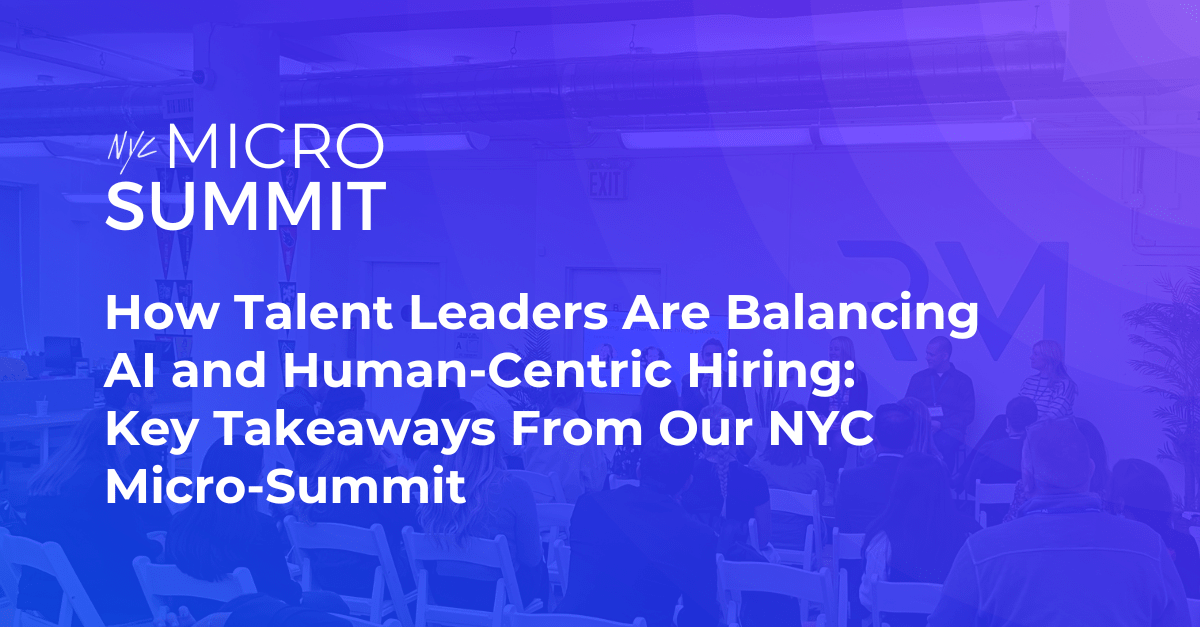
Talent leaders, as highlighted in a May 2026 NYC micro-summit, are strategically deploying AI to automate repetitive recruitment tasks, freeing recruiters to engage in relationship-building and personalized candidate interactions. Despite AI’s efficiency, candidates—especially underrepresented groups—continue to value human elements such as diverse interview panels and thoughtful communication, underscoring the necessity of balancing automation with genuine human connection to avoid negative experiences like ghosting, which 76% of candidates cite as their top frustration.
Companies like Marriott exemplify a cautious yet forward-thinking stance by integrating AI to enhance efficiency without replacing human recruiters, preferring technology that categorizes candidates as qualified without assigning comparative scores. Complementing this, organizations leverage AI to personalize outreach messages and reduce biased language in job descriptions, while using AI-generated structured interview scorecards and pre-interview candidate insights to foster authentic connections. Importantly, AI’s role remains tactical—synthesizing notes and identifying unvalidated requirements—allowing recruiters to focus on high-value, human-centric activities such as active listening and face-to-face engagement, thereby preserving the human essence at the heart of recruitment.


Job Seekers Embrace AI Tools
With AI-powered résumé builders and interview platforms now standard, candidates and recruiters alike must balance automation’s efficiency with the need for authenticity and human judgment in every stage of the hiring process.
By mid-2026, AI had become deeply integrated into the job search process, with two-thirds of candidates using tools for résumé writing, interview practice, and career guidance, as reported by Career Group Companies. Educational institutions like Cal Poly adapted by adopting AI-powered platforms such as BigRésumé, which helps candidates tailor their résumés to applicant tracking systems by analyzing both the résumé and job description. However, career advisors like Yasna Mukundan caution that AI should serve as an aid rather than a replacement for authentic human expression in applications, underscoring the importance of maintaining a personal touch despite technological advances.
Recruiters and organizations are also evolving alongside candidates, embedding generative AI within applicant tracking systems to conversationally guide applicants and enhance screening efficiency, as noted by Ben Alexander. Yet, human oversight remains crucial, with recruiters like Matt Parks acknowledging that while AI aids the review process, some candidates experience near-instant rejections likely driven solely by AI, highlighting ongoing challenges in balancing automation with fairness and human judgment.
Companies like Equip exemplify proactive organizational adaptation by compressing early-stage recruitment into largely automated workflows that screen resumes, assess skills, and conduct AI-led interviews, effectively managing overwhelming applicant volumes. Equip’s platform enhances recruiter capability through transparent metrics like the Job Fit Score, which benchmarks candidates and provides AI-generated explanations, enabling recruiters to make informed decisions with clarity and efficiency.
Equip is also pioneering privacy-conscious, dynamic talent assessment by integrating Google’s Gemini for real-time conversational interviews that evaluate only candidate responses, deliberately excluding tone, appearance, or delivery style to reduce bias. Furthermore, Equip tightly controls data flow to ensure candidate information is limited to role-relevant fields and is not used to train external AI models, reflecting an evolving commitment to ethical AI deployment in hiring.