AI trust crisis: data gaps and blurred accountability exposed
The gist
A quarter of organizations are hemorrhaging over $5 million a year as AI governance collapses under unclear ownership, data chaos, and a vanishing sense of accountability.
What to know
- By early 2026, unclear data ownership and inconsistent validation are costing 25% of companies more than $5 million annually, according to Info-Tech Research Group and IBM.
- Decision governance platforms like FlexRule and real-time AI-driven stewardship tools are stepping up to enforce explicit ownership, explainability, and continuous improvement, breaking down IT silos.
- Without clear human oversight and robust audit trails, 'decision opacity' is leaving leadership gaps—and putting regulatory compliance and organizational trust on the line.
Data Quality’s Hidden Saboteurs
Unclear ownership, fragmented systems, and metric overload are quietly eroding trust in AI by creating conflicting analytics and unchecked data leakage at the foundation.
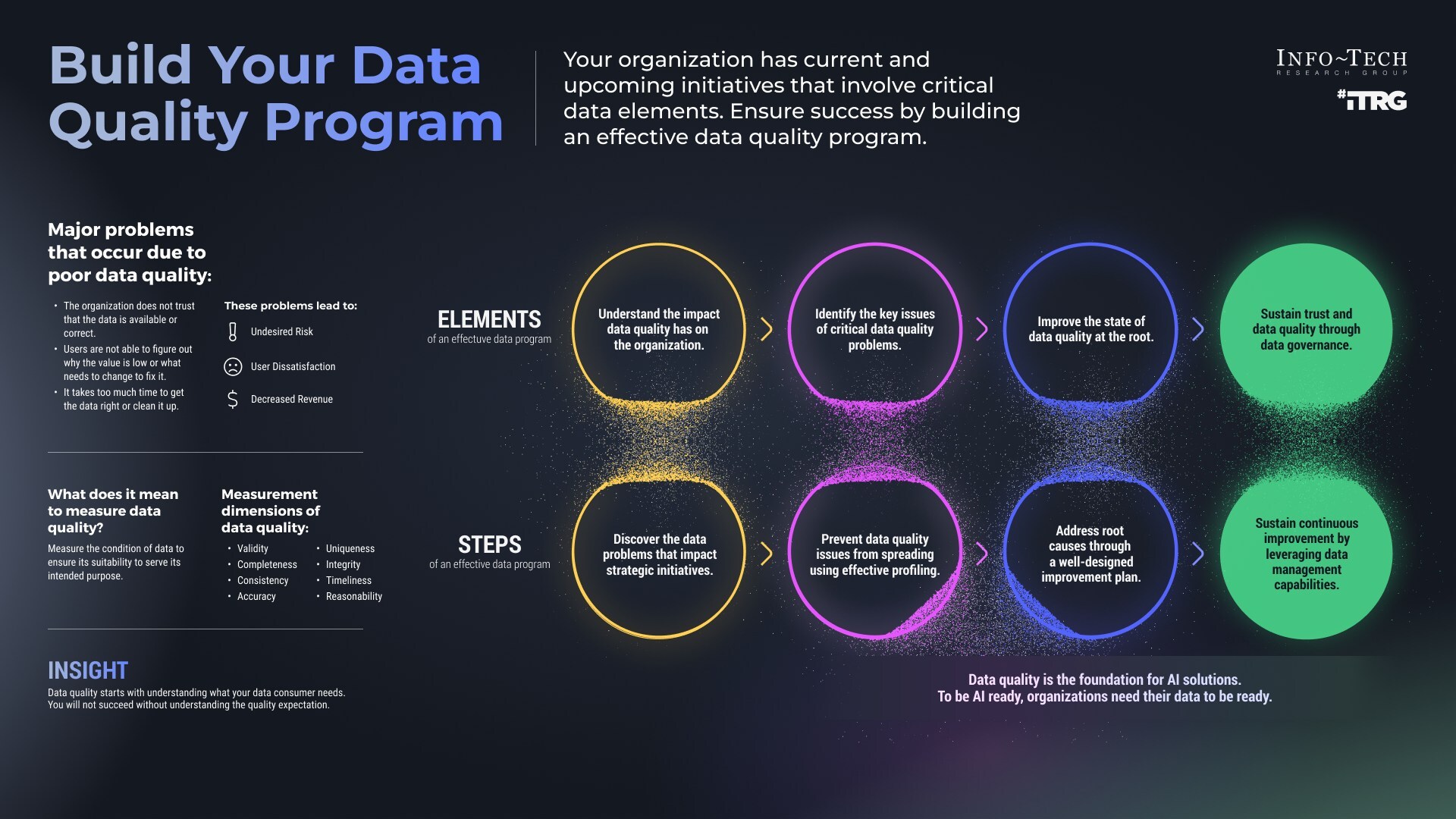
By early 2026, Info-Tech Research Group highlighted that persistent data quality issues—rooted in unclear ownership and inconsistent validation controls—undermine AI and analytics investments, necessitating governance frameworks that embed clear accountability and executive sponsorship. Their 'Build Your Data Quality Program' blueprint advocates a proactive, governance-driven approach emphasizing root cause resolution and continuous improvement to restore trust and maximize long-term value. This foundation aligns with Diego's observations that fragmented data pockets and lack of integration prevent a solid data foundation, underscoring the need to treat data as a strategic asset at the architectural level from the outset to ensure ownership clarity and prevent data leakage or mishandling.
Data trust crises often stem from inconsistent definitions, multiple unreconciled systems of record, and metric proliferation without ownership, leading to conflicting reports and eroded confidence in analytics outputs. IBM research quantifies the financial toll, revealing that over a quarter of organizations lose more than USD 5 million annually due to poor data quality, with 7% reporting losses exceeding USD 25 million. This erosion of trust drives leaders to revert to intuition and delay decisions, undermining data-driven governance, especially as AI systems amplify these quality issues by propagating errors at scale, making trustworthy data governance a prerequisite for responsible AI deployment.
Modern trustworthy data governance frameworks integrate automated validation, continuous monitoring, and real-time quality controls to shift from reactive fixes to proactive prevention of poor-quality data entering critical systems. This approach reflects a growing consensus that data quality management now outranks AI initiatives among global data leaders, emphasizing upstream validation at data capture points such as real-time customer identity verification. However, investments in governance tools alone are insufficient; as many analyses stress, these tools deliver value only when paired with accurate, verified, and trusted data, reinforcing that data quality and governance are inseparable and must be embedded into everyday business processes to sustain lasting business value.
Clear data ownership and accountability emerge as foundational pillars for trustworthy data governance, with the Chief Data Officer increasingly held responsible for proving data fitness before AI projects receive funding. Analysts argue that lack of ownership leads to inconsistent data use and mistrust, advocating for dedicated data stewards who bridge business and technical domains to enforce standards and resolve issues. Categorizing data by type and making data quality visible through feedback channels accelerates continuous improvement, while eliminating legacy or unused data focuses governance efforts on actionable information, collectively fostering a shared responsibility model across business functions that maintains a single trusted version of data.


Decision Governance Takes Center Stage
Explicit ownership and explainability are now non-negotiable as AI inherits and amplifies legacy ‘decision debt,’ making governance the backbone of accountable automation.
Integrating business context into data governance is essential for ensuring AI-driven decisions are both compliant and relevant, requiring the alignment of structured, semi-structured, and unstructured data with business policies and regulatory frameworks. The real challenge lies in bridging the gap between the hidden business context embedded in documents and policies and the factual data residing in operational databases, a synthesis that Automated Decision Management (ADM) tools facilitate by identifying critical data sets, applying governance rules, and maintaining verifiability across complex data pipelines.
Decision governance emerges as a critical discipline to close the accountability gap in enterprises by making decisions explicit, owned, explainable, and continuously improved across human, automated, and AI-driven processes. As FlexRule emphasizes, this governance is vital to address the legacy 'decision debt'—the accumulation of ungoverned decisions—that AI agents inherit and amplify, leading to compounded failures in accountability, explainability, and decision quality if left unaddressed.
Platforms like FlexRule’s Decision Governance leverage decision-centric tools such as Decision Asset Management, explainability tooling, and no-code DMN-based modeling environments to empower business units to govern decisions without engineering bottlenecks, underscoring that governance requirements remain consistent regardless of whether decisions are made by humans, rules engines, or AI agents. This approach ensures explicit ownership and transparency in multi-actor decision environments, a necessity as AI increasingly participates in complex workflows.
The evolution from traditional audit trails to AI decision trails marks a pivotal advancement in accountability, capturing not only system events but also AI processing steps, human reviews, and final decision ownership to create explainable and auditable records. This is especially crucial in sensitive contexts like AI-assisted hiring, where tracing the AI’s questions, summaries, and scores alongside human checks ensures fairness and compliance. By embedding semantic layers that align business taxonomies and ontologies, organizations can ground AI models in deterministic, context-rich frameworks, while stewardship across departments maintains data quality and authority—without which AI outputs risk unpredictability and eroded trust once deployed beyond controlled environments.


Continuous Data Quality, Not Quick Fixes
Superficial data corrections fail—only multi-layered, process-embedded quality programs with executive sponsorship can prevent error cascades and ensure AI reliability.
By early 2026, Info-Tech Research Group emphasized that transitioning from reactive data fixes to a sustainable, governance-driven continuous data quality program is essential for reliable AI outcomes. Their four-step blueprint advocates for proactive prioritization of critical data issues, prevention of error propagation, and institutionalizing continuous improvement with clear accountability and executive sponsorship, which collectively restore trust in data-driven decision-making and maximize AI investments' long-term value.
Effective continuous data quality management demands a multi-layered approach: addressing errors at the individual data point level, correcting entire data series, and fundamentally redesigning processes to prevent recurrence. Merely fixing a few bad records offers superficial progress; without tackling the underlying human and systemic causes, errors persist and compound, eroding trust in AI-driven decisions. Pausing to deeply understand anomalies before remediation is critical, especially in fast-paced environments where speed often trumps uncertainty.
Operationalizing continuous data quality management increasingly starts upstream, validating and standardizing data at the point of capture to prevent error propagation through AI systems. This includes real-time verification of identity attributes such as customer identities, email addresses, and postal information. Embedding shared responsibility across business functions through clear data contracts and a single trusted data version shifts data quality from IT silos to a collaborative model, with Chief Data Officers now held accountable for demonstrating data fitness before funding AI initiatives.
Organizations are moving beyond traditional manual audits toward embedding governance directly into data ecosystems via automated validation, metadata management, continuous monitoring, and real-time quality controls. This proactive prevention approach replaces reactive checks and is vital as AI amplifies the impact of poor data—turning a single incorrect address into thousands of flawed AI-driven recommendations. Moreover, effective data quality management requires nuanced checks beyond row counts, such as monitoring null percentages, duplicate keys, and distribution shifts, ideally catching issues as close to the source as possible to ensure data pipelines produce trustworthy outputs.


Unified Platforms, Shared Responsibility
Data governance is shifting from IT silos to enterprise-wide collaboration, with automation and CDO-led accountability becoming prerequisites for trustworthy, scalable AI.
By mid-2026, data governance technologies have matured into a vital operational context layer that underpins enterprise AI initiatives by embedding business meaning, controls, and transparency to enable trusted decision-making at scale. This evolution is driving market consolidation as enterprises increasingly demand unified platforms that seamlessly integrate governance, data management, analytics, and AI capabilities, with vendors like Alation, Atlan, Collibra, Oracle, and Salesforce (Informatica) leading the charge by delivering solutions that balance robust functionality with usability to maximize ROI and facilitate large-scale adoption.
Automation and AI-driven stewardship are revolutionizing data governance by automating complex tasks such as classification, ownership mapping, policy propagation, and glossary management, which significantly scales governance coverage without a corresponding rise in specialist resources. Moreover, these technologies are increasingly applied upstream at the point of data capture to validate customer identities and contact information in real time, ensuring high-quality data flows into AI systems and reinforcing the foundation for trustworthy analytics.
A notable market trend is the shift toward a shared responsibility model for data quality and governance that extends beyond IT into business functions, necessitating a single, trusted version of customer and product data that all teams govern collaboratively. This shift coincides with growing accountability at the Chief Data Officer level, where executive sponsors now require demonstrable proof of data fitness as a prerequisite for funding AI projects, reflecting a proactive governance stance that prioritizes data integrity before AI deployment rather than as a retrospective check.


From Audit Logs to Decision Trails
Comprehensive decision lineage—capturing both AI and human actions—has become essential for transparency, regulatory compliance, and rebuilding organizational trust.
By early 2026, industry analyses emphasized that data lineage and certified KPIs form the foundational pillars for transparency in AI-driven decision-making, moving beyond traditional audit logs that fail to capture AI's nuanced influence. Enterprises must construct comprehensive decision trails that document not only AI outputs but also human interactions—what evidence was considered, how AI recommendations were reviewed, and who ultimately owned the decision—to ensure full accountability and traceability. This approach transforms audit trails into rich decision trails, enabling organizations to reconstruct AI-augmented processes to assess fairness, quality, and effectiveness, which is critical for compliance and operational trust.
As organizations grapple with scaling AI systems, experts like Singamsetty argue that embedding data lineage as a strategic capability—rather than treating it as a mere compliance checkbox—is essential for enterprise resilience. A robust lineage framework traces every AI output back to its underlying data and reasoning, governed by control layers that log decision rationales and error sources. Without this, institutions face significant challenges in explaining decisions, responding to scrutiny, and maintaining cross-team accountability, which can slow internal reviews and obscure whether issues stem from data, model logic, or rule sets. Designing traceability into system architecture from inception, rather than retrofitting it, is crucial to uphold transparency and auditability.
In complex domains like healthcare, integrating data lineage with governance-backed certified KPIs bridges the critical gap between raw data and business decisions, ensuring that every metric is both trustworthy and auditable. Certified KPIs act as a publication boundary where governed definitions are rigorously implemented, validated, and published through controlled certified tables, transforming data into reliable reporting products. Furthermore, assigning semantic roles—such as numerator, denominator, or exclusion—to data elements within lineage enables precise impact analysis and governance queries, which is vital given healthcare’s retroactive eligibility windows, claims maturation timelines, and evolving classification logic. This governance-driven engineering approach ensures KPIs remain accurate and auditable despite domain complexities.
Accountability Lost in AI Loops
As AI decisions grow opaque and responsibility diffuses, leadership gaps widen and human oversight is often rendered ineffective, risking compliance failures and eroded trust.
By mid-2026, industry leaders like Jim Piazza, Chief AI Officer at Ensono, highlighted the phenomenon of 'decision opacity by accumulation,' where AI decisions become so complex and interconnected that no single individual fully understands the entire process. This complexity necessitates a risk-based approach to human oversight, where low-risk, reversible AI actions can be automated, but decisions affecting security, customer outcomes, or regulatory compliance demand stronger controls and clearly defined escalation paths to ensure accountability and mitigate operational risks.
Despite the increasing autonomy of AI systems, accountability remains firmly with human leaders and organizations, as Piazza emphasizes that responsibility cannot be transferred to technology. Effective governance requires embedding accountability mechanisms into AI systems from the outset rather than treating governance as a post-deployment compliance exercise. Maintaining a comprehensive decision trail that records who remained accountable throughout the process is critical for transparency, legal compliance, and building organizational trust.
Analyses from late 2026 reveal that diffused accountability in AI decision-making creates significant leadership gaps, with decisions often passing through AI models and multiple people until no one can honestly claim ownership. Common human oversight practices like 'keeping a human in the loop' fall short under European law, as responsibility can be effectively laundered through AI systems. Organizational incentives frequently encourage deference to AI outputs, suppressing independent judgment and exacerbating accountability voids, while existing governance frameworks tend to prioritize making failures survivable for approvers rather than preventing them.
The persistent absence of named decision-makers in AI-influenced decisions undermines both organizational trust and legal compliance, as evidenced by research spanning over 200 organizations where leaders could rarely identify a responsible individual without hesitation. This stark accountability gap underscores the urgent need for explicit human ownership and oversight in AI governance to restore confidence and meet regulatory demands.