AI turns SaaS upside down: pricing chaos, margin squeeze, and the death of the seat license
The gist
AI is throwing SaaS economics into chaos—obliterating seat licenses, squeezing margins, and forcing software giants and startups alike to rewrite their playbooks for survival.
What to know
- Traditional per-seat SaaS pricing is collapsing as AI drives a shift to complex, hybrid models and gross margins plunge from 70–90% to as low as 20–60%.
- Classic SaaS moats like proprietary code and high switching costs are vanishing, pushing defensibility toward proprietary data, workflow integration, and AI agent orchestration.
- AI-powered automation is slashing SaaS headcount and boosting efficiency—Shopify cut 30% of staff while raising ARR per employee to $1.3 million, and investors now chase AI-driven power users over old-school growth metrics.
Hybrid Pricing Disrupts SaaS
AI agents and automation are forcing SaaS giants to abandon seat licenses for complex, multi-layered pricing models as variable compute costs squeeze margins and upend traditional growth strategies.
AI agents and automation are fundamentally reshaping SaaS business models, forcing a rapid evolution from traditional per-seat licensing to hybrid pricing structures that blend seat-based, usage-based, and agent licensing models. Industry giants like Microsoft and Salesforce have pioneered these changes, with Microsoft launching premium AI-infused tiers such as the $99 E7 and $19.99/month 365 Premium, and Salesforce introducing 'agentic work units' and enterprise license agreements that decouple revenue from headcount. This shift is driven by the need to recover significant variable compute costs per interaction—unlike the near-zero marginal cost of legacy SaaS—resulting in compressed gross margins that now often range from 20-60% for AI-native offerings, compared to the historic 70-90%.
Margin compression is not merely a technicality but a structural upheaval, as AI-native SaaS companies face ongoing capital requirements for compute infrastructure, model training, and data pipelines, pushing their economics closer to infrastructure providers than traditional software. Scale, once a reliable path to improved unit economics in SaaS, now threatens profitability if efficiency gains lag behind surging AI usage. As a result, established SaaS firms with cash-generative cores—like Microsoft and Salesforce—can afford to temporarily sacrifice margins or even run at zero gross margin to outlast AI-native upstarts, while startups rely on capital market funding to undercut incumbents and accelerate automation.
The proliferation of AI agents is also driving SaaS companies to rethink their value proposition and revenue strategies, as agent-driven automation reduces the need for human seats and shifts customer ROI calculations from user counts to outcomes and productivity gains. This has led to the adoption of pricing models tied to verified AI-driven work output—such as Securonix's 'analyst-equivalent work' pricing and Decagon's per-conversation or per-resolution fees—while credit-based and tiered subscription models (as seen with Figma and Anthropic) are increasingly used to segment users and align costs with actual AI consumption. However, the complexity of AI pricing, with its significant variable compute costs and evolving user behaviors, means most leading SaaS companies now run two or three concurrent pricing models to maximize flexibility and customer fit.
Despite the hype, monetizing AI features remains challenging, as evidenced by Microsoft's Copilot adoption—where only about 3% of Office 365 users pay for the add-on despite massive investment and executive optimism. This disconnect highlights the difficulty of converting free or organic users into durable, high-margin power users, a challenge compounded by the need to balance initial zero or negative margin credits with long-term retention and lifetime value. As Jason Lemkin observes, 'inference is the new sales and marketing,' underscoring how AI-driven SaaS companies must invest heavily upfront to acquire and engage users, with retention at 12 months (50-70%) now a critical metric for sustainable margins.





AI Erodes Classic SaaS Moats
Generative AI is commoditizing features, slashing switching costs, and shifting SaaS defensibility to proprietary data, workflow integration, and agent orchestration as legacy advantages vanish.
Generative AI has fundamentally weakened the traditional competitive moats of SaaS—such as high switching costs and proprietary code—by making it possible for enterprises to replicate core functionalities using generic or optimized large language models. As one analyst put it, 'Generative AI acts as an eraser for these advantages,' with AI agents now capable of mirroring the features that once justified premium pricing and vendor lock-in. In this new landscape, defensibility is being rapidly reinvented around data ownership, seamless workflow integration, and the orchestration of AI agents, as these become the true differentiators in a world where software features are increasingly commoditized.
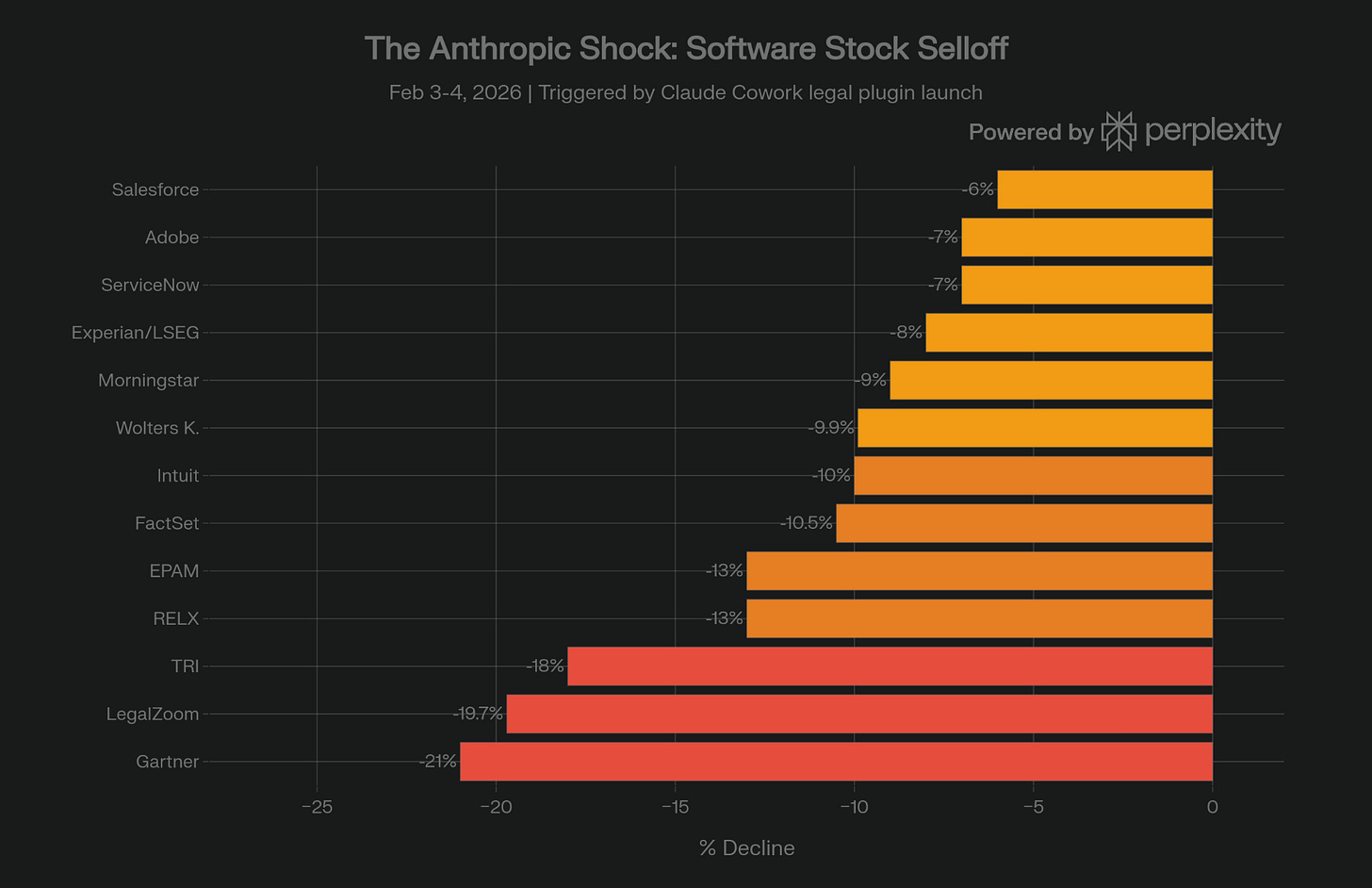
By early 2026, the erosion of traditional SaaS moats has accelerated, with AI-native products commoditizing thin-moat tools and simple workflow wrappers, and even enabling rapid assembly of enterprise-grade workflows. Anthropic's Claude Cowork, for example, was built in under two weeks and can autonomously handle tasks like building spreadsheets or drafting reports, signaling that legacy SaaS products' moats are now paper-thin. The rise of agentic AI shifts value creation from organizing human labor to executing work autonomously, undermining seat-based licensing and pushing SaaS vendors to seek defensibility in data ownership, workflow integration, and agent orchestration—areas now exemplified by companies like Salesforce, Atlassian, and MongoDB.
AI is also dramatically lowering the cost and friction of switching between SaaS providers, as agents automate data migration and integration, erasing the 'hostage' effect of legacy systems like SAP and Oracle. The Klarna CEO notes, 'The next thing that's going to hit everyone bad is the switching cost of data,' with AI already enabling one-click migrations that threaten incumbents' market valuations and price-to-sales multiples. As a result, the application layer is being commoditized, and the true source of value and defensibility is shifting toward proprietary data, workflow integration, and the ability to orchestrate complex agentic systems.
Despite the disruption, some SaaS incumbents are leveraging their established infrastructure, operational expertise, and vast proprietary data to reinforce new moats. Companies like SAP, Atlassian, and ServiceNow are using AI to automate maintenance and streamline workflows, with ServiceNow's RaptorDB supporting thousands of autonomous agents and rebuilding enterprise infrastructure for an agentic future. These firms demonstrate that while code and interface moats are fading, deep workflow integration, operational scale, and unique data assets remain formidable barriers to entry—especially when paired with AI-driven innovation.





Automation Slashes SaaS Headcount
Agentic workflows and AI-powered automation are driving massive productivity gains, transforming workforce needs, and making AI fluency a must-have skill in every SaaS role.
AI is fundamentally transforming the operational backbone of SaaS companies, driving dramatic productivity gains and reshaping workforce composition. Companies like Shopify have seen their ARR per employee soar to $1.3 million while reducing headcount by 30% since 2022, and 76% of SaaS firms with over $50 million ARR have reported workforce reductions—most notably 42% in engineering, 27% in customer success, and 26% in marketing. This acceleration, mirrored by Klarna's halving of its workforce from 7,000 to below 3,000 without additional funding, signals a new era where AI-powered automation enables companies to do more with less, prioritizing efficiency and operational leverage over traditional headcount growth.
The rise of agentic workflows—where AI agents autonomously execute complex, data-intensive tasks—is redefining both the value and complexity of SaaS operations. From Box’s deployment of agents that extract structured data and automate business intelligence, to Aptean’s AI agents slashing process times from hours to minutes at Toufayan Bakeries, SaaS companies are increasingly 'leasing digital co-workers' to handle repetitive, long-running tasks. This shift not only boosts productivity but also demands new approaches to data governance, security, and workflow orchestration, as the stakes of managing thousands of automated agents and their access to sensitive enterprise data rise exponentially.
As AI becomes embedded in every layer of SaaS, workforce skill requirements are evolving at breakneck speed, with AI fluency now a critical hiring criterion and a prerequisite for modern GTM roles. The number of B2B software jobs requiring AI skills has grown 14-fold in just two years, and companies like Notion and monday.com are retooling talent strategies to prioritize young, adaptable talent and partner-led AI expertise. Training initiatives, such as New Horizons embedding Microsoft Copilot instruction into Office courses, further illustrate how companies are weaving AI literacy into daily workflows, ensuring both technical and non-technical employees can harness agentic tools effectively.
AI-native SaaS startups, founded after 2022, are outpacing legacy peers with median growth rates of 40%-110%—three times faster than traditional SaaS—though often at the cost of slightly lower gross margins as they invest in rapid AI integration. Meanwhile, established incumbents like SAP, Atlassian, and ServiceNow are leveraging AI to automate the 'grunt work' of software maintenance and IT service management, reinforcing their competitive moats. ServiceNow’s launch of RaptorDB, designed to support autonomous agents, exemplifies how incumbents are shifting engineers’ focus from routine tasks to higher-level problem-solving, blending operational efficiency with continuous innovation.





Margins Squeezed by AI Compute
Soaring infrastructure costs from AI are compressing SaaS margins, forcing a shift to new pricing models and exposing firms unprepared for real-time cost tracking to investor skepticism.
AI integration has fundamentally upended the traditional SaaS economic model, shifting it from a world of near-zero marginal costs to one resembling infrastructure businesses, where every customer interaction incurs meaningful variable compute expenses. This transition, as seen across companies like Microsoft, Anthropic, and Replit, has compressed gross margins from the SaaS-standard 75–90% down to 25–40% for fast-scaling AI-native startups, with 84% of companies reporting at least a 6% margin decline due to AI infrastructure costs. The result is a new era where scale no longer guarantees efficiency gains, and CFOs are often caught off guard by rapidly escalating LLM-driven costs that were never part of original budget models.
The complexity of cost tracking and pricing in AI-driven SaaS has forced companies to experiment with new models—moving away from seat-based licensing toward consumption, outcome, or productivity-based pricing, as illustrated by Securonix’s analyst-equivalent pricing and Microsoft’s $99 E7 tier for AI agents. However, only 43% of companies track AI costs by customer and just 22% by transaction, making profitability analysis and ROI measurement increasingly challenging. Those with robust FinOps practices and real-time cost monitoring are better positioned to manage these pressures, while others risk margin erosion and investor skepticism.
Investors, boards, and private equity are recalibrating their expectations in response to these structural shifts, distinguishing between initial margin impacts from user acquisition (such as zero or negative margin credits) and the durable margins from high-retention, high-value power users who pay 10x traditional SaaS prices. While public markets punish margin compression and product commoditization, private equity is quietly harvesting incremental EBITDA by embedding AI for operational efficiency across portfolios. Meanwhile, the traditional CAC-to-LTV metric is losing relevance in this volatile landscape, with retention at month 12 (M12) emerging as a critical indicator of business durability.
Margin management in the AI era is a high-stakes balancing act: companies like Anthropic are introducing tiered pricing, rate limits, and hybrid models to align revenue with compute costs, but risk alienating their most engaged users or losing them to open-source alternatives. At the same time, the rapid depreciation of AI models and hardware is turning compute into a commodity, squeezing hyperscaler margins and raising existential questions about the sustainability of subsidized consumer AI adoption. As capital costs rise and investor patience wanes, SaaS incumbents and startups alike are being forced to prioritize efficiency, real-time cost control, and pricing strategies that reflect the true value delivered by AI features.




Incumbents Double Down on AI
SaaS leaders like Salesforce and monday.com are reinventing themselves through bold AI-driven partnerships, new value metrics, and sweeping product pivots to survive the coming 'SaaSpocalypse.'
By early 2026, SaaS incumbents such as Aptean and monday.com are demonstrating that survival in the AI-driven SaaS landscape hinges on strategic pivots that embed AI not just into products, but into the very fabric of their partner and client relationships. Aptean’s launch of 'Intelligence as a Service' on AppCentral 2.0, for example, goes beyond mere AI feature add-ons, delivering custom AI agents via a white-glove partnership model that slashes workflow times—Toufayan Bakeries cut a traceability process from four hours with eight people to under an hour with one. Meanwhile, monday.com is evolving its go-to-market approach by expanding its partner program with AI-powered matchmaking engines and global advisory boards, positioning AI as a core growth lever and opening new revenue streams through scalable, partner-led initiatives.
The interplay between SaaS incumbents and AI-native challengers is further illustrated by the collaboration between Salesforce and Smarsh, where the integration of AI-powered solutions is driving tangible gains in regulated sectors. Smarsh’s 'Archie' AI agent, built on Salesforce’s Agentforce 360 Platform, achieved a remarkable 59% self-service adoption rate, underscoring how incumbents can empower challengers to enhance customer engagement and productivity. This collaborative dynamic exemplifies a broader trend: rather than competing head-to-head, incumbents and challengers are forging strategic partnerships to co-create value and thrive in the rapidly evolving AI SaaS ecosystem.
Amid mounting fears of an impending 'SaaSpocalypse,' Salesforce is doubling down on its AI-driven future through bold financial and product maneuvers. The company’s $50 billion share buyback and the $800 million in annual recurring revenue generated by its Agentforce AI platform signal a decisive shift in both investor relations and product strategy. By introducing new metrics like 'agentic work units,' Salesforce is not only adapting its offerings but also reframing how value is measured in the AI era, demonstrating the lengths to which incumbents will go to maintain their competitive moats as the SaaS landscape is reshaped by artificial intelligence.