AI voice agents slash waits, boost revenue across industries
The gist
AI voice agents are obliterating wait times, quadrupling transaction speeds, and turning call centers into revenue machines across industries.
What to know
- By early 2026, companies like Home Depot and Wells Fargo use advanced AI voice agents to handle billions of interactions with seamless context transfer and urgency recognition.
- Latency in AI-powered voice conversations has plunged from 75ms to as low as 5ms, boosting natural dialogue performance by 30% and enabling authentic, low-latency exchanges.
- Platforms such as Sadie and Click Voice AI have slashed front desk costs by half and increased appointment bookings by up to 45%, with ROI now measured by outcomes like hang-up reduction, revenue recovery, and customer loyalty.
Beyond Human Voices
AI voice agents now face scrutiny for their ability to manage urgency, context, and seamless handoffs—revealing that a lifelike voice exposes, rather than hides, weak service processes.
By early 2026, advancements in natural voice AI have significantly raised customer expectations, shifting the focus from mere pronunciation to the AI's ability to understand urgency, manage complex issues, and execute seamless escalations. This evolution demands rigorous containment discipline, confidence thresholding, and flawless context transfer during AI-to-human handoffs to prevent frustration, especially in critical scenarios like billing disputes or emotionally charged complaints. Evaluations now prioritize whether customers can effortlessly reach human agents without losing language preferences or call context, underscoring that a more human-like voice only amplifies service model weaknesses if foundational processes are flawed.
Technical foundations of advanced AI voice agents rely on deploying multiple specialized large language models (LLMs) that simulate distinct personas or roles, enabling contextually authentic and personalized interactions. Ryan Murha highlights this multi-LLM approach alongside voice cloning technologies, such as those from 11 Labs, which replicate individual voices with near-perfect fidelity and minimal latency, transforming generic text-to-speech into highly realistic conversations. These innovations, combined with training on targeted data corpora, reduce the need for exhaustive information retrieval, thereby accelerating response times and enhancing user experience.
The engineering challenges underpinning effective AI voice agents center on achieving ultra-low latency and reliable end-to-end streaming to maintain natural conversational flow. As emphasized in mid-2026 interviews and analyses, reducing latency from 75 milliseconds to as low as 5 milliseconds can yield a 30% performance boost, with every 10-millisecond improvement materially enhancing interaction smoothness. Handling bidirectional interruptions and sequencing inference correctly ensures conversations feel fluid, while innovations like automatic context compaction address the token management challenges inherent in long multi-turn dialogues, a problem voice AI has pioneered solutions for ahead of other AI domains.
Recent ecosystem developments have expanded the capabilities and accessibility of AI voice agents beyond core voice models to include reasoning engines, vector databases, and coding agents, facilitating complex multi-turn context management and multimodal integration. AssemblyAI's CEO notes that this broader infrastructure supports practical applications like drive-through ordering and AI note-taking, while democratization through coding agents empowers small businesses to automate back-office tasks and build voice AI solutions without traditional engineering resources. This ecosystem growth is catalyzing a 100-fold expansion in the total addressable market and accelerating widespread adoption by late 2026.






Trust Hinges on Effortless Escalation
Customer trust plummets when AI voice agents fail at context transfer or force repetition, making frictionless escalation and minimized caller effort the new benchmarks for success.
By early 2026, the rise of natural-sounding AI voice agents significantly raised customer expectations, as these agents created an illusion of deep understanding and nuanced comprehension. However, when AI systems failed to handle complex issues or required customers to repeat information during AI-to-human handoffs, frustration intensified, eroding trust despite improved voice quality. Experts emphasize that seamless escalation with full context transfer, retention of language preferences, and clear confidence thresholds are essential to prevent the more human-like voice from amplifying service flaws.
Innovative designs that imbue AI voice agents with authentic human personality traits and role-specific behaviors, as Ryan Murha describes with multiple LLMs representing different facets of a person, enhance interaction naturalness and customer comfort. Coupled with context-aware responsiveness that adapts tone and content based on user needs and agent roles, this approach reduces friction and awkwardness, setting the stage for broader acceptance of voice AI in 2026 and beyond.
Reducing customer effort remains paramount; AI voice agents must eliminate repetitive tasks, avoid forcing customers through convoluted menus, and proactively manage intent recognition and issue resolution. As highlighted in analyses from mid-2026, trust builds when AI minimizes caller labor rather than masking outdated service models behind friendlier voices. Mapping friction points such as repeated verification and lost context before AI deployment is critical to ensure these agents genuinely streamline the customer journey and lower stress at the crucial first contact.
Transparency and smart deployment strategies further optimize customer experience: disclosing AI involvement upfront reduces hang-up rates by about 20%, countering fears that such honesty deters callers. Meanwhile, providing clear human off-ramps for customers reluctant to engage with AI, as Fred Bean advises, respects diverse preferences and prevents alienation. Although voice AI adoption is growing, many customers still prefer text channels for convenience, underscoring the need for flexible, context-aware designs that preserve seamless AI-human handoffs to maintain comfort and satisfaction.


From Cost Center to Revenue Driver
AI voice agents are transforming call centers into profit engines by enabling faster transactions, personalized engagement, and expanding into sectors from education to public safety.
AI voice agents have revolutionized call centers and customer service operations by transforming them from cost centers into dynamic revenue engines. Companies like Home Depot leverage AI to identify customer intent within seconds and complete transactions four times faster than traditional systems, while banks such as Wells Fargo and Bank of America use AI assistants like 'Fargo' to handle billions of interactions, reducing reliance on human agents and enabling more personalized, frictionless experiences that boost customer loyalty and repeat engagement.
Beyond traditional support, AI voice agents are increasingly driving sales and expanding into diverse sectors including education, public services, healthcare, and hospitality. For instance, Deliveroo employs voice agents to streamline restaurant communications, Masterclass offers interactive AI teachers like Gordon Ramsay for on-demand learning, and the Ukrainian government uses voice AI to provide real-time frontline updates and safety information. This broadening of use cases illustrates AI’s role not only in operational efficiency but also in enhancing accessibility and engagement across industries.
Operational integration of AI voice agents is advancing cautiously yet steadily, especially within large-scale contact centers where gradual adoption balances technological benefits with employee job security concerns. Meanwhile, small businesses and enterprises alike are empowered by democratized AI development tools and improved contextual understanding—such as AssemblyAI’s environment-aware models used in drive-throughs—enabling tailored, efficient voice interactions that reduce friction and elevate customer satisfaction across sectors from mortgage services to retail and hospitality.
In hospitality, automotive dealerships, and home services, AI voice agents enhance operational efficiency by ensuring 24/7 availability, reducing missed calls, and automating routine tasks like order taking and appointment booking. Platforms like Sadie and Click Voice AI have demonstrated significant improvements in lead conversion and cost savings, with Sadie supporting over 1,500 venues in Australia and Click Voice AI boosting appointment bookings by up to 45%. However, successful deployment requires smart integration with human fallback options to maintain customer satisfaction and manage complex interactions effectively.
In the restaurant industry, AI voice agents address a critical operational pain point by dramatically reducing missed calls that cost Quick Service Restaurants tens of thousands annually per location. Properly configured AI systems not only outperform human agents in customer sentiment and wait times but also ensure consistent promotion mentions and upsell attempts, protecting margins and enabling objective offer testing. As Ryan Louis, CEO of Revmo AI, emphasizes, this combination of reliable execution and labor cost savings frees staff to focus on core functions, delivering substantial value beyond mere wage reductions.




ROI Redefined by Outcomes
Success metrics for AI voice agents have shifted to focus on revenue recovery, reduced hang-ups, and customer loyalty—proving that transparency and conversational quality drive business impact.
By mid-2026, the measurement of AI voice agents' ROI had evolved far beyond traditional metrics like ticket deflection, with industry leaders such as Forethought’s Antoine Nasr emphasizing broader outcome-based metrics including revenue recovery, reduced hang-ups, and enhanced customer loyalty. Reports from late July highlighted that optimizing AI interactions—such as greeting callers with the business name and transparently disclosing the AI nature of the assistant—significantly lowered hang-up rates by about 20%, underscoring the importance of meaningful conversational elements over superficial factors like voice gender or greeting length.
AI observability and transparency emerged as critical pillars for accurately assessing AI performance and ensuring ROI measurements reflect genuine business impact rather than surface-level statistics. Alfredo Salkeld of Upfirst pointed out that raw hang-up rates often reflect a phone number’s reputation more than AI effectiveness, advocating for evaluation focused on calls with actual AI interaction. This emphasis on transparency also correlates with improved customer loyalty and operational efficiency, as disclosing AI involvement reduces customer frustration and hang-ups.
Concrete business impact became increasingly evident as AI voice agents demonstrated clear ROI through cost savings and enhanced customer satisfaction, shifting customer preferences toward AI interactions due to improved conversational quality. Even small local businesses, like a neighborhood pizza shop, showcased the broad applicability of advanced AI agents capable of natural, engaging dialogues, signaling operational efficiency gains across diverse sectors.
In sectors like quick service restaurants, AI voice agents proved instrumental in recovering millions in lost revenue by addressing missed calls and ensuring consistent greeting and promotion mentions. Reports quantified annual revenue leaks of $3.65 million across 50 locations due to missed calls, while well-configured AI systems outperformed humans on sentiment scores and wait times, achieving 100% greeting consistency and enabling objective offer testing. Ryan Louis, CEO of Revmo AI, highlighted that AI’s greatest value lies not only in labor savings but also in eliminating execution noise, thereby enhancing customer loyalty and operational consistency during peak demand.


The Voice Stack Dilemma
Winning with voice AI now requires dissecting the tech stack and making precise build-or-rent decisions for each layer, with latency and usage volume dictating the path to cost-effective scale.
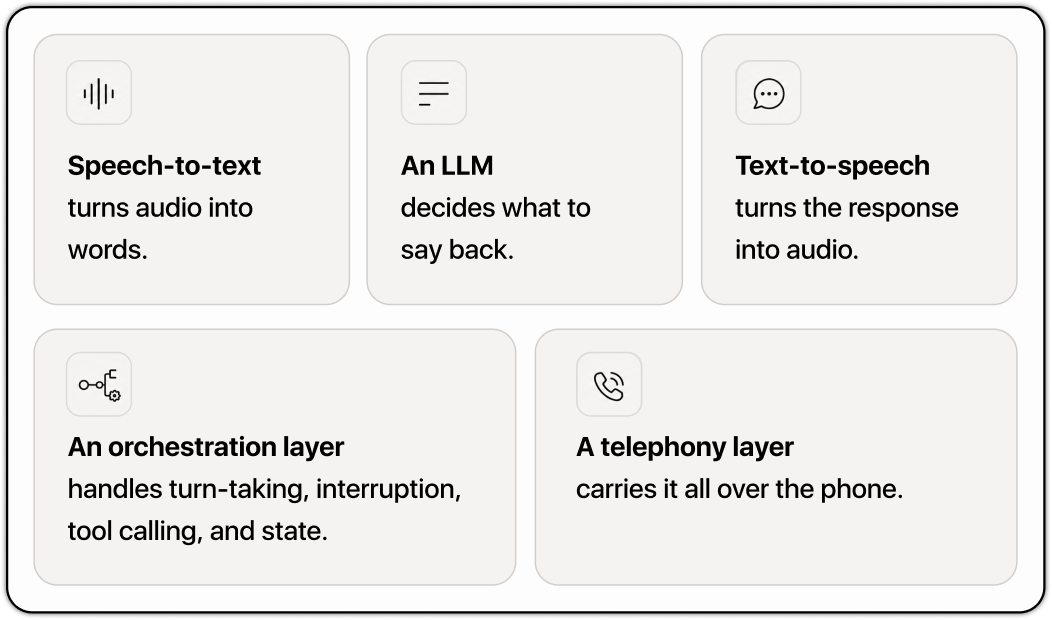
By early 2026, a nuanced framework for evaluating voice AI vendor partnerships has crystallized around dissecting the voice stack into five distinct layers—speech-to-text (STT), large language models (LLM), text-to-speech (TTS), orchestration, and telephony—and rigorously deciding whether to build or rent each based on precise thresholds such as latency, volume, compliance, and language needs. Organizations that cannot clearly define these technical and business criteria for each layer remain in the exploratory phase, underscoring the importance of a detailed readiness assessment before vendor evaluation.
Strategic vendor selection in voice AI demands treating build versus buy as multiple, layer-specific decisions rather than a monolithic choice, since each component comes with its own market dynamics, pricing models, and technical trade-offs. This approach prevents costly mistakes from oversimplification and aligns investment with business priorities—firms generating revenue directly from voice AI tend to own more layers, whereas those leveraging voice for support or sales typically rent the stack to optimize resource allocation.
Performance imperatives, particularly latency targets under 800 milliseconds to maintain natural conversational flow, heavily influence architectural choices; stitching together multiple vendors often fails to meet these stringent requirements, making an integrated platform or owning critical layers essential. Additionally, cost-effectiveness hinges on usage volume and internal expertise, with a practical build threshold emerging around 50,000 to 200,000 minutes of voice traffic and dedicated engineering capacity—below which managed platforms dominate on economics, and above which custom builds can reduce per-minute costs by up to 80%.
Beyond initial development, organizations frequently underestimate the ongoing operational burden of maintaining voice AI systems, which includes continuous model upgrades, prompt drift mitigation, regression testing, and dialect coverage expansion. Regulatory and linguistic complexities further complicate vendor and architecture choices; for instance, fused speech-to-speech models like OpenAI’s Realtime API, despite impressive demos, lack auditability and thus are unsuitable for regulated industries, while multilingual environments with code-switching users demand specialized speech-to-text solutions beyond standard US English benchmarks.

Adoption Hinges on Human Touch
AI voice agents boost efficiency in restaurants, dealerships, and home services, but true adoption depends on blending automation with personal connection to overcome skepticism and friction.
Customer adoption of AI and digital voice technologies varies widely across industries, shaped by both comfort levels and the nature of interactions. In restaurants, roughly a quarter of customers remain unwilling to use mobile apps for ordering, and many are still uncomfortable with AI-assisted or voice ordering due to perceptions of impersonality. Successful implementations often blend AI support with human interaction, such as AI assisting servers rather than replacing them, preserving the personal touch diners value. Similarly, in automotive dealerships, phone friction remains a major barrier despite digital retailing growth, with nearly half of sales and most service appointments still booked by phone, yet customers face long hold times and scheduling difficulties that dampen conversion rates.
AI-powered communication tools are increasingly pivotal in overcoming these adoption challenges by transforming operational pain points into data-driven opportunities. Dealerships leverage AI call analytics to identify frustrated customers, competitor mentions, and price-shopping behaviors through transcripts and sentiment analysis, enabling targeted coaching and staffing adjustments that improve customer engagement. Integration of AI platforms with CRM and DMS systems further empowers employees with real-time customer insights, fostering personalized and efficient conversations that build trust and loyalty. This focus on communication quality addresses a critical friction point, as Widewail CEO Kyler Owens highlights that nearly 42% of negative dealership reviews stem from communication issues rather than pricing, underscoring the premium customers place on a professional and transparent buying experience.
In the restaurant sector, AI voice agents like Sadie are beginning to alleviate phone order friction by automating order taking and payment processing, reducing missed orders and easing staff multitasking during peak hours. However, customer reluctance persists, especially around complex or personalized phone interactions, indicating that operational efficiency gains must be balanced with sensitivity to customer preferences. Meanwhile, the home services industry exemplifies a rapid shift in consumer comfort with AI voice tools, where adoption surged from 6% to 45% in early 2026. Platforms like Click Voice AI help smaller contractors compete by improving lead response rates by up to 50%, reducing missed calls by 40%, and cutting front desk expenses in half, demonstrating how AI can unlock revenue and service improvements even in traditionally underserved sectors.
Regional and industry-specific nuances further complicate customer adoption dynamics, as seen in the western United States where dealership communication satisfaction declined across nearly all major OEMs this quarter. This highlights the ongoing challenge of maintaining consistent communication quality in a rapidly evolving technological landscape. As AI solutions mature and become more normalized, the expectation is that customer acceptance will grow, particularly when automation enhances convenience and speed without sacrificing the human elements customers value most.