AI’s ‘engels’ pause: youth jobs vanish, inequality surges as worker confidence collapses
The gist
AI-driven automation is gutting youth and women’s jobs, fueling a new era of inequality as workers’ confidence craters and the promise of AI-powered prosperity leaves millions behind.
What to know
- Since ChatGPT’s debut, employment for 22-25-year-olds in AI-exposed roles has plunged by up to 16%, with women in clerical jobs facing a staggering 86% of AI-driven unemployment.
- Big Tech’s new grad hiring collapsed from over 50% to just 7%, forcing a scramble for AI skills and leaving traditional career ladders in ruins.
- Despite record corporate profits, workers’ tech confidence drops 14 points each year, and 57% of Americans now believe AI’s risks outweigh its benefits.
Vanishing Gateway Jobs
AI is erasing critical entry-level and administrative roles—especially for young workers and women—shattering career ladders and exposing millions to invisible unemployment.
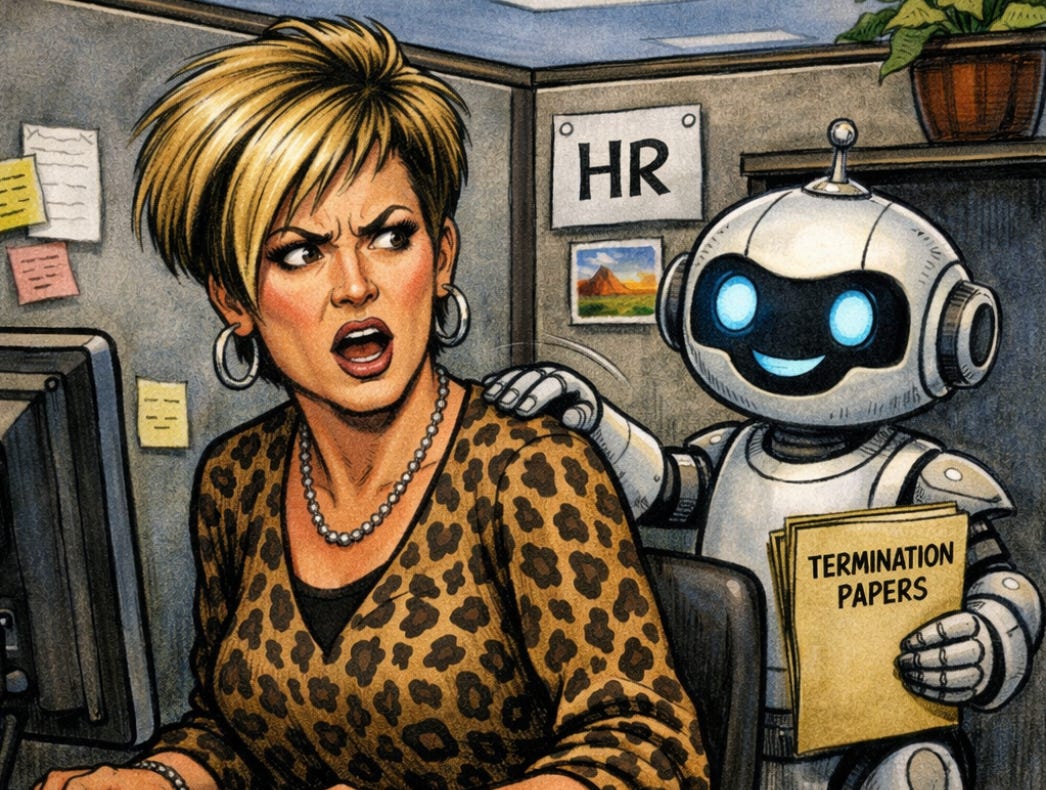
AI-driven automation is disproportionately eroding entry-level and administrative roles, with young workers aged 22 to 25 experiencing a striking 13-16% decline in employment in AI-exposed jobs such as software development and data analytics since the advent of ChatGPT. This invisible unemployment is compounded by the fact that many recent graduates lack the transferable skills to pivot into other roles, as advanced AI tools increasingly perform tasks once assigned to college grads earning $50,000 to $150,000, leaving youth particularly vulnerable to labor market disruption.
Women, especially those in clerical, administrative, and middle management roles within large organizations like hospitals and government, face outsized risks from AI displacement, with Brookings estimating that 86% of AI-driven unemployment will be among women. Many of these women are highly educated and well-paid, yet their routine paperwork and administrative tasks—over 90% of which AI could replace—threaten to sever critical career pathways and destabilize employment pipelines in female-dominated Gateway jobs that serve as stepping stones to higher-wage roles.
The disruption of Gateway jobs, which are crucial for non-degree workers’ upward mobility, is particularly alarming as roughly half of the career pathways connecting these entry-level roles to Destination jobs are highly exposed to AI. With over 15 million non-degree workers in these vulnerable positions, the traditional routes for skill development and career progression are at risk, exacerbating invisible unemployment and widening inequality among lower-wage workers who rely on these stepping stones.
Big Tech’s dramatic reduction in new graduate hires—from over 50% pre-pandemic to just 7% currently—reflects a broader shift in hiring strategies that now prioritize AI literacy and technical skills over traditional degrees. This shift not only slows the inflow of young workers into the labor market, creating a form of invisible unemployment, but also transforms the nature of entry-level roles toward AI-supervised analyst positions, demanding practical AI knowledge and disrupting long-established career pathways for youth and recent graduates.






Trust Gap Widens
As AI leaders tout optimism and profits soar, worker confidence nosedives and public skepticism intensifies, revealing a stark cultural and geographic divide in AI’s perceived risks and rewards.
By early 2026, a stark divergence has emerged between employer optimism and worker confidence regarding AI adoption. While AI leaders like Anthropic CEO Dario Amodei openly predict that AI could displace up to 50% of entry-level white-collar jobs within the next five years, workers are simultaneously experiencing a 14-percentage-point annual drop in confidence about their tech skills, reflecting growing anxiety about their ability to adapt to this rapidly shifting landscape.
This optimism among employers is tempered by a cautious duality, as highlighted by Amodei, who notes that the very forces accelerating AI capabilities are also the loudest advocates for safeguards, underscoring a complex balancing act within the industry. Yet, this nuanced stance contrasts sharply with widespread public skepticism: despite ChatGPT’s 900 million users, 57% of American voters believe AI’s risks outweigh its benefits, a sentiment fueled by fears of job displacement across both white- and blue-collar sectors and amplified by media narratives around AI’s environmental impact.
Geographic and sectoral disparities further complicate perceptions of AI’s economic promise. The concentration of wealth among AI industry titans—Elon Musk’s fortune now surpassing John D. Rockefeller’s Gilded Age wealth relative to GDP—highlights a growing divide, with American workers exhibiting more negativity toward AI partly due to cultural sensitivities around creative jobs and environmental concerns. In contrast, countries like China display roughly half the level of distrust, illustrating how local context shapes the evolving dialogue between employers and workers about AI’s role in the future economy.



The New Anti-Worker Economy
AI-driven automation accelerates layoffs and atomizes the workforce, breaking the social contract and fueling a barbell economy where prosperity is hoarded by a shrinking elite.
AI-driven labor shifts have precipitated a systemic breakdown of the traditional social contract between labor and capital, where soaring GDP and record corporate profits starkly contrast with stagnant wages and declining worker confidence. This phenomenon echoes a compressed version of Engels’ Pause from the British Industrial Revolution, with rising output failing to translate into worker benefits within a decade rather than decades, signaling deep social and economic risks ahead.
The fiduciary imperative to maximize shareholder value accelerates AI-driven layoffs and workforce restructuring, exemplified by scenarios where a CFO replaces eleven employees with three AI agents and a single prompt engineer earning $68,000. Nobel laureate Daron Acemoglu terms this the 'anti-worker' path of AI development, where technology is designed to replace rather than augment human labor, exacerbating wage stagnation and worker disenchantment amid unprecedented productivity.
AI's pervasive algorithmic control transforms workers into mere data points, eroding human dignity and morale as monitoring intensifies—from warehouse bathroom break efficiency to keystroke tracking of remote employees. This shift, coupled with the atomization of the labor market favoring contractors and solopreneurs leveraging AI, destabilizes traditional employment models, deepens inequality, and fosters a 'barbell' economy where a shrinking elite captures most gains while many fade into unproductivity.
Individual adaptation strategies like upskilling and building 'Human+AI' hybrid workflows fall short amid the scale of AI-driven displacement, underscoring the urgent need for systemic policy and legal reforms. Without coherent labor protections, tax code updates, and frameworks addressing worker ownership of AI training data, the political vacuum risks entrenching inequality and wage stagnation, potentially making AI's employment impact a defining issue in the 2028 presidential race.