AI’s enterprise reality check: hype meets human hurdles and workflow woes
The gist
Despite $30 billion in hype, enterprise AI is hitting a wall—struggling with complex tasks, cultural pushback, and workflow snags that keep real business impact elusive.
What to know
- AI flunks at relationship-driven and sustained professional tasks—success rates drop below 25% and performance tanks after hours of use.
- Only 5% of enterprise generative AI pilots deliver fast revenue gains, with 67% success when vendors tailor AI to existing workflows—especially for back-office automation.
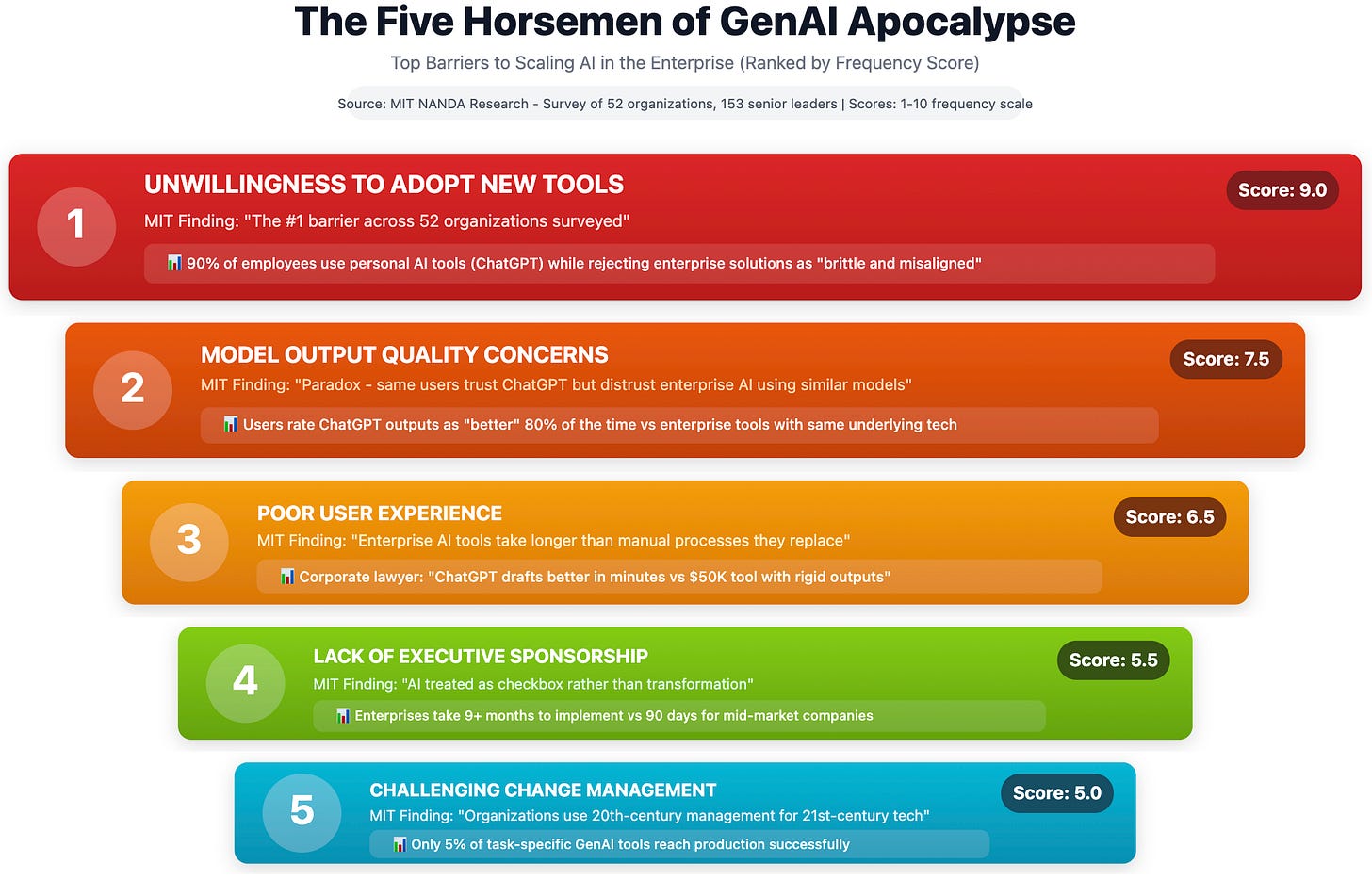
- Organizational resistance, misaligned decision rights, and outdated processes—not technology—are the main roadblocks, with most companies using AI for simple tasks like email summaries, not game-changing automation.
AI Hits Workflow Wall
AI tools excel at simple tasks but fail to sustain accuracy or reliability in complex, cross-system enterprise workflows, forcing companies to rely on human oversight and limit automation ambitions.
While AI has made strides in automating discrete, well-defined tasks such as sourcing in sales or note-taking during meetings, it consistently struggles with complex, relationship-driven activities that require nuanced human judgment and sustained interaction. For example, AI can handle email writing and list building effectively, but closing deals remains a human domain limited by time and relational dynamics, as noted in 2025 analyses. This gap underscores that AI currently acts more as a productivity copilot than a replacement, with enterprises slow to reduce headcount due to reliability and integration challenges.
Technical limitations become starkly apparent in AI’s inability to maintain performance over extended, complex workflows. Studies from early 2026 reveal that AI task success rates plummet below 50% after just a few hours of continuous operation, necessitating either fragmentation of tasks into smaller units or sophisticated systems capable of interruption recovery. This fragility is compounded by AI’s propensity for hallucinations and errors, as exemplified by sudden model regressions causing wildly inaccurate outputs without user changes, forcing constant human oversight and intervention.
The fragmented nature of enterprise software ecosystems severely hampers AI’s ability to orchestrate complex workflows reliably. Without unified contextual data—spread across disparate CRM systems, call logs, and best-of-breed tools—AI models like ChatGPT can generate plausible outputs but lack the integrated understanding necessary for error-free automation. Unlike software development, where compilers and tests ensure correctness, enterprise AI workflows lack such verifiability, resulting in persistent reliability issues and limiting AI’s role to augmenting rather than replacing human operators.
Despite advances in foundational AI models, real-world evaluations such as UC Berkeley’s 2026 study reveal that even state-of-the-art systems like GPT-5.5 fail to surpass 25% success on professional tasks across 55 industries, with the hardest tasks scoring zero. This 'Jagged Frontier' of AI capability means that while routine, well-defined tasks may be disrupted, complex, multi-step workflows requiring sustained reasoning and domain expertise remain beyond AI’s reliable reach. Companies like Klarna have experienced setbacks after replacing humans with AI, highlighting ongoing skepticism about trusting AI for fully autonomous operations without continuous quality assurance.






Culture Trumps Code
Organizational resistance, misaligned authority, and employee pushback—not technical limitations—are the primary reasons most enterprise AI investments stall or underdeliver.
Despite massive investments exceeding $30 billion in generative AI, enterprises face a profound organizational resistance that stymies adoption, primarily because AI tools are often brittle, overengineered, and misaligned with actual workflows. As highlighted in the August 2025 "Enterprise AI Unlocked" analysis, employees frequently reject AI solutions that disrupt their established work patterns, underscoring that the core challenge is not technology capability but poor organizational design and decision-rights misalignment. Companies making strides are those rethinking authority and embedding AI into real workflows rather than relying solely on budget or model sophistication.
By late 2025, research revealed that enterprises disproportionately allocate over half of their GenAI budgets to sales and marketing, despite back-office automation delivering the highest ROI through operational streamlining and cost reductions. Moreover, internal AI builds in regulated sectors suffer from low success rates—about one-third—compared to a 67% success rate when partnering with vendors who tailor solutions to existing workflows. This targeted execution approach, focusing on a single strategic pain point, emerges as a critical organizational strategy to overcome structural barriers and realize AI’s business value.
Cultural resistance and governance challenges further compound AI adoption hurdles, as seen in early 2026 when Accenture’s CEO Julie Sweet resorted to mandating AI tool usage among senior management under threat of withheld promotions. This top-down enforcement reflects a broader disconnect between AI evangelists—often tech enthusiasts or executives—and the everyday workforce, who perceive AI initiatives as valueless or intrusive. Additionally, entrenched governance models designed for sequential workflows struggle to accommodate complex multi-agent AI systems, leading to organizational friction and stalled scaling despite pockets of high adoption and productivity gains.
By mid-2026, analyses from Andus Labs and experts like Greg Shove converge on the conclusion that outdated workflows, misaligned decision rights, and incentive structures—not AI technology itself—are the primary culprits behind the lack of measurable enterprise AI returns. The pervasive 'Trust Deficit,' where leaders expect deterministic outcomes from inherently probabilistic AI, further stalls adoption. Without a fundamental redesign of operating models to enable faster, AI-driven decision-making and flatten hierarchical structures, organizations risk relegating AI to incremental efficiency tools rather than transformative assets, causing ROI to 'leak' to individual users instead of scaling organization-wide.





Integration Over Hype
Fragmented tech stacks and a deep disconnect between AI champions and frontline workers keep enterprise AI stuck in pilot purgatory despite relentless media buzz and consumer excitement.
Despite the widespread enthusiasm and rapid consumer adoption of AI tools like ChatGPT, enterprise integration remains slow and fraught with challenges, particularly due to fragmented technology stacks that require human intervention to synthesize context across systems. As noted in August 2025 analyses, while AI can automate up to 95% of routine sales tasks, critical relationship-driven activities such as closing deals still demand human involvement, capping productivity gains. This fragmentation and the difficulty of creating reliable AI agents that seamlessly integrate into complex workflows underscore a significant product and organizational barrier limiting AI’s real-world impact in sales and beyond.
By mid-2025, rigorous studies including MIT’s NANDA initiative revealed that only about 5% of enterprise generative AI pilots yield rapid revenue gains, with 95% failing to produce measurable financial returns or productivity improvements. Success stories typically hinge on laser-focused execution targeting a single strategic pain point and partnering with vendors who tailor AI solutions to existing workflows, especially in back-office automation where ROI outpaces the heavily funded sales and marketing applications. Moreover, deployments leveraging external vendor tools boast a success rate of roughly 67%, compared to just one-third for internally built systems, highlighting that integration and adoption strategy trump raw AI model quality in driving business value.
The cultural and perceptual divide between AI evangelists—often tech insiders or corporate champions—and the broader workforce has fostered skepticism and resistance that blunt AI’s transformative potential. As Clive Thompson observed in early 2026, AI enthusiasts sometimes struggle to connect with 'normies,' leading to top-down mandates that 'rankle' employees. This disconnect is mirrored in niche hype phenomena like Raspberry Pi’s meme stock surge, which reflects geek culture enthusiasm rather than mainstream productivity gains. Consequently, the gap between AI’s media-fueled hype and tangible workplace impact is exacerbated by overpromising, poor-quality AI outputs labeled as 'slop,' and a pressing need for improved AI literacy to set realistic expectations and foster meaningful adoption.
By mid-2026, comprehensive research from institutions like BCG, Harvard, and Berkeley confirmed that AI’s real-world workplace impact remains limited, with advanced models such as GPT-5.5 passing only 24% of professional task assessments and failing entirely on the most complex challenges requiring sustained reasoning and domain expertise. While a small cadre of 'Frontier Professionals'—about 16% of AI users—achieve significant productivity boosts by understanding AI’s strengths and limits, the majority experience negligible benefits, partly because enterprises have yet to adapt culture, incentives, and workflows to capture AI’s value. This misalignment causes AI-driven productivity gains to 'leak' to individuals rather than scale organizationally, underscoring the gulf between AI’s hyped potential and its current jagged frontier of practical utility.



Scale Starts Small
Production-ready AI requires cautious rollout, robust human oversight, and iterative hands-on experimentation to avoid costly missteps and build real organizational trust.
Effective AI deployment begins with building production-ready solutions from the pilot stage, ensuring systems can handle enterprise-scale volume from day one rather than settling for mere prototypes or demos. This approach is complemented by limiting initial AI rollouts to a small fraction of users or traffic—around 1%—to safely experiment with multiple ideas and minimize risk, a strategy highlighted in the AWS-led guidance on scaling agentic AI.
Integrating AI agents as microservices within existing architectures demands an event-driven design paired with robust observability and human oversight to manage risks and incrementally learn capabilities. This layered approach—having humans 'in the loop' or 'on the loop'—ensures that AI deployment remains controlled and adaptive, as emphasized in the AWS framework for scaling AI in enterprise environments.
Early, hands-on experimentation with emerging AI technologies, supported by vendor partnerships such as those with AWS account teams, is critical for building organizational confidence and agility. This proactive engagement enables businesses to seize opportunities swiftly and fosters a culture of innovation necessary for scaling AI impact effectively.
Measuring AI success through tangible business outcomes—like revenue growth, cost savings, and cycle time reductions—rather than technical metrics such as model accuracy or user adoption rates, shifts focus to real-world impact. Moreover, aligning all teams around a bold, shared objective, such as reducing process times from weeks to minutes, galvanizes creativity and collaboration, driving the 10x improvements that AI promises.
AI Shifts, Not Shrinks, Jobs
AI adoption is reshaping roles and boosting expert productivity, but direct layoffs remain rare as most firms use AI for basic support tasks and redeploy talent into new domains.
By mid-2025, AI had firmly established itself as a productivity copilot that significantly amplifies the capabilities of domain experts, especially engineers who reported up to 10x productivity gains by using AI as a creative 'slot machine' for idea generation. However, this boost is tightly coupled to the user’s expertise; AI’s utility diminishes when it surpasses the human’s knowledge, underscoring that AI complements rather than replaces expert judgment. This dynamic creates a divide where non-experts often struggle to effectively leverage or verify AI outputs, risking errors due to insufficient domain understanding.
Despite widespread AI adoption—about two-thirds of firms by late 2025—its integration remains largely superficial, with nearly 40% using AI for basic tasks like email summarization via tools such as Microsoft Copilot or ChatGPT. More advanced AI embedding, like fraud detection, was rare, reflecting early-stage workforce skill shifts and a cautious approach to automation. Firms anticipate modest headcount reductions primarily through attrition and hiring freezes rather than layoffs, while simultaneously creating new roles in cybersecurity and process redesign, illustrating AI’s role in reshaping rather than erasing jobs.
By early 2026, data revealed that AI-driven layoffs were exceptionally rare, with only about 1% of organizations reporting minimal headcount reductions directly attributable to AI. Instead, companies leveraged AI to redeploy talent strategically, expanding into new markets enabled by AI capabilities such as automated translation. This recalibration often contradicted initial expectations, as some firms prematurely laid off workers anticipating productivity gains that failed to materialize, leading to rehiring. The complexity of AI deployment—balancing costs, risks like hallucinations, and lack of best practices—means automation decisions remain highly context-dependent and experimental.
By mid-2026, the human-AI collaboration paradigm had crystallized around AI automating repetitive, manual tasks while leaving creative and judgment-intensive work firmly in human hands, as illustrated in professions like law and accounting. This shift not only augments productivity but also transforms job roles by combining multiple tasks into new hybrid functions, prompting organizations to rethink job descriptions and workflows. Success in harnessing AI’s potential increasingly depends on organizational factors—digitization, flexible 'beehive' structures, and a culture of trust between humans and AI agents—highlighting that AI’s workplace impact is as much about people and processes as it is about technology.