AI’s identity crisis: financial giants race to rein in bot-driven security risks amidst adoption surge
The gist
As AI adoption explodes in finance, banks are scrambling to control an identity crisis where bots and rogue accounts outnumber humans—fueling record security risks and regulatory heat.
What to know
- Non-human identities like bots and service accounts now vastly outnumber traditional users, with stolen credentials driving up to 31% of breaches costing U.S. firms $10.22 million each.
- Industry leaders such as Experian are embedding security as their first investment, leveraging unified control planes and cutting-edge tools to keep AI-driven threats in check.
- Despite rapid AI advances, only 13% of financial institutions run fully autonomous agents—most still rely on human oversight to ensure trust, explainability, and compliance.
Identity Sprawl Fuels Chaos
Financial institutions face a tidal wave of unmanaged bot and service accounts, with outdated identity governance leaving billions in assets vulnerable to credential-based attacks.
As financial institutions accelerate their adoption of AI, the complexity and scale of identity governance risks have surged, driven by the proliferation of both human and non-human identities—service accounts, bots, and large language models now vastly outnumbering traditional users. This explosion of identities, coupled with the rise of shadow AI operating outside IT oversight, has created a sprawling attack surface rife with unmanaged entitlements, long-lived credentials, and shadow accounts that persist beyond employee departure. Industry reports—such as Verizon’s 2025 DBIR and IBM’s Cost of a Data Breach—underscore the gravity of the situation: stolen credentials remain the most common breach vector, accounting for up to 31% of incidents and costing U.S. firms an average of $10.22 million per breach, while Microsoft’s Entra data reveals a staggering 600 million identity attacks per day, 99% of which are password-based.
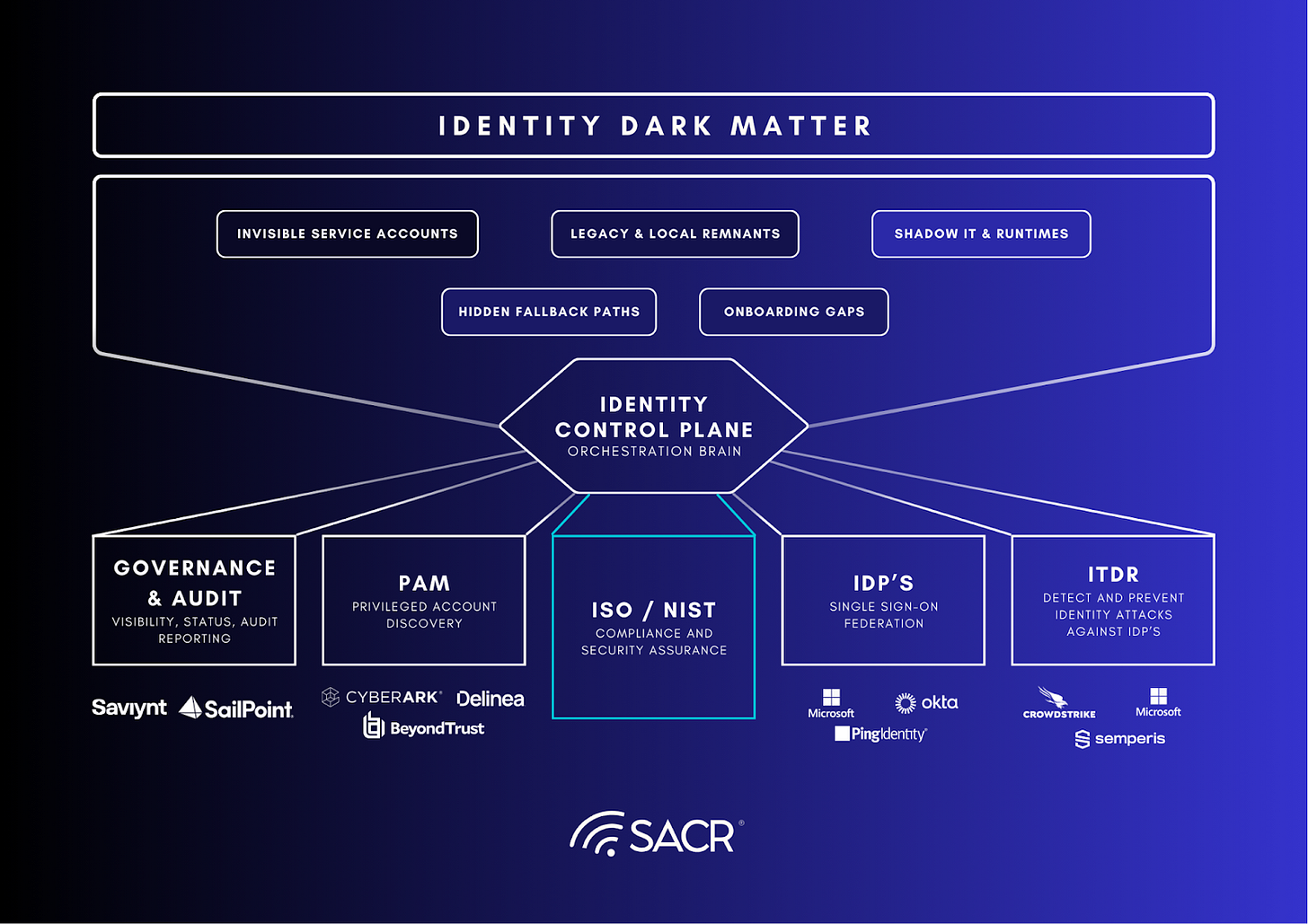
Traditional identity governance approaches—such as periodic access certification campaigns—have proven woefully inadequate in this new landscape, often devolving into ineffective 'rubber-stamping' exercises due to review fatigue and lack of business context. The resulting entitlement sprawl, exacerbated by SaaS proliferation and multi-cloud adoption, has outpaced the capabilities of legacy IGA platforms, leaving millions of inconsistent permissions and unmanaged 'Identity Dark Matter' that attackers exploit. As highlighted by SailPoint and ManageEngine, remediation remains slow and fragmented, with 33% of organizations admitting they cannot address identity risks quickly enough, and political obstacles—such as unclear ownership and lack of executive sponsorship—often outweighing technical challenges.
To counter these escalating risks, industry leaders and innovators are pivoting toward unified, visibility-first identity security architectures that integrate advanced detection and automated remediation. Companies like Orchid Security are championing the use of agent-based, host-level observability and LLM-assisted analysis to uncover insecure authentication paths, long-lived tokens, and policy gaps—illuminating the 'Identity Dark Matter' that traditional tools miss. Integration with platforms such as Microsoft Entra, SailPoint, Okta, and CrowdStrike enables streamlined governance, while automation reduces onboarding times and improves audit posture, as evidenced by Orchid’s claim of cutting onboarding from weeks to days and enhancing real-time risk insights for financial institutions.
The strategic imperative for financial institutions is clear: security must be treated as the foundational investment that enables innovation and resilience in the face of AI-driven threats. As Experian’s leadership asserts, 'It's the first dollar we should spend,' with security spending optimized through scale and bolstered by the acquisition of advanced technologies like Neuroid for bot detection. This ethos—embedding security into company culture and prioritizing governance-first approaches to shadow AI and entitlement management—reflects a growing industry consensus that robust identity defense is the linchpin for trust and accountability in AI-powered finance.





Unified Control Becomes Law
Industry leaders are mandating unified identity security architectures, with automation and agentic AI now critical to managing risk and compliance at scale.
The operational backbone of responsible AI in financial services is increasingly defined by unified control planes and integrated governance frameworks. Experian’s award-winning Marketplace platform, recognized by Dataiku in late 2025, exemplifies this trend by leveraging unified control and seamless Dataiku integration to deliver transparent, measurable financial returns. This approach is echoed in ManageEngine’s 2026 findings, which stress that true identity security at scale hinges on unified architectures and coherent data models—essential for managing the complexity and risk that come with proliferating AI-driven identities.
Automation and agentic AI architectures are rapidly becoming indispensable for both operational efficiency and security in financial organizations. From interface.ai’s Q4 2025 Agentic Banking release, which introduced unified governance and prescriptive analytics, to the widespread adoption of developer-driven observability in platforms like Slack and Orchid Security, the industry is moving beyond siloed tools. These advances enable real-time monitoring, proactive threat detection, and streamlined onboarding, as seen in Orchid’s ability to accelerate application integration and reduce compliance costs through agent-based observability and LLM-assisted analysis.
As AI adoption accelerates—84% of financial decision-makers now consider it critical—data quality, transparency, and regulatory compliance have emerged as top priorities for building trust. Experian’s ongoing investment in secure, centralized data usage and its robust data ecosystem directly address these concerns, while new solutions like WitnessAI and Orchid Security offer customizable guardrails and visibility-first approaches to ensure compliance without sacrificing operational agility. However, the sector remains cautious: only 13% of organizations have deployed fully autonomous agents, underscoring the ongoing importance of human oversight and explainability in AI-powered decisions.
Security is not just a technical requirement but a cultural cornerstone for leaders like Experian, which views security as the 'first dollar' spent and leverages its scale to invest in cutting-edge defenses such as Neuroid for bot detection. This ethos allows for robust security budgets even under public company scrutiny, and is increasingly necessary as 52% of organizations cite security, privacy, and compliance as barriers to scaling agentic AI. The market’s appetite for adaptive, industry-specific security frameworks is further evidenced by WitnessAI’s $58 million funding round, signaling that robust, scalable, and flexible security operations are now table stakes for responsible AI in finance.

Human Oversight Still Reigns
Despite AI's rapid rise, most financial decisions remain under human review as organizations deploy layered governance and phased adoption to curb 'shadow AI' and regulatory risk.
Building ethical AI-driven financial systems hinges on robust human oversight, transparent governance, and phased adoption strategies. Early adopters like Gold Bond, Inc. demonstrated that integrating human-in-the-loop processes—such as data verification and departmental training—was essential not only for explainability but also for establishing consumer recourse and trust. As Dan Herbatschek of Ramsey Theory Capital later warned, the proliferation of 'shadow AI'—AI operating outside IT visibility—exposes enterprises to operational blind spots and regulatory risks, underscoring the necessity for governance-first approaches, clear policies, and continuous monitoring to uphold accountability.
The financial sector’s move toward responsible AI has been marked by a deliberate emphasis on change management, rigorous testing, and human validation at every stage. Gold Bond, Inc. increased AI adoption from 20% to 71% by leveraging trained 'super-users' and sandbox environments, demonstrating that behavioral shifts and ethical deployment require more than technical fixes—they demand cultural buy-in and ongoing oversight. This approach is echoed in industry calls for proactive monitoring and role-based access controls, which balance the need for innovation with the imperative to address bias, fairness, and consumer recourse without resorting to outright bans.
By early 2026, industry data revealed that only 13% of organizations had moved to fully autonomous AI agents, with a striking 69% of AI-powered financial decisions still verified by humans—a testament to the enduring importance of human oversight. Observability tools have become critical for real-time visibility into agent behavior, supporting transparency, explainability, and ethical deployment. Yet, persistent barriers remain: over half of organizations (52%) cite security, privacy, and compliance as significant challenges, highlighting that technical and regulatory hurdles must be addressed to ensure fairness and public accountability in AI-driven credit decisioning.
Experian’s leadership has publicly acknowledged the profound ethical responsibility that comes with shaping individuals’ financial destinies through AI-powered credit scoring. Alex Lintner, Experian’s tech chief, emphasizes that while AI can enhance governance and explainability, its inherent risks—such as hallucinations and inaccuracies—demand vigilant human oversight and rigorous pre-deployment testing with synthetic and depersonalized data. Initiatives like Experian Boost, which allows consumers to proactively improve their credit scores by adding nontraditional payment data, exemplify a commitment to fairness, transparency, and consumer empowerment, with Lintner noting, 'We provide it for free because it's the right thing to do.'
Despite advances in AI, a persistent gap remains between the technology’s perceived and actual capabilities, particularly regarding trustworthiness and explainability in sensitive financial decisions. Experian’s approach—using AI to monitor model drift, ensure depersonalization of data, and empower data scientists to override or discard unreliable outputs—reflects a broader industry recognition that human oversight is not just a safeguard, but a prerequisite for ethical, accountable AI. As Lintner cautions, 'If you trust AI to the point where you blindly trust it and always follow it and you don't check yourself through the data scientist... it bears risk,' underscoring the ongoing need for responsible, human-centered AI integration.

Privacy Anchors AI Trust
Experian and peers are setting new benchmarks by blending privacy-first data practices and transparent AI oversight to win consumer trust and meet escalating regulatory demands.
Institutions like Experian and interface.ai are setting the standard for balancing advanced analytics with robust privacy protections and regulatory compliance, demonstrating that consumer trust can be built without sacrificing innovation. Experian’s award-winning AI-driven Marketplace platform and interface.ai’s Q4 2025 Agentic Banking release both showcase how secure, centralized data use and unified governance controls can empower consumers, broaden access to financial services, and drive business growth—all while maintaining fairness and transparency. These efforts underscore a growing industry consensus that responsible AI adoption must be anchored in privacy, security, and regulatory rigor to truly earn and sustain public trust.
Transparency and explainability have emerged as non-negotiable pillars for consumer trust and regulatory compliance in AI-driven financial services, as highlighted by Experian’s practices and recent studies. By early 2026, 73% of financial decision-makers cited regulatory concerns and 65% pointed to data quality as top challenges, with data quality being the single most important factor influencing trust in AI vendors. Experian’s approach—providing both lenders and consumers access to the same, double-encrypted data and embedding AI oversight into risk assessment—demonstrates how clear, explainable systems can satisfy both legal requirements and consumer expectations, fostering confidence in automated decisions.
The tension between the essential role of financial data and individual privacy rights is navigated through a combination of consumer empowerment tools, depersonalized analytics, and strict data access controls. Experian, for example, enables hundreds of millions of consumers to proactively share their data in exchange for access to financial products and services like Experian Boost, which helps improve credit scores by including recurring payments. At the same time, the company relies on depersonalized behavioral data—eschewing personal identifiers such as age or ethnicity—and restricts access from public AI models, ensuring that AI is used for governance and oversight rather than profiling or exposure, thereby aligning with both ethical standards and regulatory mandates.
Security remains the bedrock of trust in AI-driven financial systems, with Experian exemplifying an industry-wide recognition that without robust protection against data breaches and AI-powered cyber threats, no amount of innovation can justify public confidence. The company’s proactive investments—such as acquiring Neuroid to combat bot attacks and leveraging economies of scale to fund top-tier security talent and technology—are matched by a corporate ethos that treats security spending as a non-negotiable priority. As Experian’s leadership asserts, 'If we don’t do that well, we don’t have a reason for existing,' highlighting that security is not just a technical requirement but a fundamental business imperative.
AI Success Demands Discipline
Award-winning platforms like Experian's Marketplace prove that operational rigor, ethical guardrails, and hands-on change management are the true drivers behind measurable AI value in finance.
Experian's award-winning Marketplace platform stands as a beacon of industry innovation, demonstrating how the fusion of advanced AI and cloud computing can yield both transparent financial returns and meaningful consumer empowerment. Recognized with the 'Best Return on AI' at the 2025 Dataiku Frontrunner Awards, Experian's initiative underscores a pivotal industry shift from traditional predictive analytics to autonomous, actionable AI that delivers measurable business outcomes. This evolution not only sets a new standard for operational discipline but also highlights the growing expectation for AI systems to drive tangible value in financial services.
A defining feature of successful AI deployments in finance is the unwavering focus on fairness, privacy, and trust—principles that Experian has woven into its ongoing investments in cloud-based AI solutions. By prioritizing secure, centralized data use and ethical considerations, Experian broadens access to credit and financial services, illustrating how operational discipline and responsible innovation can advance financial inclusion. This approach reflects a broader industry recognition that ethical AI is not just a regulatory checkbox, but a strategic imperative for sustainable growth.
Real-world case studies from companies like Gold Bond reveal that the key to effective AI adoption lies in embedding AI into existing workflows, guided by strong IT leadership and robust change management. Gold Bond's leap in daily AI adoption—from 20% to 71%—was driven by integrating AI into high-friction business processes and empowering 'super-users' through targeted training and sandbox testing. Their pragmatic, multi-model approach, coupled with human-in-the-loop oversight and rigorous data verification, ensures operational resilience and accountability, while cautioning against the pitfalls of overhyping AI or neglecting security and human review.
By early 2026, the industry’s commitment to responsible AI is further exemplified by innovations such as Witness’s customizable AI guardrails and interface.ai’s Agentic Banking release. Witness empowers financial institutions to implement nuanced, industry-specific safety measures using natural language, enhancing both security and operational flexibility. Meanwhile, interface.ai’s expanded BankGPT suite delivers prescriptive analytics and unified governance, enabling community banks and credit unions to achieve measurable growth and improved customer experiences—all while maintaining secure, compliant, and disciplined AI deployments.
