AI’s power surge sparks gridlock: U.S. data centers outpace energy infrastructure amid regulatory paralysis
The gist
America’s AI-fueled data center boom is slamming into a wall of regulatory gridlock, leaving the nation’s power grid straining and U.S. tech competitiveness at risk.
What to know
- By late 2025, AI data centers devoured over 4% of U.S. electricity—demand is skyrocketing 15–20% a year while the grid crawls at 2% capacity growth.
- Permitting delays, NIMBY resistance, and political inertia are stalling transmission upgrades for up to a decade, despite enough generation capacity on paper.
- Clean energy projects worth 266 GW were scrapped in 2025, while tech giants like Microsoft and Amazon are now funding their own power sources just to keep up.
Grid Strain Hits Fast Forward
AI data centers are overwhelming U.S. utilities with explosive demand, exposing how regulatory paralysis and slow transmission upgrades have left the grid unable to keep pace with a surging digital economy.
By late 2025, the U.S. power grid began showing clear signs of strain as AI data centers rapidly escalated electricity demand, growing at 15–20% annually—far outpacing the grid’s modest 2% capacity growth. This surge, exemplified by a five-year utility forecast jump from 24 GW in 2022 to 166 GW in 2025 (equivalent to adding five New York Cities’ peak load), has pushed data centers to consume over 4% of U.S. electricity, with projections reaching nearly 12% by 2030. Regions like ERCOT and PJM face acute challenges, including soaring electricity prices and operational stress, as utilities scramble to meet this unprecedented load, revealing early economic and grid stability pressures.
Underlying these operational stresses is a systemic bottleneck rooted not in generation capacity but in the labyrinthine regulatory and procedural paralysis that stymies infrastructure expansion. Projects face a gauntlet of federal, state, and local reviews—NEPA, species consultations, community meetings, and lawsuits—that cumulatively delay critical energy and mineral developments by 7 to 12 years or more, as seen in the Thacker Pass lithium mine’s 12-year timeline from application to operation. This regulatory inertia, compounded by socio-political factors like Boomer NIMBYism and a service economy that manages the process of not building, has left the U.S. grid flatfooted amid rapidly rising AI power demands.
The mismatch between the rapid pace of AI data center buildouts—often completed within 12 to 24 months—and the protracted timelines for expanding transmission infrastructure, which can take five to seven years or effectively 'infinite' for interregional lines, has emerged as a critical bottleneck. Industry leaders like Jigar Shah emphasize that the U.S. is not short on generation but on transmission capacity, with transformer shortages and 30% transmission losses further compounding the problem. This disconnect forces data centers and utilities to explore unconventional solutions, including off-grid power generation and legislative proposals mandating such shifts, though these remain politically contentious and uncertain.
Early signs of social and regulatory pushback are mounting as clustered AI data centers strain grid quality and provoke community resistance, with some states imposing blanket bans on new developments. This social license bottleneck threatens to slow AI infrastructure expansion below the pace required by industry growth. Meanwhile, utilities grapple with economic risks from speculative project applications clogging grid queues, with only about 20% of proposed data centers expected to materialize, and uneven ratepayer protections across jurisdictions. These dynamics underscore a growing tension between the urgent need for rapid energy infrastructure buildout and the entrenched political, social, and regulatory barriers that continue to delay it.





Red Tape Stalls Progress
A web of permitting delays, NIMBYism, and politicized utility commissions has created a fragmented regulatory maze, turning infrastructure expansion into a decade-long ordeal and threatening energy security.
The U.S. energy infrastructure expansion is severely hampered by a labyrinth of regulatory and political obstacles that create systemic paralysis. As illustrated by the stalled rebuilding of the Francis Scott Key Bridge—delayed over a year due to exhaustive environmental reviews, community consultations, and permit processes—the aggregation of micro-decisions across federal, state, and local jurisdictions, each granting veto power to stakeholders, results in a system that 'literally cannot build.' This paralysis is further entrenched by entrenched boomer NIMBYism, where communities resistant to change block projects that might affect property values, and a service economy that prioritizes process management over production, compounding delays for critical clean energy and transmission projects.
Critical mineral projects essential for clean energy, such as the Thacker Pass lithium mine, exemplify the protracted timelines caused by overlapping federal and state permitting, lawsuits, and community opposition, stretching over 12 years compared to 2-3 years in Australia and Canada. These delays are not due to technical or financial constraints but stem from regulatory complexity and political tradeoffs that undermine U.S. competitiveness and energy security. Efforts under the Trump administration to ease permitting for nuclear energy and free federal land for data centers have made some progress but have not fully resolved local opposition or the intricate web of regulations, leaving bottlenecks in place as AI-driven demand surges.
The role of Public Utilities Commissions (PUCs) is pivotal yet fraught with political tension, as they control the approval of infrastructure investments and rate-setting that directly affect the viability of AI data centers. Growing public opposition, fueled by concerns over environmental impacts and rising energy costs shifted to residential ratepayers, has made PUC decisions highly politicized. Some utilities, like NiSource in Indiana, have pioneered upfront payment models to shield ratepayers from infrastructure overbuild costs, but many others lack such protections, raising the risk of subsidization by consumers. This patchwork regulatory environment, combined with lengthy rate cases and political pressure, creates a fragmented landscape that slows grid expansion and complicates nationwide infrastructure development.
By early 2026, the political and regulatory landscape remains a complex battleground where NIMBY opposition, state and local politics, and conflicting policy priorities slow critical energy infrastructure needed for AI growth. Governors like Josh Shapiro have publicly called out the broken utility rate regulation model and urged fellow leaders to educate themselves on the stakes, highlighting the political risks of inaction. Meanwhile, bipartisan legislative efforts such as the Manchin-Barrasso Energy Permitting Reform Act and the House-passed Speed Act aim to streamline permitting and interregional transmission planning, though implementation lags and local resistance persists. This tension underscores a broader dilemma: balancing environmental and community concerns against urgent national energy needs, with rising electricity prices and infrastructure bottlenecks threatening U.S. competitiveness and grid reliability.



Hyperscalers Go Off-Grid
Tech giants and data centers are sidestepping grid bottlenecks by directly funding power plants and deploying massive battery storage, redefining how energy is sourced and managed for AI workloads.
By early 2026, the rapid expansion of AI data centers, fueled by massive funding rounds such as OpenAI's $100 billion raise led by Amazon, Microsoft, and Nvidia, has catalyzed a wave of innovative energy solutions aimed at circumventing traditional grid constraints. Hyperscalers are increasingly investing directly in electric generation projects, like those by Williams Companies, to supply their data centers and shield retail consumers from inflationary electricity costs. Concurrently, pragmatic off-grid strategies, including 'bring your own generation' and bridge power projects, have gained traction as temporary fixes to the slow pace of grid expansion, although fully permanent off-grid operation remains unlikely due to the inherent benefits of grid connectivity and reliability.
Battery storage has emerged as a linchpin technology in addressing U.S. grid bottlenecks, with installations soaring over 57 GWh in 2025—a 30% year-over-year increase—and projections reaching 70 GWh by 2026, representing a $25 billion investment. These batteries, deployed not only at transmission levels—as exemplified by Boston’s 700 MW battery project—but increasingly on distribution circuits, offer a cost-effective alternative to traditional grid upgrades. ISOs such as PJM, MISO, and SPP view batteries as the only viable near-term solution to manage grid reliability and rapidly integrate the surging AI compute demand, effectively redefining the power race amid energy crises.
The protracted timelines for transmission capacity expansion—five to seven years for new lines and effectively 'infinite' for interregional projects—have spurred the rise of hybrid on-site/grid-connected power models that allow data centers to partially self-generate power during peak demand, thereby bypassing bottlenecks. Behind-the-meter (BTM) battery storage solutions, championed by tech giants like Microsoft, Google, and Meta, enable rapid deployment within months, circumventing the typical 5-8 year front-of-the-meter interconnection queues. These BTM systems not only provide peak shaving and outage resilience but also create a 'virtual capacity expansion,' allowing data centers to draw more power internally than their grid-approved limits without increasing peak grid demand, effectively smoothing volatile AI load fluctuations.
Distributed energy resources are further unlocking grid capacity through innovative market mechanisms such as leasing models and virtual power plants (VPPs). Companies like Sunrun lease solar and battery systems to customers with no upfront costs, retaining ownership and aggregating these assets into VPPs that can be controlled via software to provide incremental grid capacity—a solution eagerly financed by hyperscale data centers desperate for rapid grid access. While regulatory complexities in regulated markets slow deployment due to tri-party negotiations among utilities, customers, and hyperscalers, ongoing discussions suggest these hurdles can be overcome. Meanwhile, utility-owned distributed batteries, as pioneered in Minnesota, exemplify pragmatic and accountable infrastructure strategies that transform grid bottlenecks into opportunities for cheaper, cleaner, and smarter energy by 2030.


Energy Dominance as Strategy
The AI arms race is now a global energy contest, with U.S. national security hinging on rapid capacity growth and China’s aggressive buildout threatening America’s leadership in data and infrastructure.
By late 2025, the U.S. recognized that maintaining AI leadership hinges on a robust and expanding energy supply, with OpenAI urging the nation to build 100GW of new capacity annually to outpace China’s aggressive infrastructure growth. This urgency is underscored by the White House’s national security strategy emphasizing energy dominance—not just for domestic AI demand but also to reduce reliance on adversarial energy suppliers—while Saudi Arabia’s investments in data centers and partnerships with both U.S. and Chinese tech firms highlight the global geopolitical stakes entwined with energy and AI infrastructure.
The U.S. energy mix is undergoing a significant evolution, with nuclear power—especially small modular reactors—poised to become the backbone of electricity generation within a decade, complementing solar, coal, and natural gas. However, unlike China’s rapid and often environmentally costly expansion, U.S. energy development is hampered by regulatory hurdles and political tradeoffs, such as local opposition to repurposing federal lands for nuclear-powered military bases. This cautious approach contrasts sharply with China’s willingness to aggressively build capacity, reflecting a fundamental geopolitical divergence in energy strategy amid the AI power race.
By early 2026, the U.S. faced emerging bottlenecks in power infrastructure as AI-driven electricity demand surged, exposing underinvestment in generation capacity due to years of minimal power demand growth. Meanwhile, China’s energy infrastructure expanded at a breakneck pace—growing coal, renewables, nuclear, and battery capacity—resulting in substantial spare generation capacity that could shift the global balance of AI data center hosting. This disparity is compounded by China’s dominance over solar panel supply chains, limiting the U.S.’s ability to scale renewables quickly and placing it at a geopolitical disadvantage despite holding over 40% of the world’s data centers.
As of mid-2026, China’s electricity generation surpassed the combined output of the U.S. and EU, hitting 10,000 terawatt hours compared to the U.S.’s flat 4,000, fueled by massive investments in renewables that outpace Europe, the UK, and the U.S. combined. The U.S., though energy independent and the world’s largest oil and LNG producer, struggles with electricity shortages due to slow permitting, regulatory resistance, and political fears around nuclear and solar expansion. This energy shortfall threatens to constrain AI data center growth, underscoring a critical tension between legacy energy concerns and the urgent need to power rapid AI advancements potentially reaching superintelligence by 2027.






Clean Energy Projects Axed
Policy reversals and rising costs triggered the cancellation of nearly 2,000 U.S. power projects in 2025, wiping out hundreds of gigawatts in clean energy and opening new investment opportunities amid growing supply gaps.
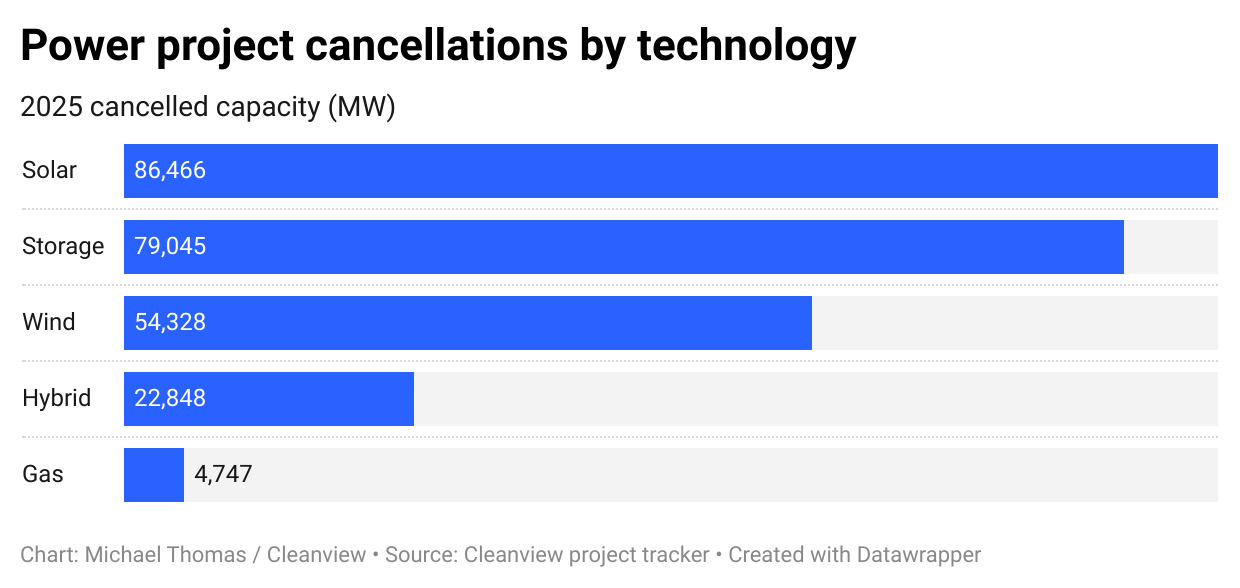
The year 2025 saw a dramatic setback in U.S. energy infrastructure with the cancellation of 1,891 power projects totaling 266 GW—roughly one-quarter of the nation's current electricity capacity—of which 93% were clean energy projects such as utility-scale solar (86 GW), battery storage (79 GW), and wind (54 GW). This wave of cancellations, driven by Trump administration policies including tariffs, the withdrawal of clean energy tax credits, and regulatory roadblocks, has not only constrained electricity supply but also threatens to slow the AI boom by exacerbating rising electricity prices and undermining U.S. competitiveness in the global AI and energy sectors.
Rising interconnection costs—averaging $753,116 per MW in MISO—and sweeping ISO reforms since 2023 have accelerated project cancellations, resulting in an estimated $400 billion in lost investment capital that would have revitalized rural economies. This economic fallout, coupled with policy incoherence, jeopardizes grid reliability and affordability at a time when U.S. electricity demand is surging at an expected 2.5% annual growth rate, driven not only by AI data centers but also electric vehicles and industrial sectors, thereby creating both risks and new opportunities for utilities and infrastructure investors.
By early 2026, investors have begun recognizing the undervaluation of top-performing utilities, which trade at only a 6% premium despite exhibiting 2% higher growth rates compared to peers, signaling a compelling investment opportunity amid regulatory and affordability challenges. Moreover, 'picks and shovels' companies like Caterpillar and aluminum smelters that supply critical engineering, construction, and materials for large-scale energy infrastructure stand to benefit from structural growth as AI-driven electrification demands more robust grid and data center support.
Innovative financing models are emerging where hyperscalers—tech giants such as Amazon, Microsoft, and Nvidia, who have collectively backed OpenAI with over $100 billion—shoulder upfront costs for grid modernization and electricity generation to power AI data centers, potentially insulating retail consumers from electricity price inflation. However, the regulatory environment remains a pivotal risk factor, as Public Utility Commissions hold the power to approve or deny infrastructure investments and associated rate base returns (typically 9% to 11%), with regional market differences—such as the congested PJM interconnection queue and the freer but less resilient ERCOT market—further complicating utilities' ability to capitalize on AI-driven energy demand.


Transmission Revolution Underway
A new era of high-voltage lines and legislative reforms is breaking gridlock, but transmission and equipment constraints now threaten to outpace even the most ambitious clean energy and AI expansion plans.
By late 2025, a coordinated surge in high-voltage transmission projects marked a pivotal shift toward a modernized U.S. grid capable of supporting large-scale clean energy integration. Regions like the Southwest Power Pool (SPP), MISO, PJM, and ERCOT embarked on constructing 765kV AC transmission lines—the first of their kind in decades—highlighting a unified effort to expand backbone infrastructure. Despite political and regulatory hurdles, such as the DOE’s cancellation of a loan guarantee for the Greenbelt Express project, these initiatives pressed forward, signaling resilience in overcoming financing challenges to unlock vast renewable potential across the Great Plains and beyond.
Permitting reform emerged as a linchpin for breaking interregional transmission bottlenecks, with the Manchin Barrasso Energy Permitting Reform Act (EPRA) introducing federal roles in planning and cost allocation that garnered bipartisan Senate support. Yet, as of late 2025, these reforms remained a work in progress, with NEPA-related components advancing in the House but full implementation still years away. This legislative evolution addresses the fragmented U.S. grid landscape—dominated by roughly 3,000 local utilities lacking coordinated interregional frameworks—unlocking a massive, previously untapped opportunity to scale transmission capacity across regions.
Entering 2026, the grid’s modernization bottleneck shifted from generation scarcity to transmission and equipment constraints, with transformer lead times exceeding a year despite existing manufacturing capacity. Innovations like robotic cable coatings promise to reduce the roughly 30% transmission losses, while integrated approaches connecting generation, transmission, and usage are gaining traction to meet AI-driven energy demands. However, long-term bets on nuclear and fusion remain limited by capital intensity and timelines, underscoring the urgency of optimizing current infrastructure and market designs to keep pace with rapid renewable and data center growth.
By early 2026, public-private partnerships and utility-owned distributed batteries emerged as pragmatic pathways to rapidly unlock grid capacity and alleviate transmission bottlenecks intensified by soaring AI data center demand. Companies like Sunrun pioneered leasing models for solar and battery systems that integrate into virtual power plants (VPPs), enabling faster deployment and smarter grid coordination without upfront customer costs. Minnesota’s utility-owned battery initiatives exemplify this balanced approach, overcoming regulatory complexities through tri-party negotiations and smart system coordination, thereby transforming gridlock into an unprecedented opportunity for cheaper, cleaner, and more resilient energy by 2030.