AI’s power surge: U.S. grid buckles as data centers outpace energy expansion
The gist
America’s AI boom is colliding head-on with an overtaxed power grid, threatening to stall innovation as energy-hungry data centers outpace infrastructure upgrades.
What to know
- By early 2026, AI data centers in hotspots like Virginia are devouring over 25% of local electricity, with U.S. AI-driven demand projected to hit 600 TWh annually by 2030—nearly 12% of the nation’s power.
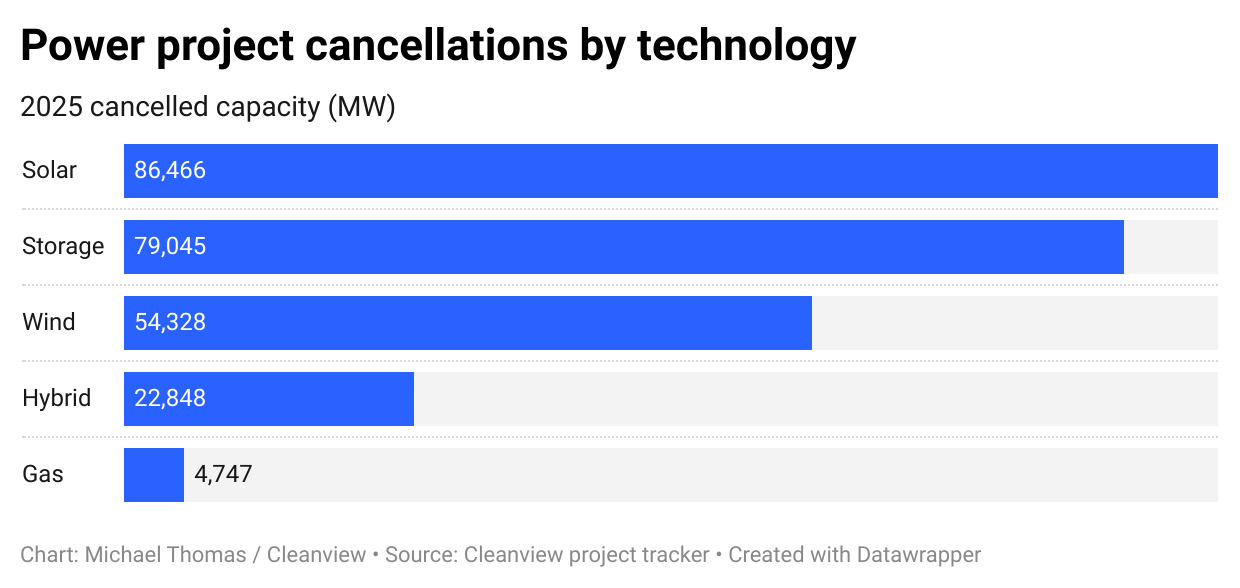
- Regulatory paralysis and red tape have caused decade-long delays and led to the cancellation of nearly 1,900 power projects in 2025—93% of them clean energy—crippling grid expansion.
- China is outpacing the U.S. by expanding its energy capacity at 20x the rate, while America scrambles to keep fossil fuel plants running and struggles with transmission bottlenecks.
Infrastructure Gridlock Exposed
Years-long regulatory delays and mismatched build timelines are leaving AI data centers starved for power, driving up costs and threatening America’s tech edge.
By late 2025, the U.S. was grappling with early and visible strains on its energy infrastructure driven by soaring electricity demand from AI data centers and related technologies. The collapse of the Francis Scott Key Bridge in March 2024 and the year-long delay in its reconstruction exemplify the broader paralysis in infrastructure development, which stems less from financial or engineering challenges and more from a labyrinth of regulatory hurdles, including environmental reviews, community consultations, and stakeholder veto powers that collectively stall progress.
The rapid expansion of AI data centers has dramatically outpaced the U.S. grid’s capacity growth, with electricity demand from these centers growing at 15–20% annually compared to the grid’s 2%, causing significant grid stress and rising electricity prices in hotspots like Virginia, where data centers consume over 25% of electricity. In 2024 alone, U.S. data centers used roughly 200 TWh—comparable to Thailand’s entire national consumption—with projections soaring to over 600 TWh by 2030, nearly 12% of all U.S. power demand, driven almost entirely by AI workloads.
Despite the urgent need for new energy capacity to sustain AI growth, exemplified by OpenAI’s call for 100 GW of annual new builds to maintain U.S. AI leadership over China, infrastructure expansion faces a critical timing mismatch: while new AI data centers can come online within 12–24 months, major power projects like nuclear restarts and small modular reactors have lead times stretching into the 2030s. This disconnect forces hyperscalers to scramble for power amid rising prices and operational inefficiencies, with idle AI chips translating into millions of dollars in lost value.
By early 2026, the U.S. energy sector confronted a perfect storm where AI-driven electricity demand surged alongside manufacturing and EV adoption, further straining a grid hampered by slow infrastructure buildout and regulatory delays. Regions like ERCOT in Texas, despite relatively faster permitting, already faced significant load growth projections (53 GW through 2030) and initial market strains, while the depletion of previously utilized stranded energy assets forced a pivot to new capacity builds. Meanwhile, global peers like China aggressively expanded both coal and renewable generation, underscoring the risk that U.S. regulatory inertia and slower capacity expansion could erode its competitive edge in powering AI’s future.






Permitting Paralysis and Policy Gridlock
Decade-long delays, NIMBY resistance, and contradictory policies have stalled nearly all new clean energy projects, crippling the U.S. grid’s ability to expand.
The U.S. energy infrastructure development is mired in a labyrinth of regulatory and policy hurdles that collectively create near-paralysis despite individually rational decisions. As detailed in the 2025 analysis 'Time To Build,' layers of environmental reviews, community consultations, and multi-jurisdictional permits grant extensive veto power to stakeholders, resulting in decade-long delays exemplified by the Thacker Pass lithium mine’s 12+ year timeline—contrasting sharply with 2-3 years in Australia and Canada. This bureaucratic inertia is compounded by political and social dynamics such as entrenched Boomer NIMBYism and a service economy that prioritizes process management over tangible construction, effectively stalling critical projects and even urgent repairs like Baltimore’s Francis Scott Key Bridge collapse.
Political tradeoffs and contradictory policies further exacerbate infrastructure stagnation, as seen in the Trump administration’s simultaneous fast-tracking of power-hungry data centers while imposing roadblocks on renewable projects like solar and wind, contributing to a staggering 1,891 power project cancellations in 2025 totaling 266 GW—93% of which were clean energy. States like Virginia and Ohio have become battlegrounds where regional restrictions and NIMBY politics block clean energy hubs, driving supply bottlenecks that fuel rising electricity prices and threaten both AI growth and grid reliability. Moreover, recent ISO reforms intended to improve project queue quality have paradoxically accelerated cancellations, deepening the crisis.
Efforts to reform permitting processes and expand transmission infrastructure offer a glimmer of hope but remain in early, multi-decade stages. The bipartisan Energy Permitting Reform Act (EPRA), passed by the Senate Energy Committee in late 2025, targets interregional grid expansion and federal permitting roles, addressing the critical shortage of transmission 'wires' rather than generation capacity—a point emphasized by Jigar Shah who critiques the misplaced focus on generation over transmission. Yet, as of mid-2026, the U.S. grid still suffers from fragmented regional planning and state-level permitting bottlenecks, with transmission construction plummeting from 4,000 miles in 2013 to just 322 miles in 2024, far below the 5,000 miles annually needed to keep pace with demand.
The rapid surge in AI and data center energy demand exposes and intensifies these systemic regulatory failures. By early 2026, data centers face severe challenges securing new capacity due to permitting delays and supply chain bottlenecks in natural gas turbines and nuclear installations, compounded by restrictive regulations that prevent efficient grid management practices like load shedding and backup generator use. Federal leadership, including Secretary of Energy Chris Wright, is actively working to dismantle these regulatory barriers, but the slow pace and political conflicts—especially over federal land use in the West—continue to hamper timely infrastructure expansion, risking higher energy costs and lost economic opportunities.



Fossil Fuels’ Reluctant Revival
Grid reliability crises and surging AI demand have triggered a coal and gas resurgence, forcing emergency government interventions that clash with climate goals.
By early 2026, extreme weather events like Winter Storm Fern starkly revealed the indispensable role of fossil fuels in maintaining grid reliability, with coal-fired generation surging 31% and natural gas increasing 14% while renewables like solar and wind declined. In New England, petroleum oil temporarily became the predominant energy source, underscoring a broader pattern where traditional fossil fuels act as critical stopgaps during energy security crises.
Despite decades of decline, coal power has experienced a notable resurgence in the United States and parts of Asia due to mounting grid reliability fears amid rapidly rising electricity demand. In the U.S., coal plant retirements slowed to the smallest annual pace since 2008, with the Department of Energy issuing over 40 emergency orders since May 2025 to keep at least 4.4 gigawatts of coal capacity online, including plants like Michigan’s J.H. Campbell and Maryland’s Wagner Generating Station Unit 4. This government intervention reflects a pragmatic response to infrastructure shortfalls, even as it conflicts with long-term decarbonization goals.
Globally, coal capacity continues to expand, particularly in China and India, where new coal-fired power plants and coal-based steel production are growing despite environmental pressures. China commissioned 78 gigawatts of new coal capacity in 2025—the highest in a decade—while India leads over 60% of new blast furnace projects, highlighting a regional reliance on coal as a reliable, affordable, and dispatchable energy source amid intermittent renewables and energy security concerns. Minimal investment in greener steel technologies further complicates the balance between immediate industrial energy needs and climate commitments.
The resurgence of coal and natural gas underscores the complex tension between urgent energy security and long-term decarbonization ambitions. Grid operators like PJM warn of capacity shortages and increased blackout risks due to transmission bottlenecks and soaring peak demand—forecasted by NERC to rise by 224 gigawatts over the next decade, the steepest growth since 1995. Consequently, emergency government orders have extended the operation of aging fossil fuel plants well beyond their planned retirements, strategically timed to cover peak summer loads, illustrating how thermal coal remains the 'workhorse fuel' essential for 24/7 power despite environmental and policy pressures.



China’s Energy Blitz Outpaces U.S.
China’s state-driven, all-of-the-above energy expansion is eclipsing U.S. efforts, giving it a decisive advantage in powering AI growth and global influence.
By late 2025, China had embarked on an aggressive, centralized expansion of its energy infrastructure to fuel AI advancements, integrating AI models like DeepSeek and Qwen into military applications and continuing to rely on Nvidia chips. This contrasts sharply with the U.S., where the AI data center boom strains capital, power, and labor resources, crowding out other economic sectors and reflecting a slower, more fragmented approach. OpenAI’s call for the U.S. to build 100GW of new energy capacity annually underscores the urgency to keep pace with China's rapid growth and avoid losing ground in AI leadership.
By early 2026, China’s energy infrastructure growth was staggering—expanding coal, gas, renewables, nuclear, and battery capacity at more than 20 times the pace of the U.S., creating significant spare capacity to meet soaring power demands. This expansion enabled China to generate 10,000 terawatt hours in 2024, outstripping the combined output of the U.S. and EU by 40%, with solar generation alone surging 46% in 2024 and projected to rise another 48% in 2025. Meanwhile, the U.S., despite hosting over 40% of global AI data centers, faced bottlenecks from slow power generation growth and long lead times for gas turbines, threatening to slow its AI infrastructure expansion.
China’s strategic control over the solar panel supply chain and its decisive, diversified energy buildout—including coal, renewables, and nuclear—contrast with the U.S.’s regulatory hesitations and fragmented energy policies. The U.S. has historically been wary of nuclear and even solar energy, with political and regulatory hurdles slowing new capacity additions despite solar and wind accounting for nearly all recent electricity generation. This bifurcation in energy strategies not only limits U.S. energy expansion but also creates geopolitical leverage for China, positioning it strongly in the AI power race where energy availability is becoming the critical bottleneck.
Looking into mid-2026, China’s continued investment in coal as a reliable electricity source amid constrained hydrocarbon access further solidifies its energy advantage, enabling ample power supply for AI data centers. In contrast, the U.S. faces a growing electricity shortage despite energy independence, with demand outstripping supply and utilities struggling to meet needs. China’s renewable capacity now surpasses that of Europe, the UK, and the U.S. combined, aiming for half its energy from renewables, while U.S. electricity price spikes and ratepayer resistance highlight the challenges of sustaining AI infrastructure growth under current constraints.



Stopgap Solutions Strain the Grid
With generation bottlenecks and transmission woes, companies are resorting to backup generators and load shedding, exposing the urgent need for grid modernization.
In response to immediate energy capacity constraints for AI infrastructure, market actors are increasingly turning to independent power solutions and grid load shedding strategies, such as utilizing backup diesel generators during peak demand periods to free up as much as 80 gigawatts of power, as noted in late 2025 analyses. However, these stopgap measures face regulatory hurdles, with current rules restricting diesel use for load shedding, prompting energy leaders like Secretary Chris Wright to advocate for permitting reform and regulatory modernization to unlock flexible energy management options.
The bottleneck in expanding generation capacity is underscored by a two- to three-year backlog in gas turbine manufacturing and the impracticality of nuclear energy expansion in the near term due to lengthy permitting and construction timelines, highlighting the urgency for alternative approaches. By early 2026, the focus has shifted toward addressing transmission constraints rather than generation shortages, with experts like Jigar Shah emphasizing, 'We are not short generation in this country... We are short wires,' signaling a critical need for grid modernization and interregional transmission development to keep pace with surging AI-driven power demand.
Permitting reform, particularly through legislative efforts like the Manchin Barrasso Energy Permitting Reform Act (EPRA), is widely regarded as a pivotal catalyst for enabling interregional grid expansion and transmission planning, which currently lacks coordination across regions such as MISO, SPP, and the interior west. The EPRA’s transmission title, praised as 'extremely helpful' and having passed the Senate Energy Committee decisively, aims to streamline federal permitting roles and cost allocation, with the House poised to advance NEPA-related reforms that could significantly accelerate transmission projects and alleviate infrastructure bottlenecks.
Texas’ ERCOT market exemplifies rapid market and technological adaptation to AI-driven energy demand surges, with forecasts projecting a 53-gigawatt increase by 2030 and a dramatic jump in utility forecasts from 24 gigawatts in 2022 to 166 gigawatts in 2025. This growth is supported by aggressive renewable deployment and over 9 gigawatts of battery storage installations to manage volatility, facilitated by Texas’ regulatory agility and expedited permitting processes. Yet, as electricity prices rise from historically low levels, demand—particularly from price-sensitive bitcoin miners—may moderate, illustrating the complex interplay between market dynamics and infrastructure constraints.

Permitting Reform: The Critical Lever
Sweeping legislative reforms like EPRA are emerging as the linchpin for unlocking stalled transmission projects and breaking America’s energy infrastructure deadlock.
Sweeping legislative reforms like EPRA are emerging as the linchpin for unlocking stalled transmission projects and breaking America’s energy infrastructure deadlock.