AI’s trillion-dollar buildout sparks funding alarm
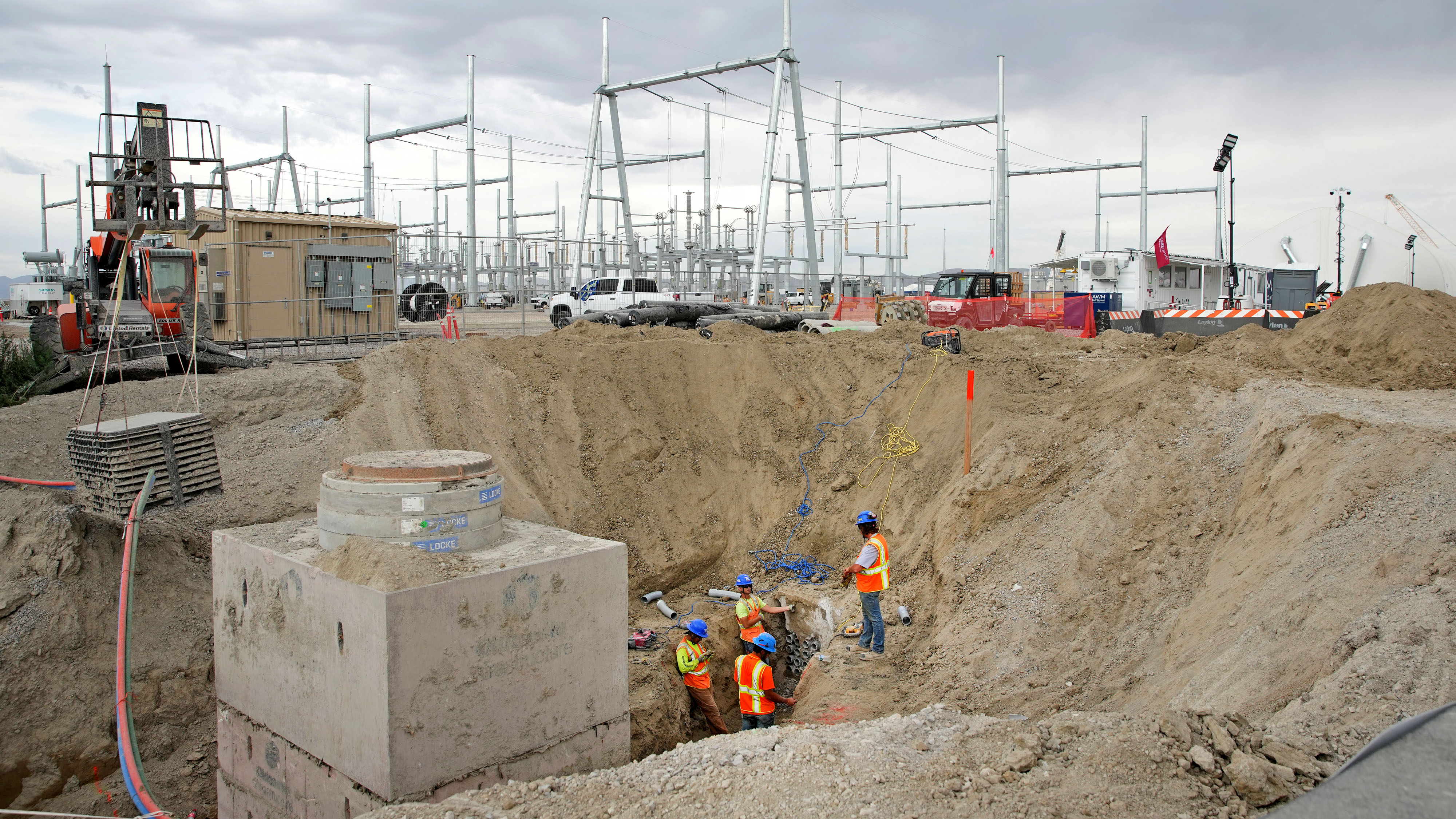
The gist
Wall Street is sounding the alarm as AI’s trillion-dollar infrastructure race squeezes funding and power into the hands of a few tech giants.
What to know
- By October 2026, investors warned AI’s capital needs could exceed $1 trillion a year, with the upside focused on mega-cap buyers like the Mag 7.
- Hyperscalers like Meta, Microsoft, and Amazon are expected to spend a staggering $800 billion on AI infrastructure this year alone, with cloud capex approaching 3% of U.S. GDP by 2027.
- As NVIDIA and Broadcom post record AI hardware revenues, asset managers caution the boom is dangerously dependent on a handful of big spenders—while AI app companies face harsh scrutiny over unpredictable, price-sensitive revenue.
AI Funding Power Players
Investor warnings now focus on a deepening split between mega-cap giants able to bankroll AI infrastructure and the rest of the market left scrambling for capital.
By October 2026, the warning from investors was no longer just that AI was expensive, but that the market was splitting around who could actually finance the buildout. CNBC had already framed the coming 2026 splintering as a need to distinguish “who is spending money and who is making it,” with Blue Whale’s Stephen Yiu cautioning against being positioned in the AI spenders, while Schroders’ Dorian Carrell said investors should question rich multiples because companies were still figuring out how to fund their AI plans.
That concern sharpened when top asset managers tied AI’s upside to a narrow set of dominant buyers, effectively warning that infrastructure demand and market leadership were becoming concentrated in a few mega-cap hands. At a Future Investment Initiative panel in October 2026, Gavin Baker of Atreides Management said the infrastructure layer was the safest place to be while the application layer looked bubble-prone, and he described the Mag 7 as “the AI race” in “win or you die” terms, adding that “The aggregate [Mag 7] market cap… will for sure go to $50 to 100 trillion.”


Contracts Trump Hype in AI
Infrastructure firms are winning investor confidence with long-term, revenue-backed leases while AI software startups struggle to justify sky-high valuations.
AI’s expansion is being financed less like a software boom than like an industrial buildout. SmartReversals’ Trading Compass said “Meta Platforms and Microsoft have launched a historic capital arms race… META guiding for up to $135 billion in 2026 capex to power its nuclear-backed ‘Prometheus’ supercluster, while MSFT leverages a massive $250 billion cloud commitment from OpenAI,” and added that “the 2026 market landscape is being redefined by a stark divergence between capital-intensive infrastructure builders and rapid-adoption software leaders,” while Tesla is “funding its own $20 billion move into AI and robotics through record energy storage margins.”
That spending divide matters because infrastructure companies can point to contracted demand rather than hoped-for monetization. AOL.com reported “Applied Digital Inks $5.2B AI Factory Lease” and that the stock “Soars 282%,” while Simply Wall Street said the company “switched on Phase 1 of Building 2 at its Polaris Forge 1 campus, adding 75 MW of AI capacity under 15 year CoreWeave leases tied to US$7 billion in contracted revenue”; Macro Notes captured why investors reward that model: “For every dollar of AI infrastructure that depreciates, roughly $1.19 of hyperscaler and neocloud revenue is now coming in,” making “four profitable giants spending $725 billion” fundamentally different from weaker AI bets.


AI Spend Rivals National Economies
AI infrastructure investments are ballooning to levels that move entire GDP percentages, signaling a shift from tech sector spending to macroeconomic force.
The numbers now attached to AI infrastructure are no longer venture-scale or even sector-scale; they are macro-scale. Torsten Slok of Apollo estimates cloud companies’ capital expenditure will run at roughly 3% of U.S. GDP every year from 2027 to 2029, up from 0.3% in 2019 and 1.4% in 2025, leading him to argue the data-center buildout is “smaller than housing in level but larger in the change in share of GDP,” a comparison Michael Burry amplified when sharing Slok’s warning that “a cycle that builds at 0.85 percentage points a year can unwind at a similar pace.”
Company spending forecasts point the same way: Amazon, Alphabet, Meta Platforms, Microsoft, and Oracle are expected to spend about $800 billion in combined capital expenditures this year, with most of it going into new data centers, and multiple market estimates now converge on hyperscaler capex exceeding $1 trillion in 2027. S&P said accelerating AI investments could reach $1 trillion in 2027, Bank of America lifted its view to above $1 trillion with 2026 at $800 billion to $900 billion, and Peter Diamandis said 2,441 proposed U.S. data center projects scheduled for 2026 through 2028 represent as much as $2.48 trillion in planned investment.
Concentration Fuels Capital Fears
Market leaders like NVIDIA, Broadcom, and Microsoft dominate both spending and profits, but asset managers warn this narrow base could destabilize the entire AI buildout.
By October 2026, the warning was no longer abstract: major market voices were saying AI infrastructure depended on too little capital and too few buyers. In September, Goldman strategist Ben Snider said AI investment spending was “driving about half of S&P 500 earnings growth,” and 24/7 Wall St. concluded that “index profit growth leans heavily on one capital spending cycle run by a small group of buyers,” naming “NVIDIA, Broadcom, and Microsoft” as central to it. The concentration was visible in the operating numbers as well: NVIDIA posted “Q2 FY27 revenue of $96.22 billion, up 105.8% year over year,” with “data center at $89.02 billion,” while Broadcom said its “AI semiconductor revenue reached $16.70 billion in Q3, up 221% year over year,” even as Microsoft remained “on the buyer side” at “full-year capex of $115.95 billion” and a “FY27 capex expectation of roughly $175 billion.”
That concentration warning hardened into a funding alarm in mid-October, when Pensions & Investments reported that asset management CEOs were publicly arguing the AI infrastructure buildout still needed more capital. At the same time, analysis of Gartner’s October warning recast the buildout as a cost-of-capital problem, citing an estimate that “cost pressure and the absence of sufficiently differentiated business models could force more than 80% of neocloud providers to cease operating independently by 2030,” while the market’s repricing showed where investors saw the strain: “CoreWeave took the headline damage, falling more than 15%,” and peers sold off harder than Nvidia.
AI Apps Under Investor Microscope
AI application companies face mounting skepticism as unpredictable revenue streams and volatile compute costs make their business models look fragile compared to infrastructure giants.
Investors are harsher on AI application companies because software revenue still looks contingent rather than contracted. The Black Swans 📈 captured that asymmetry bluntly: cloud platforms exposed to AI are “relatively safer” but “Won’t 10x,” while smaller application bets are “more vulnerable to competition and swings,” and Yahoo Finance showed why, arguing software vendors must prove AI creates paid usage rather than lower seat counts, with Adobe’s bear case centered on low-cost generative tools eroding pricing and Palantir’s on contract concentration, termination clauses, and growth normalization. Even where infrastructure names look expensive, the market is often underwriting more visible demand: “The share price has surged approximately 354.3% over three years… The elevated P/S multiple still implies that much of the AI data center growth story is being paid for upfront by investors.”
That skepticism deepens because application monetization depends on unstable compute economics and concentrated demand. The Black Swans 📈 said the path to “Lab 10x revenue while continuing to only 3x compute” requires “some combination of… 1. Lab margins have to increase, 2. The price of compute has to increase, 3. Labs have to spend a greater fraction of their compute on inference”; meanwhile, “Spot prices for compute are up 40%+ from the February trough,” labs “can’t rely on spot instances,” and “Roughly a quarter of OpenAI’s 2024 compute spend went to inference… and it’s certainly closer to 50% if not higher now,” making revenue mix and margins inherently less predictable. It also states that “as AI models become smarter, they’ll better monetize the same amount of compute,” even giving a valuation-style example: “If a true human-level software engineer that could run on an H100 equivalent… that H100,” but that only underscores how much application valuations hinge on uncertain future monetization efficiency rather than lease-like contracted cash flows.