America’s AI gridlock: soaring data center demand exposes a system that can’t build fast enough
The gist
America’s power grid is buckling under AI’s explosive energy appetite, with bureaucratic red tape and sluggish upgrades threatening to derail both economic growth and national security.
What to know
- AI-driven electricity demand is surging 15–20% annually, but grid capacity is crawling at just 2% growth—setting the stage for costly project delays and decade-long permitting headaches.
- Federal and state reforms aim to fast-track grid expansion and shift costs to tech giants, yet NIMBY opposition and regulatory snarls keep progress painfully slow.
- China now generates 40% more electricity than the U.S. and EU combined, highlighting a strategic vulnerability as U.S. electricity prices soar nearly 40% since 2021.
Permitting Gridlock Exposed
Decade-long regulatory delays and speculative demand forecasts are paralyzing U.S. grid expansion, leaving AI data centers starved for power as infrastructure struggles to keep pace.
The U.S. energy infrastructure is grappling with profound bottlenecks as AI-driven electricity demand surges, exposing systemic weaknesses in regulatory and procedural frameworks. Projects like the rebuilding of Baltimore's Francis Scott Key Bridge remain stalled a year after collapse due to protracted environmental reviews and stakeholder consultations, illustrating how federal and state permitting processes—often spanning 7 to 12 years—cripple timely infrastructure development. This regulatory labyrinth, compounded by stakeholder veto powers, creates a 'system that literally cannot build,' leaving critical assets like lithium mines and gas turbines delayed for over a decade, thereby exacerbating grid capacity constraints amid soaring AI data center power needs.
Speculative demand forecasting for AI data centers further muddies the waters, inflating utilities' projections by including multiple, overlapping, or even unrealized projects. This lack of standardized vetting processes has prompted calls from FERC Commissioner David Rosner and the Data Center Coalition to improve data quality and transparency, as states like Texas struggle to assess the realism of forecasts that predict two- to threefold electricity demand increases within a few years. The resulting uncertainty risks burdening ratepayers with the costs of unnecessary infrastructure, while utilities and grid operators face challenges in planning for a rapidly evolving energy landscape.
By early 2026, the strain on the U.S. grid became unmistakable: AI data center electricity demand is growing at 15–20% annually, vastly outpacing the grid's 2% capacity growth and driving regional price spikes, especially in hotspots like Virginia, Texas, and California. Despite hyperscalers investing billions in dedicated generation, the long lead times for new power plants—often stretching into the 2030s—create a critical timing mismatch with the rapid AI infrastructure rollout. Meanwhile, transmission build-out timelines have ballooned to effectively 'infinite years,' and a shortage of gas turbines with multi-year backlogs limits short-term capacity expansion, forcing reliance on natural gas and complicated regulatory waivers for load shedding that could free up to 80 gigawatts if eased.
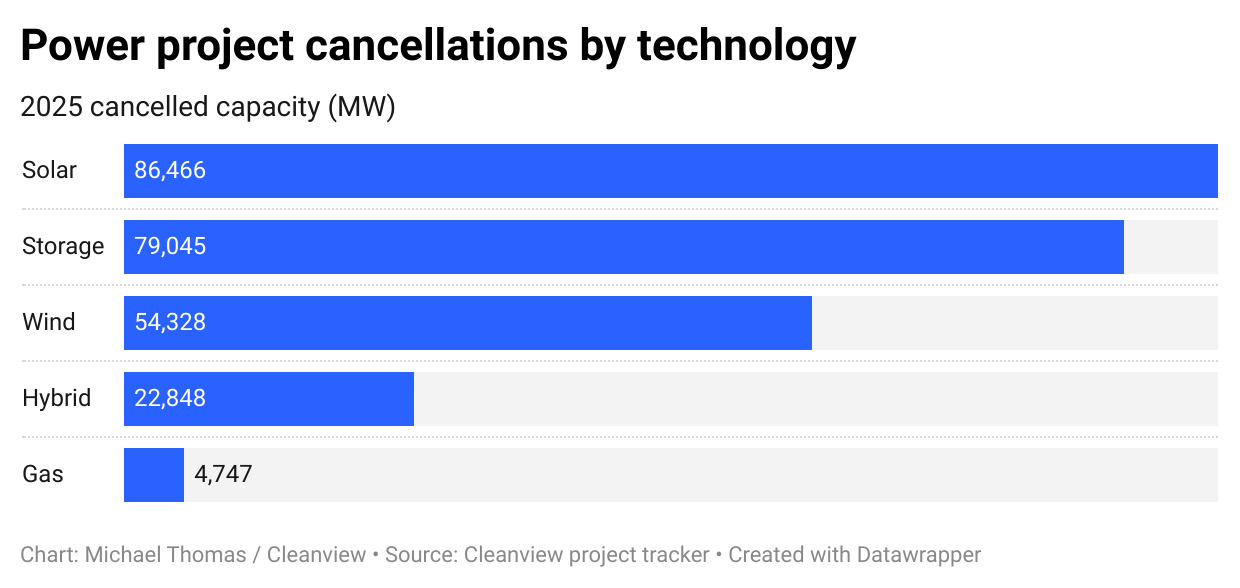
The confluence of soaring AI-driven demand and widespread cancellations of nearly 1,900 power projects totaling 266 GW in 2025—93% of which are clean energy initiatives—signals an emerging crisis for U.S. grid reliability and affordability. Policies from the Trump administration, including tariffs and the phasing out of clean energy tax credits, have chilled renewable development, while state-level opposition and transmission bottlenecks further stall capacity expansion. This regulatory and political impasse threatens to raise electricity prices, undermine the U.S.'s competitiveness in the global AI race, and force a costly and rapid rewiring of a grid originally built over a century, now strained beyond its limits.





Policy Reform Bottlenecks
Patchwork reforms and NIMBY resistance are forcing states to shift grid costs to tech giants, while outdated regulatory models struggle to adapt to the explosive and unpredictable AI load.
Federal and state policymakers have pursued a patchwork of regulatory reforms to accelerate grid expansion amid surging AI-driven energy demand, with early efforts under the Trump administration easing nuclear permitting and freeing federal lands for data centers to circumvent local restrictions. However, persistent state and local 'not in my backyard' (NIMBY) opposition and lengthy permitting delays continue to bottleneck infrastructure development, as highlighted by the decade-long timelines from permitting to construction noted by industry stakeholders. Legislative milestones such as the Manchin Barrasso Energy Permitting Reform Act (EPRA) and the SPEED Act have sought to streamline interregional transmission planning and overhaul permitting processes, yet full realization remains a multi-decade challenge requiring greater federal coordination akin to the highway system model. Meanwhile, states like Texas have introduced targeted measures like Senate Bill 6 (SB6) to shift transmission costs to large load users and institute mandatory demand management programs, reflecting a growing trend toward balancing infrastructure needs with consumer protections amid unprecedented grid stress.
Public Utilities Commissions (PUCs) have emerged as pivotal gatekeepers in managing AI data center expansion, wielding authority over infrastructure planning, permitting, and rate-setting that effectively controls data centers’ grid access. This regulatory power is increasingly contested amid public and political pushback over rising residential energy costs and environmental concerns, as seen in states like New Jersey. To mitigate cost-shifting risks, PUCs are enforcing upfront payments from data centers for grid connection infrastructure—refunded through lower rates—to ensure utilities retain ownership and prevent undue burden on other consumers. Yet, longstanding regulatory frameworks designed for stable, verifiable load growth are proving inadequate, with critics like Governor Shapiro calling out the broken utility model and urging balanced oversight to adapt to the speculative and rapidly evolving demands of AI-driven load growth.
The proliferation of speculative large-load interconnection requests from AI and data center developers has inflated demand forecasts and strained grid planning, prompting regulators and grid operators such as FERC, ERCOT, PJM, and SPP to implement reforms emphasizing project maturity and commercial commitment. Initiatives like ERCOT’s 'Batch Zero' and SPP’s HILLGA framework require developers to demonstrate readiness before entering transmission studies, while industry leaders including Google, Amazon, Microsoft, and OpenAI advocate for standardized commitment frameworks and integrated generation-load analyses to accelerate project energization. Alternative proposals, such as NRG Energy’s competitive 'open seasons' for transmission capacity, aim to replace traditional queue priority and ensure large loads bear upgrade costs, reflecting ongoing regulatory debates to balance consumer protections with the urgent need for infrastructure expansion.
Despite growing electrification demands and AI-driven load growth necessitating increased utility distribution investments, affordability concerns have led some states like Delaware to propose spending caps that risk undermining necessary grid expansion. Regulators in 2026 are responding by demanding rigorous justification of distribution spending through transparent data use and smarter demand management to avoid costly overbuilds and better leverage behind-the-meter resources. This nuanced approach acknowledges that while arbitrary spending caps are ill-advised given forecasting complexities, strategic oversight is essential to ensure investments support a robust, modernized grid capable of meeting future energy needs without disproportionately burdening consumers.



Investment Surge, Supply Crunch
Utilities are pouring unprecedented capital into grid upgrades and equipment manufacturing, but supply chain bottlenecks and skyrocketing component demand threaten to stall the AI energy boom.
The explosive growth of AI data centers is driving utilities and infrastructure providers to embark on an unprecedented capital expenditure surge to modernize the U.S. grid and expand capacity. With data center demand projected to grow 15–20% annually—far outpacing the grid’s historical 2% growth—utilities like Georgia Power are proposing massive investments, such as a $15 billion plan to increase capacity by 50% over six years, primarily to serve AI-driven loads. This rapid expansion is reshaping regional markets, with ERCOT alone forecasting 53 gigawatts of load growth through 2030, underscoring Texas as a critical hub for utility investment amid fast permitting and historically low electricity prices that attract hyperscale operators.
To support this surge, utilities are not only expanding generation but also undertaking historic transmission upgrades, including multiple 765kV high-voltage projects across key regions like SPP, MISO, PJM, and ERCOT. Despite setbacks such as the DOE’s cancellation of the Greenbelt Express loan, the overall transmission buildout remains robust, with hundreds to thousands of miles of new lines planned annually. However, the pace of grid expansion lags behind AI infrastructure buildouts, causing regional electricity price spikes and stressing utilities, which must now innovate with new load management programs and financial structures to balance speculative demand and protect ratepayers.
The investment surge extends deep into manufacturing and equipment supply chains, as utilities confront long lead times for critical components like generation step-up transformers, whose demand has soared 274% since 2019 with delivery times exceeding two years. Companies such as Hitachi Energy and Siemens are committing over $1 billion to U.S. transformer manufacturing facilities to alleviate bottlenecks, while utilities like Duke Energy are creating procurement subsidiaries to secure scarce equipment. This intense capital deployment, projected to reach $1.4 trillion by 2030, is reshaping the utility sector’s financial and operational models, with large customers like Google and Amazon increasingly bearing the cost burden to shield residential consumers.
Major utilities such as Xcel Energy, Dominion Energy, and Exelon are evolving their capital plans to align with the AI-driven demand surge, collectively committing tens of billions in grid resiliency, transmission, and generation investments through 2030. Dominion’s $55 billion plan for Virginia, heavily focused on data center clusters, and Exelon’s $41.7 billion multi-jurisdictional investment highlight a strategic pivot toward regulated infrastructure platforms that integrate renewable energy and transmission expansion. This transformation is occurring amid a broader national reckoning with aging infrastructure and competitive pressures from global peers like China, which has tripled its grid capacity since 2010, emphasizing the urgency for the U.S. to accelerate modernization efforts.
Forecast Fictions Fuel Risk
Inflated and unverified demand forecasts from data center developers risk billions in unnecessary infrastructure, stoking public backlash as residential customers face soaring bills.
The surge in electricity demand forecasts driven by AI data centers has created significant uncertainty and regulatory challenges, as many utilities and grid operators lack standardized processes to verify the commercial viability of these projects. For instance, PJM Interconnection and Texas lawmakers uncovered that developers often submit multiple interconnection requests across utility territories without disclosure, inflating demand forecasts and risking speculative overbuilds. Federal regulators like FERC Commissioner David Rosner and industry groups such as the Data Center Coalition are pushing for greater transparency and commercial readiness verification to ensure infrastructure investments align with real demand, aiming to prevent residential ratepayers from underwriting speculative projects that may never materialize.
Utilities are responding to the AI data center boom with massive capital expenditures, exemplified by Georgia Power’s $15 billion proposal to increase capacity by 50% over six years, and Texas’s ERCOT facing a nearly 300% surge in large load interconnection requests, reaching 233 gigawatts—almost triple the state’s peak demand. While these investments aim to meet soaring demand, critics warn of potential cost-shifting to residential customers if anticipated data center loads fall short, as utilities earn regulated returns on capital investments regardless of actual usage. Legislative measures like Texas’s Senate Bill 6 attempt to address fairness by shifting transmission costs to large loads and requiring upfront financial guarantees, but public utilities commissions remain pivotal in balancing infrastructure expansion with consumer protections.
The rapid escalation in electricity prices—marked by a nearly 40% increase since 2021 and a 7% jump in 2025 alone—is driven by a complex interplay of factors beyond data centers, including fuel price volatility, extreme weather recovery costs, and costly grid upgrades. However, data centers significantly amplify these pressures, as seen in PJM’s capacity market where forecast errors related to data center loads caused capacity prices to soar 9.3 times, resulting in a $16 billion cost increase passed to consumers. Public frustration is mounting, with rising bills becoming a political flashpoint and fueling opposition to data center expansions, especially in states like New Jersey and Georgia where investigations into cost-shifting practices are underway.
The traditional utility regulatory model, designed for predictable and local load growth, is increasingly ill-suited to the modern energy landscape dominated by speculative, large-scale data center demands. Public utility commissions often rubber-stamp infrastructure investments based on inflated forecasts, leading to billions in grid upgrade costs shifted onto residential and small-business customers who ultimately pay for capacity that may never be used. This systemic issue, highlighted by the Union of Concerned Scientists’ finding of over $4 billion in shifted connection costs, underscores the urgent need for regulatory reforms such as ring-fence tariffs, separate load classes, and better cost allocation mechanisms to protect consumers and ensure fairness in rate structures.


Big Tech Bets on the Grid
Giant transmission projects and hybrid power models are racing against persistent permitting delays and equipment shortages, as utilities prioritize utility-scale solutions over distributed innovation.
Despite a notable increase in new high-voltage transmission lines in 2024, largely completing projects initiated over a decade ago, the U.S. grid’s expansion remains hampered by slow permitting processes and uncertain regulatory support under the current administration. FERC Order 1000, which mandates proactive 20-year transmission planning, stands as a crucial but politically fragile policy tool, underscoring the persistent tension between urgent infrastructure needs driven by doubling AI and renewable energy demand and the inertia of legacy regulatory frameworks.
Strategically, large-scale, top-down solutions championed by initiatives like the Clean Economy Project—heavily influenced by Bill Gates and Breakthrough Energy—prioritize major clean firm power projects and expanded transmission infrastructure over distributed energy resources. While demand-side innovations such as virtual power plants are acknowledged, the prevailing view favors utility-scale upgrades as the fastest path to systemic decarbonization, reflecting a pragmatic focus on scaling infrastructure to meet surging AI data center loads and renewable integration.
Emerging technological innovations are addressing critical grid constraints through hybrid data center power models that combine grid connectivity with on-site generation to circumvent transmission bottlenecks, alongside grid-enhancing technologies like robotic cable coatings that reduce transmission losses by up to 30%. However, persistent challenges such as transformer shortages—with wait times exceeding a year—and social license hurdles in states imposing bans on new data centers highlight the multifaceted nature of these constraints, demanding integrated solutions that span generation, transmission, and consumption.
A growing consensus emphasizes maximizing existing grid capacity—currently utilized at only about 40-50%—through improved operational planning, market reforms, and regulatory innovations like non-firm connection agreements, which could unlock up to 900 GW of latent capacity without new infrastructure. This approach, advocated by coalitions including Google and Tesla, offers a faster, more cost-effective alternative to protracted transmission buildouts that can take 5 to 15 years, thereby aligning with the rapid deployment timelines of renewables and AI data centers while mitigating the bottleneck posed by transmission limitations.


China’s Speed, America’s Stalemate
While U.S. energy projects languish in red tape, China’s rapid grid and AI infrastructure buildout exposes a strategic gap that threatens America’s economic and technological edge.
The U.S. energy infrastructure is mired in prolonged regulatory and stakeholder hurdles that delay critical mineral projects essential for AI and economic security, exemplified by the Francis Scott Key Bridge collapse remaining unrepaired a year later due to extensive environmental and community reviews. In stark contrast, China completes similar projects in roughly 18 months, as seen with the Thacker Pass lithium mine’s 12-year U.S. timeline versus China’s rapid development, underscoring a strategic vulnerability that Beijing exploits by betting America cannot swiftly fix its supply chain and energy infrastructure bottlenecks.
Amid intensifying U.S.-China competition for AI supremacy, energy dominance has emerged as a critical strategic front. OpenAI’s call for the U.S. to build 100GW of new energy capacity annually highlights the urgency, while China integrates AI models like DeepSeek and Qwen into military systems and rapidly expands its power generation across coal, renewables, nuclear, and battery storage. Saudi Arabia’s investments in data centers and collaborations with both U.S. and Chinese tech firms further complicate the geopolitical landscape, positioning energy infrastructure as a linchpin for AI leadership and economic security.
Despite rising AI-driven electricity demand, U.S. transmission grid expansion remains sluggish, with only 55 miles of new high-voltage lines built in 2023 and a modest uptick to 880 miles in 2024 largely from decade-old projects. While the Biden administration improved federal permitting and introduced FERC Order 2020 to mandate proactive transmission planning, uncertainty looms over continued implementation. Experts argue for a stronger federal role akin to the highway system to overcome fragmented interests, emphasizing that accelerating grid modernization is vital not only for climate goals but also for securing economic and geopolitical advantages in the AI era.
By early 2026, China’s energy infrastructure advantage is unmistakable: it now generates 40% more electricity than the U.S. and EU combined, with solar capacity surging by nearly 50% annually. Meanwhile, the U.S. faces a growing electricity shortage threatening its AI leadership, constrained by regulatory barriers, rising prices, and reliance on Chinese-controlled solar panel supply chains. Secretary Doug Burgum underscores that energy dominance—already bolstered by the U.S. being the largest oil producer and LNG exporter—is critical to converting electricity into intelligence, framing energy strategy as a national security imperative to reduce dependence on adversaries funding global conflicts.