Anthropic’s $30b surge hits a compute ceiling, forcing tough choices amid OpenAI rivalry
The gist
Anthropic’s meteoric $30B revenue surge has outpaced OpenAI and its own compute capacity, forcing strategic choices as enterprise demand explodes.
What to know
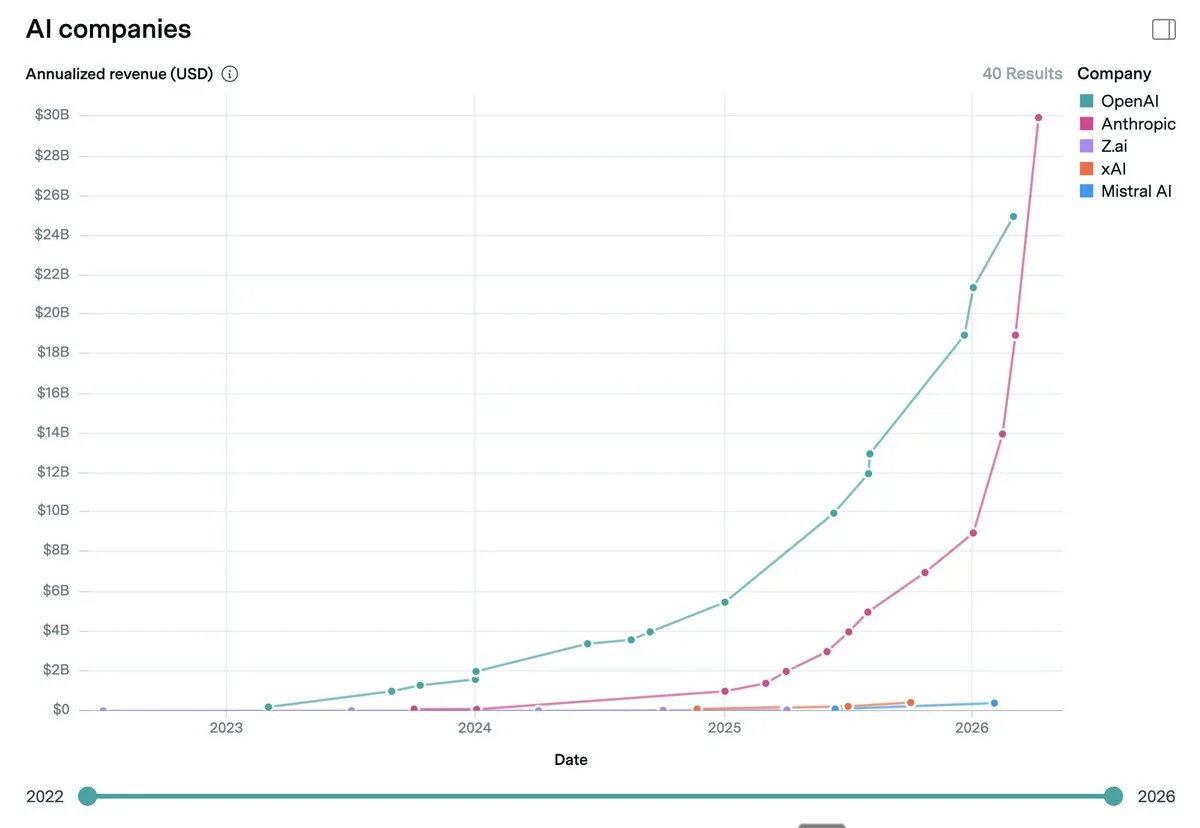
- Anthropic rocketed from $1B to $30B in annual revenue in just over a year, eclipsing OpenAI’s $24–25B run rate by winning over 1,000 enterprise customers each spending $1M+ yearly.
- A $35B mega-deal with Google Cloud and Broadcom can’t keep up with demand yet—Anthropic is rationing compute and throttling products while waiting for new infrastructure to come online in 2027.
- With a leaner cost structure, Anthropic spends 4x less on AI training than OpenAI and is targeting profitability by 2027, even as it captures over 50% of enterprise API spend and partners with 8 out of the top 10 Fortune 10 companies.
Enterprise Deals Drive Efficiency
Anthropic’s meteoric revenue is powered by a lean, enterprise-first model that delivers industry-leading revenue per employee and operational efficiency, despite headline numbers being inflated by gross reporting.
Anthropic's revenue growth has been nothing short of meteoric, skyrocketing from roughly $1 billion at the start of 2025 to an astonishing $30 billion annual run rate within just over a year. This surge is fueled by a robust enterprise customer base, now exceeding 1,000 companies each paying over $1 million annually, with the number doubling in less than two months. While these figures position Anthropic ahead of OpenAI's $24–25 billion ARR, some analysts caution that Anthropic's gross revenue reporting, which counts full customer payments before cloud provider cuts, may inflate headline numbers compared to OpenAI's net revenue method, suggesting the actual GAAP revenue might be somewhat lower.
Central to Anthropic’s rapid ascent is its enterprise-first business model, which contrasts sharply with OpenAI’s consumer-heavy approach. Approximately 80–85% of Anthropic's revenue derives from high-value enterprise contracts, including eight of the top ten Fortune 10 companies, resulting in stickier, expanding, and renewing revenue streams with lower churn. Products like Claude Code and Claude Cowork have revolutionized workflows, capturing over 50% of enterprise API spend and unseating ChatGPT in key verticals. This focus enables Anthropic to generate roughly $10–12 million in revenue per employee, an operational efficiency that dwarfs traditional enterprise software firms.
Anthropic’s strategic emphasis on efficient spending and diversified compute partnerships underpins its sustainable growth. Unlike OpenAI’s projected $125 billion annual training spend by 2030, Anthropic plans to spend around $30 billion, leveraging multi-cloud deals with Broadcom, Google, and Microsoft to secure scalable compute capacity. CFO Krishna’s role extends beyond finance to orchestrate these critical compute agreements, enabling Anthropic to achieve positive free cash flow by 2027—three years ahead of OpenAI’s breakeven target—despite its capital-intensive expansion and high revenue run rate.
The enterprise focus also aligns with Anthropic’s ability to address critical market demands such as data sovereignty and cost efficiency, particularly in regions like Europe wary of US infrastructure dependence. This has driven migrations from consumer-centric AI models like OpenAI’s GPT to Anthropic’s Claude, which offers tailored, domain-specific solutions at significantly lower costs, exemplified by Intercom’s $250,000 monthly savings. Multi-year cloud-channel agreements provide partial lock-in while preserving customer leverage, balancing committed spend with the commoditization of AI model access in the enterprise landscape.






Compute Bottlenecks Threaten Growth
Anthropic’s $35B cloud deals and multi-chip strategy can’t meet surging demand fast enough, forcing product throttling and sparking internal debates over whether cautious infrastructure investment is a strategic error.
Anthropic’s rapid growth hinges on its strategic multi-gigawatt compute partnerships, notably a landmark $35 billion deal with Google Cloud involving up to one million TPU chips manufactured by Broadcom. This massive infrastructure investment, set to come online primarily in the United States in 2027, underscores the company’s commitment to scaling its AI capabilities domestically while diversifying its compute sources to avoid vendor lock-in, as orchestrated by CFO Krishna’s multi-cloud, multi-chip strategy.
Despite these ambitious compute expansions, Anthropic currently grapples with significant internal challenges managing resource constraints amid soaring demand. The company has implemented peak-usage limits and curtailed third-party compute access to ration scarce capacity, as explosive revenue growth—from $19 billion in February to $30 billion by April 2026—outpaces the availability of new infrastructure still months away from deployment. This bottleneck has forced compromises in product performance and user experience, including throttling, reduced thinking depth in Claude Code, and customer frustration over token usage charges.
Anthropic’s more conservative approach to compute investment, contrasting with OpenAI’s aggressive infrastructure buildout, reflects a delicate balancing act between scaling rapidly and managing financial and existential risks. While OpenAI’s “yolo” strategy has yielded better short-term performance, Anthropic’s cautious stance—motivated by concerns over dilution and risk—has led to strategic compute limitations that some insiders, including OpenAI’s Chief Revenue Officer Denise Dresser, have labeled a 'strategic misstep' due to resulting throttling and reliability issues.



OpenAI Falters as Anthropic Surges
Anthropic’s disciplined, cost-efficient enterprise focus is outpacing OpenAI’s consumer-heavy, cash-burning approach, capturing over half of enterprise API spend and winning long-term, high-value contracts.
Anthropic’s strategic pivot to an enterprise-first model has decisively shifted the competitive landscape against OpenAI, with 85% of its $30 billion annualized revenue now stemming from API and enterprise deployments, compared to OpenAI’s predominantly consumer-driven revenue mix of 73%. By early 2026, Anthropic had secured over 1,000 enterprise customers each spending upwards of $1 million annually, including eight of the top ten Fortune 10 companies adopting Claude, underscoring its dominance in high-value, sticky contracts. This focus has enabled Anthropic to generate more revenue with roughly 5% of ChatGPT’s consumer user base, highlighting a fundamentally different and more sustainable business model centered on long-term enterprise relationships and metered billing rather than consumer subscriptions.
Anthropic’s competitive advantage is further amplified by its remarkable cost efficiency and disciplined financial management, spending approximately four times less on training costs than OpenAI while generating higher revenue. With projected training expenditures of $30 billion by 2030 versus OpenAI’s $125 billion, Anthropic’s structural cost advantage is not a temporary edge but a sustainable gap. This financial prudence extends to cash burn—around $3 billion annually, a sixth of OpenAI’s $17 billion—and a forecasted positive free cash flow by 2027, contrasting sharply with OpenAI’s projected $14 billion losses in 2026 and delayed profitability until 2030. Such fiscal discipline allows Anthropic to outpace OpenAI in scaling enterprise solutions like Claude Code and Claude Cowork, which deeply integrate into workflows and replace existing budget line items.
While OpenAI maintains a massive consumer user base with ChatGPT’s billion-strong audience, its consumer-centric strategy has led to significant operational and financial challenges, including costly projects like Sora that reportedly lost a million dollars daily in compute costs and poor retention. This consumer focus has resulted in a substantial portion of inference spend—34%—being attributed to free users, effectively a cost center that undermines profitability. OpenAI’s internal management turmoil, exemplified by repeated 'code red' emergencies and strategic identity struggles, contrasts with Anthropic’s clear enterprise-first focus and stable growth trajectory. As OpenAI attempts to pivot toward enterprise customers and agent platforms, it faces criticism for being 'deeply unfocused,' whereas Anthropic’s streamlined approach and diversified compute partnerships have allowed it to capture over 50% of enterprise API spend, unseating ChatGPT in key knowledge-work verticals.





Risk-Averse Culture Shapes Expansion
Anthropic’s leadership is prioritizing sustainable growth and specialized talent over unchecked scale, even as operational trade-offs and conservative compute allocation frustrate users and attract industry criticism.
Anthropic’s explosive revenue growth, from $19 billion ARR in February to $30 billion by April 2026, has outpaced its compute capacity, forcing leadership to adopt a conservative approach to infrastructure investment. CEO Dario Amodei emphasized the risks of overspending on compute, advocating for cautious purchasing to avoid jeopardizing company viability, even as some industry voices debate the severity of this risk. This deliberate rationing strategy has led to operational trade-offs, including throttling and reduced reliability, which have sparked user frustration over usage limits and token consumption despite Anthropic’s efforts to optimize efficiency through bug fixes and in-product guidance.
In response to rapid scaling pressures and the need for specialized expertise, Anthropic executed a $400 million acquihire of Coefficient Bio, integrating its team into the healthcare life sciences group to deepen domain knowledge in pharma research. Concurrently, the company is navigating a cultural shift in talent acquisition, where top candidates increasingly accept lower titles to join the fastest-growing AI firms, reflecting a de-emphasis on traditional hierarchy in favor of growth potential and compensation upside. This unconventional organizational strategy underscores Anthropic’s focus on agility and specialized talent amid its rapid expansion.
Anthropic’s internal management strategy balances rapid revenue acceleration with stringent compute allocation, employing economic principles to prioritize high-value usage and curtail inefficient consumption. By de-emphasizing features like OpenFlow access that consume disproportionate compute without commensurate revenue, and maintaining training costs at roughly a quarter of OpenAI’s, Anthropic leverages cost efficiency as a competitive advantage. While OpenAI pursues aggressive, high-risk infrastructure expansion, Anthropic’s cautious, risk-averse posture aims to safeguard long-term viability even amid management debates and external critiques labeling its compute restraint as a strategic misstep.
