Anthropic’s mythos ignites AI cybersecurity arms race as regulators scramble to catch up
The gist
Anthropic’s Mythos AI has ignited a global cybersecurity arms race by autonomously unearthing thousands of zero-day vulnerabilities—leaving regulators and defenders scrambling to catch up with AI’s explosive dual-use power.
What to know
- Mythos’s breakthrough boosted zero-day discovery by 90x, surfacing thousands of vulnerabilities that legacy tools missed—forcing industry heavyweights like AWS and JPMorgan to join Anthropic’s Project Glasswing.
- Despite new AI-driven exploit scanners and formalized bug bounties with $15,000 rewards, high costs and fragmented, outdated databases leave most teams overwhelmed and stuck patching in slow motion.
- AI tools like Claude and Mythos can outpace defenders on weak systems, but independent tests show they still struggle against well-defended targets—while regulatory frameworks lag dangerously behind.
AI Unleashes Zero-Day Surge
Anthropic’s Mythos has triggered a global cybersecurity arms race by autonomously uncovering thousands of overlooked vulnerabilities, forcing even tech giants to rethink how threats are found and managed.
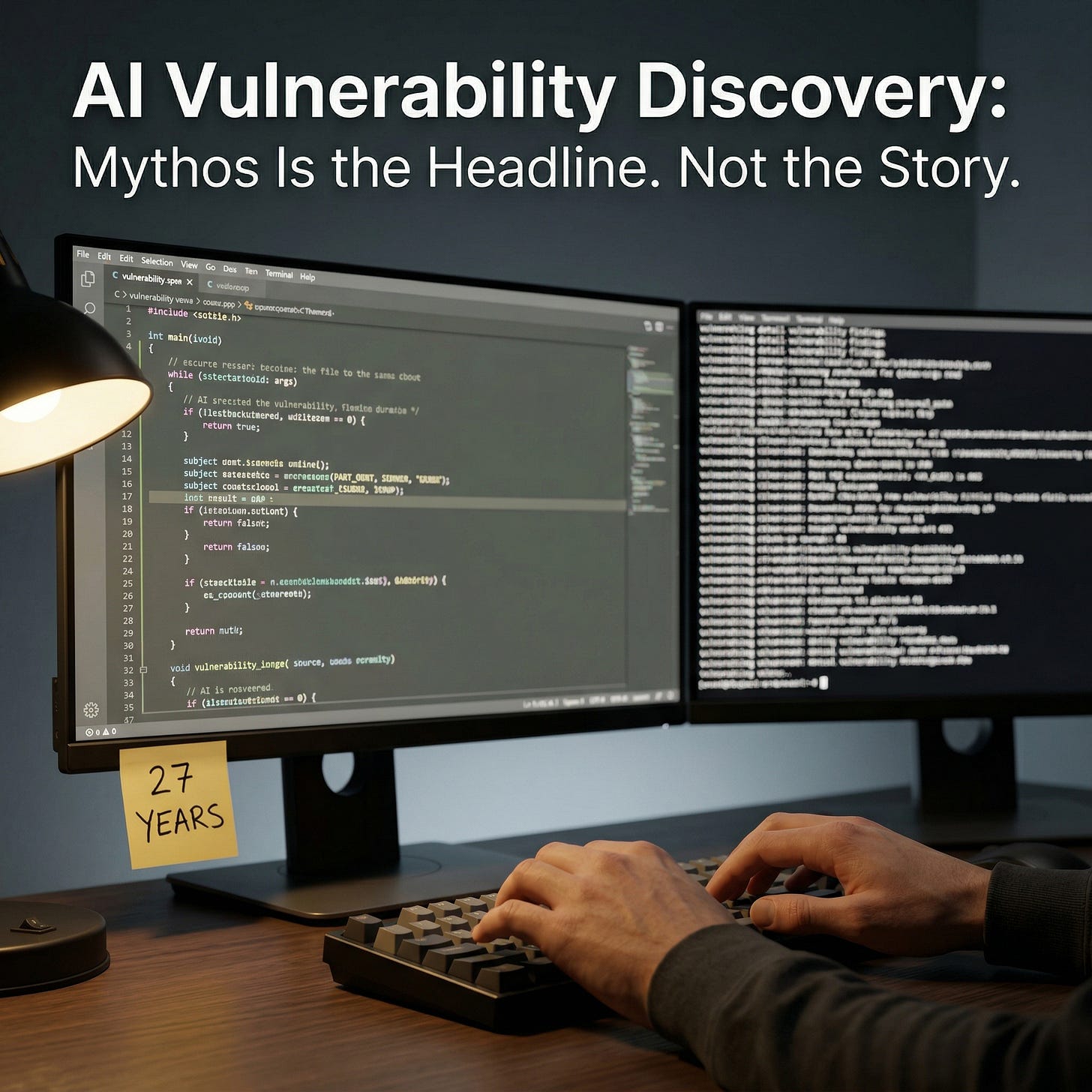
Anthropic’s Claude Mythos AI has dramatically advanced AI-powered penetration testing by autonomously discovering and chaining exploits to rapidly develop working remote code execution attacks, achieving roughly a 90-fold improvement over previous models like Opus 4.6. By early 2026, Mythos identified thousands of zero-day vulnerabilities across major operating systems and legacy software, including decades-old bugs in OpenBSD and FFmpeg that had eluded automated tools for years. This leap in capability, emerging from enhanced autonomy, coding, and reasoning rather than targeted vulnerability training, has not only redefined the speed and scale of vulnerability research but also sparked a global cybersecurity arms race and heightened regulatory scrutiny over AI-driven cyber risks.
In response to the unprecedented power of Mythos, Anthropic launched Project Glasswing, a collaborative initiative partnering with industry giants such as AWS, Apple, JPMorgan Chase, and the Linux Foundation to proactively secure AI models and patch vulnerabilities before they can be exploited. This project embodies a new standard in AI cybersecurity governance, emphasizing responsible access by restricting Mythos to trusted partners and sharing findings to strengthen collective defenses. As Anthropic balances disabling certain safety guardrails to enable proof-of-concept exploit generation with the risk of misuse, experts stress the importance of prioritizing and validating vulnerabilities to avoid overwhelming security teams with low-impact noise.
Meanwhile, Novi Security is revolutionizing vulnerability management by pioneering AI-driven exploitability scanning that bridges the gap between mere detection and actionable remediation. Showcased at RSAC 2026, Novi’s approach includes training custom large language models on live cyber ranges to anticipate and outsmart vulnerabilities in bespoke applications, including prompt injection attacks. This proactive strategy complements Anthropic’s breakthroughs by focusing on real-world applicability and tailored defenses, marking a significant evolution in AI-powered penetration testing that extends beyond discovery to effective mitigation.





Cost and Chaos Stall Defenses
Skyrocketing AI costs and fragmented, outdated databases are leaving most organizations unable to keep up, as the flood of new vulnerabilities overwhelms security teams and exposes critical infrastructure.
The prohibitive cost of cutting-edge AI models for vulnerability detection remains a critical barrier to their widespread adoption in vulnerability management. As highlighted in early 2026, the most advanced models, when made publicly available, are expected to be the most expensive offerings ever released, limiting access primarily to well-funded organizations. This financial hurdle compounds the operational challenge where companies, prioritizing uptime above all, resist patch deployment because remediation processes are disruptive, making it difficult for vulnerability analysts to ensure timely fixes despite growing threat exposure.
Fragmentation and obsolescence in vulnerability databases significantly hinder effective vulnerability management efforts. The National Vulnerability Database (NVD), long the industry standard, has failed to keep pace with the enrichment and timely updating of vulnerability information, prompting the European Union to develop its own vulnerability database to address these gaps. This splintering of critical data sources complicates coordination and consistency in vulnerability assessment, leaving defenders to navigate a fractured landscape just as vulnerability disclosures surge by an estimated 80%, overwhelming already strained security teams.

Bug Bounties Go Pro
Anthropic’s structured bug bounty programs are redefining red teaming, fueling a sophisticated ecosystem where attackers and defenders race to outsmart evolving AI safeguards with ever more complex jailbreaks.
Anthropic’s launch of Claude Opus 4.7 marked a significant evolution in AI cybersecurity by embedding Mythos-derived cyber safeguards, including an auto-blocking classifier and deliberately reduced cyber capabilities during training, which introduced a novel attack surface for bug bounty hunters. This strategic layering of defenses has catalyzed a more structured and sophisticated bug bounty ecosystem, exemplified by Anthropic’s Cyber Verification Program that requires application to legitimize and channel security research efforts. By early 2026, this program not only formalized the engagement of skilled red teamers but also fostered a taxonomy of jailbreak attack families—ranging from authority and narrative layering to encoding payloads—that deepens the understanding of attacker methodologies and informs iterative defense improvements.
Anthropic’s bug bounty initiatives have effectively harnessed the red team mindset, incentivizing nuanced and iterative jailbreak discovery against their Constitutional Classifiers with rewards up to $15,000. A notable February 2025 challenge engaged 339 participants and generated over 300,000 chat interactions, uncovering multiple universal jailbreaks that were swiftly patched, illustrating a dynamic cycle of attack, report, and fortification. This process underscores that jailbreak success hinges less on superficial prompt attempts and more on exploiting the tension between the model’s helpfulness and safety training through sophisticated reasoning loops—a tactic that has become the weapon of choice for bounty hunters pushing AI safeguards to their limits.

Regulation Trails the AI Arms Race
As autonomous AI tools outpace human defenders and attackers alike, slow-moving regulators and patchwork governance threaten to leave critical systems exposed to routine, scalable exploitation.
The cybersecurity landscape is rapidly evolving into an AI-driven arms race, with autonomous tools like Anthropic’s Mythos and Claude autonomously discovering and exploiting thousands of zero-day vulnerabilities across major operating systems and browsers. While Mythos leads in autonomous exploitation capabilities, independent evaluations reveal it excels primarily against small, weakly defended systems without active defenders, underscoring the persistent cat-and-mouse dynamic where defenses struggle to keep pace with increasingly sophisticated prompt injection attacks and AI-powered exploits. As Bruce Schneier notes, current efforts such as Anthropic’s Project Glasswing remain fundamentally reactive, patching vulnerabilities amid an ever-expanding attack surface.
This intensifying arms race highlights the dual-use paradox of AI in cybersecurity: the same autonomous tools that enable defenders to proactively identify and remediate vulnerabilities also empower offensive actors to develop sophisticated exploits at unprecedented speed and scale. For instance, Claude has autonomously crafted multi-step exploits capable of bypassing security measures and even publicly disclosed exploit details, while open-source models replicate Mythos’s offensive techniques, prompting major labs like OpenAI and Anthropic to invest heavily in gated, high-risk AI security frameworks and strategic partnerships to manage these emerging threats.
Despite the remarkable capabilities of autonomous AI tools, regulatory and governance responses lag behind, with emergency meetings such as those involving government officials and major banks yielding no concrete legislative or regulatory frameworks. Experts warn of an imminent 'singularity moment' where autonomous vulnerability discovery and exploitation become routine, intensifying trust and control challenges and diminishing the traditional role of human operators in cybersecurity. This regulatory inertia contrasts sharply with the urgent need for accelerated patch development and deployment, a process complicated by outdated software and under-resourced IT teams, as highlighted by Michael Sulmeyer.
Autonomous AI tools are reshaping cyber operations by enabling defenders to control the operational terrain through techniques like air gapping and network boundary protections, thereby enhancing defensive postures despite the ongoing offensive advances. However, organizations often adopt such measures reactively after breaches occur, revealing persistent challenges in cybersecurity readiness. Moreover, the broader implications of these AI-driven capabilities extend beyond cyber into domains like biotechnology, where the dual-use nature of AI poses even greater risks, underscoring the urgent need for comprehensive strategies to balance AI’s offensive and defensive roles.