Atlas debuts as humanoid factory push accelerates
The gist
Humanoid robots are making their industrial debut with impressive efficiency, but true factory-floor autonomy remains just out of reach.
What to know
- Boston Dynamics’ Atlas robot, powered by NVIDIA chips and backed by Hyundai, wowed CES 2026 and kicked off a new era of practical, AI-driven humanoid deployments.
- By mid-2026, robots like Figure 02 and Apptronik’s Apollo are loading parts, handling logistics, and even sewing garments—with China aiming for 10,000 units in factories by year’s end.
- Despite the hype, robots still excel at repetitive tasks, not full production flows, as real-world reliability, safety, and seamless human-robot teamwork remain stubborn hurdles.
AI Chips Power Next-Gen Robots
NVIDIA’s advanced hardware and Boston Dynamics’ AI-driven training have transformed humanoids like Atlas from rigid prototypes into adaptive, bimanual agents ready for real-world manufacturing challenges.
By early 2026, Boston Dynamics' public debut of the Atlas humanoid robot at CES marked a pivotal moment in humanoid robotics, breaking years of secrecy and signaling the company's leadership in the field. The carefully controlled demonstration, designed to avoid high-profile failures, sparked widespread industry and media attention, raising anticipation about the practical deployment and future direction of humanoid robots in complex environments.
The integration of NVIDIA’s cutting-edge hardware, particularly the Jetson AGX Thor and Nova Orin architectures, has revolutionized humanoid robotics by delivering unprecedented AI performance, energy efficiency, and real-time edge inference capabilities. Platforms like Vecow’s EAC-7000 Series and Booster Robotics’ T2 humanoid leverage these chips to enable sophisticated perception, multimodal understanding, and closed-loop whole-body control, facilitating dynamic balance and bimanual manipulation essential for complex, real-world tasks.
Advances in AI training methodologies, such as Boston Dynamics' use of reinforcement learning in simulation and egocentric video training, have transformed humanoid robots from rigidly programmed machines into adaptable agents capable of mastering high-variability industrial tasks. Aya Durbin highlights that this shift towards physical AI and behavior training allows robots like Atlas to autonomously acquire and reliably perform complex skills, scaling their capabilities to meet the demands of manufacturing environments where flexible labor solutions are critical.
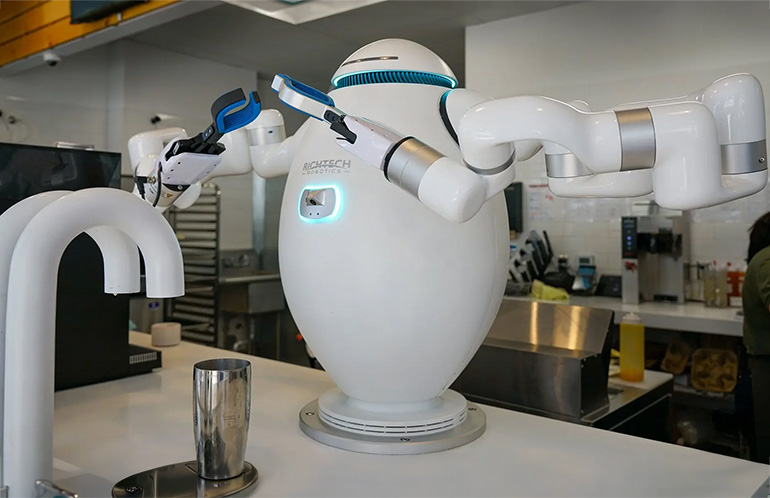
Beyond hardware and AI, the development of integrated software ecosystems and communication networks is accelerating humanoid robotics innovation. Richtech Robotics’ ADAM platform, powered by NVIDIA Isaac and Jetson Thor, exemplifies this by enabling real-time, low-latency embodied AI interactions through a 24/7 interactive livestream, fostering continuous learning from unpredictable human inputs. Similarly, PNDbotics’ full-stack in-house development and proprietary high-bandwidth PND-Network support multi-robot collaboration and large-scale deployment, underscoring the importance of seamless hardware-software integration for practical, scalable humanoid applications.



Big Tech Bets on Embodied AI
OpenAI, Hyundai, and cloud giants are driving a new era of humanoid robots, fusing AI expertise with industrial partnerships to move robotics from hype to high-stakes infrastructure and factory deployment.
By early 2026, Boston Dynamics' cautious public debut of the Atlas humanoid robot at CES, co-located with parent company Hyundai, marked a pivotal shift from secretive development to pragmatic industrial engagement. Their well-rehearsed, controlled demonstration underscored a strategic move to build credibility amid skepticism, emphasizing practical manufacturing integration rather than hype. This collaboration signals Hyundai's commitment to embedding advanced robotics into its production lines, reflecting a broader industry trend toward transparent, application-focused partnerships.
OpenAI’s establishment of an in-house robotics team led by Aditya Ramesh, formerly of the SORA video research group, represents a strategic consolidation of AI expertise aimed at developing embodied robots to support skilled infrastructure workers. This initiative revives ambitions akin to the Stargate project, targeting deployment in data center construction and maintenance, and aligns with visionary goals from leaders like Sam Altman and Elon Musk who foresee humanoid robots as essential for large-scale infrastructure projects such as orbital Dyson swarms. The projected market potential for such physical robots surpasses that of GPUs due to their longevity and full-stack integration possibilities.
Richtech Robotics exemplifies ecosystem collaboration by integrating NVIDIA’s Jetson Thor hardware and Isaac robotics platform software to power its AI-driven humanoid, ADAM, which performs real-world tasks like serving drinks and preparing food. Their innovative 24/7 interactive livestream model fosters continuous global user engagement, creating a dynamic feedback loop that enhances embodied AI capabilities. Moreover, Richtech’s strategic partnerships with cloud giants like Microsoft Azure facilitate scalable industrial deployment, demonstrating how unified development platforms can standardize and accelerate humanoid robotics beyond experimental stages.
The tripartite alliance among Boston Dynamics, Hyundai, and Google DeepMind epitomizes a powerful fusion of cutting-edge AI software with robust robotic hardware, accelerating humanoid robot innovation for industrial applications. This collaboration not only propels deployment but also nurtures a broader robotics ecosystem, supporting startups such as Neura Robotics and fostering technological spillovers. Complementing this, Siemens’ comprehensive automation infrastructure—including digital twins, AI-enabled sensing, and integrated control systems—enables seamless integration of humanoid robots into complex factory environments, as evidenced by large-scale deployments like Jack Technology’s 2,000-robot order for apparel manufacturing and ANYbotics’ autonomous inspection robots in hazardous settings.


Factories Embrace Humanlike Machines
Robots such as Figure 02 and Apptronik’s Apollo are proving their worth on assembly lines and logistics floors, with China’s aggressive rollout highlighting both rapid progress and persistent skill limitations.
By mid-2026, humanoid robots have transitioned from experimental prototypes to active participants in diverse industrial settings, demonstrating tangible benefits in sectors ranging from automotive manufacturing to logistics. For instance, Figure’s 11-month deployment at BMW’s Spartanburg plant saw its Figure 02 robots efficiently load over 90,000 parts during 10-hour shifts, contributing to the assembly of more than 30,000 X3 vehicles, while GXO pioneered live humanoid robot trials in logistics facilities. This shift underscores the growing confidence in humanoid robotics to augment human labor in environments originally designed for people.
The humanoid form factor emerges as a critical enabler for seamless integration into existing human-centric industrial workflows, allowing robots like Apptronik’s Apollo and Agility’s Digit to perform dexterous tasks such as box loading and automotive part sequencing without requiring costly factory retrofits. Apptronik’s Apollo, deployed on Mercedes-Benz assembly lines, exemplifies this versatility by undertaking monotonous tasks that enhance operational efficiency and worker satisfaction. As Brian Ringley from Apptronik emphasizes, the design philosophy prioritizes utility and clear functional identity over anthropomorphic aesthetics, aiming for robots that are perceived as practical factory tools rather than humanoid curiosities.
China’s aggressive push toward humanoid robot deployment in garment factories highlights both the promise and current limitations of this technology in specialized industrial contexts. Robots like Aitu have achieved a 97% success rate in fabric handling and improved sewing quality to over 98%, with economic payback projected within 18 months. However, as Lou Lingtong notes, these humanoids currently excel at discrete repetitive tasks rather than full production flows, necessitating ongoing real-world training and data acquisition. Supported by government initiatives aiming for 10,000-unit scale deployment by the end of 2026, China is also cultivating a workforce skilled in robot maintenance and development, anticipating new job creation alongside automation.
Large-scale deployments in apparel manufacturing and electronics logistics further illustrate the operational maturity of humanoid robots, with companies like Jack Technology ordering 2,000 units to boost efficiency by at least 30%. Trials at Siemens’ electronics plant demonstrated Alpha robots autonomously moving 60 crates per hour with over 90% success during 8+ hour shifts, showcasing reliable integration with human workflows. Complementing humanoids, robotic dogs such as ANYmal enhance safety in hazardous environments by autonomously performing inspections using infrared and acoustic sensors. Siemens’ comprehensive digital infrastructure, including digital twins and AI-enabled sensing, facilitates real-time data exchange and synchronization between robots, human operators, and production systems, underscoring the importance of deep system integration for effective industrial deployment.


Orchestration Unlocks Robot Synergy
AI-driven orchestration platforms and digital twins are making it possible for diverse robot fleets to collaborate seamlessly, tackling complex, variable manufacturing tasks that once defied automation.
By mid-2026, AI-driven orchestration platforms like Teradyne Robotics' PolyScope X have revolutionized humanoid and mobile robot workflows by integrating modern web technologies, containerized applications, and native ROS 2 support. These platforms enable advanced multi-threaded automation, demonstrated through coordinated mobile material flow and AI vision-guided palletizing at Automate 2026, highlighting the shift toward flexible, adaptive, and synchronized robot operations in complex industrial environments. Practical deployments such as the MiR1200 Pallet Jack and the UR AI Trainer, developed with Scale AI, showcase how simulation tools and AI-driven orchestration facilitate scalable automation across diverse tasks, from dexterous manipulation to data center cable insertion.
The collaborative ecosystem of robotics companies at Automate 2026, including Rockwell Automation with its FactoryTalk Orchestration post-OTTO Motors acquisition, Siemens leveraging NVIDIA Omniverse for synthetic data training, and Roboteon’s AI-driven orchestration software, underscores a multi-vendor approach to scalable automation. Roboteon’s platform exemplifies seamless integration across heterogeneous robot fleets and enterprise systems like SAP EWM and Microsoft Dynamics 365, employing digital twins and machine learning to optimize workflows such as picking and replenishment. This multi-faceted orchestration not only enhances operational flexibility but also accelerates automation deployment in warehousing and manufacturing settings.
AI integration is fundamentally transforming industrial robotics by enabling adaptation to variable and complex production processes that were previously infeasible with rigid programming. This evolution allows robots to handle deformable materials, such as fabric in textile processing, and partially automate intricate tasks like automotive wire harness assembly. Moreover, AI-enhanced robots are increasingly tasked with hazardous and variable operations—ranging from foundry fettling to EV battery disassembly—improving safety and productivity in environments too unpredictable for traditional automation methods.
Safety and real-world readiness remain paramount as AI-driven orchestration platforms mature; Nvidia’s Halos for Robotics introduces full stack safety systems critical for integrating humanoid robots in industrial settings. The use of digital twins and advanced kinematics not only addresses labor shortages but also preserves manufacturing knowledge, ensuring that flexible and adaptive humanoid workflows are both safe and effective. As Will Healy III emphasized, these developments represent tangible, deployable solutions that bridge the gap between AI research and factory-floor realities, laying a practical foundation for future autonomous robotic systems.


Limits of Autonomy on Display
Despite expanding into service roles and achieving high task accuracy, humanoid robots still struggle with full production autonomy, requiring ongoing human oversight and spawning new support jobs.
By mid-2026, humanoid robots are evolving beyond their traditional roles in warehouses and logistics to increasingly serve in general service sectors such as hospitality, restaurants, and even home environments, signaling a broadening application landscape. However, their industrial deployment remains focused on narrow, repetitive tasks rather than managing entire production flows, as noted by Lou Lingtong of Aitu, who emphasized that humanoids 'can perform individual processes well, but are still unable to run an entire production flow without human involvement.' This shift toward service roles highlights both the expanding ambitions and current operational limits of humanoid robotics.
Reliability and economic viability continue to be pivotal challenges for humanoid robots on the factory floor, where productivity gains must justify the investment. Aitu’s robots demonstrate promising metrics with a 97% success rate in fabric separation and over 98% sewing quality, achieving payback periods around 18 months, yet these figures underscore the high bar for widespread adoption. Concurrently, safety and hardware serviceability are critical, as exemplified by PIABOT Robotics’ G2 robot completing 2,283 error-free tasks over eight hours, illustrating the necessity for stable and repeatable performance in real-world industrial environments.
Human-robot interaction remains a significant hurdle, particularly in manipulation tasks like grasping and sorting that demand extensive real-world data and training to enhance adaptability and reliability. Facilities such as the Cixi training center provide over 90 hours of daily simulated scenarios across nine industries to address these challenges, reflecting the intensive efforts required to bridge the gap between robotic precision and human dexterity. Meanwhile, the persistent shortage of manufacturing labor is driving adoption, but rather than full replacement, humanoid robots currently fill labor gaps, simultaneously creating new roles in maintenance, debugging, and secondary development, as highlighted by Lou Lingtong and Xiong Rong.
Despite ongoing skepticism about their industrial viability, organizations continue to invest heavily in humanoid robotics, signaling sustained confidence in their long-term potential. This persistent innovation momentum suggests that while current deployments are limited in scope, the roadmap toward scalable, autonomous humanoid workforces by 2030 remains an active and evolving frontier, integrating emerging technologies like digital twins and edge computing to overcome present limitations.