Ayar labs raises $500m in AI optical push
The gist
AI’s trillion-dollar networking race is being supercharged by photonics breakthroughs, as Ayar Labs, Nvidia, and Marvell shatter hardware bottlenecks and redraw the global chip power map.
What to know
- Ayar Labs just raised $500 million at a $3.75 billion valuation, while Broadcom snagged Apple chip orders through 2031, signaling fierce competition beyond Nvidia’s turf.
- Goldman Sachs predicts AI optical networking will explode from $15 billion to $154 billion by 2028, with co-packaged optics grabbing 59% of that spend.
- Asia-Pacific and US are racing to build next-gen photonics infrastructure and advanced cooling for AI data centers, as rack densities soar past 200kW and demand hits record highs.
Photonics Shatters Bandwidth Barriers
Chipmakers are dismantling memory and cooling bottlenecks by embedding photonic chiplets and microfluidic cooling directly alongside GPUs, enabling ultra-high bandwidth AI networks that copper cabling can’t match.
Breakthroughs in advanced packaging technologies such as low-temperature hybrid copper bonding, Intel's EMIB-T roadmap, and cutting-edge RDL scaling combined with UCIe 3.0 integration are revolutionizing AI memory packaging and chip interconnects. These innovations directly tackle critical bottlenecks in memory bandwidth, cooling efficiency, and supply chain constraints, enabling AI accelerators to achieve higher performance and reliability amid escalating data center demands.
Pioneering work by Marvell and Lightmatter in photonic interconnects paired with microfluidic cooling is redefining thermal management and high-speed optical communication in AI data centers. Marvell’s fabless model, leveraging Tower Semiconductor’s advanced photonics processes, has already shipped over 5 million coherent photonic integrated circuits, underscoring the real-world deployment and scalability of optical solutions that address bandwidth and heat dissipation challenges beyond traditional electronic interconnects.
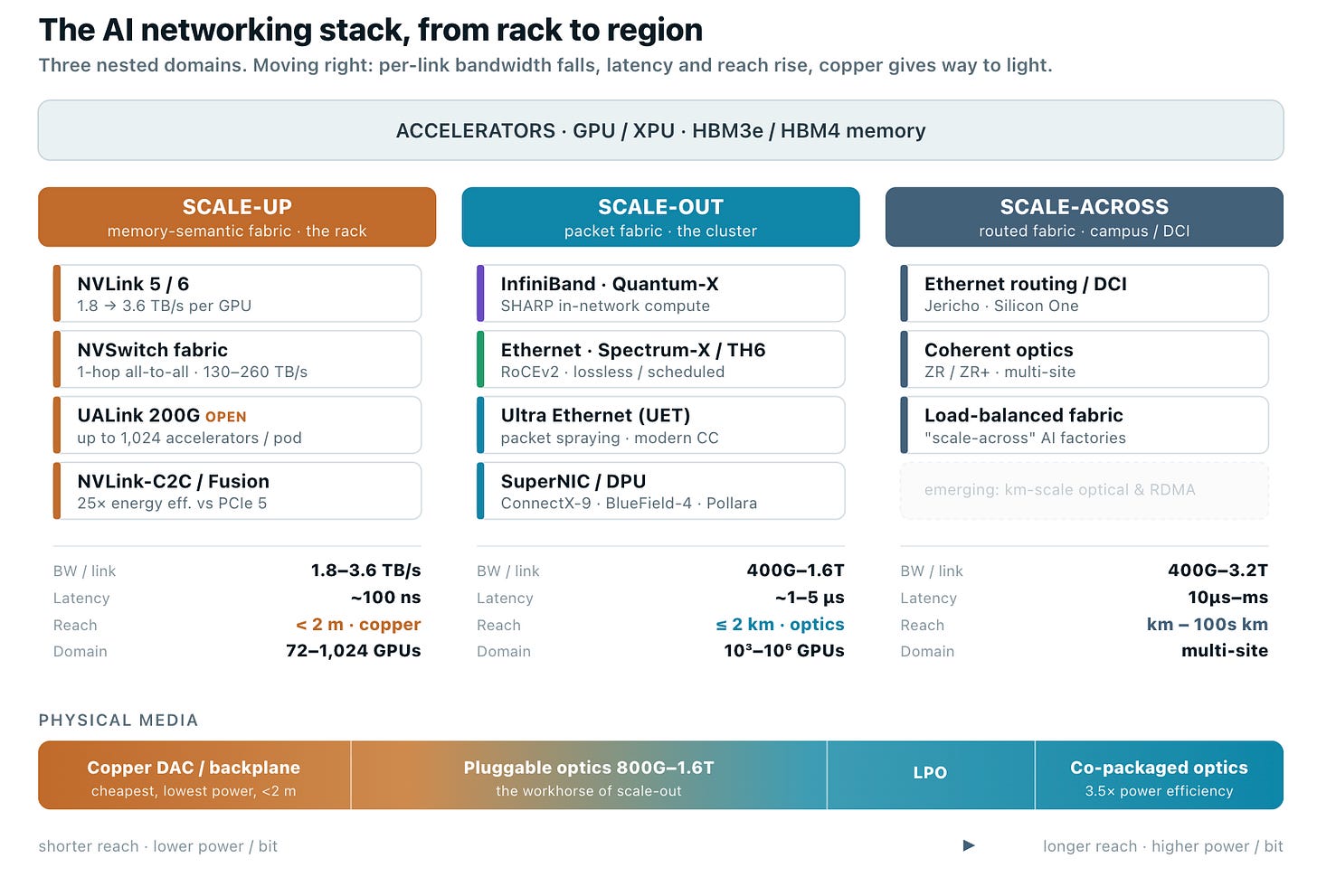
The transition from copper to optical interconnects is accelerating as physical limits of copper cabling become apparent, with Nvidia’s NVLink Fusion ecosystem strategically partnering with photonics leaders like Ayar Labs, Marvell, and Lightmatter to pioneer co-packaged optics (CPO) and hybrid bonding approaches. These architectures integrate photonic chiplets directly alongside GPUs on ASIC substrates, minimizing latency and power consumption while enabling ultra-high bandwidth scale-up networks necessary for next-generation AI workloads.
Silicon photonics is on a rapid trajectory to meet AI’s insatiable data transfer demands, with commercial 1.6-terabit transceivers already available and 6.4-terabit links projected by the early 2030s. Overcoming silicon’s intrinsic limitations through heterogeneous integration of materials like III-V compounds and lithium niobate, this technology is not only easing AI data bottlenecks but also driving a fundamental restructuring of data center architectures around optical scale-up, as evidenced by substantial investments in photonic quantum computing surpassing superconducting approaches.


AI Hardware’s $1 Trillion Power Shift
Soaring AI chip demand is redrawing the semiconductor landscape as memory giants and new photonics startups seize investor attention, driving up valuations and fueling a high-stakes battle for market dominance far beyond Nvidia.
The AI hardware investment landscape is rapidly diversifying beyond established giants like Nvidia, as exemplified by Ayar Labs' recent $500 million funding round that valued the company at $3.75 billion, signaling robust investor appetite for emerging semiconductor innovators. Concurrently, Broadcom's securing of Apple ASIC orders through 2031 underscores a strategic expansion in AI chip and data center networking supply, reflecting a competitive reshaping of market leadership and investor confidence in players extending beyond Nvidia's dominance.
Investor focus is increasingly concentrated on memory chip manufacturers such as Micron, Samsung, and SK Hynix, whose market capitalizations have soared past $1 trillion amid acute HBM and DRAM shortages that grant them significant pricing power. This shift is driven by the soaring costs of AI token consumption, which have forced companies to reallocate budgets—often at the expense of payroll—to sustain AI infrastructure investments, highlighting memory as a critical bottleneck in the AI hardware ecosystem.
The AI data center market is undergoing a staggering $1 trillion arms race fueled by hyperscalers and specialized players, with Nvidia dominating the networking fabric stack and driving explosive revenue growth—its Q1 FY2027 revenue surged 85% year-over-year to $81.6 billion. This momentum is mirrored by other semiconductor leaders like Broadcom, AMD, and Micron, whose revenues have soared due to AI demand, while supply constraints are paradoxically viewed as bullish indicators of sustained capital expenditure and market expansion.
Goldman Sachs projects optical networking as AI's next trillion-dollar opportunity, forecasting the market to balloon from $15 billion to $154 billion by 2028, with co-packaged optics alone expected to capture 59% ($91 billion) of AI networking spend. Companies like Lumentum stand to gain disproportionately due to their pure-play focus on optical communications, supplying critical lasers and photonic components, while networking content per computing unit in Nvidia’s AI systems is set to increase nearly 29-fold, underscoring the escalating strategic importance of optical interconnects in next-generation AI hardware.
Asia-Pacific’s Liquid-Cooled AI Leap
Asia-Pacific data centers are leapfrogging traditional designs with direct-to-chip liquid cooling and low-latency optical networks, setting new benchmarks for power density and efficiency as the region races the US in next-gen AI infrastructure.
Asia-Pacific is rapidly advancing its AI network infrastructure with a strong emphasis on low-latency optical backbones and cross-border coordination, led by major players like China Mobile and Huawei. This regional push, highlighted by GSMA, aims to support surging AI data demands through strategic collaboration, positioning the Asia-Pacific as a critical hub for next-generation photonics development alongside the US.
By 2026, the explosive growth in AI inference workloads is transforming enterprise AI factories and data center strategies, making power-efficient optical networking the new frontline in managing costs, scaling capacity, and maximizing token throughput. Both Asia-Pacific and US hubs are investing heavily in these advanced optical technologies, recognizing that upgrading networking infrastructure is essential to maintaining a competitive edge in the intensifying AI hardware arms race.
To sustain the escalating rack densities driven by AI workloads, Asia-Pacific data centers like BDC in South Asia are pioneering direct-to-chip liquid cooling solutions, currently managing 90 megawatts of capacity with this technology. With rack densities soaring from 10kW to over 100kW and next-generation Fire Rubin racks projected to exceed 200kW, this shift from traditional air cooling to advanced liquid cooling is critical for maintaining performance and efficiency in next-gen AI data centers.