Azure rockets past $100b, but margin squeeze worries investors
The gist
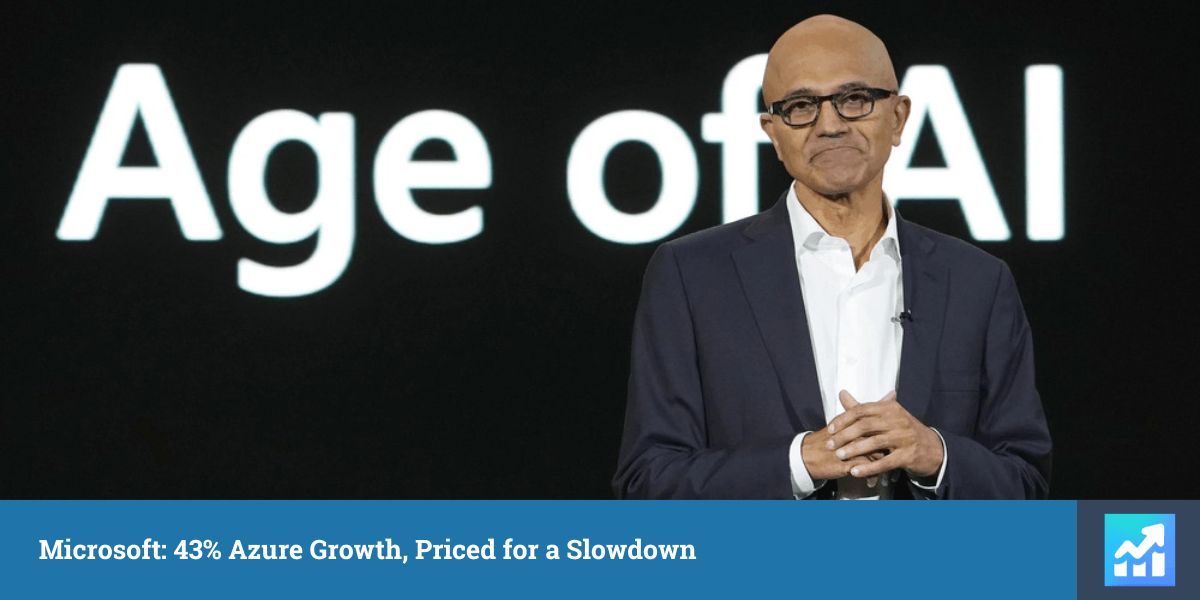
Microsoft Azure has rocketed past $100 billion in annual revenue—fueling record cloud earnings—but investors are sweating as massive AI infrastructure spending squeezes margins.
What to know
- Azure revenue soared 41-43% year-over-year, driving Microsoft Cloud to a whopping $214 billion in sales.
- Microsoft is pouring cash into AI and data centers, with capex jumping 70% to $41 billion and set to top $50 billion next quarter.
- Despite hefty growth, free cash flow margins have slid from 29% to 20%, sparking debate over how long the cloud AI supercycle can keep paying off.
Azure’s Growth Engine Unleashed
Azure’s explosive revenue surge is underpinned by a record $678 billion backlog and an aggressive global data center buildout, locking in future double-digit growth even as demand outpaces supply.
Microsoft Azure has achieved a landmark milestone by surpassing $100 billion in annual revenue, driven by an impressive 41-43% year-over-year growth rate that marks its fastest expansion in four years. This robust cloud and AI-driven momentum significantly contributed to Microsoft Cloud's overall revenue of approximately $214 billion, which grew 27% year-over-year, underscoring Azure's pivotal role in the company’s fiscal success. CFO Amy Hood highlighted that new capacity investments are quickly monetized within the quarter, reinforcing strong future revenue visibility amid accelerating demand that continues to outpace supply.
Microsoft's fiscal year 2026 results reflect a strong financial performance with total revenue reaching $331.8 billion, an 18% increase year-over-year, and operating income climbing 21% to $155.2 billion, yielding a resilient operating margin of 46.8%. Adjusted earnings per share rose to $4.74, surpassing expectations, while GAAP diluted EPS grew 32% to $17.95, signaling robust profitability alongside rapid cloud expansion. Despite this, capital expenditures surged dramatically—up 70% to $41 billion in Q4 and expected to exceed $50 billion next quarter—reflecting aggressive investments in AI infrastructure and data center capacity expansion, which are critical to sustaining Azure's growth trajectory.
Future revenue visibility is exceptionally strong, supported by a massive contracted backlog—Microsoft’s commercial remaining performance obligation soared 84% to $678 billion with a weighted duration of 2.3 years—providing a solid foundation for sustained growth. This backlog, combined with rapid capacity expansion including 88 new data centers added globally in FY26 and plans to double capacity within two years, positions Microsoft to meet soaring customer demand that currently exceeds supply. CFO Amy Hood emphasized the company's ability to swiftly monetize efficiency gains, further enhancing near-term revenue realization and reinforcing confidence in continued double-digit growth into FY27.






AI Model Marketplace Power Play
Microsoft’s neutral, multi-model AI platform and custom silicon are attracting major enterprise adoption, fueling new monetization streams and expanding its cloud dominance beyond traditional licensing.
Microsoft’s multi-model AI strategy is a cornerstone of its cloud and AI growth, offering enterprises access to over 11,000 interchangeable models from providers such as OpenAI, Anthropic, Mistral, xAI, and its own MAI family. This approach, emphasized by Satya Nadella, positions Microsoft Azure as a neutral platform where enterprises can avoid vendor lock-in by selecting models based on quality, latency, cost, and compliance, while retaining control over their data. The strategy also integrates proprietary AI hardware like the Maia 200 accelerator, delivering up to 40% better performance per watt and significantly reducing operating costs, which enhances both efficiency and competitive positioning in AI cloud services.
Rapid adoption of AI-driven products such as Microsoft 365 Copilot underscores strong market traction and enterprise integration, with paid seats surpassing 30 million and net seat additions more than doubling quarter-over-quarter. Major enterprises including NHS England, KPMG, HSBC, and AstraZeneca have deployed tens of thousands of seats, while user satisfaction has doubled to an all-time high. This momentum is supported by evolving monetization models that combine traditional per-seat licensing with innovative usage-based billing, exemplified by GitHub Copilot’s 60% quarter-over-quarter revenue acceleration, which expands Microsoft’s total addressable market and enables more granular enterprise consumption.
Microsoft is rapidly scaling its AI tooling ecosystem and infrastructure to meet surging demand, with its Foundry platform now serving 100,000 customers and doubling revenue year-over-year while processing over one trillion tokens annually—a fourfold increase. The company has added 31 new data centers in the latest quarter alone, on track to double total capacity within two years, and has cut GPU dock-to-live time by nearly 50%, maximizing hardware utilization. This vertical integration of AI models, proprietary silicon, cloud infrastructure, and AI-powered applications like Agent 365 and Web IQ reflects a comprehensive strategy to capture value as enterprises transition from AI experimentation to large-scale adoption.
Microsoft’s Model Context Protocol (MCP) exemplifies its sophisticated AI architecture by connecting AI agents to enterprise business systems with governed data models, rules, permissions, and audit trails. This separation of harness, context, memory, and action space from any single AI model family allows enterprises to deploy substitutable models tailored to specific tasks across sales, finance, supply chain, HR, and customer service. Such innovation not only enhances operational control and compliance but also reinforces Microsoft’s position as a platform enabling enterprises to orchestrate AI at scale with flexibility and security.


Capex Supercycle Squeezes Margins
Microsoft’s unprecedented $50 billion AI infrastructure spend is compressing free cash flow and returns on capital, forcing a delicate balance between rapid expansion and capital efficiency.
Microsoft’s aggressive AI infrastructure expansion has driven capital expenditures to a historic $41 billion in FY26, surging 70% year-over-year and expected to exceed $50 billion in Q1 FY27 alone, as the company races to double its data center capacity within two years to meet soaring Azure demand that still outpaces supply. CFO Amy Hood highlights that efficiency gains are quickly monetized within the same quarter, helping to partially offset the margin pressures from this capital-intensive growth, yet the challenge remains balancing rapid scaling with cost control amid unprecedented investment levels.
Despite robust revenue growth—Azure up 43% and Microsoft Cloud revenue increasing 27%—Microsoft faces notable margin compression as capital expenditures now consume roughly 35% of revenue, nearly doubling the historical average of 18.3%. This capex supercycle has squeezed free cash flow margins from around 29% to approximately 20%, while returns on invested capital have declined from about 30% to 22.7% since 2022, reflecting the rapid buildout of data centers outpacing AI revenue realization and raising concerns about near-term capital efficiency and potential misallocation risks if AI growth slows.
Microsoft’s vertical integration strategy, exemplified by its custom Maia AI accelerators delivering a 40% power efficiency gain over off-the-shelf GPUs, is a critical lever for managing operating costs and sustaining margins amid the capital-intensive AI infrastructure buildout. CEO Satya Nadella emphasizes that these efficiency improvements translate into tens of millions in avoided expenses as inference workloads scale, enabling Microsoft to undercut competitors on price while maintaining gross margins. This silicon-software-cloud synergy underpins expectations for positive free cash flow in fiscal 2027 despite ongoing heavy investment.
Operationally, Microsoft maintains a strong operating margin near 45% through disciplined expense control, workforce optimization, and improved resource utilization, even as AI infrastructure costs—GPUs, power, data center depreciation—compress gross margins from 68% to 65%. Strategic accounting changes, such as extending data center depreciation from 15 to 25 years and reclassifying some leases, further reduce short-term expenses and bolster GAAP operating income. Meanwhile, Microsoft’s deliberate allocation of limited GPU capacity across Azure, GitHub Copilot, M365 Copilot, and internal R&D reflects a long-term focus on sustainable AI growth, balancing immediate revenue acceleration with future proprietary model development ahead of OpenAI IP expiration in 2032.

Investor Faith Meets Margin Jitters
Despite blockbuster Azure gains and a disciplined capex strategy, Microsoft’s stock lags as investors weigh near-term margin compression against the long-term payoff of its AI and cloud bets.
Investor sentiment toward Microsoft's AI and cloud investments has been broadly positive, buoyed by strong Azure revenue growth—43% year-over-year—and better-than-expected earnings that triggered a 9% after-hours stock jump. Confidence is further reinforced by CFO Amy Hood's assurance that efficiency gains from the $41 billion AI infrastructure spend are quickly monetized, with expectations for Azure growth to accelerate to roughly 45% next quarter despite capital expenditures climbing above $50 billion. This optimism is tempered by a cautious stance among some investors awaiting clearer returns from large strategic bets like the $70 billion Activision Blizzard acquisition, reflecting a balance between enthusiasm for Microsoft's multi-model AI platform strategy and prudence on timing of payoffs.
Despite strong growth metrics, Microsoft's stock price has declined 11% over the past year, signaling investor concerns about the heavy capital expenditure cycle compressing free cash flow margins from an average of 29% down to approximately 20%. The market has de-rated the stock to 23.9x forward earnings, well below its five-year average of 29.8x, even as forward EPS estimates rose 23%, indicating that investors are pricing in risks related to the sustainability of AI infrastructure spending and its impact on profitability. Returns on capital have also declined, with ROIC falling from around 30% to 22.7%, as data center investments outpace AI revenue growth, raising questions about near-term profitability and margin stability.
Microsoft's disciplined capital expenditure approach, contrasted with peers like Alphabet and Meta, has earned investor respect for focusing on investment returns rather than engaging in an arms race, which supports a more sustainable growth narrative. The company’s strategic allocation of cloud capacity—balancing internal R&D with product lines such as GitHub Copilot and M365 Copilot—creates a temporary tradeoff in Azure revenue growth, which some investors scrutinize amid high AI investment. While cloud revenue growth has slowed to around 38%, below market expectations, analysts view this as a deliberate, long-term R&D investment positioning Microsoft for AI and cloud leadership by 2032.
Investor concerns also focus on Microsoft’s growing dependency on its OpenAI partnership, which drives 82% of future revenue commitments growth but introduces concentration risk given OpenAI’s current lack of profitability. Although Microsoft’s free cash flow has declined by 23%, it remains positive—a notable contrast to competitors like Google and Amazon whose free cash flow turned negative this quarter—supporting a relatively favorable investor sentiment. This nuanced view acknowledges Microsoft’s management of AI-related risks better than other tech giants, balancing strong AI revenue streams with margin pressures and capital intensity.