Billionaires push back on wealth tax criticism
The gist
America’s billionaire class is fighting back against calls for higher taxes, sparking a high-stakes clash over wealth, fairness, and the future of economic power.
What to know
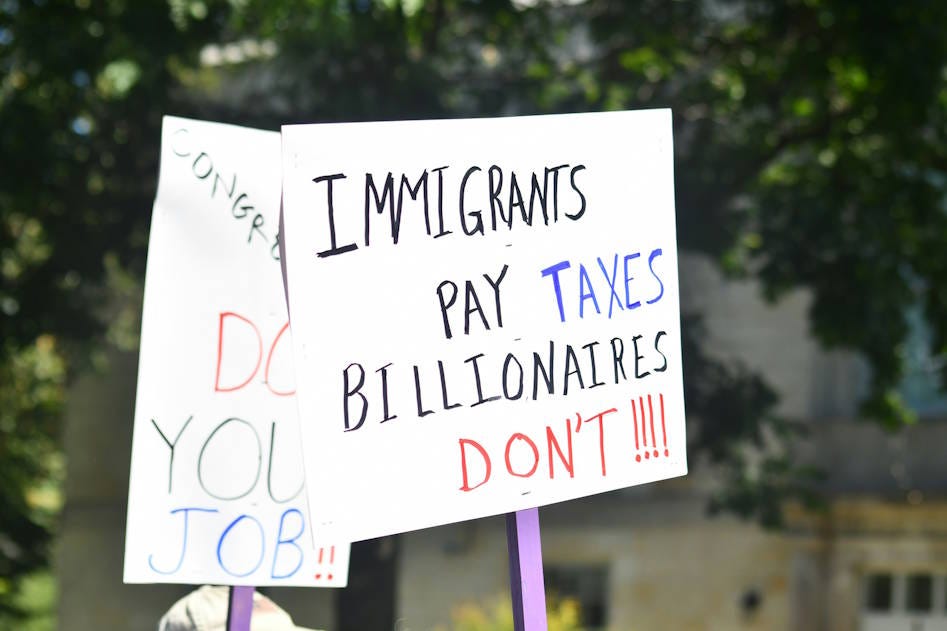
- Billionaires like Jeff Bezos and Steve Roth argue they're already major economic contributors and denounce wealth taxes as bad policy, while critics point out their effective tax rates can be as low as 8.2%.
- Current loopholes like the step-up in basis at death and favorable capital gains treatment let the richest 10% control 68.3% of U.S. assets, intensifying historic wealth inequality.
- Political and economic roadblocks—including fears of capital flight and AI-fueled job losses—are complicating efforts to implement billionaire taxes, even as public anger reaches a boiling point.
Billionaires Fight Back
Jeff Bezos and Steve Roth counter accusations of tax dodging by reframing billionaires as economic engines and philanthropists, arguing that targeting their wealth is both unfair and economically misguided.
Billionaires like Steve Roth vocally oppose the rhetoric encapsulated by phrases such as 'tax the rich,' equating it to hate speech that offends him as deeply as racial slurs. Roth defends the economic and philanthropic contributions of billionaires, highlighting that the top 1 percent pay 50 percent of New York’s income taxes and serve as major employers. He criticizes targeted tax policies like New York’s pied-à-terre tax, viewing them as irresponsible political gestures that unfairly single out wealthy individuals such as Ken Griffin, whom he defends against what he sees as vilification.
Jeff Bezos challenges common narratives about billionaire tax avoidance, calling the 'buy, borrow, die' strategy a myth and emphasizing that he pays taxes on Amazon’s sales. While supporting tax reform, Bezos shifts the focus from increasing taxes on the wealthy to addressing broader systemic issues such as government inefficiency and wasteful spending. He argues that doubling his own taxes would not materially help low earners, advocating instead for zero federal income taxes on the bottom 50 percent of Americans, and supports targeted levies like New York’s pied-à-terre tax as reasonable, cautioning against broad wealth taxes that could stifle economic activity.
Both Roth and Bezos frame billionaires not as villains but as essential contributors to economic vitality and social good. Bezos explicitly defends figures like Ken Griffin, asserting they have not harmed communities but rather bolstered them, while Roth underscores the philanthropic roles of the wealthy. This defense is coupled with a broader ideological stance favoring low tax rates, especially for lower-income groups, with Bezos advocating tax cuts for lower earners and highlighting technological innovation, such as AI, as a driver of economic growth that can reduce the need for increased taxation on the rich.
Despite their public defenses of low taxation, the effective tax rates paid by billionaires often remain substantially lower than those of average wage earners, a disparity that critics highlight but defenders like Roth tend to omit. A 2021 White House study found the top 400 billionaire families paid an effective federal tax rate of just 8.2 percent, compared to 13 percent for the average American taxpayer, largely due to favorable capital gains and dividend tax treatments. This tax structure underpins much of the billionaires’ opposition to wealth taxes, which they argue are misguided and economically harmful.





Loopholes Fuel the Divide
Tax policies like the step-up in basis and capital gains breaks let the ultra-wealthy accumulate assets virtually untaxed, driving a historic surge in wealth concentration and leaving most Americans further behind.
Critics argue that current tax policies fundamentally exacerbate wealth inequality by allowing asset owners to accumulate wealth largely untaxed, in stark contrast to wage earners who face annual income taxes. As highlighted in the analysis of New York’s pied-à-terre tax, assets grow tax-deferred while workers’ income is clipped by 30-40% annually, enabling a class of 'super owners' to amass wealth unchecked. Targeted measures like New York’s second-home tax cleverly hit a narrow segment of the wealthy but fail to address the broader concentration of billionaire wealth held by figures such as Elon Musk and Jeff Bezos, leaving the core problem of tax avoidance largely intact.
A major loophole perpetuating historic wealth transfer is the step-up in basis at death, which critics call an 'obvious and graceful solution' to end, as it allows the ultra-wealthy to avoid capital gains taxes indefinitely by passing assets to heirs without triggering tax events. This mechanism, combined with lax enforcement and a tax system that has seen inheritance and top income tax rates slashed since the 1980s—from post-WWII highs of up to 90% to much lower levels today—has fueled an unprecedented concentration of wealth. As one critic notes, this rollback has revived a millennia-old pattern where a tiny elite controls the vast majority of resources, reversing the mid-20th century’s 'golden age of capitalism' that supported a robust middle class.
The growing wealth gap is starkly illustrated by data showing the richest 10% now owning 68.3% of U.S. assets, up 8 percentage points since 1990, while the bottom 90% hold just 31.7%. Stock ownership is similarly concentrated, with the top decile controlling 87% of all stocks, meaning that booming markets largely benefit the ultra-wealthy rather than the majority. Meanwhile, systemic barriers such as rising student debt, scarce entry-level jobs, and soaring real estate prices trap lower-income Americans in economic fragility, forcing reliance on family support and credit. This K-shaped economy deepens inequality as younger, low-income, and Black adults face declining financial stability, underscoring the inadequacy of current policies to bridge these divides.
Critics emphasize that meaningful billionaire tax reform requires national-level policies that can close loopholes, prevent tax flight, and fund robust IRS enforcement to counteract the billionaire class’s economic rigging. While local initiatives like New York’s pied-à-terre tax target visible symbols of wealth, they risk alienating key taxpayers who contribute disproportionately to public coffers—Whitney Tilson notes that 1% of NYC taxpayers pay 47% of the city’s income tax—and may inadvertently drive away vital economic engines such as Wall Street. Thus, aggressive wealth and estate taxation, paired with strengthened enforcement, is viewed as the only viable defense for ordinary families’ financial futures amid rising public anger and the complex challenges posed by AI-driven economic disruptions.



AI and Anger Reshape the Debate
As AI-driven job losses and public outrage intensify, political efforts to tax billionaires face resistance from fears of capital flight and the growing influence of tech elites over both the economy and policy.
Implementing billionaire taxes faces significant political and economic hurdles, as illustrated by California's one-time 5% billionaire tax which Noah Smith critiques for its funding instability and risk of billionaire migration, echoing concerns raised by Tom Steyer about balancing inequality reduction with maintaining California's role as an innovation hub. This tension underscores the delicate political calculus where states must weigh the benefits of taxing extreme wealth against potential capital flight and economic disruption, a challenge compounded by billionaires’ quasi-sovereign influence on global monetary policy and democratic norms by 2026.
Public anger over widening wealth inequality, fueled by a K-shaped economy where lower-income Americans face stagnant wages and rising debt while wealthier households continue discretionary spending, intensifies the social pressure for billionaire tax reforms but also complicates political consensus. Heather Long’s observation that 'Americans are literally getting squeezed' captures the emotional and financial strain felt by many, yet this resentment, if driven solely by anger as analysts warn, risks undermining pragmatic policy design and effective implementation.
The rapid economic disruption wrought by AI-driven automation exacerbates wealth inequality by displacing upper-middle income workers without offering higher-paying alternatives, concentrating wealth among a small elite with privileged access to lucrative private AI companies. This dynamic, highlighted by Anthropic’s analysis of exclusive venture capital circles and Larry Fink’s warning of a fracturing global capitalism favoring capital over labor, deepens social divides and heightens political challenges in crafting billionaire tax policies that can effectively address these structural inequities.
The political and social landscape for billionaire tax reforms is further complicated by deep social divides and cultural fragmentation, as seen in stark contrasts between affluent enclaves like Greenwich, Connecticut, and nearby struggling communities, fueling populist resentment and skepticism toward government authority. Voices warning of a potential revolutionary tipping point in America reflect widespread perceptions of systemic economic oppression and intimidation-based power, underscoring that successful tax reform will require overcoming not only technical design flaws but also profound societal mistrust and polarization.