Bitcoin’s power law: from volatile bet to timeless bedrock of economic integrity
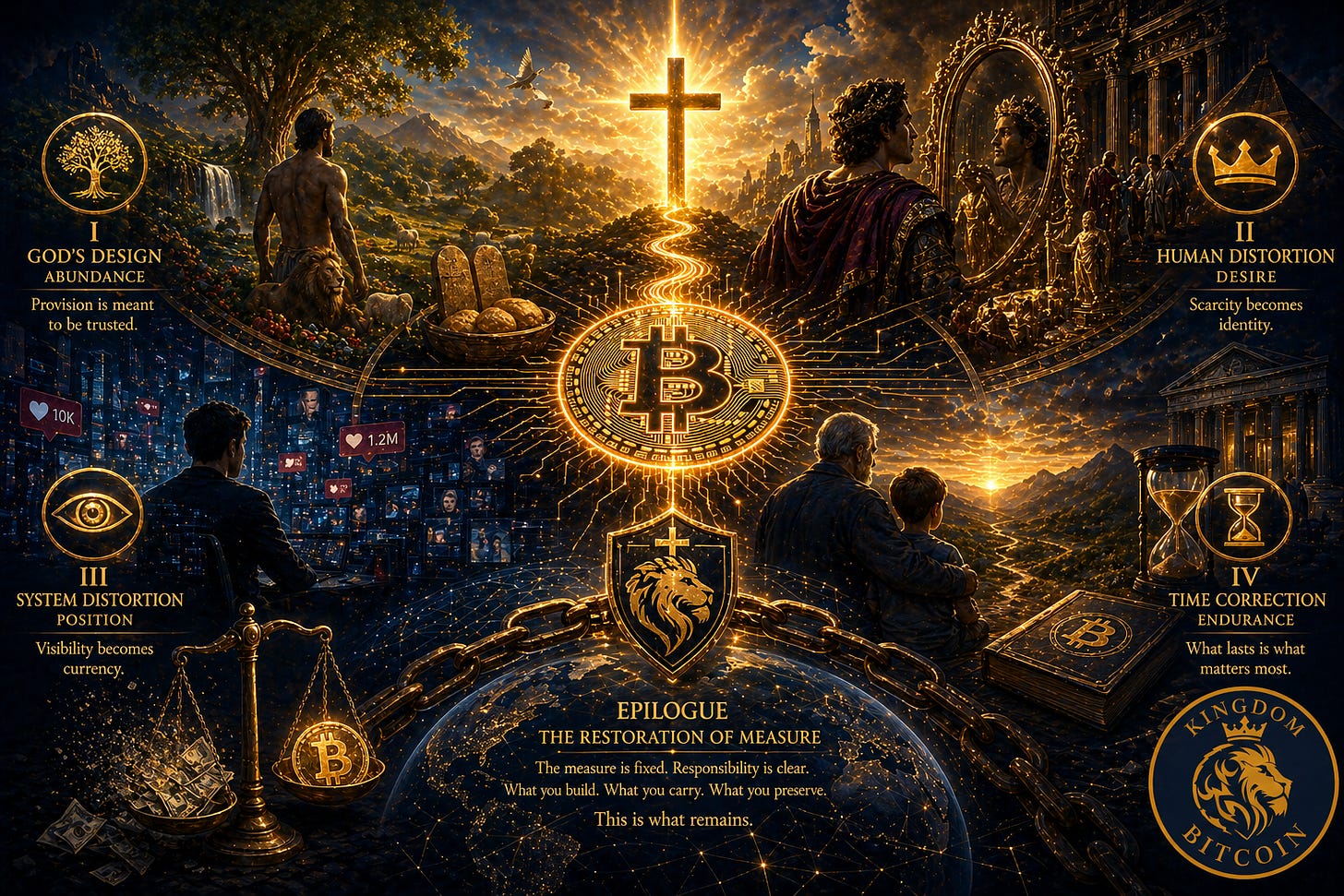
The gist
Bitcoin isn’t just surviving market mayhem—it’s scientifically proven, morally grounded, and redefining what it means to build generational wealth.
What to know
- By early 2026, the Scientific Bitcoin Institute validated Bitcoin's adherence to a universal 'Power Law,' shifting its analysis from speculation to rigorous science.
- Bitcoin’s fixed supply and rule-based system now anchor a movement from short-term price chasing to long-term stewardship and personal sovereignty.
- Despite making up only a quarter of one percent of global wealth, Bitcoin’s resilience through regulatory attacks and financial crises positions it as the new bedrock for honest economic value.
Conviction Over Speculation
Bitcoin’s scientific validation as a power law asset shifts its appeal from price speculation to a test of personal conviction and generational sovereignty.
By early 2026, the Scientific Bitcoin Institute's work to quantify Bitcoin's adherence to a 'Power Law'—a mathematical pattern observable in phenomena from city populations to planetary orbits—has elevated Bitcoin analysis from speculative guesswork to rigorous science. This mathematical inevitability underpins Bitcoin's superiority as a long-term store of value compared to traditional assets like gold, reinforcing the need for long-term conviction. As George emphasizes, such conviction is not born from short-term market trends but forged through a 'crazy lifetime of experience' across multiple cycles, where persistence—'just putting one foot in front of the other' during difficult times—is the ultimate tool for embracing Bitcoin's foundational principles.
Beyond its mathematical framework, Bitcoin embodies a profound moral choice centered on ownership and generational sovereignty, allowing individuals to opt out of flawed fiat systems. As articulated in the 2026 opinion piece, 'The price is not the point. Ownership is the point,' highlighting Bitcoin's role in transforming holders from 'forced consumers' into 'voluntary builders' who secure enduring value for their families and future generations. This shift from transient price speculation to steadfast ownership underscores Bitcoin's unique position as both a financial and ethical foundation for those seeking lasting autonomy.

The Morality of Measurement
Bitcoin’s honest unit of account reintroduces the ethical imperative of fair measurement, challenging the corrosive injustice embedded in fiat money systems.
By early 2026, it became clear that stable and honest measurement of value is essential for societal trust and fairness, as unstable fiat currencies distort true worth and undermine economic justice. Without a fixed unit of account, economic signals become ambiguous, leaving individuals confused and unable to effectively save or plan, as the value of their efforts erodes unpredictably. This instability in measurement not only disrupts personal financial security but also corrodes the foundational trust necessary for a just economy.
The ethical dimension of honest measurement is deeply rooted in timeless principles, with biblical scripture underscoring the moral imperative of using accurate weights and measures. Proverbs 11:1 explicitly condemns dishonest scales, framing economic fairness as a matter of righteousness. This connection highlights that corruption in measurement systems is not merely a technical flaw but a profound injustice that distorts outcomes and violates enduring ethical standards.
Bitcoin emerges as a powerful tool to escape the corrupt fiat economy by offering sound money that preserves real value and resists counterfeit prices and fake debt. As articulated in May 2026, this shift is not just monetary but cultural, challenging the pervasive fiat ethics that have normalized destructive economic behaviors for generations. By promoting genuine value creation, Bitcoin confronts the entrenched fiat culture and provides a pathway toward restoring economic justice.
Restoring sound money and economic sanity is a gradual, deeply personal process akin to recovering from a mass delusion, requiring individuals to reclaim their financial sanity one at a time. Drawing on Charles Mackay’s 1841 insights from 'Extraordinary Popular Delusions and the Madness of Crowds,' this perspective emphasizes personal responsibility in rejecting the flawed fiat system and embracing the discipline of sound money, underscoring that systemic change begins with individual awakening.


Stewardship Across Centuries
True wealth endures through patient stewardship and integrity, with Bitcoin serving as a vehicle for values that outlast manufactured scarcity and fleeting trends.
True endurance in value fundamentally differs from manufactured rarity, as it is revealed and tested over time rather than constructed or marketed. By early 2026, analyses such as "The Scarcity Paradox | Part IV — The 400-Year Horizon" emphasized that while rarity can be artificially created, endurance demands patience and discipline across generations, shifting value toward intangible qualities like trust, wisdom, and relational responsibility. This shift underscores that as technological abundance grows, the scarce and valuable assets become those that cannot be rapidly replicated or commoditized, necessitating stewardship that transcends immediate gratification.
Long-term stewardship requires a radical departure from the present-focused optimization prevalent in modern culture, demanding patience, discipline, and a commitment to outcomes beyond one's lifetime. Drawing on scriptural teachings such as Proverbs’ call to leave an inheritance to children’s children, stewardship is framed not merely as financial inheritance but as the transmission of wisdom, character, and responsibility. This 400-year horizon compels decisions measured by integrity and continuity rather than short-term returns, positioning wealth as a tool and stewardship as a test of faithfulness within a stable measure.
Bitcoin emerges as a pivotal tool in this framework of long-term stewardship by introducing a fixed, predictable supply and immutable rules that restore integrity to the measure of value. Unlike traditional financial systems that encourage constant motion and consumption, Bitcoin rewards patience, conviction, and self-custody, aligning closely with enduring principles rather than replacing them. As noted in the 2026 epilogue "The Restoration of Measure," Bitcoin removes distortions that have historically eroded value, offering a stable monetary framework essential for preserving honest wealth and clarifying relational responsibility across generations.
The scarcity paradox ultimately reveals that manufactured rarity alone is insufficient without moral discipline and faith-based stewardship to preserve honest value over time. As articulated in "The Weight of Leadership | The Stewardship Test," the greatest threat to wealth is undisciplined stewardship rather than external forces like taxation. Stewardship is not about scale or rapid growth but about faithfulness within the measure given, emphasizing that wealth should never possess its owner but serve as a magnifier of responsibility, requiring patience and relational accountability across generations.
Integrity as Leadership Currency
Leadership in the Bitcoin era is earned through relentless authenticity, personal discipline, and the refusal to shortcut principles—even in obscurity.
Leadership integrity is forged through relentless authenticity and moral discipline, demonstrated by consistently doing the right thing even when unobserved. As emphasized in a May 2026 interview, true success demands daily commitment without shortcuts, embodying principles over time rather than seeking overnight results. This foundation of personal integrity is echoed by leaders at UTA who stress leading by example, practicing what they preach, and cultivating trust through honesty and difficult conversations, which are essential for genuine engagement and sustained influence.
Effective stewardship in leadership balances inclusive decision-making with ultimate accountability, fostering a culture where diverse perspectives are valued but responsibility remains clear. A UTA leader’s 30-year journey from mailroom to agent exemplifies how sustained firsthand experience reinforces authenticity and trustworthiness, critical for long-term credibility. This approach aligns with Bitcoin’s leadership ethos, where influence grows from consistent restraint and character cultivation rather than the pursuit of power or visibility.
The long arc of Bitcoin’s leadership mirrors John Maxwell’s notion of being 'called before qualified,' highlighting that meaningful influence often begins in obscurity and requires persistent stewardship. Drawing on historical examples like George Washington’s voluntary relinquishment of power and the Founding Fathers’ constitutional distrust of concentrated authority, Bitcoin’s leadership underscores moral discipline and accountability as safeguards against corruption, ensuring transformational change is stewarded responsibly over generations.
Sustaining Bitcoin’s vision transcends wealth accumulation, focusing instead on stewardship as a test of character, responsibility, and generational impact. As articulated in late May 2026 opinions, wealth serves as a magnifier and responsibility, where true inheritance involves transferring wisdom, discipline, and moral accountability alongside capital. Bitcoin’s reward system—valuing patience, self-custody, and long-term thinking—contrasts sharply with modern finance’s immediacy, reinforcing that leadership rooted in stewardship demands consistent authenticity and accountability, as illustrated by the Parable of the Talents.


Resilience Forged by Critique
Bitcoin’s survival is built on rigorous self-examination and relentless testing, shifting the burden of proof onto skeptics as traditional systems falter.
Bitcoin’s resilience is forged through a disciplined process of rigorous self-skepticism and relentless testing against existential threats, embodying what can be called earned conviction rather than blind faith. By actively steel-manning the strongest criticisms—ranging from fears of coordinated global government bans to the possibility of 51% attacks—Bitcoin’s proponents have subjected the network to the unforgiving anvil of reality, ensuring that belief in its value is grounded in tested robustness rather than wishful thinking.
Despite being declared dead hundreds of times, Bitcoin’s persistent survival amid regulatory hostility and internal conflicts starkly contrasts with the growing fragility of the traditional global financial system, which by 2026 was buckling under accelerating money printing, compounding sovereign and corporate debt, and structural currency debasement. This enduring strength fundamentally shifts the burden of proof onto skeptics, compelling them to explain why Bitcoin is worthless or doomed when it has repeatedly demonstrated antifragility where conventional systems have not.

Scarcity as Constitutional Bedrock
Bitcoin’s fixed supply and rule-based design offer a new monetary constitution, challenging the inflationary status quo and redefining what anchors economic value.
By early 2026, Bitcoin remained a modest player in the global wealth ecosystem, representing only about a quarter of one percent of total wealth. Yet, its fixed supply and scarcity set it apart from traditional assets and currencies that expand over time, positioning Bitcoin as a unique monetary system capable of preserving value amid inflationary pressures and expanding global wealth. This scarcity underpins Bitcoin’s role as a form of monetary constitutionalism—governed by transparent, immutable rules rather than political discretion—mirroring the durable architecture of the U.S. Constitution and offering a stable, rule-based alternative to centralized monetary systems.
Bitcoin challenges civilization’s entrenched tendency to prioritize short-term consumption over long-term stewardship by embodying a system designed for enduring preservation of economic value. Its emergence from obscurity, much like the hidden development of moral and political leaders, underscores the necessity of patience, conviction, and integrity in building durable civilizational infrastructure. This trajectory parallels the founding principles of American constitutional governance, which was deliberately constructed around distrust of concentrated power and emphasized accountability and moral discipline—values that Bitcoin’s decentralized and transparent monetary system inherently supports.
Evaluating Bitcoin’s significance purely through nominal dollar terms is misleading because the measuring stick itself—the fiat currency—is subject to continual change and inflation. Instead, Bitcoin’s true value lies in its relative purchasing power and its capacity to serve as a stable measure of value over time, effectively acting as a durable economic foundation that transcends the volatility of traditional currencies. This reframing highlights Bitcoin’s potential as a cornerstone for a stable, enduring civilizational order aligned with principles of long-term stewardship and integrity.