BlackRock, JPMorgan push tokenization past $35b
The gist
Wall Street just put $35 billion on-chain as giants like BlackRock and JP Morgan turn blockchain tokenization from buzzword to backbone of global finance.
What to know
- BlackRock’s $3B Bidd fund and JP Morgan’s Moni fund now run tokenized money market products on Ethereum and Solana, moving institutional finance onto public blockchains.
- The 2026 Clarity Act finally separated securities from commodities and utility tokens, unleashing a wave of regulated, 24/7 tokenized products from BlackRock, Coinbase, and Nasdaq.
- Ethereum’s Fusaka upgrade and ERC 3643 standard now power over $35B in tokenized assets across 23 jurisdictions—with on-chain funds, collateral, and yield tokens flooding DeFi and credit markets.
Institutions Double Down
Wall Street’s biggest names moved from pilot projects to full-scale tokenization, with private credit leading the charge and regulatory-compliant infrastructure unlocking real-world asset liquidity.
By late 2025, institutional interest in tokenization had moved decisively beyond theoretical discussions to tangible pilot projects and regulatory filings, signaling a foundational shift in financial markets. NASDAQ’s SEC filing to list tokenized securities marked a critical regulatory engagement milestone, while industry giants such as BlackRock and Larry Fink publicly identified tokenization alongside Bitcoin as a major secular theme, underscoring growing institutional endorsement. This momentum was further evidenced by major asset managers including Franklin Templeton, VanEck, Grayscale, Bitwise, and WisdomTree actively experimenting with tokenized ETFs and stocks, illustrating a broad-based commitment to exploring tokenized real-world assets.
Private credit emerged as the fastest-growing segment for tokenization, driven by a pressing demand for exit liquidity and operational efficiencies. Figure’s pioneering efforts exemplify this trend, having issued $12 billion in loans on-chain and slashing loan processing times from the industry average of 40 days to just 10, while reducing costs to 30% of traditional levels. By late 2025, Figure had also developed critical blockchain-native infrastructure such as the DART asset registry and Democratized Prime financing marketplace, which scaled institutional liquidity nearly tenfold in Q4 alone, laying the technological and regulatory groundwork for broader adoption of tokenized real-world assets.
The regulatory landscape remained a complex but evolving frontier, with ongoing dialogues involving the SEC, CFTC, and Congress aimed at establishing clear frameworks for tokenized assets. Early institutional tokenization efforts emphasized regulated, permissioned tokens that mirror the exact rights of underlying securities, avoiding synthetic or derivative constructs to maintain legal clarity and investor protections. Companies like Securitize played a pivotal role as transfer agents for major institutions such as BlackRock and KKR, facilitating compliance and foundational technology upgrades that enable tokenized securities to function seamlessly within existing financial ecosystems.
Foundational technology upgrades across the financial infrastructure ecosystem accelerated in tandem with institutional experimentation, with entities like the DTCC exploring Ethereum-based solutions to streamline back-office operations and settlement processes. This technological evolution enabled tokenized securities to operate on established blockchains such as Ethereum, Solana, Algorand, and Hedera, unlocking 24/7 tradability, composability, and interoperability. Concurrently, stablecoin issuers began integrating short-term commercial paper into their reserves, exemplified by protocols like Sky (formerly MakerDAO), which helped establish treasury-backed stablecoins as a critical foundation for the emerging tokenized real-world asset ecosystem.






Tech and Scale Breakthroughs
Ethereum’s major upgrades, new compliance standards, and interoperable platforms like Tzero enabled regulated, high-volume tokenized assets to flow seamlessly across blockchains and institutions.
By late 2025, major financial institutions like BlackRock and JP Morgan spearheaded the tokenization of traditional financial instruments, launching tokenized money market funds on public blockchains such as Ethereum and Solana. BlackRock’s Bidd fund, with nearly $3 billion in assets, demonstrated the practical benefits of 24/7 real-time settlement and liquidity conversion to stablecoins, while JP Morgan’s Moni fund marked a regulatory milestone as an OCC-regulated bank issuing tokenized assets on Ethereum. These initiatives reflect a strategic push to enhance collateral mobility and operational efficiency, signaling a broader institutional embrace of blockchain-based market infrastructure.
The period saw significant technological advancements underpinning institutional tokenization, notably the Ethereum Fusaka upgrade which increased BLOB capacity eightfold, dramatically improving Layer 1 and Layer 2 scalability essential for high-volume institutional use. Complementing this, the emergence of the ERC 3643 permission token standard addressed regulatory demands for on-chain identity, compliance, and control, gaining adoption across 23 jurisdictions with over $35 billion in assets under management. Ethereum’s battle-tested resilience and broad EVM compatibility solidified its role as the foundational blockchain for Wall Street’s tokenization efforts, with BlackRock publicly endorsing it as the core infrastructure for real-world asset digitization.
Interoperability and comprehensive infrastructure development emerged as critical themes, with platforms like Tzero building modular, chain-agnostic ecosystems that span transfer agent services, primary issuance, secondary trading, and custodianship. This approach breaks down previous siloed tokenization efforts, enabling seamless connectivity across multiple Layer 1 blockchains and democratizing access to a diverse range of tokenized assets—from private securities to collectibles and intellectual property. Such infrastructure evolution supports both institutional and retail participation, reflecting a maturation of the tokenization ecosystem toward scalable, compliant, and user-friendly solutions.
Privacy and regulatory compliance advanced hand-in-hand through innovations like zero knowledge proofs, which enable blockchain scalability and incorruptibility without sacrificing transaction privacy—a critical requirement for institutional adoption. Enterprises and banks, including Deutsche Bank and UBS, piloted blockchain infrastructure leveraging these technologies, often converging on Ethereum as a shared settlement layer that balances sovereignty with interoperability. Additionally, programmable smart tokens on blockchains like TX chain introduced native compliance features such as transfer restrictions and jurisdictional controls, facilitating regulatory adherence directly on-chain and expanding the scope of tokenized assets to encompass everything from real estate and investment funds to esoteric assets like vintage cars.

Exchanges Go All-In
NYSE and Nasdaq are building 24/7 tokenized trading platforms and partnering with crypto firms, as tokenized assets leap from pilot to mainstream with billions now trading on-chain.
By early 2026, institutional adoption of tokenized assets surged as major financial powerhouses like BlackRock and JP Morgan launched tokenized ETFs and money market funds on Ethereum, with BlackRock's $2.2 billion tokenized Treasury fund, Biddle, even becoming tradable on decentralized exchanges such as Uniswap. This momentum was bolstered by significant investments from firms like Ark Invest and strategic partnerships involving Nasdaq, NYSE, and DTCC, which received SEC approval for pilots to tokenize US equities and treasuries, signaling a regulatory green light and a shift from synthetic to native on-chain asset ownership.
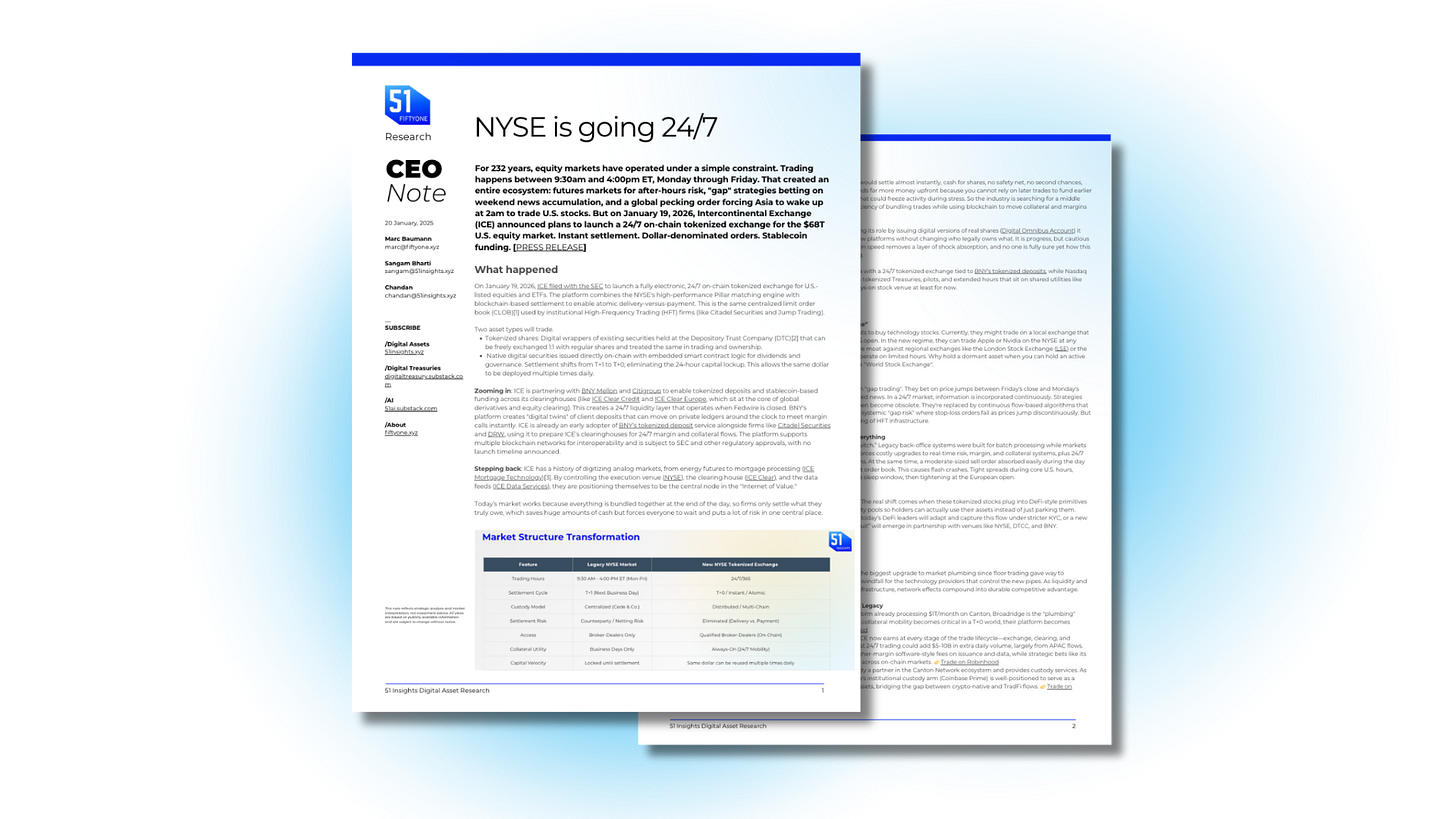
Major exchanges are aggressively integrating tokenized assets into traditional finance workflows, with the NYSE developing a 24/7 tokenized securities trading platform that combines its Pillar matching engine with blockchain-based atomic settlement, enabling fractional shares and near-instant settlement. Meanwhile, Nasdaq partnered with Kraken to offer tokenized stock trading across multiple blockchains, targeting a 2027 rollout, reflecting a broader institutional embrace of blockchain infrastructure to modernize capital markets and meet evolving investor demands for continuous, global access.
Tokenization rapidly expanded across diverse asset classes including equities, treasuries, credit, and commodities, with tokenized US Treasury products surpassing $15 billion in early 2026 and tokenized gold dominating the commodity sector with a $5 billion market cap and $178 billion in 2025 trading volume. This growth is underpinned by institutional-grade products like BlackRock's BUIDL and Ondo's tokenized treasury funds, which offer 24/7 liquidity, programmable compliance, and integration into DeFi, attracting capital previously held in non-yielding stablecoins and signaling a maturation from speculative narratives to real-world financial utility.
The integration of tokenized assets into traditional finance workflows is accelerating through collaborations between blockchain infrastructure providers and legacy institutions, exemplified by DTCC's partnership with the Canton Network for treasury tokenization and ICE's alliances with BNY Mellon and Citigroup to enable tokenized deposits and stablecoin funding. These efforts facilitate real-time, 24/7 settlement and collateral mobility, fundamentally transforming post-trade processes and signaling a convergence where tokenized securities become foundational to capital markets operations rather than peripheral experiments.

Clarity Act Unleashes Growth
Sweeping regulatory clarity from the Clarity Act and global task forces empowered financial giants to launch regulated, always-on tokenized products—fueling adoption and investor confidence worldwide.
The passage and anticipated enactment of the Clarity Act in mid-2026 represent a watershed moment in regulatory clarity, distinctly separating securities from commodities and utility tokens, thereby catalyzing the tokenization of a broad range of assets including equities, treasuries, and commodities. This legal framework has empowered major institutions such as BlackRock, JP Morgan, and Coinbase to accelerate their tokenization initiatives, with firms like Securitize and platforms like the NYSE and Nasdaq integrating regulated tokenized products that offer 24/7 trading, fractional ownership, and near-instant settlement. As Brian Armstrong of Coinbase highlights, this clarity paves the way for a 'win-win-win' outcome benefiting the crypto industry, banks, and consumers alike, fostering unprecedented market confidence and mainstream adoption.
Institutional strategies have evolved significantly to adapt to the emerging regulatory landscape, with major financial players like Morgan Stanley recommending capped crypto allocations, Franklin Templeton tailoring tokenized fund versions across jurisdictions, and JP Morgan experimenting with stablecoin-settled commercial paper on public blockchains. Partnerships between traditional exchanges such as the NYSE and crypto-native platforms like Securitize, Kraken, and OKX exemplify a collaborative approach to compliance, leveraging regulated intermediaries to maintain investor protections while enabling innovative features like atomic delivery-versus-payment and continuous liquidity. This pragmatic adaptation underscores a shift from experimental deployments to structured, scalable tokenized products that align with evolving compliance demands.
Global regulatory engagement and task forces, notably the UK Treasury's 2026 financial market tokenization task force involving BlackRock, Goldman Sachs, and JPMorgan, alongside SEC innovation exemptions and multi-jurisdictional approvals of standards like ERC 3643, have fostered a more coherent and interoperable ecosystem for tokenized assets. These efforts focus on enhancing settlement speed, transparency, and risk mitigation through permissioned tokens with embedded compliance features, enabling cross-border operations and institutional-grade custody solutions. The convergence of global regulatory initiatives and institutional collaboration is driving a robust infrastructure that supports the mainstream integration of tokenized financial products across markets.
Despite significant progress, challenges remain as regulatory debates continue around issues such as KYC enforcement, stablecoin yield restrictions, and the pace of legislative approvals, with the Clarity Act facing delays due to conflicting interests between crypto advocates and traditional banks. Nonetheless, market participants like Robinhood are launching KYC-compliant tokenized securities platforms, and institutional demand for regulated tokenized products continues to grow, supported by innovations in stablecoin interoperability and decentralized finance protocols. This dynamic environment reflects a cautious but confident trajectory toward a future where tokenized assets coexist seamlessly within regulated financial markets, balancing innovation with investor protection.




TradFi Meets DeFi Head-On
Tokenized funds, collateral, and yield-bearing stablecoins are now powering institutional DeFi, as multi-chain interoperability and regulatory clarity drive a new era of hybrid finance.
By late Q2 to Q3 2026, institutional tokenization had evolved into a sophisticated ecosystem supporting advanced use cases such as tokenized collateral in DeFi lending, yield-bearing stablecoins, and on-chain institutional credit markets. Major players like BlackRock and Apollo actively integrated tokenized funds into decentralized protocols, with BlackRock’s $2.2 billion tokenized Treasury fund, Biddle, becoming tradable on Uniswap X under permissioned, KYC-compliant frameworks, signaling a pivotal shift towards merging traditional finance with DeFi. This maturation was underpinned by regulatory clarity in the US, which had previously constrained institutional participation, and was further bolstered by platforms like Hyperliquid enabling leveraged trading on tokenized equities and Figure Technology’s SEC-registered yield-bearing token YLDS gaining traction as collateral in institutional trading venues.
The market’s maturation was marked by the emergence of multi-chain ecosystems and interoperability efforts that facilitated seamless integration of tokenized assets across diverse blockchains, enhancing liquidity and composability. Initiatives such as DTCC’s tokenization of US Treasuries on the Canton blockchain and the launch of Zero, a Layer 1 blockchain backed by Citadel Securities, NYSE, and others, exemplify this trend toward scalable, interoperable infrastructure. These developments enabled tokenized collateral to function natively on-chain, supporting 24/7 trading and settlement, and allowed yield-bearing tokenized assets like gold, S&P 500 funds, and stablecoins to coexist in the same wallets, thus broadening institutional access and investment strategies beyond traditional constraints.
Tokenized collateral and yield-bearing stablecoins emerged as critical pillars of institutional credit markets, with products like Circle’s USYC and Ondo’s USDY leading a rapidly expanding market that surpassed $15 billion in tokenized U.S. Treasuries by early 2026. These assets offered institutions enhanced transparency, continuous collateral monitoring, and regulatory compliance, enabling their use as always-on collateral within DeFi protocols such as Aave and Deribit. However, despite growing adoption, regulatory gating and KYC requirements maintained a permissioned environment, limiting retail participation and underscoring the hybrid nature of the evolving TradFi-DeFi landscape.
Advanced institutional tokenization also extended into commodities and equities, with tokenized gold becoming a flagship asset class due to its fractional ownership, 24/7 trading, and yield-bearing capabilities, as demonstrated by Tether’s XAUT surpassing $700 million in tokenized bullion. Meanwhile, platforms like Kraken expanded yield products for tokenized stocks and planned global offerings beyond US equities, leveraging atomic swap technology to facilitate seamless multi-chain trading. These innovations reflect a broader trend of integrating traditional asset classes into blockchain ecosystems, supported by growing developer engagement and ongoing efforts to address regulatory and liquidity challenges.



On-Chain Markets Accelerate
Continuous, global tokenized trading is becoming reality, democratizing access to private assets and pushing traditional institutions to embrace Ethereum and multi-chain strategies despite regulatory and liquidity hurdles.
The trajectory toward fully on-chain capital markets is accelerating, driven by institutional initiatives like ICE's planned 24/7 tokenized exchange and BlackRock's roadmap integrating tokenized money market funds and stablecoins. These developments promise continuous liquidity and atomic settlement, fundamentally transforming traditional markets that have long been constrained by limited trading hours and slower settlement cycles. However, challenges such as market fragmentation, liquidity constraints, and the need for pragmatic regulatory clarity—highlighted by the anticipated Clarity Act—remain critical hurdles to widespread adoption.
Tokenization is democratizing access to private and global markets by unlocking liquidity for thousands of private companies unable to IPO traditionally, while also extending wealth accumulation opportunities beyond US-centric finance. Platforms like Pre Stocks, Republic Mirror tokens, and Propy are pioneering this shift, with tokenized stocks reaching a $1.2 billion market cap and real estate transactions exceeding $5 billion on-chain. This democratization is bolstered by vibrant community engagement and the gradual meshing of traditional incumbents like Goldman Sachs and JP Morgan with blockchain innovations, signaling a hybrid evolution rather than a disruptive replacement.
Ethereum emerges as the foundational blockchain platform for institutional adoption, supported by its resilience, regulatory readiness, and extensive Layer 2 ecosystem. Major financial institutions are increasingly building on Ethereum and its EVM-compatible networks to leverage programmable securities, privacy features, and scalable infrastructure, moving away from private permissioned chains that lack liquidity and transparency. This multi-chain future, including public permissioned chains like Avalanche and Canton, reflects an industry consensus that no single blockchain will dominate but rather coexist to solve distinct business problems.
Looking ahead, the financial system is poised for a profound transformation akin to the 1971 Bretton Woods reset, where programmable assets dissolve the traditional public-private market divide and enable automated, transparent transactions via smart contracts. While the transition will be gradual, marked by regulatory shocks, infrastructure build-out, and entrepreneurial innovation, the long-term outlook anticipates tokenization reshaping up to a quadrillion dollars in assets by 2030. Institutional players like GSR are preparing globally with licensing and infrastructure to provide secondary liquidity, while regulatory innovations such as the SEC’s innovation exemption could unlock new DeFi utilities for tokenized securities, cementing tokenization’s role in the future financial landscape.