BlackRock’s bitcoin ETF drives the ownership shift
The gist
Bitcoin’s wild west era is over—institutions now hold the reins, fueling record ETF inflows, taming volatility, and cementing crypto’s place in mainstream finance.
What to know
- BlackRock’s iShares Bitcoin Trust (IBIT) ETF rocketed to over $60 billion in assets in under a year, becoming the dominant Bitcoin ETF and institutional on-ramp.
- Since mid-2025, daily sell-offs of $2.5–$3 billion from early whales have been absorbed by ETFs, corporate treasuries, and pension funds, slashing volatility to around 35%.
- Institutions now control 18.5% of Bitcoin’s supply, with innovations like Lightning Network and BitVM boosting appeal—and sovereign and pension fund inflows unlocking trillions in sidelined capital.
ETFs Ignite Institutional Wave
The explosive rise of BlackRock’s IBIT ETF triggered a historic transfer of Bitcoin from veteran retail holders to institutions, transforming the market into a regulated, long-term investment arena.
The early institutional entry into Bitcoin was catalyzed by the launch of Bitcoin ETFs, notably BlackRock’s iShares Bitcoin Trust (IBIT), which facilitated a pivotal accumulation phase where long-time retail holders—some up 50 to 1000 times their initial investment—began selling to institutional players. This 'changing of the guard' marked a maturation of the market, as BlackRock and others amassed Bitcoin through ETFs, providing a regulated and accessible on-ramp for institutional capital previously sidelined by regulatory and technical barriers.
BlackRock’s IBIT ETF rapidly ascended to become one of the top 20 ETFs by assets under management, surpassing $60 billion within less than a year—an unprecedented speed in ETF history—and dominating the Bitcoin ETF space with assets exceeding the combined total of all other Bitcoin ETFs. This surge was fueled by massive inflows, including $675 million in a single day across US Bitcoin ETFs and $405 million into IBIT alone, underscoring strong institutional acceptance and signaling Bitcoin’s transition into mainstream financial portfolios.
The emergence of Bitcoin ETFs like IBIT has not only broadened retail adoption by enabling traditional investors to roll 401ks and IRAs into Bitcoin but also introduced a new class of institutional holders with longer investment horizons and greater stability. This shift has facilitated sophisticated trading strategies such as the basis trade in onshore futures markets, contributing to a more mature and stable market dynamic compared to previous retail-driven cycles, as ETFs have become a stabilizing force by parking assets for decades in retirement accounts.
By late 2025 and into 2026, BlackRock’s strategic integration of IBIT into its broader fund offerings, alongside SEC approvals expanding derivatives exposure, signaled growing institutional confidence and bullish sentiment toward Bitcoin’s long-term growth. The ETF’s rapid accumulation—reaching nearly 3% of Bitcoin’s total supply and generating substantial fee revenue—combined with endorsements from major asset managers like Fidelity and Franklin Templeton, marked a watershed moment that unlocked trillions in sidelined capital from pension funds, sovereign wealth funds, and registered investment advisors, fundamentally reshaping Bitcoin’s ownership landscape.




Whale Sell-Offs Absorbed Quietly
Massive daily liquidations by early whales are being methodically absorbed by ETFs and treasuries, driving a silent redistribution that stabilizes prices and signals Bitcoin’s transition to institutional hands.
Since mid-2025, Bitcoin has entered a pivotal 'distribution phase' likened to a silent IPO, where early holders and whales are methodically selling significant portions of their holdings amid unprecedented market liquidity. Notably, Galaxy Digital facilitated a $9 billion Bitcoin sale for a single client, exemplifying this patient profit-taking. This phase is characterized by a steady daily sell-side pressure of $2.5 to $3 billion, reflecting a gradual and deliberate transfer of ownership from a concentrated group of risk-tolerant early adopters to a vastly broader base of institutional investors, retail participants, and corporate treasuries, including pension funds and ETFs. As Mike Novogratz and Guy Swan observe, this transition is only possible now due to the maturation of market infrastructure and liquidity, enabling large holders to rebalance portfolios without triggering price crashes.
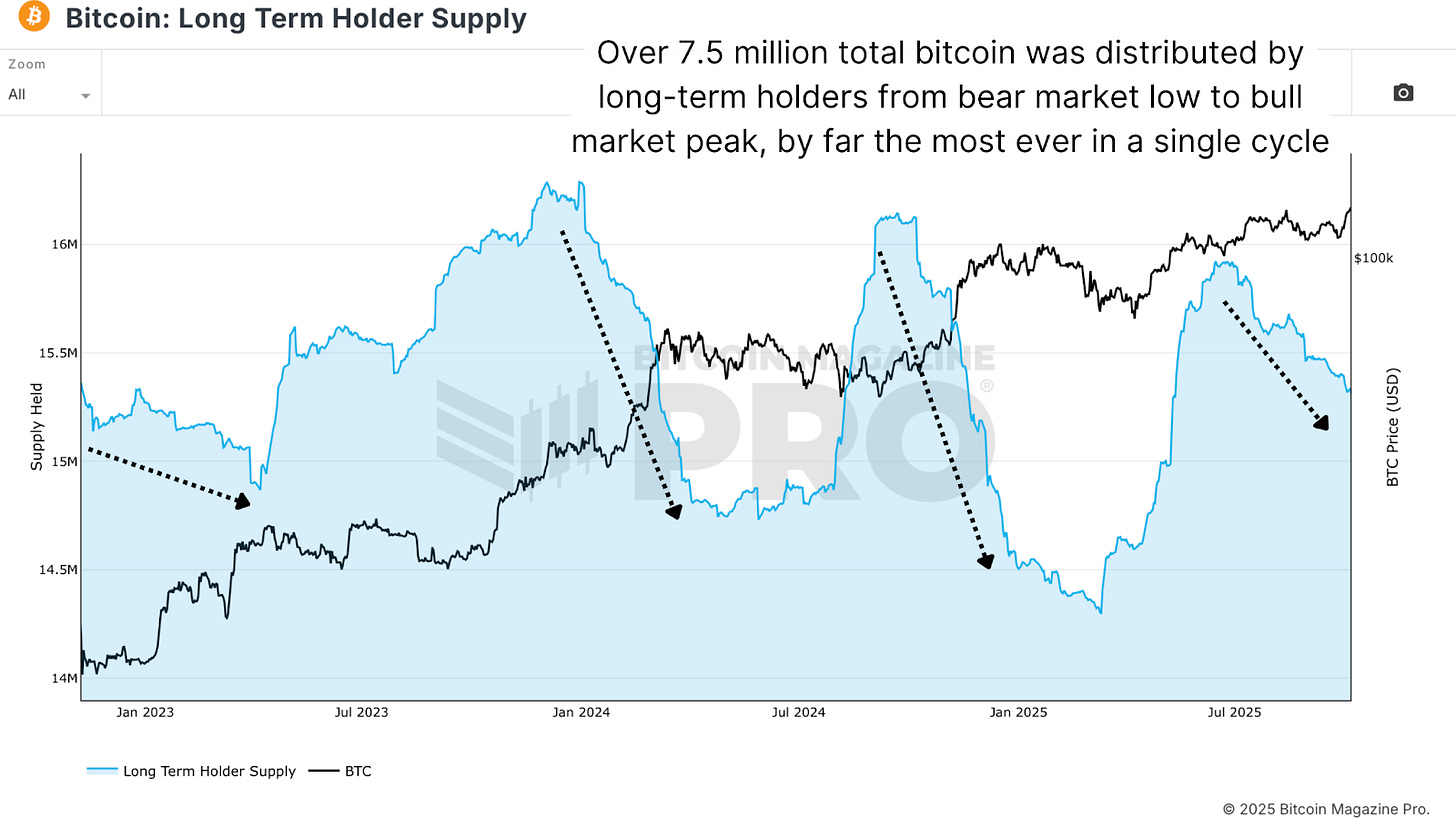
This distribution phase is unfolding during a risk-on environment marked by abundant liquidity, high confidence, and stable prices hovering between $95,000 and $106,000, even as long-dormant coins—some untouched since Bitcoin’s single-digit price days—are reactivated and sold. The resulting market dynamics diverge from typical bear market sell-offs; instead, Bitcoin exhibits halved annualized volatility at around 35%, underscoring strong institutional absorption of massive selling pressure. US-listed Bitcoin ETFs and public treasury companies have played a crucial role, increasing holdings from $130 billion to $140 billion while long-term holder supply declined from 14.75 million BTC. This absorption has prevented price collapse, signaling a structural shift from retail speculation to institutional reserve asset accumulation.
The ongoing redistribution of Bitcoin ownership from a small cadre of OG whales to millions of distributed investors fundamentally reduces volatility and susceptibility to manipulation, fostering a more mature and resilient market. This maturation is akin to historical IPO transitions seen in companies like Facebook and Robinhood, where early investors sold into liquidity and new holders stepped in, paving the way for long-term growth and stability. Analysts emphasize that this phase, expected to last six to eighteen months, is not a sign of market collapse but rather the 'end of the beginning'—a necessary evolution toward Bitcoin becoming a foundational monetary asset embraced by institutions, corporations, and countries for treasury diversification and reserves.
By late 2025, data reveals that long-term holders distributed approximately 7.5 million BTC—over one-third of total supply—realizing $33 billion in gains at an average price near $110,000. However, institutional accumulation, including ETFs and public treasury companies, accounted for only about 25% of this distribution, with retail investors absorbing the majority. This disproves narratives of institutional market manipulation to suppress prices; instead, institutions have consistently accumulated even amid falling prices. The broadening ownership base, now spread across hundreds of thousands more holders, enhances decentralization and diminishes the risk of price manipulation by a few whales, marking a profound generational wealth shift and solidifying Bitcoin’s transition from speculative asset to durable store of value.




Accumulation Reshapes Market Dynamics
Institutional accumulation has fundamentally changed Bitcoin’s ownership structure and price discovery, compressing volatility and shifting the market from speculative trading to durable, long-term holding.
Since early 2025, Bitcoin has undergone a significant 'changing of the guard' accumulation phase where early retail holders, some profiting 50 to 1000 times their initial investment, have been steadily selling to institutional investors such as BlackRock, ETFs, and corporate treasuries. This transition, described as an accumulation phase akin to traditional stock market dynamics, has consolidated ownership and set the stage for Bitcoin’s evolution into a mature, stable financial asset with new price formation mechanisms. As a result, lending businesses have flourished, reflecting holders’ preference to access gains without selling, underscoring a shift toward long-term institutional stewardship rather than speculative trading. [1, 2, 3]
BlackRock’s iShares Bitcoin ETF (IBIT) exemplifies the institutional accumulation trend, rapidly ascending into the top 20 ETFs by assets under management with over $60 billion by late 2025 and becoming BlackRock’s top revenue generator with allocations nearing $100 billion by late 2026. This ETF, alongside corporate treasuries like Michael Saylor’s Strategy, which has purchased over 800,000 BTC, has absorbed substantial selling pressure from long-term holders distributing millions of coins, thereby stabilizing Bitcoin’s price within a tight range of $95,000 to $112,000 and halving its annualized volatility from 60% to around 35%. The presence of onshore US futures markets combined with spot ETFs has also enabled sophisticated basis trades by hedge funds, introducing new institutional price discovery mechanisms distinct from previous retail-driven cycles. [4, 11, 12, 14, 19, 23, 30, 38]
Institutional holders, particularly those using Bitcoin ETFs within retirement vehicles, act as a stabilizing force by parking capital for decades, which significantly reduces volatility and alters Bitcoin’s risk profile compared to earlier cycles dominated by retail speculation. This shift is reflected in Bitcoin’s ownership distribution becoming more fragmented and decentralized, with over 80% of circulating supply held by long-term holders and institutions now controlling approximately 18.5% of total supply. The resulting market maturity is characterized by compressed drawdowns, extended consolidation phases, and spot-led rallies on expanding volume, signaling a transition from speculative frenzy to a durable, stable asset favored for treasury diversification and reserve holdings by corporations and countries alike. [5, 8, 9, 10, 15, 16, 17, 45, 53]
Throughout 2026, institutional accumulation has continued unabated despite price fluctuations, with US spot Bitcoin ETFs consistently registering strong inflows—such as nearly $2 billion in April and a six-day consecutive inflow streak in March—and corporate treasuries like Strategy aggressively adding tens of thousands of BTC. This steady accumulation, supported by improved custody solutions, regulatory clarity, and innovative financial products, has contributed to Bitcoin’s reduced realized volatility (down from above 80% in 2021 to around 42.5% in early 2024) and a more investable, liquid market structure. Experts emphasize that this maturation phase is a multi-year process driven by strategic, long-term institutional planning rather than short-term speculative momentum, with Bitcoin’s market cap still modest relative to gold, suggesting significant upside potential as institutional capital increasingly dominates ownership and price formation. [29, 33, 34, 35, 38, 40, 41, 42, 44, 48, 54, 61, 62, 63, 69, 70, 74, 75, 80, 86, 87]
Tech Upgrades Fuel Confidence
Breakthroughs like Lightning Network and BitVM are unlocking new programmability and DeFi potential for Bitcoin, drawing fresh institutional interest and supporting surging ETF inflows.
Bitcoin's technological landscape has experienced a renaissance marked by renewed developer enthusiasm and breakthroughs aimed at enhancing its programmability and DeFi compatibility without compromising its foundational trust assumptions. Projects like Lightspark have propelled innovations on the Lightning Network, making it increasingly viable for institutional use, while research into BitVM promises to unlock programmability on Bitcoin’s base layer without requiring protocol changes. This wave of innovation coincides with tangible market validation, as evidenced by spot Bitcoin ETFs drawing approximately $2 billion in net inflows in April 2026—the strongest monthly inflow since October 2025—signaling both growing institutional confidence and market stabilization.
The maturation of Bitcoin’s institutional market is underscored by its sophisticated custody and trading infrastructure, where assets are held by qualified custodians and accessed through brokerage platforms bound by fiduciary duties. This concentrated ecosystem, dominated by a select suite of products, has contributed to a notable reduction in volatility, which is now largely influenced by traditional financial mechanisms such as wirehouse portfolio updates. Such structural developments reflect a market that is not only more stable but also deeply integrated into conventional financial channels, facilitating broader institutional participation.
Looking ahead, Bitcoin’s future utility and institutional appeal are expected to hinge on enhanced programmability delivered through more expressive layer two solutions rather than alterations to its base layer. As Bitcoin Dave articulates, this approach could unlock significant new functionalities by adding trustless computation capabilities atop Bitcoin’s sound, non-sovereign monetary foundation—qualities that have cemented its legitimacy beyond mere social consensus or meme culture. However, the ongoing sovereign debt crises and monetary debasement present a dual-edged opportunity: while Bitcoin is uniquely positioned to capitalize on a global shift toward sound money, its potential will remain constrained if it fails to evolve beyond its current status quo as a non-sovereign store of value.



Bitcoin Becomes a Safe Haven
Bitcoin’s outperformance during global crises and its integration into traditional finance have cemented its status as a premier institutional-grade asset and geopolitical risk barometer.
By early 2026, Bitcoin had firmly established itself as a resilient global monetary asset and liquidity indicator, outperforming traditional safe havens like gold and the S&P 500 amid geopolitical tensions such as the Middle East conflict, where it surged up to 21%. This evolution is underscored by Michael Saylor’s Strategy accumulating nearly 89,000 bitcoins valued over $7 billion, reinforcing Bitcoin’s strategic treasury role and signaling a shift from speculative asset to institutional-grade financial instrument.
The integration of Bitcoin into traditional finance accelerated significantly with the SEC’s approval of spot Bitcoin ETFs, unlocking trillions in sidelined capital from pension funds, sovereign wealth funds, and retirement accounts. Institutional inflows surged in March 2026, exemplified by nearly $1 billion in Spot ETF purchases over six consecutive days and a net flow swing from negative $2 billion to positive $5.3 billion, highlighting renewed confidence and liquidity support amid ongoing geopolitical risks.
Bitcoin’s role as a geopolitical risk barometer has deepened, with its price discovery reflecting real-time responses to global events such as the Iran ceasefire collapse, even when traditional markets were closed. Sovereign adoption, led by El Salvador’s pioneering legal tender and geothermal mining initiatives, is creating a strategic dynamic where early adopters gain geopolitical advantage, pressuring other nations to hold Bitcoin lest they face strategic disadvantage, as noted by BlackRock CEO Larry Fink’s shift to calling Bitcoin a “flight to quality” international asset.
Despite a crypto bear market and macroeconomic headwinds, Wall Street’s commitment to Bitcoin and crypto remains robust, with major institutions like Morgan Stanley, Citi, and BlackRock actively promoting onchain financial services. This institutional focus has shifted from short-term price volatility to long-term structural developments including stablecoins, tokenization, and regulatory clarity, setting the stage for renewed liquidity and market growth in the latter half of 2026, as highlighted by Bitwise’s Ryan Rasmussen and industry leaders at the New York Stock Exchange.



Sovereigns Enter the Arena
Nation-states and pension funds are accelerating Bitcoin adoption, turning it into a strategic reserve asset and forcing global policymakers to reckon with its rising monetary influence.
Nation-states and pension funds are accelerating Bitcoin adoption, turning it into a strategic reserve asset and forcing global policymakers to reckon with its rising monetary influence.